An independent, peer-reviewed study found that students using Hawkes Learning outperformed students using traditional paper-and-pencil homework — on quizzes, on final exams, and overall satisfaction. This study was conducted by James Quinlan, a mathematician at the University of Southern Maine. It was published in the Ohio Math Journal and was not funded, commissioned, or sponsored by Hawkes Learning in any way. The Question Every Math Instructor Has Asked Does online homework actually work, or does it just make grading easier? It is a fair question. Switching students from paper-and-pencil homework to an online platform is a real change, and instructors deserve more than a promise that it will improve student outcomes. They deserve evidence. James Quinlan designed a controlled study in a first-semester calculus course, comparing students using traditional homework to students using Hawkes Learning with no funding from Hawkes. Just a researcher who wanted an honest answer. This blog shines a light on what he found. How the Study Was Designed Quinlan ran his study across two sections of first-semester calculus at a small private college in New England. The setup was carefully controlled to ensure a fair comparison: Same course. Both groups covered identical material. Same instructor. Both sections were taught by the same person using the same teaching approach. Same assessments. Both groups took the same quizzes and the same final exam. The only difference was the homework format. The control group completed traditional paper-and-pencil homework — the same approach most math courses have used for decades. The experimental group completed their homework using Hawkes Learning, a mastery-based learning system that guides students to a deep and genuine understanding with personalized learning support along the way. At the end of the course, Quinlan also surveyed the Hawkes Learning group about their experience with the platform. What the Study Found Performance: Hawkes Learning students scored higher Students in the Hawkes Learning group outperformed the traditional homework group on both quizzes and the final exam. Assessment Traditional Homework Hawkes Learning Quiz Average 74 (SD 14.5) 83 (SD 9.7) Final Exam Average 72 (SD 19.3) 81 (SD 16.7) This was not a marginal difference. Across the course's two primary measures of student learning, the Hawkes Learning group came out ahead, and both gaps were statistically significant (quiz average: p = 0.0047; final exam: p = 0.0428). Notably, students using Hawkes Learning weren't just scoring higher on average — they were also more consistent. Their lower standard deviations on both assessments (9.7 vs. 14.5 on quizzes; 16.7 vs. 19.3 on the final) indicate scores clustered more tightly around the higher average, rather than the improvement being driven by a handful of standout performers. That consistency reflects how the platform is designed to work. Hawkes Learning tracks each student's performance at the problem level, identifies where individual students are struggling, and generates practice sequences calibrated to those specific gaps. Students who would typically fall behind in a traditional homework format get support targeted to what they personally need, not a uniform experience that works best for students who were already on track. Satisfaction: Students preferred the online experience When surveyed at the end of the semester, students using Hawkes Learning reported higher satisfaction with the homework format than the traditional group: 93% of students using Hawkes agreed they received prompt feedback on their homework — a 45 point gap from students in the traditional group. Students specifically highlighted instant feedback and access to worked example solutions as features that helped them learn. Hawkes Learning students were also significantly more likely to say they liked mathematics (81% vs. 61%, a 20-point gap). They reported spending less time on homework overall, with only 22% agreeing they spent too much time, compared to 43% of traditional students — a 21 point gap. The table below, from the original study, breaks down agreement rates on all six student survey items by group, along with the statistical significance of each difference. Student satisfaction is not just about comfort — it is connected to engagement. Students who feel supported by their course materials are more likely to complete assignments, stay in the course, and persist through difficulty. 4 Reasons Why Online Homework Works Quinlan's findings are consistent with what researchers have observed across college algebra, pre-calculus, and statistics courses: online homework platforms produce results at least equal to traditional homework, and often better. The reasons are not mysterious. 1. Feedback that arrives when it is still useful. With paper homework, a student who solves a problem incorrectly on Monday may not find out until Thursday, after already moving on. Hawkes Learning tells students immediately whether they got the question correct, and helps them understand why or why not. The feedback arrives at the exact moment when it can change how a student thinks about a problem. 2. Support for students who are stuck. When a student hits a wall on traditional homework, they either leave the problem blank or worse...they guess. Hawkes provides example solutions so students can see how a problem is approached and apply that reasoning to their own work. The result is less frustration and more time actually learning. 3. Data that helps instructors help students. Hawkes Learning tracks which topics students struggle with, how many attempts each problem takes, and how much time students spend on each lesson. Instructors do not have to wait for a poor quiz grade to find out a concept did not land; the platform tells them in advance. 4. Time back for instructors. Automated grading is more than just an added convenience. It recovers time that can go toward better course preparation, more focused student interaction, and the work that actually requires a human touch. What This Means for Your Course First-semester calculus is one of the highest-stakes courses in undergraduate education. Students who struggle often lose confidence, change majors, or leave STEM pathways entirely. Quinlan's study supports that the right homework platform can move the needle on the outcomes that matter most — the quiz grades, the final exam scores, and the student experience that determines whether someone stays engaged with mathematics. About the Researcher James Quinlan is a mathematician at the University of Southern Maine. His research focuses on mathematics education, including the effectiveness of technology-based learning tools in college mathematics courses. Published in: Ohio Math Journal Full study available at: https://ohiomathjournal.org/article/4182/galley/4423/view/ The author disclosed no financial or non-financial interests related to this research. This study was not funded, commissioned, or sponsored by Hawkes Learning. About Hawkes Learning Hawkes Learning's platform is built around mastery-based learning, immediate feedback, and data-driven instruction — the same principles that drove the results in Quinlan's study. Ready to see Hawkes Learning in your courses? Contact us to learn more and get started seeing results in your courses.
![]()
September 9, 2026
An independent, peer-reviewed study found that students using Hawkes Learning...
Read More
Course: Math2228 — Elementary Statistical Methods I Hawkes Learning Product Used: Beginning Statistics, 3rd Edition Highlights: 86.67% final grade average — across three Spring 2026 sections of Math2228 using Hawkes Learning, students averaged a final course grade of 86.67%. 93.12% homework grade average — using Hawkes Learning, students engaged consistently with the homework with a 93.12% average homework score across all three sections. Greater confidence and independence — students reported feeling less anxious, more capable, and better prepared for exams compared to previous sections using ALEKS. Overview: Across three sections of Professor Jeffery Mobley’s statistics course at East Carolina University, students who demonstrated strong mastery through Hawkes Learning homework also performed strong on tests and the final exam. The pattern was consistent across assessment types: students earning A and B averages on tests maintained homework averages above 98%, while students earning A and B grades on the final exam maintained homework averages above 97%. For Professor Mobley, the results point to something important: student success in Hawkes homework aligned with their ability to demonstrate that learning again in tests and final exams. The Data: Homework Grades by Course Outcome Final Overall Grade Students who earned an A in the course averaged a homework grade of 99.57%. Students who earned a B averaged 95.31% on homework. For students who failed the course, the average homework grade was 47%. Final Grade Average Homework Grade A 99.57% B 95.31% F 47% Test Average (40% of Course Grade) The pattern holds for tests, which account for 40% of the course grade. Test Average Grade Average Homework Grade A 99.39% B 97.54% Final Exam (20% of Course Grade) Even on the final exam — a single, high-stakes assessment — homework completion predicted performance. Final Exam Grade Average Homework Grade A 98.34% B 96.62% What the Numbers Tell Us Students earning the highest marks consistently completed nearly all their Hawkes homework, with this pattern appearing at every assessment level, suggesting that the mastery-based homework is helping students build genuine understanding that carries beyond homework and into higher-stakes testing. Students who failed the course averaged just 47% on Hawkes homework, reinforcing the connection between engaging with the mastery-based work and overall success. “The educational roadblocks that Hawkes Learning courseware solved for my classes were helping students to understand their mistakes, time spent on learning the material, and the confidence level of students with the subject matter.” What Hawkes Solved Professor Mobley identified three specific educational challenges that Hawkes Learning addressed: Helping students understand their mistakes — The AI Tutor and tutoring aids in Learn and Practice mode guide students through errors in real time rather than leaving gaps unaddressed. Time spent on learning the material — The structured model keeps students engaged with the content meaningfully, not just clicking through. Student confidence with the subject matter — By requiring demonstrated mastery before progressing, Hawkes builds the kind of confidence that shows up on exam day. Professor Mobley's Statistics students offered candid feedback on their experience with Hawkes Learning: "I really enjoy Hawkes Learning. My favorite subject has always been math, but I have to say this is the easiest math I've ever had because of Hawkes Learning." "Before starting this class, I was really nervous and knew I was going to struggle. Hawkes Learning has helped me succeed a lot and feel better about my math skills." "I really love the way that it has a feature to help in every aspect. It really helps me understand the material and solve problems on my own." "I like Hawkes Learning, and it is easier to learn from than other math platforms like ALEKS." "It is the best learning platform I have used in my academic career. It is easy to use and explains the lessons well." Key Takeaway At East Carolina University, strong Hawkes Learning homework performance carried through to strong results on tests, the final exam, and in the course overall. The data tells only part of the story. Students also reported feeling more confident, less anxious, and better able to understand mistakes and solve problems independently. Photo Courtesy of ECU University Communications
![]()
August 19, 2026
Course: Math2228 — Elementary Statistical Methods I Hawkes Learning Product...
Read More
We're excited to announce the launch of the 7th Edition of Introductory Algebra by D. Franklin Wright! Designed to help students build a strong foundation in algebraic concepts, the 7th edition expands its focus on real-world applications, expanded practice opportunities, and updated content, while maintaining a streamlined structure ideal for a single-semester Introductory Algebra course. With newly developed exercises, application-based chapter projects, and enhanced courseware, this edition supports a seamless transition from prealgebra to algebra. What’s New in the Introductory Algebra 7th Edition The 7th edition introduces new content and a streamlined table of contents to improve organization and pacing, while continuing to support the foundational topics instructors expect in a single-semester Introductory Algebra course. New in this Edition: New Chapter: Strategies for Academic Success New Chapter: Geometry and Statistics New Lesson: Least Common Multiple of Polynomials These additions complement core algebra topics such as solving linear equations and inequalities, exponents and polynomials, rational expressions, and quadratic equations, ensuring comprehensive coverage with added flexibility and relevance. Explore the Full Table of Contents Expanded Practice & Assessment Questions To support diverse learning preferences and create more opportunities for skill development, Courseware exercises have been significantly expanded. What's New in the Courseware Question Bank: 1,500+ new questions added 300 application-based questions (a 149% increase from the previous edition) 84 specific to the Strategies for Academic Success chapter With these additions, the 7th edition now includes over 3,300 courseware questions—a 92% increase from the previous edition! New Features More Ways to Connect Algebra to Everyday Life and Work Building on prior real-world applications, the 7th edition places a stronger emphasis on relevance—introducing brand new chapter projects and expanding opportunities for students to apply algebra to everyday situations, careers, and collaborative problem-solving. Real-World Connections & Collaborative Projects 22 ready-to-assign chapter projects (two per chapter) promote collaboration and connect mathematics to hands-on, real-world scenarios. “Connections” chapter openers link key concepts to everyday experiences, helping students answer the question, "Why do I need to know this math?" An expanded emphasis on applications helps develop real-world problem-solving skills. Learning Support for Immediate Practice and Confidence New Completion Examples guide students through concepts with partial solutions in the Courseware, reinforcing understanding and allowing students to quickly check their work. This approach reinforces learning and helps students build confidence as they progress. Improved Organization & New Instructional Content Updates in the 7th edition reflect feedback from instructors and students, with a focus on relevance, flexibility, and student success. A streamlined table of contents improves content flow, progression, and the overall student experience. New chapter: Strategies for Academic Success Covers time management, test-taking strategies, note-taking, and stress reduction to help students thrive in any math course New chapter: Geometry and Statistics Offers additional topics to give instructors more flexibility in their instruction and provide topics for deeper learning and skill-building New lesson: Least Common Multiple of Polynomials Updated examples and lesson content for modern relevance and improved clarity New and updated calculator instructions and formula tables Designed for Single-Semester Introductory Algebra Courses With a refined scope and sequence, the 7th edition further supports single-semester Introductory Algebra courses, helping instructors plan, pace, and assign content efficiently while preparing students for subsequent math topics. Want a Closer Look? Get Trial Access
![]()
January 26, 2026
We're excited to announce the launch of the 7th Edition of Introductory Algebra...
Read More
At Hawkes, instructor feedback is critical to guiding product enhancements. We actively seek input from educators and use those insights to guide updates that make a real difference in teaching and learning. In response to recent instructor feedback, we’ve added 283 new questions across 14 lessons in our Calculus courses—expanding both the quantity and quality of practice available to students. These new questions include: More lower-difficulty questions to help students build confidence Textbook-aligned exercises that integrate smoothly into existing courses Conceptual questions that emphasize reasoning, interpretation, and understanding For instructors, these additions offer more flexibility in homework and assessments while helping students engage more deeply with core calculus concepts. New Questions at a Glance Want to see what’s new and where these questions appear? Access the quick reference guide for your Calculus title below: Single Variable Calculus with Early Transcendentals, 2nd Edition See What's New → Calculus with Early Transcendentals, 2nd Edition See What's New → Calculus with Early Transcendentals Plus Integrated Review, 2nd Edition See What's New → Tips & Instructions for Incorporating These New Questions Which titles received the new questions? Single Variable Calculus with Early Transcendentals, 2nd Edition Calculus with Early Transcendentals, 2nd Edition Calculus with Early Transcendentals Plus Integrated Review, 2nd Edition Are serial numbers available for Hawkes instructors? Yes! Check out these quick reference guides for a breakdown of the latest questions in each title including what changed, corresponding lessons, and serial numbers. Are new questions automatically added to my assignments? New questions are not automatically added to the Hawkes Default Curriculum. You’ll need to take a few simple steps to incorporate them into your assignments or Custom Curriculum using the steps in the dropdown questions below. If you have any questions about this question bank expansion project or need help assigning them to your courses, our Customer Success Team is always available to help! Contact them any time at instructorsupport@hawkeslearning.com. How do I add these new questions to an existing assignment? In your instructor dashboard, select Assignments > Manage > WebTest. Select Manage in the top-right corner, then select the test name and Copy button. Select the Edit icon to the left of the copied test. Select “Default Curriculum” if you have not assigned the questions in a Custom Curriculum yet. Otherwise, select your Custom Curriculum. Select a Chapter, then Lesson from the left column. New questions will be labeled “New” and displayed towards the bottom of the left column as highlighted in the screenshot below. Select the +Add button to include the questions in your assessment. Be sure to Save your changes. How do I add these new questions to a custom curriculum? In your instructor dashboard, select Assignments > Manage > Curriculum. Select any course which has the Curriculum you would like to update assigned. Select a Lesson Name in the left column. New questions will be labeled “New” and displayed towards the bottom of the left column as highlighted in the screenshot below. Select the +Add button to include the questions in your Custom Curriculum. Be sure to Save your changes. We know that every new question is another opportunity for students to practice, build confidence, and make progress toward mastery. These updates reflect your feedback and our shared focus on student success. More enhancements are always on the roadmap, and we look forward to continuing to build alongside instructors like you!
![]()
January 14, 2026
At Hawkes, instructor feedback is critical to guiding product enhancements. We...
Read More
Courses: Quantitative Reasoning, Elementary Statistics, Functions and Modeling, and Precalculus for ENG-PHYS-CS Course Type: Corequisite Math Pathways Quick Stats: The percentage of students completing college-level math in a single semester rose from 29% to an average of 73% per term, showing steady, lasting improvement. When surveyed, 100% of students enrolled in a lab (corequisite) course said it helped them succeed in their math class. Background & Overview Seminole State College (SSC) math faculty sought to redesign their math sequence to help students graduate on time and place them into math pathways most relevant to their fields of study. In fall 2017, the Mathematics Department launched corequisite math pathways in Quantitative Reasoning, Statistics, and STEM tracks. Within just a few semesters, SSC transitioned to a 100% corequisite model across all math courses. Placement & Course Structure Students are placed in a pathway based on their major, so they can learn the most applicable mathematics for their future careers. Placement into a corequisite course is determined by ACT math scores, QAS Accuplacer results, and a Multiple Measures Rubric to ensure students receive the level of support they need. * STEM includes Precalculus for ENG-PHYS-CS and Functions & Modeling Each pathway pairs with a credit-bearing course immediately followed by a lab (corequisite) course that provides targeted lesson content and individualized support. With this model, students receive one-on-one help immediately after learning new material, reinforcing mastery and confidence. Corequisite remediation is also offered online, where intentional communication and targeted math review are integrated directly into the course design. Results & Student Impact With this new model, more students are passing their credit-bearing math courses within their first year, increasing overall retention and graduation rates. “The lab class (corequisite) helped me so much. I was able to get one-on-one help on questions I needed help with. The extra class was the reason I was able to pass with an A.” -Isaac H., Seminole State College student “Special Topics (corequisite course directly following the credit-bearing math course) really helped me grow as a student! Being able to head to Special Topics after learning a new objective was very helpful because I was able to receive one-on-one help from the professor. It was a class that definitely gave me the confidence to succeed in college! “ -Bryce F., Seminole State College student
![]()
November 11, 2025
Courses: Quantitative Reasoning, Elementary Statistics, Functions and Modeling,...
Read More
“I would recommend Hawkes wholeheartedly to anyone seeking to integrate an online textbook experience with their students.” Lucy Horton is an associate professor at College of Coastal Georgia and teaches dual enrollment courses at a local high school. She has been teaching dual enrollment courses for three semesters with Hawkes Learning and recently shared her experience. Title Used: Precalculus, 3rd Edition “The amazing folks at Hawkes Learning understand the challenges that educators face each semester and provide unprecedented, personal one-on-one help every time. What I am in awe about most recently is the fact that Hawkes set up three Sundays in a row that corresponded with the start times of various colleges around the country. It was on Sunday afternoon when I realized something was awry with my grade book. I was able to call in on Sunday and talk with a live agent, and they set up a Zoom call with me, shared my screen, and walked me through all the necessary fixes. It is absolutely amazing that a company would provide this amazing service—right in time—for educators trying to be fully prepared and ready for the new semester! Way to go, Hawkes; you guys get it and provide amazing support when it is most needed. I am so grateful! My students appreciate the Hawkes platform for its videos, practice, AI tutor, and opportunities to improve their math skills. The platform provides students with what they need and educators with seamless integration with various college learning platforms. I would recommend Hawkes wholeheartedly to anyone seeking to integrate an online textbook experience with their students. Their educator support is unparalleled in the marketplace. The integration between it and the various college learning platforms makes it effortless for educators trying to assign and grade student work. Thank you, Hawkes Support; you make my job much easier!” “Thank you, Hawkes Support; you make my job much easier!”
![College of Coastal Georgia]()
October 6, 2025
“I would recommend Hawkes wholeheartedly to anyone seeking to integrate an...
Read More
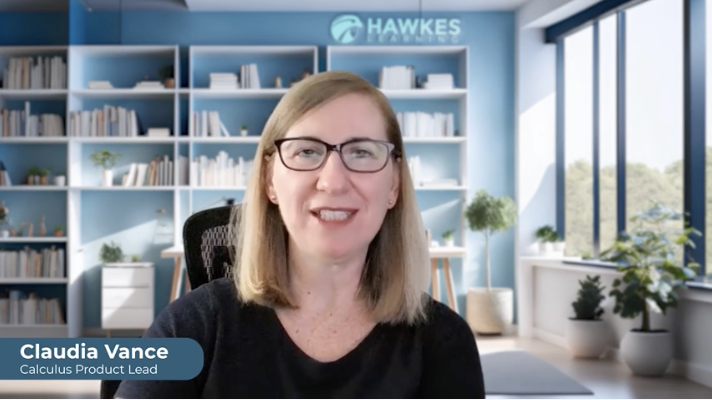
We’re excited to introduce Calculus with Early Transcendentals Plus Integrated Review courseware and eBook: a complete calculus course solution that supports student success without the need for separate remediation or additional materials. Flexibly designed for both corequisite and traditional courses, this title combines the full rigor of the calculus curriculum with strategically placed review chapters and powerful learning aids to meet each student where they are. Take a quick tour of the new Calculus with Early Transcendentals Plus Integrated Review with Calculus Product Lead, Claudia Vance! Highlights Include: Premade Diagnostics Assessments 2,800+ Total Courseware Questions 1,150+ Precalculus Courseware Questions 38 Precalculus Review Lessons & Videos New Chapter: Strategies for Academic Success Explore the Full Table of Contents Let’s Take a Closer Look at What’s Inside Premade Diagnostics Quickly assess student preparedness for curriculum-level content with pre-built diagnostic tests for each review chapter, plus a comprehensive test covering all review chapters. These assessment tools make it easy to identify gaps early and adjust instruction efficiently. 2,800+ Courseware Questions Support mastery through meaningful and plentiful practice. With more than 2,800 questions across difficulty levels—including over 1,150 dedicated to precalculus review—students can reinforce both foundational skills and core calculus concepts with immediate, guided feedback through Explain Error and AI Tutor. Precalculus Review Lessons & Videos Provide targeted, just-in-time review content right when it’s needed. These 38 short, focused lessons reinforce essential precalculus concepts with engaging lesson and example-level videos provide clear explanations and appeal to diverse student learning preferences. New Chapter: Strategies for Academic Success Give students the tools to thrive with a chapter dedicated to effective study skills, problem-solving strategies, and habits for lasting academic success. Chapter 0: Strategies for Academic Success 0.1 Understanding and Reducing Stress 0.2 Staying Organized 0.3 Managing Your Time Effectively 0.4 Reading a Textbook and Note-Taking 0.5 Using Effective Study Strategies 0.6 Reducing Test Anxiety
![]()
September 18, 2025
We’re excited to introduce Calculus with Early Transcendentals Plus Integrated...
Read More
Hello, my name is Hillary VanSpronsen and I am a faculty member at Maine Maritime Academy in Castine, Maine. I have been using Hawkes software for almost 10 years in various math classes, including Precalculus and Calculus. If you are like me, you may be onboarding several new instructors or you yourself may be new to using Hawkes software. Here are some tips for supporting student success with Hawkes. Support Starts on Day 1 At the beginning of each term, I spend about 5 minutes having students log in to the Hawkes platform; I’ve found that students who log onto Hawkes early are far more likely to complete their first homework on time because they have the chance to familiarize themselves with the platform before any work is due. During this time I highlight features students will see and follow up on any questions they have, and any pointers from faculty for a successful start. Tip from Hawkes: Have students watch Dashboard and Beyond for a quick intro to the platform! Before the first assignment, remind students often of the best ways to use Hawkes. Let them know that they should start in Practice mode, preferably doing the entire assignment, and move to Certify only after they feel confident with the material. Even after they have certified, they should complete the remainder of the questions to make sure they’ve seen everything. When issues arise and students have questions, remind them that Practice mode is a good place to revisit. Responding to Student Concerns "In the past 20 years, I have used most major competitors for online mathematics software. I have found Hawkes to be the most intuitive, the most user friendly from both student and faculty perspective, and overall, the best value. This message is one we reinforce consistently to students throughout the term, making it clear that we, as faculty, value what Hawkes brings to them." In my experience, most student complaints about the software actually stem from real problem-solving mistakes or misconceptions that would also have also given them trouble on a paper assignment—with Hawkes however, they have the opportunity to correct those mistakes and learn from them in real time. If we are gentle but consistent about having students correct their own mistakes, while also having a positive attitude about the platform, students will have a more positive outlook on the value Hawkes offers as well. Learning at Their Own Pace Hawkes makes it seamless for students to work at their own pace because they can start an assignment, pause, and resume later. You can choose to allow unlimited pauses to the Certify attempts as well. It can be beneficial for students to be able to walk away, think, tend to personal business, attend another class, or anything they might have going in their world. Save Yourself Time & Effort From the instructor’s standpoint, one tool I recommend to help students stay on track is setting auto reminders from Hawkes. I prefer to set a reminder to send to students if they have not completed the assignment by 24 hours prior to their due date, and again if they are more than five days late. The best feature of these reminders is that I can push those notifications to myself as well, helping me see at a glance who has not completed an assignment. This saves a lot of time and effort. Most importantly, as an instructor using Hawkes, it’s helpful if we complete the homework ourselves in student mode. It provides insight for tips that we can pass to students! I hope that you find these tips helpful and I wish you a successful semester using Hawkes!
![]()
We’re excited to announce the release of the 3rd Edition of Introductory & Intermediate Algebra, a high-quality combination title designed to support both corequisite models and two-course developmental algebra sequences. This new edition helps students build algebra skills for future math courses through active learning, practical examples, and real-world applications. Introductory & Intermediate Algebra, 3rd Edition Topics include: Real numbers Linear equations and inequalities Exponents and polynomials Quadratic equations Complex numbers Conic sections Sequences and series Students build conceptual understanding while engaging with skill-based and application-driven content. Explore the Full Table of Contents Let’s Take A Look At What’s New Expanded Practice & Assessment Questions To meet a wide range of learning styles and provide more opportunities for skill development, we’ve expanded both the courseware and textbook practice materials. In the Courseware: 1,400+ new questions 360 application-based 3,500+ total questions In the Textbook: 1,892 new exercises 909 new Concept Checks (Total: 925) 369 new Practice Exercises (Total: 5,468) 574 new Application Exercises (Total: 1,092) 38 new Writing & Thinking Exercises (Total: 195) 2 new Collaborative Learning Exercises (Total: 5) 7,685 total textbook exercises Completion Examples & Margin Exercises: Completion examples in the content guide students with partial solutions and an answer key at the end, while corresponding margin exercises for each example reinforce understanding through immediate practice. New & Updated Instructional Content This edition reflects feedback from instructors and students, with updates that promote academic success and more seamless instruction. Streamlined table of contents and a redesigned textbook with a modern layout improve content flow, readability, and the overall student experience. New chapter: Strategies for Academic Success Covers time management, test-taking strategies, note-taking, and stress reduction to help students thrive in any math course. New lesson: Least Common Multiple of Polynomials Updated examples and lesson content for modern relevance and improved clarity New and updated calculator instructions Real-World Connections & Application-Based Learning We’ve added new projects, exercises, and contextual content to help students see how algebra connects to everyday life. 26 ready-to-assign chapter projects (two per chapter) promote collaboration and connect math to hands-on, real-world scenarios. “Connections” chapter openers link key concepts to everyday experiences, building engagement from the start. Application-based exercises in both courseware and textbook create a cohesive learning experience that helps develop real-world problem-solving skills. Want a Closer Look? Request demo access to explore the student experience firsthand or get a free review copy of the 3rd edition textbook today!
![]()
September 9, 2025
We’re excited to announce the release of the 3rd Edition of Introductory &...
Read More
Courses: Prealgebra, Introductory Algebra, Intermediate Algebra, Precalculus, Prestatistics “With a Master’s degree in Instructional Technology, I always say Hawkes Learning has excellent products, but their service elevates them far beyond any of the other software products that I have experienced over the past 30 years.” Professor Zehr has been teaching mathematics for over 30 years and spent the last 12 years teaching developmental and applied mathematics at North Iowa Area Community College in Mason City, Iowa. Over the course of his teaching career, a significant portion has been spent working with at-risk or developmental students. In each of his courses, Professor Zehr uses Hawkes Learning’s student software and has seen an increase in students’ career-readiness and technical preparedness for future courses including those in the Arts and Sciences areas. “The courseware is designed to build confidence in the students who struggle, as well as, challenge the students, who need a good review and preparation for a college-level course. Students build their confidence as they improve their math skills, and they find comfort in the structure and repetition of the problem sets.” Hawkes’ 3-step mastery approach has helped his students with targeted practice and given them the ability to test out of sections that they’ve already demonstrated mastery. “The structure of the Learn, Practice, and Certify format provides students with a predictable framework while being able to use this structure to be able to practice, improve, and master the necessary skills to transition to the college-level courses needed to pursue their desired career.” A few stand-out features of the courseware include: Practice Test: Provides a quick review of the concepts, serving as a helpful tool for exam preparation. Best Score: Encourages students to retake tests and strive for a higher standard of success without fear of doing worse and lowering their grade. “Combine [these] features with “exceptional” service, and you have a courseware product that will prepare students at any level of ability for a promising future.”
![Rodney Zehr]()
July 21, 2025
Courses: Prealgebra, Introductory Algebra, Intermediate Algebra, Precalculus,...
Read More
Dr. Korey Kilburn teaches mathematics and leads the Aeronautical Sciences program at PennWest University–Edinboro. He stays very busy outside of the classroom as he also teaches jiujitsu, is a pilot, serves as a Hawkes Faculty Consultant, and is a former college wrestling athlete. Recently, Hawkes had the opportunity to learn more about Dr. Kilburn’s journey as an instructor and is delighted to shine a spotlight on his passion for mathematics. Read along to learn more about Dr. Kilburn’s experience as a Hawkes instructor! Dr. Kilburn teaches the following courses with Hawkes Learning’s materials: Calculus I, II, and III — Calculus with Early Transcendentals, 2nd Edition College Algebra — College Algebra, 3rd Edition Essentials of Calculus — Essential Calculus with Applications, 3rd Edition Precalculus — Precalculus, 3rd Edition Elements of Statistics — Beginning Statistics, 3rd Edition Statistics and Data Analysis — Discovering Statistics and Data, 3rd Edition While Dr. Kilburn originally attended PennWest University–Edinboro as an undergraduate wrestling athlete, he then pursued three advanced degrees, including his Ph.D. in Mechanical Engineering and Applied Math. He attributes his pursuit of higher education in math to his mentors, Mrs. Judy Scaletta and Dr. Anne Quinn. He shared that Mrs. Scaletta, his 12th grade math teacher, helped him realize he had a knack for the subject. Dr. Anne Quinn taught him in his undergraduate math courses at PennWest University–Edinboro and helped him realize all the opportunities available to him in pursuing a graduate degree in mathematics; they are now colleagues at PennWest–Edinboro. As a first-generation college student, Dr. Kilburn said that he truly appreciated Dr. Quinn’s guidance in exploring the opportunities a future in mathematics could provide for him. Dr. Kilburn’s experience as a former college athlete is applied in his classroom as he reminds his students to continue to show up and work hard in their pursuit of educational success. He reminds them that education is about the big picture, explaining, “It’s not a sprint, it’s a marathon.” Dr. Kilburn teaches a wide array of mathematics courses, ranging from College Algebra to Statistics and Data Analysis to Differential Equations. Dr. Kilburn explained, “Each semester, I look at my schedule, and if there is a corresponding Hawkes textbook I can use for my courses that semester, I will use Hawkes each chance I get.” He was initially introduced to Hawkes during an initiative to bridge the gap for incoming students who had weaker backgrounds in algebra. He enjoyed using Hawkes because of the friendly, timely support he and his students received, Hawkes’ mastery approach, and the HawkesTV video library provided to students. “I think Hawkes and I just get along well; I can implement it into my classes very easily and seamlessly, and the students are happier. I’ve noticed a lot of improvements just since I started using Hawkes,” he explained. Dr. Kilburn uses the Hawkes Sync Tool to link his Hawkes courses with his learning management system, Brightspace. He also utilizes an inclusive access model to distribute his course materials to his students so that they can have access to the Hawkes student platform on the first day of class. When asked his top reasons for returning to Hawkes each academic year, he replied, “The customer service, in general, is through-the-roof amazing. One thing I like about Hawkes is how quickly they help. Not only do they help, but they also really walk you through it. They’ll do everything to make sure you understand.” He continued, “I feel a lot of support there. I don’t feel like I’m just some number,” as he described Hawkes’ Support Team as a friend who genuinely wants to help you. When asked what advice he’d give to an instructor considering adopting Hawkes’ materials, he replied, “First, I would highly recommend it. Secondly, I would say not to be afraid to reach out and ask questions.” He has observed that his students really appreciate the straightforward structure that the Hawkes “Learn, Practice, Certify” sequence provides to them. He also enjoys how easy Hawkes makes it to customize, grade, and manage his courses within the instructor platform. Dr. Kilburn has noticed positive trends since switching to Hawkes in his courses. He explained that when he made the switch to Hawkes in his courses, he did not change his final exams, nor did he change his approach. He said that he noticed both grades and student morale improved, and he believes that is due to the Hawkes approach, which leads to true mathematical understanding. Dr. Kilburn is gifted with the ability to see mathematical applications all around him, from his car tires’ coefficient of friction to an airplane’s rates of ascent and descent. He hopes to help his students see the same applications and relevance of mathematical subjects. This is especially considered when it comes to his calculus sequence courses. He teaches Calculus I through Calculus III with Hawkes’ Calculus with Early Transcendentals. Calculus can be intimidating, so Dr. Kilburn tries to remind his students that mathematics builds upon itself and that the heart of calculus is actually algebra. He appreciates that Hawkes provides students with not only thorough content within the textbook and courseware but also comprehensive free instructional videos to bring the concepts to life. Dr. Kilburn believes that helping students make the connection of mathematics at work around them can be a motivating factor, expressing, “It’s really all around us. We have to just be aware of it.”
![]()
May 27, 2025
Dr. Korey Kilburn teaches mathematics and leads the Aeronautical Sciences...
Read More
“I’ve been really pleased with Hawkes, and their service is the best I’ve ever experienced.” With over 20 years of experience in higher education, Professor Hamid Nahavandi knows that teaching mathematics comes with unique challenges, but complicated courseware shouldn’t be one of them. Titles & Courses: College Algebra, 3rd Edition – College Algebra Precalculus, 3rd Edition – Trigonometry Calculus with Early Transcendentals, 2nd Edition – Calculus When I first adopted the Hawkes Learning platform about four years ago, I was unsure of what to expect. Prior to making the switch to Hawkes, I had been using WebAssign for about a year, but I often found it difficult to navigate, and it lacked sufficient tech support. I’d often have to rely on my colleagues for help, which was frustrating. Once I transitioned to Hawkes, I noticed the difference in Hawkes’ immediately available and excellent Support Team. My designated Customer Success Specialist, Marissa, has been wonderful and always within reach when I have any questions. I can also easily connect with Hawkes Learning’s Support Team’s 24/7 live chat. Over time, I became much more comfortable using the platform, and I continue to learn more. Recently, Joshua from the Customer Success Team came to my office and patiently walked through my Hawkes questions. I also encourage my students not to hesitate in reaching out to Hawkes’ Support Team. I remind them that Hawkes can help them through phone calls and through their live chat on the website. Our campus also has a Hawkes Student Ambassador intern. Having that extra support through the Student Ambassador program has been great for the students, as they may feel more comfortable asking a peer questions outside of our class time and my office hours. When it comes to my favorite features of Hawkes, I always think of the “Learn, Practice, Certify” sequence that Hawkes presents in their homework lessons. I often direct my students to the “Learn, Practice, Certify” features, especially when they miss class. The videos within the Learn segment have been wonderful. These tools have been great for students to catch up on lessons at their own pace, and they really help reinforce the material. The mastery-based approach used in Hawkes has had a positive effect on students’ learning. From an instructor’s perspective, I’ve found the tools within Hawkes to be very complementary to my teaching. The Curriculum feature within Hawkes Teach (the instructor side of the platform) is directly aligned with my classroom lessons, which saves me time and ensures that the material is consistently covered. The step-by-step explanations for each concept are also incredibly helpful, especially when a student needs further clarification. Another feature I really appreciate is Hawkes’ AI Tutor, which provides additional academic support to students outside of class. In conclusion, I’ve been really pleased with Hawkes, and their service is the best I’ve ever experienced.
![]()
April 1, 2025
“I’ve been really pleased with Hawkes, and their service is the best I’ve ever...
Read More
Sheri Stewart, a lecturer at Prairie View A&M University, has found Hawkes Learning to be an invaluable resource across the various courses she teaches. Read along to learn more about the impact Hawkes has made in Professor Stewart’s math classes! Titles & Courses: Mathematics with Applications in Business and Social Sciences – Finite Math Viewing Life Mathematically, Second Edition – Contemporary College Algebra Precalculus, Third Edition –Trigonometry College Algebra, Third Edition – College Algebra “I first started using Hawkes for my Contemporary College Algebra class, and it was a better fit in comparison to what we were using before,” Professor Stewart shares. She appreciated that the platform aligned with her teaching needs, offering engaging content that meets the demands of both face-to-face and online classes. After the math faculty saw Hawkes’ positive impact, they chose to expand its use to other courses, including College Algebra, Trigonometry, and Finite Math. Professor Stewart says that one of the standout features of Hawkes is the Learn-Practice-Certify model. “If students miss class or do not understand something during class, they have Learn to review the material again. Practice gives them all the tools they need if they’re not getting it,” Professor Stewart explains. For online and face-to-face students alike, Hawkes provides the necessary tools for mastering difficult concepts, particularly with its step-by-step guidance and AI-powered feature, AI Tutor. “The AI Tutor is great, and the tool answers the students’ questions in a way that we as professors would do. The other Tutor resources in Practice provide students step-by-step guidance and new iterations of problems to practice,” she says. Professor Stewart appreciates how the Certify feature incentivizes students to work through challenges and reach mastery in each homework lesson. “Who doesn’t like the opportunity to prove you’ve mastered at least 70% of the material and earn a 100% for your grade? This gives the students the incentive to really try,” Professor Stewart expresses. She loves that her students can revisit content until they truly understand it, without pressure. She has noticed that many students enjoy the ability to revisit material until they grasp it fully, without feeling overwhelmed. Additionally, she expressed that her students enjoyed using Hawkes enough to apply to intern for the company! Per her recommendation, her student, Trenton Jeffers, applied for the Hawkes Student Ambassador internship program, which has provided extra Hawkes support to the students on campus. Hawkes Learning’s customer support has been a key positive in Professor Stewart’s experience. “Whenever I’ve had a question or encountered an issue, I’ve been able to speak directly with a knowledgeable person who resolves my problem quickly,” Professor Stewart expresses. She says she’s utilized both Hawkes’ phone and chat service, finding that the Support Team’s response has always been prompt and effective. “Whenever I’ve had a question or encountered an issue, I’ve been able to speak directly with a knowledgeable person who resolves my problem quickly.” She also values the long-term access that Hawkes provides to students. “One thing I especially appreciate is the access that students have to Hawkes materials beyond the current semester,” she notes. For students progressing through a math sequence, such as from College Algebra to Trigonometry, Professor Stewart is happy the students can still access previous course materials online. “This kind of long-term access is not something I’ve seen with other platforms,” she says. Professor Stewart encourages her students to use the “Create Your Own Practice WebTest” feature to help them focus on areas of difficulty. She values this test-prep option Hawkes provides as it allows her students to select sections they’re struggling with and quiz themselves with customized practice tests. Overall, Professor Stewart highly recommends Hawkes Learning for its comprehensive platform, customizable learning tools, and strong support. “It can give you everything that you look for,” she concludes. Ready to learn more about Hawkes Learning? Explore Hawkes’ materials here!
![]()
February 27, 2025
Sheri Stewart, a lecturer at Prairie View A&M University, has found Hawkes...
Read More
A Hawkes Instructor Spotlight: Dr. Hillary VanSpronsen of Maine Maritime Academy We are delighted to spotlight Dr. Hillary VanSpronsen, a dedicated and passionate educator who teaches at Maine Maritime Academy. Dr. VanSpronsen, who primarily teaches precalculus and calculus courses, has been using the Hawkes Learning platform since 2019 to help foster student success. One of our Hawkes Student Ambassadors, Orion Tevanian, interviewed Dr. VanSpronsen to discuss her teaching philosophy, how she incorporates Hawkes into her courses, and her thoughts on the platform’s mastery-based approach. Read along to learn more about Dr. VanSpronsen’s Hawkes experience. A Diverse Approach to Teaching Dr. VanSpronsen teaches several versions of precalculus, including classes with varying speeds and content, such as business math and trigonometry. This semester, she is also using Hawkes’ Single Variable Calculus with Early Transcendentals for her Calculus II course. Having worked with different textbooks and learning tools over the years, Dr. VanSpronsen has found that Hawkes offers the flexibility and support her students need. “I’ve been using Hawkes since 2019 at a previous institution, and I’ve used it in various forms, mostly for precalculus,” she said. “It’s been a great experience.” The Best Part of Teaching: Student Connection When asked about her favorite aspect of teaching, Dr. VanSpronsen highlighted the connection she builds with her students. “My students are absolutely the favorite part of my day. Going into teaching is not a drain; it fills my cup,” she shared. She enjoys engaging with her students both inside and outside the classroom. “I love talking with them, joking with them, and teaching them,” she added. “There is nothing that they could tell me that would delight me more than to say at the end of the semester that they liked my class and they potentially have a different view of math.” Why the Mastery-Based Approach Works Dr. VanSpronsen told us that she has used nearly every online homework system available over the last 20 years. One of the standout features of Hawkes that Dr. VanSpronsen appreciates is the platform’s mastery-based approach. Unlike traditional methods that focus purely on right or wrong answers, Hawkes’ Learn, Practice, Certify model encourages students to truly master the material, helping them build a solid foundation for future learning. She appreciates that Hawkes allows her the flexibility to adjust the mastery threshold for her classes. The Importance of Practice and Tools Dr. VanSpronsen’s teaching philosophy centers on the importance of practice and using all available resources to succeed. She encourages her students to take advantage of the tools provided in Hawkes, including video explanations, the textbook, and built-in help features. By giving students the opportunity to practice, review, and learn at their own pace, Dr. VanSpronsen helps them gain the confidence they need to succeed in math. Dr. VanSpronsen’s approach to teaching, combined with the support of Hawkes, empowers students to not only excel in her courses but also to build confidence in their mathematical abilities for years to come. At the heart of Dr. VanSpronsen’s teaching philosophy is a belief in her students’ ability to succeed. She strives to create a classroom environment that fosters both academic growth and personal development. “I believe all students are capable of doing math,” she said. “They just need the right coaching, the right materials, and the right mindset.”
![]()
Hawkes Student Ambassador Kristin Jellison recently sat down with Associate Professor of Mathematics Paul Patison to learn more about his experience using Hawkes Learning at Navarro College. Professor Patison, a Navy veteran, embarked on a teaching career after completing a program sponsored by Texas A&M University-Commerce. He later earned a Master’s degree and found his passion for teaching at the college level. In this interview, Professor Patison shares insights into his Hawkes journey – from first adopting the platform in his classes to the impacts he’s observed on his students’ learning outcomes. Learn more about Professor Patison’s experiences below. Please describe your academic journey and what made you fond of the academic system. I graduated high school at 18 and I didn’t go straight into a college or a preparatory program. I was in the Navy from 18 to 22, and then when I left the Navy, I already had a family. That said, I had to work to support my family and therefore was only able to attend school part-time. As I approached 30, I found an educator preparation program at Texas A&M University-Commerce that was on the Navarro College campus and started taking the classes. Paul (front row, second from the left) receiving a Navy unit commendation award in 1990. I thought, “You know what? This might be my calling.” After I got my certification, I taught in the ISDs for 15 years from elementary to junior high and even high school with some dual credit classes. I had already worked to achieve my Master’s degree. I started teaching at Navarro for 7 years and have loved every minute. When you teach, do you take inspiration from anywhere or anyone? I had an instructor when I was working on my teaching degree at Texas A&M University-Commerce who inspired me. She challenged me on the very first night of class when I had to take a competency exam. When she was passing out the test, she stopped right in front of me, looked at me, and said, “I bet you $10 that you can’t pass this.” I would say that pushed me to seek and learn. So, I would say that instructor definitely inspired me to always continue to be better. As we reflect on your academic journey, is there a specific moment you recall working with a student where you were reminded of why you love teaching? I’ll just put this in a general sense, wrapping up more than one story or one person into one. Students will come to you for tutoring, but they’re reluctant. They’re like, “I don’t know why I’m not getting it, but if this is going to help me, then I’m going to come to you.” As they build that relationship with you, they start to trust you. Then they’re like, “You know what? I am gaining a little bit of confidence here. Yes, I can do this!” I think that is key, even at the college level. They can show their work to a professor and ask, “Am I doing this right?” and when they get the confirmation that yes, they are getting it, it just boosts that confidence to do it on their own, especially through the Hawkes program. How have you seen the Hawkes program support students? Hawkes supports the students simply because if they are not ready to demonstrate mastery of the lesson, they can get into the practice section and work on it. What I like about Practice is that students can skip lessons they have a firm grasp on already. For example, if there are five objectives in a lesson, and they are confident in two out of the five, they can just work on the three objectives. They don’t have to keep working over and over again on concepts they already mastered; instead they can simply focus on the three objectives that they’re struggling with. Also, the step-by-step solutions – I mean, you couldn’t ask for anything better! Really it’s a guided solution that the students can work through. How do you incorporate Hawkes into your teaching style and how you approach math? Typically, the problems are presented in Hawkes mirror how I teach. I’ve tried other products, but the problems are just not structured the way I teach. I use the Webtest tool to help my students, so students can mimic the testing environment and help ease their test anxiety. What classes do you teach? I teach College Algebra 1314, and NCBM 0314, which is the support class for College Algebra. I teach 1324 which is Elementary Statistics, Business Math I, and Business Math II. Business Math II is sometimes referred to as Business Calculus. You mentioned that you like how Hawkes allows Practice before doing the Mastery; therefore, students can get comfortable with the subject before moving on. Would you say that the Practice feature in Hawkes is your favorite? Yes, Practice is my favorite because of the tools that are built-in to help students. I hear from students that working in Practice is very encouraging, instead of jumping straight into Certify. There are so many students that come to us with math anxiety, and I think Hawkes does help relieve a little bit of anxiety with mathematics. Ultimately, it takes away the pressure of getting a grade. Meet the Writer Kristin Jellison is a Hawkes Student Ambassador for the Fall 2024 semester. Kristin is a sophomore at Navarro College where she is majoring in chemistry and plans to transfer to a 4-year university for forensic chemistry. Her academic interests include math and sciences, but outside her studies she enjoys reading and writing. After graduation, her career goal is to work in a forensic chemistry lab.
![]()
November 11, 2024
Hawkes Student Ambassador Kristin Jellison recently sat down with Associate...
Read More
My students no longer saw the course as a struggle between the professor and the students, but as a team effort… It changed an ‘I-win-you-lose environment’ into a ‘win-win environment.' Dr. Lawrence (Larry) Marsh has used Hawkes since the 1980s. When he initially adopted Hawkes Learning’s materials for his courses, he adopted Dr. James Hawkes’ Adventures in Statistics. Throughout the years, Dr. Marsh has watched Hawkes grow into what it is today. Dr. Marsh enthusiastically tells other instructors about the excellent resources Hawkes provides, and as of recently, he has spread this excitement around the globe! Over the summer 2024 semester, Dr. Marsh implemented Hawkes’ Discovering Business Statistics in his regression analysis course. This course was unique in that it was taught in the Tunis City of Sciences, a major educational and cultural institution located in the capital city of Tunisia, under the sponsorship of Carthage University, Avila University and the United States Embassy. The Tunis City of Sciences (Cité des Sciences à Tunis)1 The course was taught in a lecture format with the assistance of two Tunisian professors who showed the students how to use MINITAB and EVIEWS to run the regressions for the Hawkes Learning exercises. In the afternoons, Dr. Marsh would provide additional opportunities to support the students in their homework. meet with the students in a conference room to help them with their Hawkes homework. He could quickly see the students were eager to learn and participate in the course. After his summer course, Dr. Marsh shared the following comments: Hopefully, the students learned an important lesson. Under colonial rule and/or a dictatorship, it is more about who you know, and not so much about what you know. I was allowed to recommend one student for a full scholarship to attend Avila University. I recommended a student who had successfully completed all of the Hawkes’ homework well before the others. I hardly noticed him, but he did the work and got the full scholarship recommendation. The students could see that under freedom and democracy, it is what you know that counts. The students learned about regression analysis and the Hawkes Learning System, but they also learned that it is hard work and accomplishment that really matter in a land of freedom and equal opportunity. My Tunisian experience shows, once again, that the Hawkes Learning System is spreading around the world to, hopefully, be available to benefit all students everywhere. In addition to the Hawkes homework lessons, the students were required to carry out a statistical study as a research project and give a presentation to the class. Dr. Marsh says that he chooses Hawkes time and time again due to the great framework it provides to instructors. He has found that it helps him keep track of his teaching materials while also providing further support resources to him such as activities and exercises for his homework and tests. He also appreciates how Hawkes provides a supportive learning environment for students outside of the classroom. He says, “My students needed a place to learn and gain a better understanding of the course material during times when I was not there to help them. The Hawkes ‘Practice’ exercises are excellent and give my students a very solid understanding of the material.” Dr. Marsh values how Hawkes allows instructors to pinpoint where students spend the most time on their homework. This insight helps him tailor his lectures more effectively, enabling him to emphasize key concepts in class. As a result, students can complete their assignments more easily and use their time more efficiently. “A gamechanger for the professor-student relationship.” Dr. Marsh describes Hawkes as “a gamechanger for the professor-student relationship.” He says, “by using the Hawkes software, my students no longer saw the course as a struggle between the professor and the students but as a team effort with the professor helping the students be successful in achieving certification. It changed an ‘I-win-you-lose environment’ into a ‘win-win environment.'” The professor was no longer seen as the barrier to student success but as providing great encouragement and assistance to the students in gaining a more complete understanding of the material needed to certify in the Hawkes software homework exercises, quizzes and exams.” Dr. Marsh says that his student course evaluations have improved significantly by using Hawkes Learning. He says, “The Hawkes system got me better organized and gave my students excellent instruction to supplement my classroom lectures to give my students a more complete understanding of the material.” Nasreddine Nas’h, CC BY-SA 4.0 https://creativecommons.org/licenses/by-sa/4.0, via Wikimedia Commons ↩︎
![]()
Each fall and spring semester Hawkes recruits students to participate in the Hawkes Student Ambassador Internship Program. Hawkes Student Ambassadors serve their college or university by hosting weekly office hours, leading Hawkes trainings, and showing students best practices of maximizing Hawkes’ student tools for success. The Student Ambassadors also work with Hawkes in special projects such as writing for the Hawkes Blog, creating social media content, and more. If you’re interested in learning more about this internship opportunity and would like to apply for the spring 2025 semester, please visit this link: https://www.hawkeslearning.com/student-ambassador-internship Emaline from Piedmont University Emaline is a Sophomore at Piedmont University in Demorest, GA, and she majors in Communication Sciences and Disorders. She plays basketball for the university, along with being a SAIL navigator and an English peer tutor. After graduation, Emaline plans on working as Speech and language Pathologist. Outside of school, Emaline enjoys hiking and travel! Trenton from Prairie View A&M University Trenton Jeffers is a Junior at Prairie View A&M University. He is studying mathematics and hopes to get his teacher certification so that he can teach future students in various math classes. He loves to play video games and watch football and basketball in his free time. This is his second semester as a Hawkes Learning Ambassador. Kristin from Navarro College Kristin is a sophomore at Navarro College where she is majoring in chemistry and plans to transfer to a 4-year university for forensic chemistry. Her academic interests include math and sciences, but outside her studies she enjoys reading and writing. After graduation, her career goal is to work in a forensic chemistry lab. Lauren from College of Coastal Georgia Lauren Jones is a junior at the College of Coastal Georgia and plans to graduate in the Spring of 2026 with her bachelor’s degree in Middle Grades Education. With content area concentrations in Language Arts and Math, Lauren’s dream is to ignite students’ passion for reading and writing in the middle school setting. During her free time, Lauren can be found at the beach with her son and a good book. Rachel from College of Coastal Georgia Rachel is a sophomore at the College of Coastal Georgia, where she is majoring in Data Science. She hopes to use this degree to work for the FBI where she can use data to find criminals or at a major tech company like Microsoft. In her free time she likes to listen to music, play video games, and hang out with her youngest sister. Her favorite class is AI and Business Innovation where she learns about Artificial Intelligence and she hopes to use this knowledge to make an impact in society. Raegan from Purdue Global Raegan is the Senior Manager of Volunteers – North Puget Sound for Providence Swedish. As a busy professional she has found the time to go back to school and pursue a degree in Health Care Administration at Purdue University Global. She hopes to use this degree to further her career in the field of health care management. She is enjoying being back in the classroom even if it is a virtual one and currently holds a 4.00 GPA. In her free time Raegan enjoys spending time with her family and attending her kids’ sporting and musical events. She loves going to the local farmers markets and taking long bike rides through the beautiful trails of the Pacific Northwest. Spencer from Piedmont University This student accomplishes everything she puts her mind to. Spencer Davis is from Suwanee, Georgia. Before becoming a Hawkes Ambassador at Piedmont University, she began her studies at Brenau University in Gainesville, Georgia, where she was an honor student and member of the Omicron Chapter of Zeta Tau Alpha. Since transferring to Piedmont, she has done film work for the university’s Women’s Lacrosse Team, became a member or crochet club, and sister circle; a group created for young Black women to help them positively impact their community. Now that she is in her sophomore year at Piedmont and hopes to do more things with her free time and focus on her passions: reading, napping, sweet treats, volunteering at animal shelters, and writing letters to family. Lauren from Nassau County Community College Lauren is a freshman Nursing major at Nassau County Community College, where she maintains a 3.9 CGPA and a spot on the Dean’s List. She aspires to one day become a Psychiatric Nurse Practitioner specializing in mental health. Her favorite classes are psychology and English. She is proud to serve as Treasurer of the ASAP (Advancing Success in Associate Pathways) program at NCC. While she does occasionally enjoy a good Netflix binge, her true loves are reading, poetry, and audiobooks. Lauren has a three-year-old pitbull, Luna, who loves to play and run, which keeps her active. Nick from the University of North Carolina at Charlotte Nick Stevens is a sophomore at the University of North Carolina at Charlotte holding a 3.8 GPA. He is working toward a degree in marketing which he plans on using to get a job in the growing city of uptown Charlotte. He enjoys going to the gym as well as socializing with his friends at fraternity events and learning how to make new foods. Orion from Maine Maritime Academy Orion is the founding president of Maine Maritime Academy’s (MWA) Fencing Club. He is an older student who came back to school to finish a dual major program in Oceanography and Small vessel operations. Orion wants to work as a meteorologist with NOAA or NASA but likes the idea of being a boat captain as a backup plan.
![]()
September 19, 2024
Each fall and spring semester Hawkes recruits students to participate in the...
Read More
Today’s college students face a wide variety of challenges, both academically and personally, that can hinder their academic success. From struggling to grasp complex subject matter to general feelings of being overwhelmed by the demands of college life, many learners find themselves just scraping by, particularly in introductory-level courses, rather than truly thriving. To help address this need, a fresh pedagogical approach is necessary- one that puts the individualized needs of students at the center of instruction and provides the tools and support they need to take an active role in their own learning journeys. Diagnostics-Driven Instruction One major component of this student-centric model is the use of robust diagnostics. By assessing students’ strengths, weaknesses, and knowledge gaps, educators can develop personalized learning plans that target their specific areas of need. This data-driven approach ensures that instruction is tailored to each individual, rather than taking a one-size-fits-all approach. Maximizing Efficiency Diagnostic insights provided by innovative learning platforms can help optimize the educational experience for both students and faculty. By allowing students to identify and focus on their areas of weakness, diagnostic tools enable them to maximize the impact of their study time. Automated diagnostics and grading capabilities also streamline administrative tasks, freeing up valuable time for true instruction and engagement. “The diagnostic abilities of Hawkes are a game changer.” For UofL, this feature saved them from grading over 1,000 pen and paper assessments each term, allowing them to devote more resources towards direct instruction and support. Read more about how the REACH program uses Hawkes in their award-winning Learning Center. Carrye Wilkins Associate Director of the REACH Learning Center at the University of Louisville Fostering Deep Understanding Rather than simply pushing students through the material, this pedagogical approach of basing instruction on diagnostic insights focuses on cultivating a deep, lasting understanding of the subject matter. By encouraging active engagement, critical thinking, and problem-solving, students develop the skills and knowledge they need to succeed, not just in the short term, but throughout their academic and professional careers. Embracing Innovation As the landscape of higher education continues to evolve, so too must the methods used to educate and support students. By embracing cutting-edge technologies, adaptive learning platforms, and data-driven insights, implementing a student-centric pedagogical approach with diagnostics and individualized instruction ensures that you can stay at the forefront of innovation, constantly evolving to meet the changing needs of today’s learners. Empowering Students to Succeed with Hawkes By placing individualized student needs at the center of the learning experience, this pedagogical model empowers learners to take charge of their educational journeys and position themselves for long-term success. Hawkes Learning has embraced this student-centric approach, seamlessly integrating robust diagnostic tools into their courseware. These tools help students identify and address their knowledge gaps in real-time, creating personalized learning paths right in their student dashboards. With this data-driven insight, learners can maximize the efficiency of their study time and gain true mastery of the material by clearing the clutter and allowing them to focus on the concepts they need to develop further. To see how Hawkes’ diagnostic capabilities and other student-centered features can help drive student success, submit this short contact form to connect and chat with a Hawkes expert.
![]()
August 27, 2024
Today’s college students face a wide variety of challenges, both academically...
Read More
A guest blog by Student Ambassador, Lakshmi Nikhitha Tellakula, from the University of North Texas Greetings, fellow students! I’m excited to share with you my recent experience completing a difficult business analytics course as a committed Hawkes Student Ambassador. I firmly believe that the Hawkes’ Mastery Approach played a pivotal role in shaping my academic journey, and I am excited to delve into the details with you. Embracing Complexity with Support I must admit that I was a little intimidated by the subject matter when I first stepped foot into the advanced field of business analytics. Hawkes’ Mastery Approach proved to be a trustworthy mentor, providing organized assistance that enabled me to confidently work through these challenging concepts. In the realm of education, it is all too easy to fall into the trap of superficial learning, focusing solely on achieving high grades without truly grasping the underlying concepts. Hawkes encouraged a more in-depth and significant interaction with the material. The Mastery Approach prioritized comprehension and mastery over memory, fostering a true knowledge of the material. A Transformative Learning Philosophy For me, this change in learning methodology was quite transformative. I started to value education as an ongoing process of exploration and discovery rather than as a race to complete assignments. With a newfound sense of confidence, this viewpoint enabled me to approach my studies with a fresh sense of enthusiasm and dedication, which ultimately helped me excel in the course. The Mastery Approach in Action: Certify Mode One aspect of Hawkes’ Mastery Approach that impressed me greatly was its implementation in the “Certify mode.” Far from being a mundane series of exercises, this mode felt like a meticulously designed learning pathway tailored to facilitate mastery. Each step was thoughtfully crafted to reinforce learning, ensuring a comprehensive understanding of the course material. Expressing Gratitude to Hawkes In conclusion, I would like to extend my sincere gratitude to Hawkes for providing such an enriching and empowering learning experience. The Mastery Approach has equipped me with not only the knowledge and skills required to succeed but also a deeper understanding and appreciation of the learning process itself. Meet the Author: Lakshmi Nikhitha Tellakula, an MBA student at the University of North Texas specializing in Business Analytics, is recognized for her unique blend of analytical prowess and business acumen. With a focus on enhancing student experiences through data-driven insights, she aspires to become a senior business analyst post-graduation. Actively engaged in campus activities such as the Asian Student Association, and Public Relations Club, and serving as a Volunteer Social Media Coordinator, she demonstrates dedication to both academic and extracurricular excellence. In her leisure time, she finds enjoyment in playing chess and badminton, reflecting her varied interests.
![]()
August 2, 2024
A guest blog by Student Ambassador, Lakshmi Nikhitha Tellakula, from the...
Read More
A guest blog by Student Ambassador Molly Linck, University of Mississippi When I started my first college math course, I was a little nervous about how well I would learn in such a big classroom without any one-on-one time with my professor. But when I first started using Hawkes to do my homework, I instantly realized I had more access to learning materials than ever before. As a Hawkes Ambassador at the University of Mississippi, I want to tell you about some ways you can utilize Hawkes to make the most out of your study time. Practice Makes Perfect The Hawkes Practice Mode is a great way to solidify your understanding of the material before moving on to Certify. Practice features a Tutor mode which can either give you an example problem with a hint, or even a full step-by-step answer to the solution if needed. Utilizing the Practice mode can ensure you fully understand the material and how to complete the problems step-by-step before going into Certify mode. Watch the Videos In Learn mode, Hawkes offers lessons on the topic you’re studying along with an instructional video on how to do the problems. These videos can be very helpful for those times where you don’t remember some parts of your professor’s lesson or you just need a little refresher. Sometimes it’s easiest to watch a video explaining the topic, and this is when the instructional videos are perfect. Take a Practice Test The Practice Test feature, found under the WebTest section, can help you test your knowledge before an upcoming test. By creating a Practice Test, choose which topics you would like to practice, and Hawkes will do the rest in creating the test. Taking Practice Tests until you’ve mastered them can help ensure you know all of the materials and are ready to go on test day! About the Writer Molly Linck is a Hawkes Learning Student Ambassador from the University of Mississippi. Learn more about Hawkes’ Student Ambassador Program here.
![]()
July 22, 2024
A guest blog by Student Ambassador Molly Linck, University of Mississippi When...
Read More
Highlights & Overview: Of students who passed the course, 100% scored 70% or more on the homework. Of students who passed the course, 91% scored 80% or more on the homework. For students who received less than a C, their average homework score was 55.56%. Of students who failed the course, the average homework score was 31%. For students who earned a final grade of 90 or better, their average homework score was 99%. This case study explores the link between time invested in homework and overall course success. By analyzing the homework scores and final grades, we can identify significant patterns that underline the importance of consistent homework performance. Background & Context This study analyzes Dr. Herb Baum’s use of Hawkes Learning’s course materials at Guilford College during the Spring 2024 term. Dr. Baum uses Hawkes’ Beginning Statistics in his Math112 Elementary Statistics course which is facilitated in a lecture format. He has been using Hawkes’ materials since 2018 to administer his homework lessons, midterms, and final exams. He also utilizes Hawkes’ Canvas synchronization option, providing an easy grade transfer portal while also streamlining the student sign-in process. When asked about his favorite Hawkes features, Dr. Baum reports Hawkes’ renowned Customer Support Team and the intuitive Practice mode in the student platform. Dr. Baum also shares that Hawkes’ grading system in the Instructor Platform has been very beneficial. This study was conducted with the assumption that students must have a C or above to “pass” the course and move on to the next course. At Guilford College, a “C” is equal to or greater than a final grade of 72. A final score of 55 or below indicates a failing grade in the course. With Dr. Baum’s custom course settings, students receive 100% for submitting their Certify assignments on time, 75% if it is up to two weeks late, and 0 thereafter. Data Highlights MATH112 Hawkes Product Used: 3rd Edition Beginning Statistics This scatter plot demonstrates a strong positive correlation (R² = 0.7975) between students’ homework scores and their final grades. The upward trend indicates that higher homework performance is generally associated with better course outcomes, especially with higher homework scores. Additional data analysis beyond this graph further illustrates a clear relationship between homework completion and overall success in the course, providing more detailed insights into performance thresholds and grade distributions. Homework Performance and Passing the Course 100% of students who passed the course scored 70% or more on their homework. 91% of students who passed the course scored 80% or more on their homework. Homework Performance and Lower Grades Students who received less than a C had an average homework score of 55.56%. Students who failed the course had an average homework score of 31%. Homework Performance and High Achievement Students who earned a final grade of 90 or better had an average homework score of 99%. Analysis While correlation does not necessarily equate to causation, the data demonstrates a strong trend between performance in Hawkes’ homework lessons and overall course success. Students who passed the course consistently achieved higher homework scores. The fact that every student who passed the course scored at least 70% on their homework highlights the critical threshold necessary for passing. High achievers (those earning 90 or better as a final grade) nearly perfected their homework, with an average score of 99%, indicating that top students not only complete their homework but excel in it. This is a clear reflection of Hawkes’ mastery learning approach at work. When completing a Hawkes homework lesson, the student has the opportunity to truly master the learning objectives, leading them to become test-ready. Conversely, students who received less than a C or failed the course had significantly lower homework scores, averaging from 31% to 55.56%, respectively. This suggests a clear link between poor homework performance and overall academic achievement. Conclusion The evidence presented strongly supports the notion that dedicating time and effort to homework is a key factor in academic success. Ensuring students understand the importance of homework and providing innovative interactive homework opportunities could significantly improve their overall performance in the course. The more time that students interacted with Hawkes Learning’s mastery pedagogy, their overall grade was positively impacted.
![]()
As an instructor at the University of Mississippi, I’ve integrated Hawkes into my courses, and the impact has been transformative. The intuitive interface and exceptional support from their team have streamlined my course preparation process. With just a few clicks, I can effortlessly update course curriculum, due dates, etc., which has saved me valuable time each semester. Mastery Learning: A Student-Friendly Approach Unlike other textbooks and resources I’ve used before, Hawkes offers a dynamic learning environment that engages students. Through interactive modules and real-world applications, my students develop a deeper understanding of complex concepts. The immediate feedback feature allows students to correct mistakes in real time, enhancing their learning experience. Additionally, the structured Learn, Practice, and Certify approach has significantly boosted my students’ confidence and readiness for higher-level coursework. It provides a predictable framework that supports both struggling students and those seeking to excel. Course Management Made Simple In my courses, I use the Question Builder tool extensively. This allows me to customize questions into a format that I want. It is great for building in partial credit for tests, while still requiring students to get answers completely correct on homework. Further, the review-by-question feature saves me a lot of time in my large courses. It is not uncommon for me to have 500 students each semester. With the review by question feature, I don’t need to look at answers that are already correct and I can be more consistent in my partial credit policy. Our tests are administered in a computer lab, and the questions are in a random order for each student. However, when grading, the questions can be sorted into assignment order. We can grade all of the “question number one” (referring to the assignment order) for all students, and then all of “question number two” for all students, etc. I would estimate that this feature saves me somewhere between 50 to 75% of the time I would previously spend grading each individual student’s test for partial credit. Hawkes has not only enriched my teaching experience but also enabled my students to achieve higher levels of engagement and success in their courses. It’s truly a game-changer in fostering a supportive and effective learning environment. Robert Hunt, Senior Lecturer of Mathematics and Mathematics Lab Administrator at the University of Mississippi Robert has taught with Hawkes Learning’s materials in his classroom for many years. Throughout the years, Professor Hunt has taught with Mathematics with Applications for Business and Social Sciences, Essential Calculus, College Algebra, and Beginning Statistics. Robert is married and has two kids; as a family, they enjoy traveling and attending sporting events together. Robert serves as a Hawkes Faculty Consultant, providing his expertise to new and returning Hawkes instructors. To learn more about Robert, check out his Instructor Spotlight!
![]()
July 17, 2024
As an instructor at the University of Mississippi, I’ve integrated Hawkes into...
Read More
Being a mathematics major at Prairie View A&M University, I have had my fair share in the use of Hawkes. I have used the website for five different classes for the past two years. Many of the features in Hawkes are extremely helpful, but some features especially stand out and push me to be successful. Tutor While completing a problem in the Practice tab, there is a section at the bottom left that says “Tutor.” This leads to three different options: Step-by-Step, Learn, and the overall solution. The Step-by-Step guides you through the question as you answer it. Each step has directions that assist you through the question. The next tab refers the student to the interactive eBook format called the Learn mode. This helps students who need to return and be refreshed with the book’s terminology and examples. There are also videos within this section that guide the students through the lessons’ examples. The last tab is labeled “Solution.” This provides students with a big-picture solution view before the students try it themselves. This is also handy when a student gets an answer wrong and needs to compare their work to the work that is shown on Hawkes. Create Your Own Practice Test Another tool that Hawkes provides is the ability to create your own Practice Test. This function allows the students to create quizzes for themselves using specific chapters to cater to their needs. This is an amazing tool to use when preparing for exams. Students can use it while studying to test their ability to solve problems they struggle with. My Personal Experience I typically use the solution tab within the practice section throughout my classes. I learn best when I see the question worked out in front of me. I feel as though Hawkes has helped me understand these different subjects better than any teacher has explained to me. As a tutor myself, this tab also gives me a quick reminder of the steps to help me teach different math subjects to others. Sometimes, I forget how to solve a step in a problem, so Hawkes being one button click away is amazing. Exploring and using some of these features would significantly help your learning experience. Finding these features mixed with everyday learning habits could boost your productivity and learning ability. Don’t miss out on these helpful features available in your Hawkes student dashboard! Meet the Author: Trenton Jeffers is a sophomore at Prairie View A&M University, where he majors in Mathematics. He hopes to graduate with a teacher certification to begin teaching his favorite subject, Algebra. In his spare time, he tutors his peers in different math subjects. He also enjoys playing video games and basketball with his friends.
![]()
July 12, 2024
Being a mathematics major at Prairie View A&M University, I have had my fair...
Read More
Courses: Introductory Algebra, Intermediate Algebra, & College Algebra Course Type: Supplement to lecture Quick Stats: 30% Increase in Students Earning a C of Better Before using Hawkes, only 58% of students earned a C or better in the course, compared to 88% with the use of Hawkes. 20% Increase in Completion Rate The completion rate in College Algebra increased from 60% to 80% with the implementation of Hawkes. 23% Average Decrease in DFW Rate Introductory algebra DFW rate decreased 24%. Intermediate algebra DFW rate decreased 18%. College algebra DFW rate decreased 26%. At Arkansas State University, 39.6% of all first-time students are unprepared for college-level mathematics. Due to the large influx of students with developmental math needs, the math department redesigned developmental courses in order to increase success rates and standardize instruction. Teaching and learning took place in a lab setting. All lectures were available for students to review. Students were required to complete Hawkes certifications in order to take each exam.
![]()
July 1, 2024
Courses: Introductory Algebra, Intermediate Algebra, & College Algebra
Read More
To begin with, creating a comfortable and supportive learning environment is crucial in helping students feel more at ease with assessments. This involves establishing a classroom culture that emphasizes respect, inclusivity, and the value of every student’s perspective. I believe in fostering a positive classroom culture where students feel safe to express their thoughts and ideas, regardless of whether they are right or wrong. This sense of psychological safety is essential, as it allows students to take risks in their learning and not fear making mistakes. This encourages open communication and reduces the fear of judgment, which can contribute to test anxiety. When students know they can share their ideas freely and receive constructive feedback, it alleviates the pressure to perform perfectly. Among the strategies discussed in the article, the concept of “low stakes assessments” particularly appeals to me. The idea of frequent, low stakes assessments can help students become more familiar with the testing process, reducing the pressure of high-stakes testing. By breaking down the testing experience into smaller, more manageable parts, low stakes assessments demystify the process and make it feel less intimidating. This approach also allows for immediate feedback, which can help students identify and rectify their mistakes in real-time. In turn, this continuous learning cycle promotes mastery and confidence in the subject matter. However, implementing this strategy requires careful consideration. While it may be effective in reducing test anxiety, it also raises questions about the validity and reliability of the assessments. We must balance the benefits of reduced stress with the importance of maintaining the integrity of the educational outcomes. If the stakes are low, students might not be as motivated to prepare thoroughly for the assessments. Therefore, it is essential to strike a balance between maintaining the integrity of the assessments and creating a low-pressure environment for students. This might involve setting clear expectations, providing meaningful feedback, and emphasizing the formative nature of the assessments. In terms of what I am willing to try with my students, I am open to the idea of incorporating more formative assessments into my teaching practice. These assessments, which provide ongoing feedback and allow for continuous learning, can help students overcome test anxiety by breaking down the testing process into manageable parts. By focusing on the learning process rather than just the end result, formative assessments shift the mindset from fear to growth. Moreover, I believe in the power of mindfulness and relaxation techniques in managing test anxiety. Techniques such as deep breathing exercises, progressive muscle relaxation, and guided imagery can help students stay calm and focused during assessments. These practices cultivate a state of mindful awareness, allowing students to engage with the material in a clear and focused way rather than being distracted by anxious thoughts. In conclusion, while test anxiety is a significant issue in education, it is not insurmountable. By adopting a combination of supportive learning environments, low stakes assessments, and mindfulness techniques, we can help our students feel more confident and less anxious about assessments. It’s about creating an educational landscape where growth, resilience, and lifelong learning are the priorities, rather than just focusing on high-stakes outcomes. About the Writer Professor Chambliss received his undergraduate degree from Huntingdon College and obtained his masters degree from Alabama A&M. Neal has taught high school since 2008, and has been teaching as an adjunct since 2015. He began adjunct teaching first at Kennesaw State University’s Paulding campus and then began teaching at Calhoun Community College in 2022.
![]()
May 30, 2024
To begin with, creating a comfortable and supportive learning environment is...
Read More
Course: Intermediate Algebra Quick Stats: 86% of students surveyed prefer Hawkes to alternative learning programs. Professor Marjorie Johnson is an instructor at Midway University and uses Hawkes’ Intermediate Algebra software in her Math135 course. Professor Johnson has described Hawkes as easy to use among for diverse groups of of learners. She was glad that the system was easy to learn, allowing her to quickly assist her students with learning how to navigate the platform. She and her students appreciate how Hawkes provides multiple resources on the same webpage through the homework’s Learn, Practice, Certify sequence. Through Hawkes’ straightforward layout, she has found that the students can jump straight into learning the content versus learning a complicated homework system, avoiding frustration and increasing motivation. Professor Johnson also reported that the instructor platform is equally easy to use, resulting in less time building her courses and more time focusing on students’ needs like creating tailored assessments and lessons. “Hawkes Learning has made the online learning experience streamlined and easy for both instructors and students.” Professor Johnson surveyed some of her students who had used learning programs other than Hawkes Learning. 86% of students surveyed prefer Hawkes to alternative learning programs. From this survey, students reported experiencing: Fewer technical issues Increased accessibility by offering student-friendly pricing Better instructional videos in the software A more intuitive, easy-to-navigate platform “My experience has been excellent for Hawkes Learning. I even requested that if I teach a course that does not use Hawkes Learning, I can switch to Hawkes Learning. The customer service is better than any I have experienced. I have a dedicated Customer Service Specialist, Marissa Maffei, who responds quickly when I have a question. She has never let me down!" Professor Marjorie Johnson
![]()
May 9, 2024
Course: Intermediate Algebra Quick Stats: 86% of students surveyed prefer...
Read More
In the ever-evolving world of education, it is crucial for educators to continually seek out innovative and effective tools to enhance the learning experience of their students. As an instructor in a community college setting, I have had the privilege of exploring a variety of educational platforms and resources. Among these, Hawkes Learning has proven to be a game-changer in my business statistics class. Hawkes Learning is a state-of-the-art adaptive learning platform designed to provide personalized learning paths for students. Its user-friendly interface and student-centric approach set it apart from traditional learning methods. The platform is not just a tool; it’s a comprehensive learning ecosystem that caters to the diverse needs of our student population. The user-friendly design of Hawkes Learning is one of its most appealing features. The platform is intuitive and easy to navigate, making it accessible to students of all skill levels. This feature is particularly beneficial in a subject like business statistics, which can be challenging for many students due to its abstract concepts and complex calculations. With Hawkes Learning, students can explore the course materials at their own pace, reducing the anxiety often associated with learning new subjects. One of the standout features of Hawkes Learning is its adaptive learning capability. The platform adjusts to each student’s learning pace and style, providing customized content and resources based on their performance. This feature is particularly beneficial in a subject like business statistics, where understanding concepts often requires practice and repetition. With Hawkes Learning, students can revisit topics until they grasp the material, ensuring a comprehensive understanding of the subject. Absolutely one of the best things about the company is that Hawkes Learning offers exceptional customer service. Their team is always ready to assist with any technical issues or concerns, ensuring that our class can run smoothly. This level of support is invaluable in an educational setting, as it allows us to focus on teaching and learning without unnecessary interruptions. I have dealt with them on multiple occasions when I or a student had a question, and received a response very rapidly. I have not yet had a question come up that could not be answered. Another important aspect of Hawkes Learning is its flexibility. The platform can be accessed from anywhere, at any time, making it an ideal tool for both in-classroom and remote learning scenarios. This flexibility has been particularly beneficial during the recent shift to online learning due to the COVID-19 pandemic. In conclusion, the integration of Hawkes Learning into my business statistics class has been a transformative experience. The platform’s user-friendly interface, adaptive learning features, excellent customer service, and flexibility have greatly enhanced the learning experience for my students. It has not only made my job as an educator easier but has also empowered my students to take control of their own learning journey. As educators, it is our responsibility to continually seek out and implement tools that can enhance our students’ learning experience. With Hawkes Learning, we’ve found a tool that not only meets but exceeds our expectations. It is a testament to the power of adaptive learning and the potential it holds for the future of education. About the Writer I received my undergraduate degree from Huntingdon College, and I obtained my masters degree from Alabama A&M. I have taught high school since 2008, and have been teaching as an adjunct since 2015, first at Kennesaw State University’s Paulding campus, and I started at Calhoun in 2022.
![]()
April 9, 2024
In the ever-evolving world of education, it is crucial for educators to...
Read More
There are many aspects of Hawkes Learning that I could label as my favorite. Philosophically, I dig the mastery-based approach to math education. Practically, my students overwhelmingly report loving the preparation that creating a Practice Test allows them. But lately, I have been exploring student choice and rubric-based grading when utilizing the section and chapter projects that are embedded in the Hawkes Learning math curriculum. Our institution offers four math pathways to satisfy the general education math requirement of various degree programs: Quantitative Reasoning, Elementary Statistics, Functions and Modeling, and Precalculus for Engineering/Computer Science. Since navigating to this structure approximately five years ago, our focus has been to provide relevant and practical mathematical scenarios for students in each pathway as related to their degree program and ultimately their career. Subsequently, I have integrated problem-based learning into my instruction and have appreciated the discourse that is an organic byproduct of this practice. Student engagement is apparent both online as students use a discussion board to reflect and give feedback on their problem-solving processes/solutions and also in the traditional face-to-face courses as classroom conversations abound, reflecting on the project scenarios. With the recently adopted new edition of Viewing Life Mathematically, the addition of projects for each section got my instructional wheels turning. While I utilize some of these brief problem-solving scenarios to activate prior knowledge during instruction or a summative activity after teaching a particular section’s concepts, I started exploring student choice as I presented several varying projects for students to utilize at the end of each chapter to assess their understanding. I would draw from the Viewing Life Mathematically section and chapter projects but also from other Hawkes texts, and even created a few of my own! The results of a quick and painless instructional shift were quite astounding. The completion rate of projects in both my online and face-to-face courses increased drastically as students were more engaged in the activity, given they had a chance to choose an assignment that more closely aligned with their interest or degree/career goals. Since this outcome was my intent, I was encouraged but not surprised by the result of integrating student choice into an instructional practice in place. What did come as an astonishment was the connection between peers that I witnessed as students began to share with their classmates regarding their prior knowledge on the topic and/or how they planned to use these skills later in their education or career. These discussions happened face-to-face in the classroom conversations and online on discussion boards. I am still unsure if this increase in meaningful dialogue was a byproduct of the students’ overall engagement in the activity or because they felt more autonomy in the coursework given they had a choice in which how to provide evidence of their knowledge of the chapters’ concepts. Either way, I was sold! Student choice in projects/performance assessments is the way to go! Student choice in projects and performance assessments is the way to go! The biggest challenge with these types of assignments, quite arguably though, would be the grading. It takes time, especially when you are differing the assignment, and can be difficult to grade objectively given there are sometimes multiple ways to approach the project. With the integration of student choice into this instructional practice, I decided that a rubric grading system was the most systematic way to evaluate students’ projects and provide constructive commentary. Although the practice itself varied by course modality, the use of a rubric grading system enabled me to efficiently provide meaningful feedback to students while objectively formulating a grade for their project. Photo by Tirachard Kumtanom on Pexels.com I introduced this practice in my face-to-face class by allowing students to self-assess their first project using the rubric I had created. Ironically, they were more critical than I probably would have been with their evaluation, but I did encourage students to revise their project and then regrade considering their own feedback they had provided on the rubric. This activity not only increased students’ ownership in the product but also in our overall classroom procedure. I was able to gather valuable feedback from students on the rubric and made some revisions before utilizing it for the next project based on their observations. In my online course, I garnered the courage to finally try out the rubric tool in our LMS. Several instructors in our Language Arts Division had been bragging about the tool’s capabilities, but I had not determined how to put it to use in my course yet. With a quick YouTube tutorial and about an hour’s worth of work manipulating the point scale, it was all set up! Although I had been giving students broad commentary on their overall project to this point, now I was able to give students specific feedback on the various aspects of the product they had uploaded. It was a much more efficient and purposeful way to grade the assignment once I had the rubric created. Since I can track if and when feedback is read, I was excited to see more students reading the feedback on their assignment, and many even reached out to me to answer the follow-up questions I had provided as a part of the feedback. Now, students were also making more connections with me as the instructor through the grading process after further engaging with their peers during the project itself. As a part of our institution’s math pathways philosophy, our focus is to provide relevant situations that help students utilize the concepts they are being taught experientially. Through the implementation of problem-based scenarios and a structured, specific critique, students should walk away from their general education math courses with increased confidence in the math concepts acquired/refined but also in the fundamental life skills acquired as well. Meet the Author Professor Emily Carpenter has been an educator for over 15 years with experience ranging from early childhood education to higher education. Most recently, she has had the privilege of teaching various math courses at Seminole State College (SSC) in rural Oklahoma where she also serves as the Transitional Math Coordinator. With a master’s degree from Oklahoma State University in special education, she is passionate about the exciting transition to corequisite classes as SSC continues to strive to provide rigor yet equity in their mathematics courses. Professor Carpenter serves as a helpful resource to new Hawkes instructors as a Hawkes Faculty Consultant. Learn more about Professor Carpenter here in her Hawkes Instructor Spotlight.
![]()
April 3, 2024
There are many aspects of Hawkes Learning that I could label as my favorite....
Read More
Introducing Olcay Akman, a dedicated educator with over 25 years of partnering with Hawkes Learning. Dr. Akman is a professor teaching introductory statistics and beginning calculus courses, where he has seamlessly integrated Hawkes’ resources to enhance student learning. With a passion for teaching and a commitment to student success, he emphasizes flexibility and compassion, ensuring each student has the opportunity to thrive. Our Customer Experience Coordinator Victoria Kelly was excited to get the chance to interview Dr. Akman to explore the roots of his educational passion and the valuable lessons he’s acquired along the way. *Interview responses have been lightly edited for content and clarity. What courses do you teach with Hawkes Learning? I teach an introductory statistics course. My wife is also a professor; I introduced Hawkes to her when she taught Calculus and she agreed to use Hawkes for her calculus class, so basically, I teach both Stat and Beginning Calculus using Hawkes’ Beginning Statistics and Essential Calculus titles. Our offices are next to each other, she’s Dr. Akman too. Today when I told her that I was going to meet with you, she asked me to tell you how happy she was that I got her into Hawkes for Calculus. I’ve shared Hawkes with every institution I went to. I joined Illinois State in 2004 and introduced Hawkes which is still used in our Math 150 course, Fundamentals of Statistical Reasoning. I designed the whole course based on my experience with Hawkes prior to when I had joined ISU. I actually taught at the College of Charleston for a while, and so after I introduced Hawks to ISU, several instructors started using it as well. Overall, how long have you been teaching? I received my doctorate in 1994, so 2024 will be my thirtieth year teaching as a Ph. D. Altogether, I’ve been teaching since 1983 in some capacity so, I would say, in total, I have been teaching for almost 40 years. Throughout the 40 years, do you have a secret to teaching that you rely on? Early in my career, I had an epiphany that students are human, too, and they are somebody’s kids. We should not treat them with an “us against them” mentality, but rather as individuals, and we should not be punitive for life getting in their way. I think that when I woke up to this fact, I felt like I became a better teacher. It sounds like that would probably be one of the most valuable lessons you’ve learned as a teacher throughout the years… Are there any other really valuable lessons and takeaways that you’ve gained throughout the years? Another valuable lesson I learned was actually from witnessing my own son in an undergraduate program. When he was an undergraduate student, I observed some of his instructors. During his struggle with some health issues, some of his professors were not accommodating. For instance, one semester he had a very severe cold that infected his lungs, and he couldn’t make one of his assignment deadlines. He requested an incomplete in the course, but the professor was very dismissive. When I observed that I took it to heart, and I adopted this philosophy that I would be as accommodating as possible to my own students. If a student calls me to say they’re sick and cannot make the exam, I am going to meet them where they are so we can form a plan together to make up the exam. It’s apparent that your compassion just flows through your teaching. That is awesome – I’m sure that your students really appreciate that. What are some of the biggest challenges that students are facing? So there are two answers to this question: you have pre-COVID and post-COVID answers. Let’s talk about pre-COVID first. I am one of the first instructors in Hawkes’ history who started using the Hawkes software as a stand-alone course. When I started in 1998, Hawkes was designed to be a supplemental resource to an existing course. When Hawkes began to position their offerings as a complete homework system, I was one of the first ones who started using it as a standalone course. Back then, this was such an original idea to Hawkes, that programming was still in the infancy stage. I was able to work closely with some of the lead developers with Hawkes to provide my feedback, and they worked very hard to accommodate my requests. When I first used Hawkes as a standalone course, the first big challenge I had was getting students to actually study. How would I get them to Certify the material themselves and attempt to learn the material without someone holding their hands? We approached this by providing lecture notes, video clips, and additional learning resources. I would regularly look at their classroom activities to see how long they had spent on the Learn module or the Practice module. Using this information, I could guide the students in how they should invest their time. Monitoring time spent and providing a few additional supportive resources seemed to work…until COVID. I think now, the generation we have in our classes is the generation that came from the COVID shutdown. They seem to have trouble independently solving problems, which requires a different approach than “Please watch this clip and then come to my office hour, and I’ll help you.” Quite honestly, I don’t think I have found the solution to this problem yet. I am interested in research that studies this phenomenon – education articles that study the long-term impact of COVID on education. And as a side note, since I was the very first one who started using Hawkes as an online standalone course, I went to local mathematics meetings, JSS meetings and other educational meetings to share with our Math and Statistics community how Hawkes is so effective. I used to go to many conferences on Hawkes’ behalf to introduce the idea of the Hawkes Learning experience, but I think now the idea caught up! I am an organizer of a conference that is in biomathematics and ecology, education, and research (the BEER Conference). This is the second biggest biomathematics conference in the United States since the biomathematics community is an interface of biology and mathematics. All of the Covid research, cancer research, global warming research – all of these are actually biomathematics. It’s a great conference! As a social activity, we even organize a soccer match between biologists and mathematicians. That’s awesome! How has Hawkes’ unique mastery approach made a difference in your courses? When I first started using Hawkes in 1998, I was at Coastal Carolina University in Conway, South Carolina. I was kind of ahead of my peers in terms of using technology. When I found out about Hawkes’ mastery approach, it was like a light bulb sparked in my head, and I am still such a proponent of that idea. Inspired by Hawkes, I use the mastery approach in most of my courses, even in my graduate courses. I am a proponent of using homework, not as a punitive tool, but rather as a learning platform. A few years ago, I had a student who couldn’t certify all the lessons by the time the exam was due, and therefore got 0 on the test. After this incident, I received an angry email from a parent regarding the situation. This allowed me to explain the concept of Certify and why I use the mastery approach, explaining that her son was not being penalized, but rather he was being held accountable for truly learning the material before proceeding with the examination. I reminded her that an exam was a test to see how much her son had truly learned, and certifications were the method to prepare him for that examination. His mother actually thanked me, and I was glad she could understand my approach to the homework process. How have your thoughts about technology in the classroom evolved over time? I know you’ve seen Hawkes go through a lot of changes! When I started with Hawkes, you had to get a physical disk from the school bookstore and install it on individual computers. Then one year, we got a server to use in our computer lab so that we could use computer software more effectively. As an early Hawkes user, I gave feedback directly to the Hawkes engineers and developers. A specific example of how they used my feedback is found in the Hawkes Grade Book chat option feature. Back then, we didn’t have Google Meet or Zoom, so we needed a chat option to quickly communicate with our students. Awesome. I think that a great testament of how we really try to listen to our customers. Right – Hawkes values customer feedback; that’s a selling point to all of my colleagues. I always tell my colleagues and my students I have never seen a better, more responsive, more prompt, more caring tech support or customer support system than Hawkes offers. Do you have a favorite breakthrough moment that you’ve experienced with the student? I had a struggling student in my class, and one day he came to my office to talk with me. He said, “You know what? I finally understood when I was certifying these assignments. I finally understood how to study and how to learn the material— I practice problems!” I checked his activities on the Hawkes report dashboard. He was really studying the material and practicing problems, and thus he would generally only need one attempt to Certify. Keep in mind that he was really struggling; now, he’s one of the most prominent computer scientists! He worked at IBM for years, and now he has his own company. He hires our students as interns. That’s my breakthrough. If I saved one student from falling through the cracks, I think I did alright. Oh, I love that story! To see how he took what he learned in his experience to be able to turn around and invest that in the next students. That’s fantastic. Thank you for sharing that! What is something that your students do not know about you? I am a college NCAA soccer referee. I am also an avid camper and an avid hiker. During the COVID shutdown, I taught some of my classes from a van that I converted into a camper on the Appalachian Trail; that’s one of the best memories of my teaching career. You mentioned earlier that you help lead the BEER conference, what are some other professional activities that you’re involved in? Yes, I am the main organizer of The International Symposium on Biomathematics and Ecology Education and Research (BEER). I also organize an undergraduate research experience workshop called The Cross Institutional Undergraduate Research Experience (CURE). I also work with the NSF REU Program. We work with undergraduate students to train them in how to conduct research from simple programming to scientific writing, to lab work if necessary. By the time these students are finished with their undergraduate degree, they are published authors which greatly improves their chances of continuing to pursue higher degrees in education. That is a project I started in 2014 that I am very proud of. Additionally, I’m the Chief Editor of Spora, the only internationally refereed student-oriented resource journal in biomathematics. Spora is very student-friendly and provides students with constructive feedback on how to improve their journal submissions, allowing students to become student authors and provide experience. I hope that the Spora journal, the undergraduate research workshop, and the BEER Conference will remain my legacy. Those are all amazing. It sounds like you stay very busy, but busy doing really fantastic things. What is your favorite thing about your campus in Normal, Illinois? Normal is a twin city to Bloomington, Illinois. Bloomington has all the best features and advantages of big cities without the cons that often come with a big city. It’s a nice Midwest town where it’s easy to raise a family. I am a big classical music buff. In a town of our size, generally, you wouldn’t find a symphony orchestra, large bookstores, a cultural concert, a ballet, etc. However, we have all of those! I would say that my favorite part of my campus is the fact that ISU is the biggest small-town university. What are you currently researching yourself, or what are you currently reading? Since 2020 I’ve been exclusively working on COVID modeling and COVID predictions. I have published extensively on this topic to the degree that some of our models in 2020 performed better than CDC’s own models. In May 2020, when the COVID-19 pandemic was still new to the US, we published a paper on COVID modeling. A newspaper interviewed me, and asked about models and I predicted August COVID mortality rates would be 170,000. On August 15, 2020, the actual COVID mortality report was 170,456. Since then, I’ve continued studying COVID-19’s impact. Initially, there wasn’t much focus on poverty and COVID-19. I became interested in researching people who live in poverty, people who don’t have access to healthcare, and people who live in states with expanded Medicare versus no Medicare. That’s a bit of what I’ve been working on during the last three and a half years. Articles by Dr. Akman: https://pantagraph.com/news/local/education/covid-forecast-models-vary-but-an-illinois-state-university-prof-who-develops-them-is-urging/article_90f182c2-abc3-5ece-8645-b57a5fbde66b.html https://pantagraph.com/news/local/education/watch-now-illinois-state-university-professor-accurately-forecast-covid-19-deaths-by-august/article_c1fdcfac-45ad-5965-a90e-2da9c5285ddc.html https://www.wglt.org/news/2020-05-18/isu-professors-models-point-to-higher-death-toll-as-lockdowns-are-eased https://www.wglt.org/show/wglts-sound-ideas/2020-08-26/isu-professor-herd-immunity-wont-happen-on-its-own https://will.illinois.edu/21stshow/story/math-show-the-pandemic-is-far-from-over https://pantagraph.com/news/local/education/watch-now-illinois-state-university-researchers-team-recommends-n95-masks-for-air-travel/article_99b5420c-2ef8-55d2-978e-f1b6ce02c5f4.html https://pantagraph.com/news/local/education/273-illinois-state-university-cases-have-been-confirmed-since-classes-started/article_84616cae-839b-5e4a-bb61-10bf1792a747.html https://www.wglt.org/local-news/2022-01-13/an-illinois-state-university-professor-with-a-history-of-successful-covid-predictions-reflects-on-a-new-study-that-takes-into-account-human-behavior https://www.myjournalcourier.com/news/article/Illinois-man-created-coronavirus-forecast-models-15323812.php https://pantagraph.com/news/local/watch-now-illinois-state-university-biomathematics-professor-discusses-covid-19/video_bb8d84c8-3ad4-5f40-8927-d6eae21d970b.html https://pantagraph.com/news/local/watch-now-methodology-behind-isu-n95-mask-research/video_83eda0ce-7e34-5052-ad45-517a24b510a7.html
![]()
March 14, 2024
Introducing Olcay Akman, a dedicated educator with over 25 years of partnering...
Read More
Hawkes Learning has almost 40 years of experience in educational courseware; in fact, Hawkes Learning forged the first educational courseware that used precursor models of artificial intelligence joined with research-based pedagogical approaches in mastery-based learning. In Hawkes Learning, you get trustworthiness from years of experience, unparalleled care from customer support, and exceptional courseware that considers the student before the dollar. My time with Hawkes spans only 10 years of their student-centered history, but my experience is unique with them. I experienced Hawkes Learning as a tutor, adjunct faculty, and full-time tenure track faculty. For many years, I was a part of the Hawkes family, but I had to leave in 2021 when I joined a new college. For the last 3 years, I used other educational platforms, and I want to tell you why I have finally returned to the Hawkes Nest... I’ll never forget my first experience with Hawkes Learning. I was a freshman at Morehead State University in Morehead, KY studying mathematics, and I began tutoring students who used Hawkes in College Algebra and Precalculus. I was amazed at the modernized look of the system even back in 2014. As a tutor, I was able to assist students through Learn and Practice. With Practice, there were so many questions that I could work with a student on before they went to Certify. I also worked with faculty who used an emporium-style classroom with Hawkes; the instructor helped students, I helped students, and students helped students! The flexibility of Hawkes Learning provides autonomy to an instructor’s dream of their perfect classroom. The courseware never held you back on the possibilities of elevating the student success in your courses. When I transitioned from tutor to adjunct faculty, I was certainly worried that there were a lot of complicated processes behind the scenes that my instructors weren’t showing. Well… I was wrong. As an adjunct, I found the Hawkes Learning Teach accounts to be easily navigable and also offered insightful reports on student progress. These reports were essential to reporting student progress in our Early Alert System. Coordinator/Administrator templates made for an easy start where I was able to focus on course design, activities, and more! Each semester, Hawkes Learning hosted a Getting Starting Session for all faculty using Hawkes on campus. Additionally, if I had a question while working late into the night (which was/is common), Hawkes Learning was there. The 24/7 chat was available for both students and me. My last time using Hawkes was Spring 2020, and I believe we can all remember what happened in March. Since Hawkes already has dedicated Learn and Practice modules, the quick transition to online did not seem as abrupt as some of my other colleagues who did not use Hawkes. Now, I hope we never experience another pandemic, but there are other personal challenges that can cause us to shift our classrooms. Consistency is important during these times, and Hawkes provides exactly that with Learn, Practice, and Certify. When interviewing for my current role, one of my first questions was, “Do you all use Hawkes Learning as your educational courseware?” The answer was an unfortunate “no,” and I started in January 2021 with brand new, never-seen-before, courseware which was a huge challenge to get acclimated to platforms very different from Hawkes in my first year. I have been with my current college for three years, and I have now been promoted to Assistant Professor from Instructor. After talking several times with the Educational Courseware Representative for my region at conferences over the years, it was finally time to return to Hawkes Learning! Also, shoutout to Debra for being the most supportive and energetic rep out there; a great part about Hawkes Learning is that every person who works there believes in the company’s mission and puts student success first. For Spring 2024, my college is piloting Hawkes Learning, and a colleague and I are the pilot instructors for College Algebra. Although I am “piloting,” it is clear I have a long history with Hawkes Learning, and I plan to use Hawkes Learning for my mathematics courses from now on. So, why did I return? I certainly got comfortable with the other platforms; my students were doing fine; my division continued to use them; Why return to Hawkes? My teaching philosophy considers failures and mistakes a part of the learning process, but I felt that I was not creating an environment where students could recover and learn from failure without Hawkes. With the mastery-based learning approach, students may not pass their first or second attempt at Certify, and that is okay because the system will adapt to them. When students do not pass Certify, they are redirected to Practice where problems are adapted to their most immediate needs from the Certify. Students are spending more time on topics they have not mastered and gaining confidence in preparation for their next Certify attempt, Quiz, or WebTest. Parenthetically, there are curricular advantages that really impact student learning and understanding of more rigorous mathematical concepts. I have noticed that the chapters in College Algebra by Paul Sisson appropriately develop a student’s mathematical maturity. Recently, I have been covering Functions and Relations which includes the difference quotient. In the past, the difference quotient was a common challenge for my College Algebra students because the algebraic manipulation and skillset was not well defined early enough for them to attempt some of these problems. With Hawkes this semester, my students seem to take on challenging mathematics with a higher level of confidence. This is a great development in student learning because I can create projects, problems, or activities that require deeper critical thinking and algebraic skills that would have previously taken up too much cognitive load for the students. These curricular advantages are continuously unfolding as the semester progresses. Without a doubt, Hawkes Learning has the best customer support in the EdTech community. The time, dedication, and commitment to instructor and student success are huge factors of why I returned. I was tired of getting the chatbots, the hour-on-hold phone calls, or the email exchanges that don’t help immediate issues. With the 24/7 chat feature, 3 rings or fewer phone calls, and the customer support team, you are in the best hands to get your semester started. I cannot wait to work with the Customer Love team which will help me design my course to better fit the needs of my classes. For Spring 2024, my pilot colleague and I were guided every step of the way to set-up. The ease of setting up your courses is excellent for any faculty member, whether part-time or full-time. Since the last time I used Hawkes, there have been many changes that highlight Hawkes’ ability to adapt to evolving student and instructor needs. Finally, with my return to Hawkes Learning this Spring 2024 semester, how’s it going? My students are engaged in the content, working productively through the Certifys, and developing mathematical skills faster than anticipated. I can change the format of my class from mini-lectures and worksheets to projects to an emporium-style workday in Hawkes. Sure, students still get frustrated when they don’t pass a Certify, but they aren’t getting stuck as much. Features like Tutor, Explain Error, and Solution assist students in a variety of ways that meet them where they are. Misconceptions in mathematics lead to common errors, and Hawkes Learning can guide a student out of those misconceptions and into mastery of the content. I am so happy I have returned to the Hawkes Nest, and I look forward to exploring the variety of ways my teaching will evolve while using Hawkes Learning. About the Writer Hunter Chandler is an Assistant Professor of Mathematics at Bluegrass Community & Technical College. Chandler is a Ph.D. student at the University of Kentucky in STEM Education, and he holds master’s degrees in Mathematics from Central Methodist University and Adult & Higher Education from Morehead State University. He has been teaching mathematics since 2017 and has many years of experience using Hawkes Learning. His research interests include undergraduate and technical mathematics education using project-based learning and other active learning techniques for college and adult learners.
![]()
February 8, 2024
Hawkes Learning has almost 40 years of experience in educational courseware; in...
Read More
In math education, there’s a paradigm shift happening—one that is centered around understanding and engaging students in a way that makes sense to them rather than assuming a one-size-fits-all approach. Traditional materials can often feel like a foreign language, filled with complex symbols and abstract ideas. But what if course materials were designed to be more than just a manual of theories and formulas? The latest editions of Developmental Mathematics, Preparation for College Mathematics, and Algebra for College Students are designed to enhance the way mathematics is both taught and learned. From practical application-based projects to user-friendly layouts, these titles focus on creating a learning environment where math becomes a subject students can comprehend and, dare we say, even enjoy. Real-World Application-Based Projects: Move beyond theoretical concepts by incorporating real-world application-based projects that ground mathematical ideas in practical scenarios and provide an engaging and enriched learning experience. Click here to access 36 of these math projects, completely free! User-Friendly Layout: Simplify teaching and enhance learning with the eBook’s user-friendly layout integrated seamlessly into the software’s Learn mode. The platform’s intuitive interface is created with WCAG accessibility in mind, ensuring an enriched instructional experience for increased engagement and comprehension for all students. Extensive Exercise Sets and Custom Question Builder: Extensive exercise sets in the book, supplemented by a robust question bank in the software, offer a plethora of practice. Each lesson features diverse exercise types such as Fill-in-the-blank Concept Checks, True/False Question Concept Checks, Practice Questions, Applications, and Writing & Thinking, to enhance your teaching while simultaneously catering practice to individual learning styles. Beyond that, our custom Question Builder tool in the courseware empowers instructors to provide personalized assessments tailored to the unique needs of their class and assess knowledge in a more specific, targeted way. Watch this 15-minute webinar with Professor Nathaniel Raak of Mitchell Technical Institute to hear about his experience with using Hawkes’ content authoring tool in his courses. Approachable Language: Written in an approachable tone and presented in more digestible chunks, the textbooks break down algebraic concepts into easily understandable segments. This student-centric approach promotes a more accessible and enjoyable learning experience, fostering increased comprehension and retention. Updated Content with Real-World Relevance: These new editions (published 2023) include recent content and examples with real-world relevance, ensuring that students not only grasp mathematical concepts but also make meaningful connections to the world around them. Keeping the content current and relatable enhances students’ ability to apply their knowledge beyond the classroom. At the end of the day, the hope is that students leave their developmental-level math courses with a level of mastery to support their further educational goals and essential mathematical skills. We’re not promising a magic solution, but rather a shift in perspective—a move towards making mathematics more accessible, more relatable, and perhaps a little more enjoyable for both educators and students alike. Get A Free Textbook
![]()
February 5, 2024
In math education, there’s a paradigm shift happening—one that is centered...
Read More
Highlights & Overview: MAT2501 showed a 20% increase in the number of students that passed the course YoY, MAT1100 exhibited a 21% increase YoY, and MAT1000 maintained a consistent 83% pass rate. Students who passed MAT1100 and MAT2501 spent an average of 2,097 minutes in Learn, Practice, and Certify – an average of 210 minutes per week, or 30 minutes per day, across the 10-week semester. Students who passed MAT1000 spent an average of 962 minutes in Learn, Practice, and Certify – an average of 192 minutes per week, or 27 minutes per day, across the 5-week course. This study analyzes South College professor Chris Garner’s experience using Hawkes Learning’s course materials. It specifically examines Professor Garner’s course data across three courses– Mathematical Concepts and Applications (MAT1000), College Algebra (MAT1100), and Statistics (MAT2501)–emphasizing pass/fail and the relationship between these grades and students’ time invested in Hawkes Learning’s student software. Background South College initiated a pilot program for courseware in Spring 2021, with Hawkes Learning’s Beginning Statistics. This successful pilot, marked by steady growth and consistent passing rates in Beginning Statistics courses, led to the adoption of three Hawkes titles across the math department at South College in Fall 2021: Beginning Statistics, Introductory & Intermediate Algebra, and Preparation for College Mathematics. In the context of this study, students earning letter grades of A, B, or C are considered to have passed, whereas those receiving a grade of D or F are classified as failed. A, B, C Rate Comparison Statistics (MAT2501) Hawkes Product Used: 3rd Edition Beginning Statistics As illustrated in the chart above, Garner’s MAT2501 section exhibited a remarkable 20% rise in the number of students passing year over year (YoY) (21-22 vs 22-23 academic years) following the adoption of Hawkes. This increase not only reflects a continuous upward trend in the number of passing students but also demonstrates consistent growth among his students. College Algebra (MAT1100) Hawkes Product Used: Introductory & Intermediate Algebra Likewise, we observed consistent success and growth in the total number of students passing Garner’s MAT1100 course with the integration of Hawkes courseware. From the academic year 21-22 to 22-23, there was a 21% increase in the number of students passing YoY. Mathematical Concepts and Applications (MAT1000) Hawkes Product Used: 2nd Edition, Preparation for College Mathematics This course’s analysis involves a considerably smaller enrollment size compared to Garner’s higher-level courses, featuring only 87 and 40 students in each respective academic year. Evaluating this data from a holistic perspective from adoption through the Fall 2023 term indicates a consistent 83% pass rate among all students in this developmental-level course. Investigating Time Spent When investigating trends in student performance as it relates to *time spent in the courseware, the data reveals a direct relationship between the time spent in the Learn and Practice modes and pass rates. Notably, students who received failing grades (D or F) generally invested significantly less time in the software compared to their successful counterparts, underscoring the proven pedagogical design of our 3-step approach to mastery; when ample time is dedicated to genuine engagement and practice with the course material, students generally exhibit increased understanding and retention of course content, and subsequently, higher final grades, as demonstrated in the chart below. South College’s partnership with Hawkes Learning has resulted in sustained success and improved passing rates. The strategic adoption of Beginning Statistics, Introductory and Intermediate Algebra, and Preparation for College Mathematics, coupled with an emphasis on students spending more time in Learn and Practice, has proven to be a successful formula for student success as determined by their final grades. This study suggests that Hawkes’ mastery-based courseware, focusing on student engagement and time investment, can yield significant improvements in academic outcomes. *“Time spent” is measured by the duration a particular page in Learn or Practice remains on the screen, which may not precisely reflect the actual time spent interacting with the content. This variable is presumed to account for outliers in the chart, where some students exhibit high recorded ‘time spent’ without achieving the expected rate of success.
![]()
January 2, 2024
Highlights & Overview: MAT2501 showed a 20% increase in the number of students...
Read More
Discover the inspiring journey of Robert Hunt, a seasoned professor at the University of Mississippi, as we spotlight educators who are truly impacting their students’ lives at Hawkes Learning. Join us for an insightful interview where Robert reflects on his teaching experiences, navigates through challenges, and unveils the transformative role of technology in reshaping the modern classroom. *Interview responses have been lightly edited for content and clarity. How long have you been teaching, and how long have you been teaching with Hawkes? I started teaching as a grad student in the fall of 2002, and did that for a year. I was an adjunct professor in 2003, then full-time in 2004, and I’ve been here at Ole Miss ever since. I’m from Louisiana originally, but I came here and I really liked the lifestyle. Luckily, three positions became open after my adjunct year, and I managed to get one. As far as Hawkes goes, we were just using Statistics way back then. That was when you had the physical codes on the computer and it was offline! Eventually, we migrated to Hawkes with other classes, so I’ve probably been using it for 18 years. What is your favorite thing about the University of Mississippi? It’s a big school, but it still feels small. We have a smaller campus compared to some of the other southeastern universities, but here it’s compact. Even though you’ve got so many students, you’re close to everything. I don’t have to jump on a bus if I want to go to the physics building. It’s an easy walk. We’re always getting ranked as one of the most beautiful campuses in the country and there are tons of programs for young kids growing up. It’s been a great place for me! I’ll always be here. Do you have a secret to teaching? Or a most valuable lesson that you’ve learned in your teaching career? What I’ve learned is that different classes and different courses require different teaching styles. For example, when I’m teaching quantitative reasoning or even linear programming, I’m more hands-on. We do stuff in groups, and I walk around the room talking with people; I’m not just lecturing the whole time. Then, if I’m in a Business Calculus class, I find lecturing works well for that. So, it depends on what you’re teaching and the kind of students you have. What other structures and classroom setups have you tried? What have you found does work well and didn’t work out? You did touch on that already, but is there anything else you’d like to share? I’ve had traditional lectures and it’s okay, but most of my classes are what I’d call a hybrid. Normally, the classes meet for 150 minutes a week, but our classes meet for 100 minutes a week and then have another 50-minute component for homework and quizzes. We used to make them come to the lab but we don’t have enough space anymore, so we let them work from home on this section, so, it’s like a hybrid structure, and we get everything we need covered. And the students like it so – works for me! What would you say is the biggest challenge that students are facing today? Well, during COVID when the high schools were online, I don’t think a lot of them were taught very well. Of course, it was hard then, right? But now, we’re having a lot that come in, and they can’t factor. They can’t deal with fractions. There’s always been a little problem with that in the past, but since COVID, it’s a bigger problem! Hopefully, in a year or two, things will be a little bit back to normal, but that’s the biggest thing right now. What would you say is the biggest challenge that teachers are facing today? With inflation and everything – the tuition going up and the price of books going up – we seem to have more students who are having a hard time buying the materials for the course. Obviously, if they can’t buy the materials for the course that affects the teacher, too. We want to help them. At the same time, I can’t buy materials for everybody who can’t afford it. Hawkes is cheaper than basically every other company. Really, the only way we could make it cheaper is to do freeware or something and those are usually not very good. How do you engage and motivate underperforming students? Constant communication – every week. Also, one thing that’s different about my classes versus most is that we do flex mastery in Hawkes. However, I require 100% mastery so I don’t allow strikes. With 100% mastery, it forces them to look at all the questions and at least get it right once. I think that’s part of the reason our test grades are so good. I also use Hawkes’ Reporting tools when reviewing my sections. I really rely on the WebTest Summary Report and the Search by Criteria Report. I appreciate how I can choose certain parameters to quickly search through my sections in the Search by Criteria Report. I can look at assignment groups or specific assignments and see who’s completing it, who’s not, who’s logging in, and who’s not. I also use the certification status report. I check on that a good bit to see who’s doing the work. Can you tell me about a favorite breakthrough moment that you’ve experienced with a student? 10 years ago there was a student in my class who was not a math person, and he would tell you that. This was in my Quantitative Reasoning course which gives students basic overviews of different things in math that could help with everyday life. I saw him in the Walmart parking lot 3 or 4 years ago. He just thanked me so much for that class, because it was practical. I’m not saying we don’t need Algebra and Calculus, but for a lot of people, they just need the practical side of math – something that they will use. You know, the K-12 teachers always complain about students saying, how am I going to use this in real life? When a student comes back and says, “This really helped,” it feels good! I know that you’ve been teaching with Hawkes for a long time, and you’ve seen Hawkes evolve throughout the years. Can you tell me how your outlook toward technology in the classroom has evolved over time? I used to be against technology in the classroom. However, if you think about 15 years ago, there really wasn’t internet like we use it today! I’ve learned how technology can be useful to bring people together. For example, I can have my students use Hawkes or Desmos to graph certain things to visualize what we are learning versus me trying to draw a rough sketch on the board. There’s more interaction and movement. I used to have a hard time when we would do the limit definition of derivatives, trying to demonstrate the overall concept. Now they have these apps where you can show moving those points together and how the tangent line changes. So teaching is a lot more visual now; I’m all for using technology in a classroom. I Zoom every class, and I didn’t do that until COVID, but I liked it. So, even though I’m teaching in person, I’m still using Zoom. I can walk around the classroom now with a little tablet in my hand, and I can talk to students while showing them my tablet. I think technology’s done a lot more good than it’s done harm for teaching and for education. It’s also more helpful with the data review piece. As you can imagine, we were strictly relying on Excel spreadsheets before. Now, we have all these other tools we did not formerly have. We used to have to report to the Accreditation board – that used to all be on scantron machines! It’s a lot easier to go on Hawkes and pull up the item analysis right there. What led you to Hawkes and what keeps you back? Carolyn Warren was the first one to use Hawkes at Ole Miss. She wrote a Statistics book with Hawkes, and it just grew. We’re a Hawkes school, probably more than a lot of schools. When we were reviewing for the course, it was between Hawkes, Pearson, and another company for the Stats classes. We found that students who used Hawkes got much better on the final exam than all the other ones, so we kept using it, and then we started using Algebra and Business Calculus titles. Hawkes’ Customer Support is so far ahead of all these other education companies. It’s not even up for discussion. To me, it’s the support more than more than anything. That’s why I’m going to use Hawkes if it’s my choice. I’ve used a lot of Pearson in the past, too, and I’m not going to disparage them, but I like the setup of Hawkes. If I need something, or if I need your team to create a feature for me, I can ask you! Hawkes will actually think about it, and you do create a lot of them! Even if you don’t do it, at least you consider my suggestions. Nobody else is going to put the time into creating instructor-requested features. Do you have anything else to share about how the Hawkes mastery approach has really made a difference in your courses, and any other areas in the platform that have really helped your students the most? With Hawkes’ mastery, there is an expectation to master a certain percentage of the homework. With other companies, the students are graded with a raw score and they aren’t challenged to attempt the tougher questions of the lesson. With mastery-based learning, the students are forced to be exposed to all the question types in the lesson. My grades are great, so it seems that with this approach, there come higher expectations and more accountability. Students share in their evaluations that going through Hawkes’ Practice mode with step-by-step guidance really helps them. What are some of your interests outside of campus and in teaching? I’m married and have two kids, ages 10 and 12. I really value my family time! I enjoy sports, and I go to all the football games, plus a lot of baseball games. I go to as many basketball games as I can here on campus, too. My family and I really like traveling. We just went to Virginia and North Carolina over the summer. We took the kids to Williamsburg so they could explore some history. I love music and am big into classic rock but I like other genres, like the blues and old country, too. If you had a colleague, either at Ole Miss or at another school, who is considering using Hawkes in their courses, what advice would you share with them? I would sit them down and log in, and I show them everything. My old officemate at the University of Montevallo in Alabama has been using Hawkes now for about 4 or 5 years. He had a choice between Hawkes and Pearson and at his university. I told him, “Hawkes is going to have everything correct. It’s going to recognize student’s answers during the online answer entry process. Their tech support is great. It’s going be easy for the students to follow along.” Then I logged in, and I showed him the instructor side and the student side. If someone is considering Hawkes, I’ll sit down and show it to them! What would you like your students to take from their learning experience with you? Even if what we’re doing in class is something that you’re not going to be doing every day forever, there is a place for it. It is useful. It is needed. I tell my business students, “You might not ever take a derivative again, but you’re going to have to go talk to an analyst one day and you need to know what they’re talking about.” I always want them to realize that everything we do in math has a purpose, even if they don’t necessarily see that purpose yet. There’s a reason we’re giving it to you. We would like to thank Robert Hunt for sharing insights and experiences with Hawkes Learning. If you’re interested in sharing your own experiences with Hawkes Learning or if you have any questions, please don’t hesitate to reach out to us. We’d love to hear from you!
![Robert Hunt]()
December 6, 2023
Discover the inspiring journey of Robert Hunt, a seasoned professor at the...
Read More
At Hawkes Learning, we love shining a spotlight on dedicated educators who are making a difference in their students’ lives. We’re excited to introduce you to Melinda Clardy, an experienced math instructor at South Louisiana Community College (SLCC) who has been using Hawkes since 2016. In this interview, Melinda shares her teaching experiences, challenges, and insights into how technology has transformed her classroom. *Interview responses have been lightly edited for content and clarity. To get started, which courses do you teach with Hawkes? I have been teaching Math 83 (Remedial Math), our co-requisite model with College Algebra, College Algebra as a standalone course, Trigonometry, and Statistics, all using Hawkes. We also use Hawkes as a course shell for our online Trigonometry and Statistics courses–it’s great to use just one software across these courses and it’s much easier for the bookstore, our students, and myself. I’m a big fan of the Hawkes experience! Could you tell me how long you’ve been teaching and if you have a secret to teaching? I’ve been teaching at SLCC for about seven years now, but in a way, I’ve been teaching my whole life. I was part of a really big class in a really small school, and whenever I finished my work my teachers always said, “go help someone else,” and I did! I think the secret to teaching is to stay in practice. I often tell my students, there’s really no reason that I’m better at math, except that I practice it all the time. What is the most valuable lesson you’ve learned as a teacher? The most valuable thing I’ve learned is to be aware of “expectation drift”– the more you do something, the more it becomes second nature. You stop remembering what it was like to struggle with it. The analogy I use often is tying your shoes; as a child, it was the hardest thing and you probably thought about giving up a couple of different times. Now you do it without giving it a second thought. The same thing applies to algebra when you’re the one teaching the content every year, so I try to be mindful of that. Regarding your classroom structure, what setups and styles have you tried and what have you found has worked and maybe has not worked? Most of the classes that we were teaching pre-pandemic were traditional lectures. I was using Hawkes as a supplement to do the homework, to do the tests and keep everything more uniform that way. Other than the traditional lecture, the most important kind of separation from that would have been the co-requisite. So initially, any teacher could teach the co-requisite. It’s not necessarily the teacher doing the 1105, and we found that didn’t really work. We tried to use it as a separate OER thing, which is fine. However, adding the layer with Hawkes here has really made that a little bit more cohesive. They get a chance to actually see the items in sequence. This is the prerequisite skill and here’s what we’re doing, side-by-side, all presented in the same way, because how you ask a question can make a big difference in how people answer it. The more consistent that we could be, the better off it was. What would you say is the biggest challenge that students are facing today? For our students, everyone has their own life behind the scenes. Finding that balance between their personal life and struggles in school is different for everybody. I think there’s this supposition that you’re the only one having trouble. You think everyone else has it figured out because we all fake it ’til we make it. It’s easy to think, I must be the only one who doesn’t get it. That lack of faith in their own ability, or overestimation of their peers, or the combination of the two is probably what is the hardest thing for a student to get past and learn how to communicate that effectively. What would you say is the greatest challenge that teachers are facing today? Being interesting in a TikTok society is really hard to keep up with. Because most expect instant gratification, the attention span that some people have these days can make people unaware of their expectation drift as well. How engaging should something be before it’s actually important to you, if that makes sense? There’s also that feeling that any information you want is immediately available. So why should I bother to remember something? In a classroom setting that obviously doesn’t work well because exams really do test that underlying comprehension and memorization. It can be a real struggle to try to get everybody on the same page with that. Between that and academic integrity, I think those are the biggest things facing teachers right now. With academic integrity, what are you referring to? Academic integrity is a big concern in the digital age where students have access to various resources. It’s essential to ensure that students are genuinely learning and not taking shortcuts. I want to circle back to when you’re talking about trying to remain interesting with TikTok culture, what are some ways that you’re trying to combat that personally? And what are some methods that you’re employing in the classroom to be relevant? One of the things that I try to do is also something I’ve talked about on your blog before. It’s the idea of being willing to be a little bit silly if it makes an idea stick. One of my most memorable student moments is of my trig teacher in college. She was such a huge inspiration to me going forward. At that moment, she was just some weird little hippie lady, and she was trying to explain the unit circle. It was a little bit incomprehensible to me at the time because we didn’t do trig with the circles as much in high school, but I digress. It was the unit circle she was trying to explain, and she was just up there doing a free-flowing movement with her skirt. And she’s said to imagine that the unit circle is like a spool of thread. I don’t know why, but that one little thing made so much sense. That’s what I try to do. Do you have any other tips or strategies for instructors to maintain student engagement in the classroom? The other thing is embracing and understanding that you can’t please everyone. You do the best that you can, and you hope that it gets through to as many students as possible. Really embrace the idea that you’re not going to get everybody on the same page, and that’s okay. How has Hawkes helped you in your classroom, especially with online learning? It’s given me a lot of tools to be able to identify the things that I need to do. More than anything, it’s given me more freedom to do some of those higher-order thinking things and be aware of the things that they’re really getting hung up on, and what I need to focus on. It’s been a lot more than just giving them a homework tool. Do you have any memorable success stories with students who have used Hawkes in your courses? One student who stands out was actually my favorite high school student because she was a female in a math class, which was relatively rare. She went on to work in a math-related field, and I was really proud of her for it. She just used the extra practice, and she knew that she needed to. She was like, “well, I didn’t get it the first time, so I did it again.” And that’s just it – you’re not just going to get something because you looked at it once. I think that’s something that a lot of people come to college expecting, but that’s really not the case. That’s what we’re here for. Finally, what advice would you give to instructors who are new to using Hawkes Learning or similar technology in their classrooms? One of the things I think is the most valuable is to really have a reason for what you’re doing. I think in a lot of situations, I don’t use the software the way that it’s intended to be used and I’m okay with that because it’s about making my class work for my students. There’s not really a “right” or “wrong” way to use any learning tools; it’s about what’s best for your students. Having a reason for what you’re doing and knowing what you want to get out of it, and not just doing it for the sake of doing it is important. We would like to thank Melinda Clardy for sharing her insights and experiences with us. Her dedication to teaching and innovative approach to using technology in the classroom are inspiring examples for educators everywhere. If you’re interested in sharing your own experiences with Hawkes Learning or if you have any questions, please don’t hesitate to reach out to us. We’d love to hear from you!
![]()
December 5, 2023
At Hawkes Learning, we love shining a spotlight on dedicated educators who are...
Read More
Support Team Member, Victoria Kelly, sat down via Zoom with Professor Jane Kessler as part of our Instructor Spotlight series. Jane Kessler taught at Quinnipiac University in Hamden, CT and tutors students in her community. We are grateful for this opportunity to celebrate the dedication Professor Kessler demonstrates to the world of education in this Instructor Spotlight. Prior to her retirement, Professor Kessler used the Hawkes Learning platform and materials during her eight years at Quinnipiac University in Hamden, CT. Please note, this interview took place during her time at the university. *Interview responses have been lightly edited for content and clarity. What courses do you teach with Hawkes Learning? I teach Introductory Algebra and have been teaching this course for a number of years. I believe I’ve been teaching it for about 7 to 8 years. That’s great! How long have you been teaching in your career? Fifty-two years! I started teaching Junior High in the mid-1960s. In those days, you had to leave your teaching job if you were pregnant. I was married and expecting, and was encouraged to leave. Once I gave birth to my child, I began doing homebound instruction for the public schools. I also gave birth to a second child! I eventually went back to teach high school math, and eventually, I became an Assistant Principal. I moved on to become a Principal at a middle school in a different town, and I retired from public school education in 2000. I started teaching at Quinnipiac University in 1999, and that’s where I still am. Along the way, I started a private tutoring service, and I still do tutoring. I’d say I’ve been tutoring the longest, and I’m skilled in helping students prep for the ACT and the SAT. Over the years, the tests have changed and I’ve adapted. I use the motto “My business is to put myself out of business.” I want students to truly understand the material so they don’t feel they have to continue coming to tutoring. I like tutoring for these tests specifically since the students know it’s a short-time commitment. We have a few weeks where we meet to prep for the test, and that’s it! Do any of your tutoring students come back to share their scores with you? Yes! Not only do they show me their scores, but they bring back their children years later. I have taught students’ children and grandchildren throughout my tutoring years. I’m fortunate that my husband owns his own business as a C.P.A., so we’ve never really moved away from this area. We’ve been able to make those long-lasting connections with families in the community. Considering your classroom approach, do you have a favorite classroom model you gravitate toward? I do a few things that are a bit different. Many students today have special-education accommodations such as time and a half on assignments. I always tell my students, “I want to know what you know.” I give all my students that extra time. The truth is, if you don’t know the material, it doesn’t matter in the end if you have extra time, so I give everyone the same amount of time to demonstrate what they know. Sometimes I’ll interrupt the class to briefly share a colorful picture to encourage them. They’re pictures I’ve made on the computer and printed out full of encouraging words and smiley characters! Another approach I use in my class is having the students teach me. I ask them to teach me what they know and understand from the materials we have covered together. I do not give partial credit in my class, since it is so subjective. Instead, we discuss the problem together. I’ll show them the correct method of completing the problem, and then I show a common error that students make. After I demonstrate these examples, I ask the students what type of partial credit they’d give to the wrong method. I ask them to write down on their paper the points of partial credit they’d give to that individual’s incorrect work. We discuss the different values as a class. I use this opportunity to help students realize how difficult and subjective assigning partial credit can be. This practical example shows the students that they don’t even agree on what values should be assigned as partial credit! I like to show them the reasoning behind my methods. Once the pandemic began, we had a very different classroom experience. It was challenging since we were online. The university does not require that the students’ webcam be turned on, so it was difficult to know who truly was present in class or who had turned on the class meeting and walked away from their computer. At the beginning of my courses, I would leave time at the end of our lecture for the students to introduce themselves to the class. When we were in the physical classroom, I would break the students up into pairs. I know you can use breakout rooms online, but I chose not to. I would have their partner introduce the other person to the class. This exercise would cause the students to truly listen to one another’s introduction. The course I teach at the university is not a math requirement. It is important that students successfully complete my course to proceed in their math courses. I often will address the common question “When are we ever going to use this?” I share common examples of math in action through our everyday lives. I give the example of going to the supermarket and paying attention to how the product totals are added up at the register. We talk about decimals in practical terms such as an anesthesiologist measuring the anesthesia for the patient and how important their decimal placement is at that moment. As I reflect on the classroom during the pandemic, it’s just not the same. I’m concerned about our students at all levels. I saw that my class size tripled, and it was because many students were not getting the foundation they needed during the pandemic. “I appreciate how my representative, Joanna Grabert, has been proactive in helping me adjust. Your team is great about getting me what I need! I am happy that the students have a Support Team ready to help them in getting their accounts set up in Hawkes. I love that the students can all get started at the beginning of the term using the free temporary access Hawkes offers. This allows me to get started teaching on day one of class.“ I have a friend who is a computer genius in my opinion. Whenever I was considering online materials, I told her I needed a company that would be patient with older individuals. My whole reason for using Hawkes was due to the fact that my friend said Hawkes would be supportive of my needs. I feel that Joanna anticipates my needs. When we meet via Zoom to take care of my questions, she’s efficient and so helpful. I am of the generation where my grandkids know more about the computer than me, so I need a system that will be supportive of me. I have that Support in Hawkes. I’ve appreciated learning more about your teaching background and classroom environment. I would like to ask you a few fun questions as we close our time together today. What is your campus, Quinnipiac University, like? What are your favorite things about campus? Of course, we are known for our Quinnipiac University Poll, but we also have so many wonderful programs preparing the students for anything they need. We have law programs, medicine, business, and liberal arts. It’s a beautiful campus and sits on the edge of the Sleeping Giant State Park. Over the years, the school has completely transformed in its growth. I believe the students receive a great overall experience at Quinnipiac. Do you host your tutoring services from your home? Yes, I do! Before the pandemic, students and their parents would come to my home for 1-to-1 instruction. Since the pandemic began, we have met entirely online via Zoom. I work completely from word of mouth. I don’t advertise my services, but many local schools refer students to me. I typically spend an hour with the student, which is a good amount of time to address their questions! We typically customize the session based on what the student wants to cover. This can range from strictly one subject, a blend of subjects, or test-taking tips. I particularly enjoy helping students prep for ACT and SAT. I was recently a chairperson of the ACT Council-Connecticut Chapter. Since Connecticut is an SAT state, I typically work with SAT prep, however, I do work with ACT prep as well. I know a lot about taking multiple-choice tests, and I believe it’s about giving students reassurance. Reflecting on the various students you’ve worked with over the years, is there a favorite memorable moment you’ve had with your students? I recall a student I taught at Quinnipiac in two different math courses. I didn’t really hear from her after her classes until years later. She had been an education major and was entering her senior year at school. She was considering the different job opportunities she had been offered and wanted to know what my thoughts were. It meant a lot to me that she came to seek my advice. We sat down to discuss her options, and she shared that she knew I was someone she could come to and receive an honest answer. That’s a wonderful story! To finish up our time today, I would like to ask one more question: what are some of your hobbies? I enjoy cooking, swimming at the beach, walking, and arranging social functions and parties. During the pandemic, I missed hosting get-togethers! I do meet with friends on Zoom for a Lunch and Learn session where we talk about contemporary issues together. Before the pandemic we would host Lunch and Learn in person with coffee and cake, so it’s just not the same nowadays. I also really enjoy Sudoku puzzles every day!
![]()
November 14, 2023
Support Team Member, Victoria Kelly, sat down via Zoom with Professor Jane...
Read More
In the ever-evolving landscape of educational materials, the latest editions of Developmental Mathematics, Preparation for College Mathematics, and Algebra for College Students have been improved to support today’s learners with expanded exercise sets, additional context, example- and lesson-level videos, and more. Let’s dive into the key enhancements that make these editions a valuable asset for both students and instructors. Developmental Mathematics, 3rd Edition & Preparation for College Mathematics, 3rd Edition Developmental Mathematics and Preparation for College Mathematics cover a wide breadth of introductory material from prealgebra to conic sections. Designed for use in a 2- or 3-semester course, this holistic approach offers potential cost savings by eliminating the need for multiple textbooks. Emphasis on Real-World Applications: In the latest editions, 700+ application-based software questions and 1600+ application-based textbook exercises work in conjunction with two projects in each chapter to bridge the gap between theoretical knowledge and practical math skills. 260+ NEW questions in the student software offer better coverage of course content Every lesson and example has corresponding videos in the student software, providing a visual aid to enhance comprehension. Every textbook example has a corresponding margin exercise to immediately test students’ understanding of what was taught in the example. Robust Exercise Sets: Over 10,000 textbook exercises offer ample opportunities for students to practice and master newly acquired skills. 10,236 exercises in Developmental Mathematics 10,277 exercises in Preparation for College Mathematics 100+ new side bars offer an improved student learning experience with additional information such as math tips, historical context, and more. Strategies for Academic Success: This chapter has been updated and restructured to emphasize time and stress management methods for success in a developmental math course with 6 lessons and 25 new software questions. Not sure the difference between these two titles? While the content covered in each of these developmental-level titles is essentially identical, the key differentiator between the two titles lies in the order of topics covered. Do you introduce integers early in the semester or later? When do you introduce equations and how to solve them? Based on questions like these, our Hawkes experts can match you with the title that best suits your teaching methods and course structure. Chat with a rep here. Algebra for College Students, 7th Edition This seventh edition offers a seamless transition from prealgebra to advanced algebra, ensuring that students build a rock-solid foundation for success in credit-bearing courses. This title is designed to help students progress through their coursework at an accelerated pace while prioritizing a comprehensive understanding of key concepts. Students don’t just scratch the surface, but master algebraic concepts and skills thanks to the following features: Strategies for Academic Success: A new addition to the seventh edition, this dedicated chapter equips students with valuable study skills, time management, and more. Emphasis on Applications: 2 NEW application projects for every chapter, enhancing the practical relevance of algebraic concepts. These projects engage students in practical problem-solving, fostering a deeper understanding of the material. 260+ NEW application-focused questions in the software question bank, highlighting the importance of applying concepts to real-world scenarios Every lesson and example has corresponding videos in the student software, providing a visual aid to enhance comprehension. Every textbook example has a corresponding margin exercise to immediately test students’ understanding of what was taught in the example. Robust Exercise Sets: With, 6,800 textbook exercises and nearly 3,000 unique software questions, (approximately 1,300 of which are new to this edition) Algebra for College Students provides ample practice opportunities. Intermediate Algebra Topics: As the highest level offering of the developmental algebra titles, Algebra for College Students introduces several topics that are not found in Developmental Mathematics or Preparation for College Mathematics including: Sets Determinants Sequences Series The Binomial Theorem Permutations Combinations All three of these new editions prioritize the application of mathematical concepts in real-world scenarios. With robust exercise sets, multimedia resources, and additional content, these textbooks are powerful tools that help students build a solid mathematical foundation and develop essential problem-solving skills. Interested in learning more? Request free exam materials today!
![]()
November 13, 2023
In the ever-evolving landscape of educational materials, the latest editions of...
Read More
Teaching a course for the very first time is a nerve-wracking experience for any instructor. The anticipation of how the semester will unfold and the responsibility of imparting knowledge effectively create a sense of uncertainty. However, with the right resources, instructors of all experience levels can help their students succeed. A great example of this success is Professor Brenda Long, who recently taught Math 119, Elementary Statistics at San Diego City College for the first time. Even though she was a bit nervous, Professor Long conquered the spring term prepared with Hawkes Learning’s Beginning Statistics eBook + student software and helpful resources like the provided PowerPoint slides and engaging lesson-level videos. With all these tools at her disposal, she was able to provide her students with an amazing learning experience. “I was a bit nervous at the beginning of the semester as I had not taught this class before,” Long shared. “However, with all the resources that were available to me, I was successful.” Hawkes Learning offers an engaging and mastery-based Learn, Practice, and Certify learning path for homework assignments. Long utilized this interactive resource to help her students learn and apply statistical techniques at their own pace with error-specific feedback to help solidify knowledge. Professor Long’s proactive integration of technology into the classroom created a vibrant learning atmosphere and encouraged students to actively participate in shaping their education. “One of the reasons I was so successful this semester was that I was able to take my students into a computer lab,” the instructor revealed. “With the Learn and Practice mode, I was able to assist them during a lab hour.” This hands-on approach to teaching statistics proved to be immensely beneficial, particularly for students who struggled to grasp the concepts independently. By providing personalized guidance during the lab sessions, Long addressed individual difficulties and improved students’ understanding of statistical principles. The outcome of the course surpassed Long’s expectations with every student who completed the course successfully passing the class! Undoubtedly, Long’s commitment to utilizing available resources and providing exceptional support to students has played a vital role in this achievement. Hawkes Learning takes great pride in collaborating with devoted educators like Professor Long, as they enhance the student experience and empower learners to reach, and exceed their goals.
![]()
June 15, 2023
Teaching a course for the very first time is a nerve-wracking experience for...
Read More
Courses: GEN 103: Special Topics in College Mathematics for Non-STEM Majors and GEN 104: Special Topics for STEM Majors Course Type: Emporium Quick Stats: In 2015, the average pass rate was 63% (excluding withdrawals) and 57% overall using a different software platform; after implementing Hawkes Learning in 2016 the pass rate reached 79% and continued to stay above 70% over the next four years. In fall ‘16, the pass rate increased by 18%, the fail rate decreased by 15% and the withdrawal rate decreased by 4% compared to the previous fall semester. Over 75% of students who passed University of Louisville’s GEN 103/104 in the summer or fall term of 2021 using Hawkes went on to earn a passing grade in their next credit-level math course. The University of Louisville (UofL) implemented intervention courses for students who were not college-ready in mathematics to give them the support and resources they needed without slowing down their paths to graduation. With this goal in mind, UofL replaced all traditional sections of Intermediate Algebra with two new emporium-style intervention courses in algebra. These courses are part of the Resources for Academic Achievement (REACH) program, the university’s centralized academic support unit for undergraduate students. Instead of whole-class lecturing, students meet in a computer lab setting and work through their lessons with the assistance of self-paced courseware, peer tutors, and a course instructor (who serves as a facilitator and guide). REACH is the recipient of the International College Learning Center Association’s (ICLCA) 2022 President’s Outstanding Learning Center Award for Specialized Populations and a Hawkes Learning customer since 2016. After piloting the materials in spring ’16, UofL adopted Hawkes Learning’s Introductory and Intermediate Algebra courseware and customized Guided Notebook starting in summer ’16 after receiving positive student feedback, seeing overall success rates and experiencing unmatched customer support. One of the key deciding factors in moving forward with Hawkes Learning was the ability to use diagnostic testing through the courseware at the start of the term. After switching to Hawkes Learning and making several other structural changes to the program (such as the development of a common final exam), the pass rate of GEN 103/104 students increased dramatically. "The diagnostic abilities of Hawkes are a game changer." As an intervention course, GEN 103/104 students enter the course at all points on the spectrum. Hawkes’ diagnostic testing with automatic grading allows students to demonstrate proficiency in prerequisite material. For the learning center, this feature saved them from grading over 1,000 pen and paper assessments each term, saving valuable time for instruction. Since adopting the Hawkes Learning mastery-based courseware and implementing other course changes, the REACH program at UofL has seen consistent success year over year: From fall ’13-’16 pass rates were averaging below 63%. After implementing HL, average pass rates from fall ’16 to spring ’22 increased to 71.8% (74.6% when excluding the 20-21 pandemic outlier) Table 1: Hawkes Learning was implemented as part of the UofL course curriculum at the start of the 2016-2017 academic year. From the start, the course pass rate in the fall of 2016 outperformed the fall of 2015 pass rate by 18% with fail rates and withdraw rates dropping by 14% and 4%, respectively. Table 2: Over time, the implemented Hawkes Learning products have seen successful trends with consistent pass, fail, and withdraw rates that all outperform past averages from competitor curriculum materials. As demonstrated by the charts above, this upward trend in pass rates was interrupted by the 2020 COVID-19 pandemic causing the 2020-2021 academic year to be an outlier. The impact of the pandemic is still evident, as pass rates have not yet returned to pre-pandemic levels. It may take several years for students to recover the learning losses caused by the COVID-19 pandemic.
![]()
June 8, 2023
Courses: GEN 103: Special Topics in College Mathematics for Non-STEM Majors and...
Read More
One of our top priorities when writing a new edition is implementing feedback from current users, pilots, and prospects. After many conversations with instructors, we noticed a recurring theme: the importance of activity-based assessments in quantitative reasoning and literacy courses. Hands-on projects offer students the chance to apply their skills and concepts in real-world contexts, rather than irrelevant or abstract scenarios. Through these assignments, students achieve genuine mastery by analyzing information and engaging in critical thinking to arrive at a solution. This empowers them to implement problem-solving processes that closely resemble those utilized in professional settings, strengthening their ability to analyze, evaluate, and uncover fact-based solutions. With this information in mind, our team designed brand-new Section-Level Projects for almost every section in the second edition of Viewing Life Mathematically to deepen students’ understanding of key concepts by emphasizing real-world relevance, fostering critical thinking, and enhancing student engagement. These projects can be assigned individually or as a group with the primary goal of encouraging students to engage with the material in a meaningful way, helping them see the relevance and applicability of the content, or in other words…view life mathematically. By encouraging collaborative learning, these projects foster the development of communication skills and expose them to their peers’ varied perspectives and approaches, similar to the dynamic environments they are likely to encounter in their professional endeavors. “My students and I are really enjoying the relevant application and engagement with the concepts that the projects per section in Viewing Life Mathematically have brought to our time together. I hope that is a new trend with all the new editions here on out! Big fan!” – Emily Carpenter, Professor at Seminole State College and a Hawkes Learning Certified Instructor Check out our Instructor Spotlight with Professor Emily Carpenter on the blog! Barbara Miller, our dedicated Math Content Specialist, was asked about her favorite new section-level projects and she provided the following noteworthy picks: Chapter 3, Section 3: The Case of Descartes View/Download Free Project “This one is possibly my favorite project because the project uses math to analyze a math joke.” Chapter 5, Lesson 6: The Weightlessness of Parabolic Arcs View/Download Free Project “This is a project that I wrote. It was inspired by the OK Go music video for Upside Down & Inside Out, which required the use of a reduced-gravity aircraft. It’s a fun filming process that a lot of people aren’t aware of.” Want a complimentary examination copy? Complete this short shipping form and we’ll send one directly to your preferred address! Questions? Contact us.
![]()
May 30, 2023
One of our top priorities when writing a new edition is implementing feedback...
Read More
Emily Carpenter is a 6-year Hawkes Learning customer and a 20-year educator with beginnings in Early Childhood Special Education. Now in her seventh year at Seminole State College, depending on the semester, you can find her teaching General Education math using Hawkes’ co-requisite Beginning Statistics, Viewing Life Mathematically, College Algebra, or Precalculus course materials. Our Customer Experience Coordinator Victoria Kelly was excited to get the chance to interview Emily and learn more about where her passion for education began and what she has learned along the way. *Interview responses have been lightly edited for content and clarity. How long have you been teaching in general and how long have you been teaching with Hawkes materials? This is my twentieth year in education which is kind of crazy! I came on board at Seminole State about 7 years ago from K-12 where I taught a little bit of everything other than Middle School. When I came on board here at Seminole State we were using a pre-requisite model with Pearson’s MyMathLab, but within the first year we moved to four pathways all using Hawkes and all co-requisite models– so it’s been five to six years. Having taught in different classroom structures, what class models have you tried and found work the best for you? Starting in Early Childhood Special Education with my very first job out of college there was a big push for a full-inclusion mode. Ironically, fast forwarding to Higher Ed, when we started talking about the co-requisite model, I was like I get this, I understand how this works; so I would say probably the flipped classroom approach because it’s very student-centered. My job teaching co-requisites now is similar–I come in and help fill those knowledge gaps. The integrated review aspect of the co-requisite model is a big piece of that for us. We often work with adult learners, so we approach math as a set of skills and let them know that there’s no shame in saying “I can’t do that right now, but I can learn.” The flipped classroom approach gives students the freedom to identify their weaknesses and approach them from a growth mindset perspective; the integrated reviews help a lot because we can individualize instruction which really works well with my teaching philosophy in general. What would you say is the biggest challenge today’s students are facing? Particularly in math, we’re seeing huge deficits, so this semester we’re requiring some of those integrated reviews even for our students in credit-bearing courses. Many of these traditional students are also rolling out of tough algebra one and algebra two experiences in the heart of COVID so for topics that used to be pre-requisite skills we’re finding a complete lack of memory. How do you engage and motivate these underperforming students? It depends if it’s face-to-face versus online, but a common would be just communication and connection for students with myself and others in the classroom; that would probably be the biggest motivation because that’s going to be what keeps them coming back to class. We’re also doing more cooperative-based learning like the new Viewing Life Mathematically projects per section which have been amazing to have as just a little something for them to connect with each other. Creating that connection in an online course is more challenging, but we have discussion posts and some group projects where they have to get on Zoom and work with each other. For my online co-reqs, I have a weekly check-in to make contact with every student in some way shape or form. It’s hard to mimic the connection of face-to-face in an online class but we’re doing the best we can. Would you say you have had a favorite breakthrough moment with a student? Yes, one of my very first students here. She was a non-traditional student, actually a little bit older than me, and with the track she was on I wound up teaching her in one course or another every semester she was here, so I really got to walk with her on this whole journey; by the time she was in statistics, she could have been teaching the class. In fact, I think next year she is taking a middle school math position at a local school! This shaped me a lot from a compassion standpoint as well as a philosophical standpoint of what I needed to do in the classroom outside of teaching to help them understand that they are worthy of being here. I think that was probably my first understanding that at the community college level, math is the biggest hurdle that we see for students to persist. Have your students said anything about the Mastery approach and Hawkes support? They appreciate it eventually. We try to be very explicit about explaining what it is and why it’s there, so I would say that they do really start appreciating and understanding the benefits of it about mid-term. We get a lot of feedback like “this is the best math class I’ve ever had” and I don’t think it has anything to do with the instruction, I think it has more to do with the support like automatic feedback, integrated reviews, and the tutoring button. They really like the practice tests; a lot of them will say that they don’t know how to study for a math test but the practice tests really help them identify where their strengths and weaknesses are and then focus on them. So I would say they enjoy Hawkes and they eventually enjoy the mastery approach once they get a good grade! Check out this short student tutorial of Hawkes’ Practice Test feature! How has Hawkes’ training and support affected you as an instructor? I have quite a bit of experience with curriculum companies in K-12 all the way up and Hawkes’ customer support is literally the best I’ve ever worked with. If you’re thinking about the amount and time and effort we’re having to spend with students, this needs to be the easy part! I appreciate it now that I’m on the Administrative side even more, onboarding instructors is so much easier than any other publisher– it’s all so seamless. I also appreciate Hawkes’ professional development like the webinars and workshops they provide for instructors, it always seems so timely. What is something your students don’t know about you? I was homeschooled actually through 6th grade and so and then went to a big diverse high school, so my first day of teaching Elementary Education was actually my first day of being in a grade school setting! I know in some states there have some pretty large homeschool co-ops but that’s pretty unique in Oklahoma. What would you say you’re most favorite thing is about your college campus? I love that we are small. Sometimes it can be frustrating because we wear a lot of hats but it’s been easier to come in and find a place, I mean in seven years I’ve had the opportunity to have several leadership positions that at bigger institutions I wouldn’t have, so I do appreciate that. “Building relationships and supporting students is probably my most favorite thing about being at a community college because it feels worthwhile, and it goes beyond just the classroom” It’s also a cool job where sometimes you get to help students deal with some life things and with little kids it was helping them build social skills and those conversations are still there but now they’re big conversations and you feel like it’s so worthwhile to be able to be able to have those conversations and have that relationship with students.
![]()
May 8, 2023
Emily Carpenter is a 6-year Hawkes Learning customer and a 20-year educator...
Read More
As a Certified Instructor, Professor Brandon Ford of Navarro College has used Hawkes Learning for years and is a big proponent of our Mastery-based learning pedagogy. All homework and testing platforms are not built the same– Hawkes’ mastery approach can be challenging for students to adopt when they’re accustomed to being able to “turn in an incomplete assignment, make a 50 and move on” says Professor Ford. He explains Mastery-based learning like this, “You cannot learn without doing. You do not become the Quarterback for the Cowboys by simply stepping onto the field for the first time with a football. You must practice the skill to learn it. Math is no different. When I was in school, I would get a limited number of problems to practice and would be expected to learn the material (much like running a play 10 times and expected to have learned the play). Mastery-based ensures that you can practice an infinite number of problems with NO PENALTY! You can make mistakes, learn from them, and not lose points. You are offered unlimited attempts – something I wish I had when I was in school. As long as you complete the assignment by the deadline, it is a 100. Further, if you do well on the first part of the Certification, you don’t even have to complete every homework problem assigned.” Wondering how to explain Hawkes’ 3-mode “Learn, Practice, Certify” learning path to your students who are new to our Mastery-based approach? Professor Ford explains it like this: 1. Learn This is for if you do not understand my lecture or miss class. This offers a different way of presenting the information. If you struggle to understand my teaching style (or even just a particular lesson), Learn is for you! You can see examples, read the book (if reading is your learning style), or watch videos to help you understand the topics. These videos are closed-captioned for students with auditory disabilities. 2. Practice “The only way to learn mathematics is to do mathematics.” -Paul Halmos Practice is a way to “practice” problems with absolutely no penalty. Unlimited attempts, unlimited strikes, unlimited help. Practice allows you to send your instructor a copy of the problem for personalized videos, offer hints (to guide you to the answer without giving you the answer), or even give you a step-by-step walk-through. Practice is the perfect way to feel comfortable with the material. It is designed to build your confidence before “flying solo” in Certification. 3. Certify Certify is your homework. It’s a little like “Super Mario Brothers” – unlimited continues, but you only have a certain number of “lives”. Make sure you know what you are doing before jumping into Certify to reduce frustration. Can you go into Certify without Practice and Learn? Sure – but you are risking getting frustrated quickly. How many “Continues” do you use before stopping in “Super Mario Brothers”? While you can always replay the level, you will find more enjoyment if you aren’t frustrated. Once you hit Mastery, you can continue to work (with Navarro’s settings), or you can stop. By practicing (see above), you can shorten your actual homework (which gives you something to strive for).
![]()
February 3, 2023
As a Certified Instructor, Professor Brandon Ford of Navarro College has used...
Read More
Brandon Ford is what you would call a “Jack of all trades.” In addition to being a dedicated math instructor to Navarro College’s students, he is a family man with two children, and he even has his own cattle farm. Professor Ford is a Hawkes Learning Certified Instructor– an instructor who has demonstrated considerable participation in Hawkes professional development opportunities and reflects their Hawkes Learning knowledge via a couple brief Hawkes certification quizzes. As a long-time Hawkes user, it was our pleasure to sit down for a few moments to ask him more about his teaching journey. Here is a peek into Professor Ford’s conversation with Support Specialist, Victoria Kelly: *This interview has been lightly edited for content and clarity. What courses do you teach? I teach the whole developmental sequence as well as the college algebra and statistics courses. We recently had our long-term calculus instructor retire. I am not sure if that means I’ll eventually teach calculus too. How long have you been teaching at Navarro College? I’ve been at Navarro since my senior year of high school in one facet or another. I started working in the information technology department in the summer of my senior year, then I attended as a student and never left! I was working full-time in Navarro’s information technology department as I was finishing my degree at Baylor University. In the early 2000s, I started teaching math at Navarro, and in 2012 I left the IT department to officially begin teaching in the mathematics department full-time. I’m coming up on my 10-year anniversary in the math department! That’s fantastic! What is your favorite thing about working at Navarro College? I would have to say my coworkers! Navarro has an awesome history that I really love too. Navarro started post-World War II for the soldiers coming back from the war. When I was moving over from IT to instruction, I was nervous, but I have worked with amazing professors! There is a strong comradery in our mathematics wing; we have all developed not only a good working relationship but also a strong friendship. That sounds like a wonderful atmosphere to work in! Given your background, it sounds like you were probably open to elements of online learning– Over the years, how has your perspective toward online learning changed? I’ve always liked the idea of online instruction. I will say, the pandemic has definitely changed so much about online learning. For example, before the pandemic, a student willingly signed up for online learning. They knew what they were signing up for when registering for online courses. When we had to transition from face-to-face to online learning mid-semester, it was not what a lot of the students signed up for. I always say “blessed are the flexible, for they will not get bent out of shape.” We had to be very flexible with the students in this adaption to sudden online learning.000 As you reflect on the courses you have taught throughout the years, what is your favorite course to teach? I think each course has pros and cons, so it’s hard to say which is my favorite course to teach. The state of Texas is getting rid of its traditional developmental course sequence, but I did love teaching the 0306 courses! It was the course right before college algebra. We are now moving towards the corequisite model, so I would say that my favorite classes to teach now are the college algebra corequisite and college algebra courses. Their content is very straightforward and foundational. The developmental sequence has always been a passion of mine. These courses offer the opportunity to really help the students understand the material and experience a “light bulb moment.” You get to hear those stories such as “I didn’t think I could do this, but I just made an A on my test!” Moments like these are very fulfilling. You get to hear those stories such as “I didn’t think I could do this, but I just made an A on my test!” Speaking of moments like that, do you have a particular favorite breakthrough moment? Yes, I have a few! I had a student who was a cosmetology student at the time. She was discouraged about her math classes and felt intimidated by them. She was able to successfully pass her class with me, and now she’s a cosmetology instructor at the school! I had another student who was in my college algebra course and was also enrolled in the corequisite course. I saw him at the car wash one day and started chatting with him. He was about to graduate, so we were talking about his plans. He shared that he was never interested in math before taking my class, but he enjoyed learning about numbers so much he changed his major to accounting! Those stories are very special to me as they remind me that I have made a difference. Can you tell me a little more about your classroom style and approach? I would say I mix it up quite a bit, and it depends on the course. Many of my corequisite classes are project-based. Professor Young and I do a lot of presentations to share our project-based approaches with other instructors. Our contemporary math and statistics classes are pretty hands-on but in our college algebra classes, I use the iPads to work with Desmos. This allows us to look at the trends of the functions together. I am a big fan of colorful presentations, so I try to include bright colors in my classroom. The college jokes that I’m the instructor who would sing you the quadratic formula. Whatever it takes to capture the attention of the students is worth it…even if they laugh! I also just had another child, so you could say that I’m growing in my “dad-joke” humor. That’s awesome! I’m a big fan of dad jokes! It sounds like you have a great relationship with the students and really try to engage with them in the classroom. Can you tell me what approaches you take to help reach an underperforming student? How do you pinpoint these students and coach them to succeed? I try to make my classroom and office a welcoming space. I keep candy on my desk as an incentive for the student to come and ask questions. I try to connect with the students after class and relate to them on a personal level; we aren’t really going to connect with them mathematically until we can establish that personal connection of trust. Students have many things going on in life. Sometimes a student’s struggle in math is related more to what is going on in their personal life versus the academic atmosphere or math content. I try to establish that personal connection before trying to find the root of the math issues they’re having. You mentioned that students have struggles outside of the classroom that can affect the progress of their studies. What would you say are some of the biggest challenges instructors are facing? I would say the biggest challenge is simply the fact that you have to be “everything.” For example, you can’t just choose one teaching modality and expect it to work. I would also say it’s the fact that you must have everything ready by a moment’s notice. With quarantine periods being the new norm, instructors are really challenged to be ready to move courses online quickly and smoothly. This presents the challenge of reaching students who did not initially sign up to be online learners. As a Hawkes Learning Certified Instructor, I’m curious about which tools you enjoy utilizing the most in the instructor Grade Book. Could you share some of your favorite Hawkes features? I use so many of the reporting tools! I’m always running reports. I also really love the Communications tool and I love the fact that the system can automatically send a reminder 3 days before an assignment is due. I love being able to see when students have logged in in the Time Per Student report; it helps me determine how I can approach a student who is falling behind. When a student begins to stop working, it is very easy for them to lose momentum, so this report can help me intervene. I also love being able to share the HawkesTV links with my students. I record my own lecture videos, but I am glad to have the Hawkes links to share as well. I just love that there are so many resources available to me and my students. You mentioned that during the summer you and your family will be traveling and enjoying your RV. That sounds so exciting! Over the summer months, do you have anything you’re reading or researching? I’m sorry to say that my reading has waned since my two-year-old little boy came along. He is all boy and needs constant supervision. However, my mom surprised me the other day with a new book from my favorite author! I am hoping to catch up on my Dean Koontz reading from a hammock with a cold drink in my hand. Do you enjoy any podcasts? Well, back in high school I was introduced to Douglas Adams and The Hitchhiker’s Guide to the Galaxy. They have turned the original radio show into a podcast, so I have been going back and revisiting those! I have to say that other than the Lord of the Rings, The Hitchhiker’s Guide to the Galaxy is my most favorite book ever written. I go back and read it from time to time, and it still makes me laugh every time. I actually use that book in my classes! I tell my students at the beginning of the term “don’t panic” when it comes to math, which is a nod to the book. Do you have any mentors in the field? I would definitely say my mentors are the faculty I work with. We have such an incredible staff; I work with them daily and get to see what they do, how they help their students, and how they evolve to meet the expectations of education. I am always amazed at how well they teach and how they interact with their students. I learn from them daily. That’s fantastic to hear. I noticed your email signature said that you are a Phi Theta Kappa advisor! How long have you been doing that? Yes! I am a Phi Theta Kappa alumni myself-class of 2001. Our chapter really went into a decline for a little while. Back in 2016, an email went out saying that they were losing their advisor and looking for a new volunteer. I jumped in and took the reins. I have made so many wonderful friendships over the years through this volunteer opportunity. I have enjoyed seeing the students succeed and earn scholarships, graduate, and receive accolades. One of my students even was accepted to Columbia University recently. I’m really excited for her! Thank you so much for sharing your story with us. It has been an honor to get to learn more about your teaching journey, and I’m so excited to share this with our Hawkes Family.
![]()
February 1, 2023
Brandon Ford is what you would call a “Jack of all trades.” In addition to...
Read More
The REACH program at the University of Louisville was recently selected for the International College Learning Center Association (ICLCA) 2022 President’s Outstanding Learning Center Award for Specialized Populations. Led by Associate Director Carrye Wilkins, the math center at UofL’s Learning Center has accomplished a truly meaningful mission: to close the opportunity/performance gap in undergraduate math students for four consecutive years, proven by no association between GEN 103/104 pass rates and ethnicity. University of Louisville, REACH 2021-2022 Annual Report Additionally, data shows that both minority and non-minority students enrolled in GEN 103/104 are passing at not only similar rates but also higher rates than before the implementation of Hawkes. Using the Certify Learning Path of Hawkes, students are given the flexibility and greater opportunity to succeed. With this flexibility, UofL saw overall pass rates for fall/spring semesters of ’20-21 increase by 38.7% in comparison to the previous academic year. This concerted effort to level the playing field in undergraduate math is possible through a culmination of dedication and fine-tuned efforts between instructors, tutors, and a mastery-based methodology bolstered by Hawkes Learning’s unique, adaptive platform. Carrye and her right-hand, Assistant Director Kelly Coultas, currently oversee over 1,900 students annually (including 1,000 students in FA2022) in the University’s GEN 103/104 foundational math course, which has utilized Hawkes Learning’s Introductory and Intermediate Algebra textbook, software and Guided Notebook with customized content for since 2016. While the team at the University of Louisville’s REACH program is honored to have received this award and proud of the success they’ve seen with their own students, they want other learning centers to know that they can see similar successes! “This is the fourth consecutive year we have demonstrated that our classes help close the opportunity/performance gap.” – 2021-2022 REACH Annual Report, University of Louisville Here are a few ways that UofL uses Hawkes in its award-winning Learning Center: Learn, Practice, Certify Learning Path The software is self-paced in nature and allows students to move through course content at their own speed, creating a more individualized experience versus a traditional “one size fits all” lecture. Additionally, Hawkes Learning’s mastery-based homework is inherently equitable for students regardless of their prerequisite knowledge. Unlimited, penalty-free attempts on homework assignments paired with remediation and tutoring built into Practice mode, allows students as much time and help to learn content as they need without being penalized. Advanced Learning Aids Rather than simply telling students when their answer is wrong, Hawkes’ error-specific feedback pinpoints where students went wrong and walk them through the steps to get the right solution. Similarly, REACH students find the “try similar” option helpful in Practice mode to ensure understanding of the problem-solving process. Attendance Features Students in GEN 103/104 are allowed 10 absences over the course of the semester. The built-in attendance features in Hawkes helps holds students accountable and lets instructors identify at-risk students who may be struggling with outside factors. Course coordinators utilize this information to schedule Plan of Action meetings with students who are “off-track” with their course progress. Diagnostic Testing As an intervention course, GEN 103/104 students enter the course at all points on the spectrum. Hawkes’ diagnostic testing with automatic grading allows students to demonstrate proficiency in prerequisite material. For the learning center, this feature saved them from grading over 1,000 pen and paper assessments each term, saving valuable time for instruction. “The diagnostic abilities of Hawkes are a game changer.” Proctoring Solutions Carrye Wilkins has online students take Hawkes Exams in conjunction with her school’s proctoring service. She credits this with aiding the transition to virtual learning during the pandemic and keeping students honest. Easy-to-Use Interface Both the student and instructor interface make organization simple with clearly-defined requirements, “copy and paste” grade books for each learning center instructor, and the self-accelerated nature of the 3-mode learning path. It’s no coincidence that over 75% of students who passed University of Louisville’s GEN 103/104 in the summer or fall term of 2021 went on to earn a passing grade in their next credit-level math course! With the Hawkes mastery mindset, students can access the resources they need to achieve the same level of success as their peers who may have entered the course with stronger foundational knowledge, thus leveling the playing field and supporting equal-opportunity education.
![]()
Courses: Basic Mathematics & Introductory Algebra Course Type: Modular-Emporium Quick Stats: Overall, GCC saw a 32% Increase in students scoring between 80–100% on the final exam. Before using Hawkes, 33% of students in Basic Mathematics scored between 80-100% on the final exam, compared to 69% with the use of Hawkes. Before using Hawkes, 34% of students in Introductory Algebra scored between 80-100% on the final exam, compared to 63% with the use of Hawkes. Genesee Community College’s implementation of a Developmental Math Emporium for MAT 091 and MAT 092 was facilitated by a Changing the Equation grant through the National Center for Academic Transformation (NCAT). For the redesign, faculty chose Hawkes Learning, a mastery-based learning system used to engage students in the learning process with error-specific feedback. With customized assistance replacing the generic lecture, instructors began to notice an increase in student success. Instructors conducted a study to assess two major categories: achievement of student learning outcomes and course completion rates.
![]()
July 21, 2022
Courses: Basic Mathematics & Introductory Algebra Course Type: Modular-Emporium...
Read More
Courses: Precalculus Math 1103 Course Type: Lecture and online Quick Stats: Students who completed at least 80% on their homework in Hawkes scored on average 5 percentage points higher on the final exam and almost 20 percentage points higher in the overall course. The University of North Carolina Charlotte has used Hawkes’ Precalculus curriculum in all of their Math 1103 courses since Fall 2020. Course coordinator, Professor Anna Athanasopoulou, sees first-hand the impact that Hawkes Learning’s mastery-based approach has on her students and the strong correlation between the coursework they complete in Hawkes and their final exams and overall course grades. Recent data from her Fall 2021 courses show that students who completed at least 80% of their homework in Hawkes scored on average 5 percentage points higher on the final exam and almost 20 percentage points higher in the overall course, which takes all tests throughout the term into account. “Hawkes provides excellent support.” In addition to improved scores and excellent support, professor Athanasopoulou says that she finds the software convenient, especially when reviewing homework, stating, “I can see the questions the system provides to students as homework assignments.” Using Hawkes, instructors can review exact iterations of the questions each student was asked in their assignments.
![]()
April 21, 2022
Courses: Precalculus Math 1103 Course Type: Lecture and online Quick Stats:...
Read More
Courses: Elementary Statistical Methods MATH 1342 Course Type: Corequisite Lecture Quick Stats: 62% decrease in withdrawals 33% of students finished with an A 175% increase in passing rates After seeing increased student success in her curriculum-level statistics course at Dallas College, Professor Yolanda Manzano implemented Hawkes Learning’s Beginning Statistics courseware in her corequisite lecture course as well. Students that are deemed unprepared for curriculum-level statistics are placed in a corequisite course where they receive additional instruction on prerequisite skills outside of the traditional curriculum-level course with their peers. Because these classes are corequisites, they meet for three hours twice a week. By the end of fall 2021, 66% of students finished with a C or above compared to the 24% of students receiving a C or above using Carnegie Math Pathways (WestEd) in the fall of 2019. 43% more students passed the course using Hawkes compared to those using the competitor product. The fall 2021 class also saw a significant 62% decrease in the number of students who decided to withdraw from this course. When asked about students’ success using Hawkes, Professor Manzano highlighted the mastery learning pedagogy of the software, which encourages students to continue working through the material and “not settle for a low score”. She finds the software to be user-friendly and also noted the responsive and friendly tech support team that she and her students have experienced while working with Hawkes Learning. “…I like to use Chapter Projects as classroom activities… I love these because they reinforce concepts in a way that extends their knowledge by applying it in different scenarios. Making this connection is important to me because it helps them to retain information and use statistical concepts in their daily lives.” –Professor Yolanda Manzano
![]()
April 20, 2022
Courses: Elementary Statistical Methods MATH 1342 Course Type: Corequisite...
Read More
To summarize, mastery-based (or competency-based) courses measure progression based on a set of explicit learning outcomes, placing emphasis on knowledge demonstration rather than spending a set amount of time on each lesson. This approach lends itself to deeper understanding of course content since students are encouraged to actively participate in the learning process, leading to knowledge retention that lasts far beyond test time. Here are 7 ways your students can benefit from a mastery-based approach to learning, especially in light of the rise in online & hybrid course formats: Advancement Based on Demonstrated Proficiency When course advancement is based more heavily on a demonstrated proficiency level, students are held accountable for studying and taking the time to ensure that they truly understand lesson content. With Hawkes’ software, mastery is set at 80% and can be customized to your desired percentage. Upon demonstrating satisfactory understanding, students receive full credit. This approach incentivizes students to take the time to practice each concept since they are held to a higher standard of achievement. Learning is More Personalized Hawkes’ software utilizes adaptive features aimed at personalizing each student’s learning experience based on their areas of weakness. If they do not successfully reach mastery as defined in an assessment, the student is placed in Practice mode with problems tailored to concepts with which they demonstrated a lack of understanding. Intelligent tutoring & error-specific feedback help students understand where they are falling off and why, enabling them to correct any misunderstandings they may have about course content. Emphasis on Demonstrated Learning Rather Than Seat Time While not the same as a truly self-paced model, Hawkes’ mastery-based approach gives students unlimited opportunities to learn content & achieve the same level of understanding as their peers, even if it takes a bit more time for them to get there. After all, learning is not a one-size-fits-all process, and students cannot be expected to be on the same page solely based on how much time they spend sitting in class taking notes. Due dates in our software can be fixed, but this approach gives students more opportunities to prove understanding before these dates. Transparency Empowers and Motivates Learners With unlimited practice opportunities in Hawkes’ software, students can appreciate knowing that they can achieve without penalties if they struggle at first. Taking penalties off the table in a practice environment reduces anxiety and, alongside Tutor features like Explain Error, empowers students to persist. Additionally, they can see their progress towards mastery as they successfully complete assignments, providing a motivating visual of how far they have come. Assessment is a Continual Part of the Learning Cycle If a student takes an assessment only to discover, in this high-stakes environment, that they weren’t as prepared as they thought they were, it can feel too late to bother learning the material. That’s why our software includes unlimited Practice Tests to help students discover where they stand, alongside Tutor features aimed at helping them understand and correct their mistakes before test time. Instructors Can Offer More Timely Support An ongoing review of where students stand in relation to their learning goals and the class as a whole provides an invaluable picture for instructors. Hawkes’ Reports help you see where your students are struggling on an individual and class level to more quickly address at-risk students and intervene on larger-scale areas of weakness. Students Develop Lifelong Learning Habits A mastery-based approach to learning requires persistence on the student’s part, which naturally lends itself to an orientation towards long-term achievement. When a student learns how to persevere, demonstrate knowledge in new & varying contexts, and build on skills in subsequent courses, their potential is limitless. Learn More Explore Hawkes’ mastery-based text & software materials today. Request a free textbook copy for review. Request free software access. Questions? Contact us any time at info@hawkeslearning.com.
![]()
November 5, 2021
To summarize, mastery-based (or competency-based) courses measure progression...
Read More
We are inspired by our Hawkes instructors and are eager to showcase their talent and compassion for their students. Recently, Victoria Kelly of the Customer Support Team chatted with Dr. Jackie Jensen-Vallin of Lamar University on her teaching style, thoughts on classroom technology, and a few fun activities she’s been involved in over the summer! *This interview has been lightly edited for content and clarity. What led you to a career in teaching? When I was in high school, I took AP Calculus. I really liked math, but my teacher said I shouldn’t major in it, saying that the only thing you can do with a math degree is teach. (He then proceeded to tell me I wouldn’t be a good teacher since I would take it personally if my student failed.) I completed my undergraduate program at the University of Connecticut. I tried to avoid being a math major, but I took a math course in my last semester and loved it, so I pursued a degree in math and psychology. Afterwards I wasn’t sure what to do, so I went to grad school where I began student teaching. Getting to witness the light bulb moment occur in students’ minds was super impactful for me. This was all at the University of Oregon. I completed both my masters and PhD at the University of Oregon. Some people really enjoy teaching upper-level subjects, but I have always been drawn to teaching first year students. These students really need us to help at those beginning levels and coach them through! I have spent a good bit of time in the lower-level courses. Some of the students move on to STEM majors, while some of them do not, but it’s exciting to meet them in the first-year classes. I feel these students deserve someone who is going to work hard to help them understand these fundamentals. Can you tell me more about your preferred style in the classroom? I would say my classroom style is course dependent. Some of my courses are adapted lectures. I let the students ask questions and let them direct the flow of the course. For our first-year courses, I would say this is the case. For courses like precalculus, I use a flipped classroom model. My courses are typically very student-driven. That’s great! It sounds like your classes are very engaging. Fingers crossed! We certainly try! What are some ways you help motivate underperforming students? I try to help them find the help they need. Sometimes students are more comfortable sharing a question or need in a one-on-one environment versus in front of the class, so I try to make myself available for questions outside of class. Hawkes makes it so easy to check in on students’ activity levels and quickly reach out to them when needed. When I use the Search by Criteria tool for my student outreach messaging, it blind copies the students on the same message to help me save time! The students usually reply quickly and thank me for the reminder. I appreciate the ability to give a personal touch to my student communication without the large time commitment to emails. I’m so glad to hear that you enjoy that particular tool! Can you share a few more of your favorite Hawkes features? Oh my goodness, it’s all of it! The outreach tools are amazing; the reporting tools give me the information I need efficiently; the course set up process is easy and beautiful. I love the combination of Practice and Certify—it gives them the feel of traditional homework while still holding them accountable for knowing the lesson objectives. My students love the Learn mode and examples, as well as working through Practice with Step-by-Step direction. Students tell me that they jot down the Step-by-Step guidance in Practice to help them better understand the material before going to Certify. I am glad they get to work in a program that helps them receive immediate feedback. I love how Hawkes recognizes when students are close in their answer attempts. It’s a very robust program in that way! Thank you for sharing! On the note of technology, how would you say that your thoughts surrounding technology in the classroom have evolved over time, especially given the shifts in the past year? Oh, I was such a purist when I started. I let my students have a calculator in class but did not really encourage it. I would never let them have their phones out in class, either. Nowadays, we have a class group on social media where we share notes with one another! We give online quizzes and tests with additional attempts available in case their computer gives them trouble. As a department, we have really embraced the idea of using whatever tools we can to better enhance the learning experience for the students. Our faculty appreciates your support staff so much! Our rep, Joanna, has been so helpful. Your team’s assistance during the pandemic has been so supportive, and I don’t know what I would have done without you all. Hawkes was able to help us transition to an online format right away once the pandemic hit. As we close our time today, I would love to ask you a few fun questions! What are you currently reading? Do you have a summer reading list? Yes! I am currently doing the PopSugar Summer Reading Challenge. Between this list and suggestions from my stepdaughter, I am reading a lot of newer books I wouldn’t have chosen before, such as sci-fi. What has been your favorite book so far? I would say The 7 ½ Deaths of Evelyn Hardcastle was my favorite last year and The Invisible Life of Addie LaRue this year. That’s great! Do you have anything you’re currently researching? Yes, I try to participate in online workshops as much as I can. I have especially been learning more about diversity & inclusion and ways that we can incorporate this into our online learning atmosphere. What is something that your students may not know about you? I love to knit! I have tried to crochet, but I don’t enjoy that as much. I knit whenever I am stressed or tired. It’s my way to relax. You said you all will be back on campus this fall! What is your favorite thing about your campus? We have a very beautiful quad. I would say it’s the prettiest spot on our campus. There are gorgeous old trees in this area. Our Math Shop looks out onto the quad, so it’s nice for students to have a view of the beautiful trees while getting their math tutoring. Thank you so much for your time today! It’s been a pleasure getting to meet you and learn more about your journey as an instructor. We appreciate you and all you contribute to your students’ success!
![]()
August 5, 2021
We are inspired by our Hawkes instructors and are eager to showcase their...
Read More
Courses: General Math Problem Solving, Intermediate Algebra, College Algebra, Precalculus, and Calculus Course Type: Computer Lab, Self-Paced Overview: “I think using Hawkes Learning is a fantastic opportunity for all students to learn and achieve at their own pace. Teachers can add in their own activities and resources to continue to aid students in enhancing their math abilities. The friendliness of the Hawkes team is second to none. Patient, informative, and knowledgeable are all excellent qualities possessed by the Hawkes family.” —Kim Halsey Kim Halsey has been using Hawkes Learning’s courseware at Bath County High School since 2009. Her class is part of Morehead State University’s Dual Enrollment Program, which offers high school students college credit. From the first time she saw the courseware, Kim knew she wanted to “use it in every class possible.” Read more of Kim’s experience below! Testimonial: “When I first started using Hawkes, I switched off days between lecture and lab. This was harder to manage because every student worked at a different pace. All my classes now meet in a computer lab, and I may have up to six classes meeting at the same time. Each is self-paced, and I do one-on-one instruction to help students with any questions. I also encourage them to ask each other questions and talk about the math. I love the self-paced atmosphere Hawkes allows. The Learn and Practice sections offer instant feedback and flexibility and help students focus on their weak areas. The most beneficial part for students is that the Certify section is mastery-based. This is very important! It forces students to work hard to learn the material and not just memorize problem types. “As an instructor, I like the grade book and the ease of set up for the classes overall. It is very user-friendly, and I can tell at a quick glance what part of the Learning Path a student is on. I also love the friendly people at Hawkes. They are very knowledgeable and patient with phone calls. You can almost hear them smiling at you through the phone.”
![]()
July 21, 2021
Courses: General Math Problem Solving, Intermediate Algebra, College Algebra,...
Read More
Guided notebooks provide additional structure and practice opportunities for co-requisite & credit-level classes alike. These materials ask students to follow along with instructional content, apply key concepts & terms in exercises complementing those found within the software, and provide useful study tips to help learners better retain knowledge. This supplemental resource, available for a range of disciplines including statistics, mathematics, economics, English language & composition, and psychology, encourages: Application of content via interactive activities & exercises Accountability for reading material & active participation Building connections between lesson content & real-world scenarios to contextualize key topics Development of soft skills (note-taking, time management, study tips, etc.) Request a digital sample chapter In the English Language & Composition Classroom Activities on concepts including purpose, tone & rhetoric Supplemental grammar & mechanics practice to complement lessons Critical reading exercises Note-taking & annotating skill development Breakdown of the writing process Self-test comprehension checkpoints Graphic organizers In the Credit-Level & Co-Requisite Mathematics/Statistics Classroom Critical thinking prompts Connections to key mathematical concepts Watch and work exercises Self-test comprehension checkpoints Graphing templates Soft skill development including note-taking Explain in your own words Scenario-based application questions In the Economics Classroom Graphing practice – Start from scratch with axes labels and graphing Say It in a Sentence – Summarize key concepts in a single sentence Economics and You – Directly relate topics to personal experiences On Your Own – Test knowledge with application-based questions, fill-in-the-blanks, and more Test Yourself – Ensure key concepts are understood in a lesson review In the Psychology Classroom Say It in a Sentence – Summarize key concepts in a single sentence Psychology and You – Directly relate topics to personal experiences On Your Own – Test knowledge with application-based questions, fill-in-the-blanks, and more Test Yourself – Ensure key concepts are understood in a lesson review Make Connections & Build Confidence Co-requisite students can especially benefit from using guided notebooks alongside course content. The scaffolded learning approach present in these materials helps learners more readily connect concepts, building on knowledge gained in prior lessons & creating greater confidence in facing new concepts as the course progresses. The guided notebooks also present several study practices that students can integrate into their routine, setting them up for success throughout their academic careers. Request a Digital Sample Chapter | Request a Free Review Copy | Request demo access Questions? Contact us any time at info@hawkeslearning.com.
![]()
June 16, 2021
Guided notebooks provide additional structure and practice opportunities for...
Read More
Written by Dr. Chris Schroeder of Morehead State University, the third editions of the Precalculus Guided Notebook & College Algebra Guided Notebook provide tangible, pencil-to-paper resources to supplement in-person, hybrid, or online learning environments. View sample: Precalculus Guided Notebook View sample: College Algebra Guided Notebook These guided notebooks ensure accountability to course content, prompting students to actively follow along with the respective courseware’s instructional Learn mode and apply knowledge as they go. Additionally, use these resources as scaffolded learning tools to help students develop organizational and note-taking skills & build a solid foundation for future courses: Transcribe key definitions & concepts Additional problem-solving practice Build note-taking skills By the time students are ready to apply the concepts from Learn mode to answer questions, they have the major concepts of each section written down, as well as several worked-out problems to reference as they move through Certify. As test time approaches, these notes become a useful study aid covering key course material. Want a complimentary examination copy? Request one today by emailing info@hawkeslearning.com! Questions? Contact us.
![]()
March 11, 2021
Written by Dr. Chris Schroeder of Morehead State University, the third editions...
Read More
Hawkes’ Calculus software provides a full course solution for virtual learning environments with features including: Video examples for every textbook example that walk students through the problem solving process. Time-saving automated grading that gives detailed analytics on question-based performance, time one task and assignment completion. Unlimited practice problems through algorithmic question generation with tutoring and detailed solutions. The software also features several advanced learning aid functions to help students master concepts come test time: Step-by-step guides students through an interactive problem solving tutor for every question. Explain Error artificial intelligence pinpoints student errors and provides specific feedback on the mistake made. Annotated solutions with detailed explanations thoroughly break down problem solving processes. Learn more about these features and more with a free demo. Questions? Contact us any time at info@hawkeslearning.com
![]()
December 11, 2020
Hawkes’ Calculus software provides a full course solution for virtual learning...
Read More
We are inspired by our Hawkes instructors and are eager to showcase their talent and compassion for their students. Today, we are excited to share our interview with Professor Cindy Bond of Butler Community College. Professor Bond has been teaching for over 25 years, and her compassion towards her students is evident! Customer Support Specialist Victoria Kelly spoke with Hawkes Learning Certified Instructor, Professor Bond to learn about her classroom structure, her experience with Hawkes, and her overall journey as a teacher. *This interview has been lightly edited for content and clarity. What courses do you teach with Hawkes? I teach Fundamentals of Algebra, Intermediate Algebra, and College Algebra. What would you say your secret to teaching is? I would say patience and listening to students’ questions. I always want the students to feel that there is no such thing as a dumb question, and that I welcome their questions. What would you say is the most valuable lesson you’ve learned during your teaching career? Maybe realizing that although I have a subject and information to convey, my students are people with real lives, and they have a lot going on! My school has many non-traditional college students, so they have a variety of responsibilities such as jobs and families to take care of in addition to their schoolwork. While I still like to set high expectations in my classroom, I try to be aware that they have a lot on their plates and show compassion towards my students. Regarding your classroom structure, what styles and setups have you tried? What would you say has worked best and maybe not so well? I have used Hawkes Learning for a very long time in different ways. I usually tend to stick with a lecture format. I’ll start out with lecture, review questions from the book, and then go into Hawkes to review the Practice area so that they’re familiar with the process of inputting their answers. I usually only give hands-on computer time in the classroom if there is enough extra time. There are pros and cons to hand- on computer time. I think it’s more important for the students to review questions and examples with me before I let them use the computers in class. What would you say is the biggest challenge students are facing today? During the pandemic, everyone has struggled with fear of the unknown. We haven’t been sure what our fall enrollment will be like. We have some students who are more comfortable with online learning than others. The sudden shift to online learning has been challenging for everyone. Outside of the pandemic, students struggle with time management. I think in history, we’ve had periods of time where the students were simply college students and didn’t have as many other responsibilities to focus on and juggle. What would you say is the biggest challenge facing instructors? I think instructors have been exhausted during the pandemic. Once we transitioned online in the spring, I personally made about 40 videos to post online for instruction. I also had separate virtual office hours for questions. Staring at the computer that long was very challenging! How do you engage and motivate students who are underperforming? As a department, we made many policies where students must complete all their Hawkes Certifications before opening their exam. That has really helped! Outside of that, I usually reach out to individuals who are underperforming personally. Some of my students have thanked me for that personal interaction. Prior to a test, I’ll text a student who is behind to remind them about their upcoming exam. Would you say you have a unique style in the classroom? I wouldn’t say I have a unique style, but students have commented that they appreciate my teaching approach. I’d say the biggest difference in my approach is that I try to go very slowly through the steps of an example, and students really appreciate this attention to detail. I also try to pause frequently to make sure there aren’t any questions. I don’t think it’s anything revolutionary; however, my students have complimented this approach! Do you have a favorite breakthrough moment that you’ve experienced with a student? I always love to see when a student has a “lightbulb” moment! This happens occasionally, while I have other students who are dedicated to passing the class and invest a great deal of their free time in my office hours. Another situation that comes to mind is when I had a student who had some major health problems. She was even in the hospital at one point. When I went to visit her at the hospital, she was sitting in her hospital bed doing Chemistry homework. It really showed me that some students have dedication and determination to make it happen, no matter what! Having grit really makes a big difference in the student’s success. How would you say your thoughts about technology in the classroom evolved over time? Whenever I first started teaching, technology wasn’t much of an option. A few years ago, I was pretty skeptical since I couldn’t imagine giving a test online. For a while, I did try a few different online platforms for the homework. My students would share that they felt a disconnection between the homework online and the paper-pencil test. After a little while, I went back to my original methods of teaching. Over the years, there were more online programs and the existing programs became better too. When I was introduced to Hawkes, I fell in love with the mastery concept! Other platforms think they have a mastery concept, but it’s not the same. I think the mastery approach makes a world of difference. Students are not happy with making a zero. Since Hawkes rewards students with a full 100% upon reaching the mastery level, they were motivated. Our department began to administer our tests online through Hawkes. When I had initially thought about online tests, I didn’t consider how I can still encourage the student to work out their problems on scratch paper and turn it in for partial credit opportunities. Now we require students to work out their problems on paper and show each step in achieving their solutions. I have tried to explain that “back in the day” teachers would assign certain problems in the textbook for students to go home and work. Students would then hope they were on the right track then wait a day or two for their assignments to be graded and possibly find out that they were on the wrong track for the multiple problems they worked for homework. At that point, the students often had the wrong method of solving their problems embedded in their minds. Now that students use Hawkes, they are receiving immediate feedback in their homework. It’s a new paradigm shift, but it’s a good one! Hawkes tailors the learning experience to each student’s needs in a way paper and pencil assignments do not. What has led you back to using Hawkes each year? One major thing is Tech Support! That is huge. I’d also say mastery learning. For a while, I was teaching with a few different platforms, and you could see the difference in tech support across each of them. You guys answer the phone immediately, and it doesn’t go to voicemail. With other companies, I’ve been on hold for 45 minutes and still never really got an answer. What part of the Hawkes platform is making the biggest difference for your students? We didn’t always require Practice as a department, and now we do. Investing in Practice really helps the student in the Certify portion of the homework. If a student is familiar with the concepts, but not as much the input, Practice gives them the opportunity to try it out before moving to the graded component, Certify. I love the fact that it’s tailored to each student in a way that isn’t possible with traditional paper-pencil assignments. What would you say is your favorite thing about teaching? I would say the student interaction. I don’t have as much personal interaction with them these days. In previous schedules, I had more opportunities to interact with the students between classes. Frequently, at the beginning of the semester, as I stand in the front of the classroom, I have a special feeling where I know this is where I’m meant to be and what I’m supposed to do. What are some of your proudest professional accomplishments? I was on our redesign committee. We had used Hawkes before, so that piece didn’t change, but we redesigned our whole math offerings from 16-week 3 credit hour courses to 1 credit hour modules that are 5 weeks. It took several years for it to happen, and I was one of the leads on that project. I would say this is a major accomplishment I’m proud of! There was a lot of work and meetings invested into this project, and it’s really made a difference. Overall, what do you hope your students to take away from their learning experience? The importance of both sides of the equation. What I mean by this is that both sides of the learning experience are important. The instructor has to do their job by teaching and guiding the student, while the student must invest time and attention as they study the materials. Learning takes time, effort and grit on both sides of the learning experience! What would you say are the most important attributes of an instructor, and what do you think students are looking for in their instructor? An instructor needs to have knowledge of the concept, and that’s a given. Instructors who truly care are typically better teachers. When an instructor doesn’t just consider teaching a job, but rather shows care and interest in the student, it really makes a difference. What is your educational background? I went to MidAmerica Nazarene University in Olathe, Kansas-it’s a small church college. I loved my experience there! I got my degree at Wichita State University after that. What is one thing your students don’t know about you? I don’t really talk about this in my classroom, but I am a strong Christian. I believe in the power of prayer and that we have an awesome God to serve. What are some recent professional development opportunities you’ve invested in? Do you have any favorite conferences you like to attend or any favorite speakers/blogs you like to follow? I’ve been to a few NADE conferences and have enjoyed those. I have been to a few Hawkes conferences too! I have spoken at a few conferences regarding the results of our redesign. I enjoy going to conferences to learn more about what other instructors and schools are doing. What are some of your interests outside of the classroom? I love to do things with my family! I enjoy reading and am involved in my church. My husband and I enjoy having friends over to play cards and board games. We have a 9-pound mini-poodle named Baxter. What is your favorite thing about your campus? I would say we’re pretty innovative! Many local community colleges are looking to our school to see what we’re doing in light of the pandemic. I also think our department is really fun to work with!
![]()
September 28, 2020
We are inspired by our Hawkes instructors and are eager to showcase their...
Read More
Exploratory projects in Calculus with Early Transcendentals immerse students in challenging, real-world applications of course material. Assign these projects as homework or small group assignments to stimulate discussion and collaboration among your class. In light of the recent SpaceX launch to the International Space Station, consider assigning this project, in which velocity, acceleration, and Newton’s Law of Gravitation are used to calculate the value of the escape velocity for launched projectiles. DOWNLOAD FREE PROJECT
![]()
July 15, 2020
Exploratory projects in Calculus with Early Transcendentals immerse students in...
Read More
Dr. Paul Nolting, author of Winning at Math, is an expert in math learning strategies and diagnosing learning deficiencies. His lifelong passion has been helping mathematics students become stronger learners and working with faculty to incorporate the teaching of study skills in the math classroom. As the shift to complete online delivery of courses occurs, students that struggle with mathematics will need resources now more than ever on how to succeed in a math course. Dr. Nolting has shared some resources for free that you can use to help your math learners! FREE MATH STUDY SKILLS EVALUATION In this transition to taking courses fully online, math students are facing new challenges. Understanding their own areas of weakness with regards to study skills will help students become stronger learners. Check out the Math Study Skills Evaluation that you can provide to your students for FREE. The report generated upon completion will provide learning suggestions based on your each individual’s evaluation. Website: https://www.academicsuccess.com/academ/MSSEval_7thed/index.php Username: msse Password: seventh FREE CONTENT: Online Note-Taking Check out this free download that you can share with your students for tips on taking notes in an online math course. These pages from Winning at Math cover the 7 Step Process to Taking Computer-Based Instruction Notes and highlight the importance of emailing and communicating with you in an online course!
![]()
March 24, 2020
Dr. Paul Nolting, author of Winning at Math, is an expert in math learning...
Read More
The Viewing Life Mathematically software has 57 new questions available in Chapter 8: Statistics. With multiple iterations for each, these algorithmically generated questions provide 2,765 options for practice and assessment. 8.1: Collecting Data 8.2: Displaying Data 8.3: Describing and Analyzing Data Examples range in level of difficulty and mimic real-world data. Several allow students to create their own graphs, and many involve frequency tables, histograms, pie charts, and line graphs. Consider an example from Lesson 8.2: 21-B Book Street Books sells about 5,400 books each month. The pie chart displays the most popular book categories, by percentage, each month. Find the number of romance books sold each month. Round your answer to the nearest integer. View examples of new questions. How to add these new questions to your assignments: These questions will automatically be added to assignments if you are using the Hawkes Default Curriculum. If you have a customized curriculum, add these new questions to Certify assignments in Curriculum or your online WebTests. To add these questions to a custom Curriculum: In the Grade Book, select Assignments Tab > Curriculum. Name the curriculum template and select Save Changes. Select any Lesson Name in the right column. New questions will display in the left column without the ‘In Use’ designation. Select the Add button to include questions. To add these questions to a current WebTest: In the Grade Book, select Assignments Tab > WebTest. Select the Manage tab, then select the test name and Copy button. Select the Edit icon to the left of the copy of the Test. Select a Chapter then Lesson from the left column. New questions will display in the left column without the ‘In Use’ designation. Select the Add button to include questions. If you have questions, contact your Training & Support Specialist at 1-800-426-9538 or training@hawkeslearning.com.
![]()
January 24, 2020
The Viewing Life Mathematically software has 57 new questions available in...
Read More
Course: Developmental Mathematics Course Type: Traditional lecture and flipped classroom – both with Hawkes online homework Quick Stats: When students completed at least 80% of the homework, they had a 93% chance of passing the course. When students completed less than 80% of the homework, they had a 28% chance of passing. In spring 2015, Shawnee State University’s Developmental Mathematics faculty adopted Hawkes Learning’s Foundations of Mathematics workbook and online courseware in MATH 0099: Fundamental Math, Math 0101: Basic Algebra with Geometry & Applications, and Math 0102: Intermediate Algebra & Applications. The faculty chose these materials because the workbook’s beginning chapters are non-STEM, whereas the subsequent chapters focus on STEM-related topics. The explanations provide conceptual understanding, and the application questions keep students engaged. All instructors required students to complete homework within Hawkes’ online system. Most instructors assigned homework as 20% of the final grade; however, it ranged from 15% to 25%. The faculty saw a correlation between homework completion and passing the overall course. When students completed at least 80% of the assigned homework, they had a 93% chance of passing the course. When students did less than 80% of the homework, they only had a 28% chance of passing.
![]()
December 13, 2019
Course: Developmental Mathematics Course Type: Traditional lecture and flipped...
Read More
We’ve added quantity and quality to our courseware. Both second editions of Developmental Mathematics and Preparation for College Mathematics include additional questions that can be added to lessons and WebTests. These new questions include Concept Checks, Applications, and Skill Checks, which assess students on a wide range of knowledge and skills. Explore these new questions through Assignment Builder, which can be accessed through either Curriculum or WebTests under the Assignments tab of the Grade Book. Click HERE to view Preparation for College Mathematics sample questions. Click HERE to view Developmental Mathematics sample questions. If you have questions, contact your Training & Support Specialist at 1-800-426-9538 or training@hawkeslearning.com.
![]()
November 1, 2019
We’ve added quantity and quality to our courseware. Both second editions of...
Read More
The NEW title, Pathways to College Mathematics, is designed to prepare students for any mathematics pathway curriculum course. It offers a general survey of mathematics and a flexible, accelerated path to future studies in Liberal Arts Math, Quantitative Reasoning, Introductory Statistics, or STEM. It streamlines introductory level algebra content and introduces students to other fields of math, including geometry, consumer mathematics, logic, probability, and statistics. Table of Contents Chapter 0: Strategies for Academic Success 0.1 How to Read a Math Textbook 0.2 Tips for Success in a Math Course 0.3 Tips for Improving Math Test Scores 0.4 Practice, Patience, and Persistence! 0.5 Note Taking 0.6 Do I Need a Math Tutor? 0.7 Tips for Improving Your Memory 0.8 Overcoming Anxiety 0.9 Online Resources 0.10 Preparing for a Final Math Exam 0.11 Managing Your Time Effectively Chapter R: Review of Foundational Math Skills R.1 Exponents, Prime Numbers, and LCM R.2 Fractions (Multiplication and Division) R.3 Fractions (Addition and Subtraction) R.4 Decimal Numbers R.5 Bar Graphs, Pictographs, Circle Graphs, and Line Graphs Chapter Review Chapter 1: Algebraic Pathways: Real Numbers and Algebraic Expressions 1.1 The Real Number Line and Absolute Value 1.2 Operations with Real Numbers 1.3 Problem Solving with Real Numbers 1.4 Square Roots and Order of Operations with Real Numbers 1.5 Properties of Real Numbers 1.6 Simplifying and Evaluating Algebraic Expressions 1.7 Translating English Phrases and Algebraic Expressions Chapter Review Chapter 2: Algebraic Pathways: Linear Equations and Inequalities 2.1 Solving One-Step Linear Equations 2.2 Solving Multi-Step Linear Equations 2.3 Working with Formulas 2.4 Applications of Linear Equations 2.5 Ratios, Rates, and Proportions 2.6 Modeling using Variation 2.7 Solving Linear Inequalities in One Variable Chapter Review Chapter 3: Algebraic Pathways: Graphing Linear Equations and Inequalities 3.1 The Cartesian Coordinate System, Scatter Plots, and Linear Equations 3.2 Slope-Intercept Form 3.3 Point-Slope Form 3.4 Introduction to Functions and Function Notation 3.5 Linear Correlation and Regression 3.6 Systems of Linear Equations in Two Variables 3.7 Graphing Linear Inequalities in Two Variables Chapter Review Chapter 4: Algebraic Pathways: Exponents and Polynomials 4.1 Exponents 4.2 Scientific Notation 4.3 Modeling with Exponential Functions 4.4 Addition and Subtraction with Polynomials 4.5 Multiplication with Polynomials Chapter Review Chapter 5: Algebraic Pathways: Factoring and Solving Quadratic Equations 5.1 GCF and an Introduction to Factoring Polynomials 5.2 Factoring Trinomials 5.3 Special Factoring Techniques and General Guidelines for Factoring 5.4 Solving Quadratic Equations by Factoring 5.5 Operations with Radicals 5.6 Solving Quadratic Equations by the Square Root Property and the Quadratic Formula 5.7 Applications of Quadratic Equations 5.8 Graphing Quadratic Functions Chapter Review Chapter 6: Geometric Pathways: Measurement & Geometry 6.1 US Measurements 6.2 The Metric System: Length and Area 6.3 The Metric System: Capacity and Weight 6.4 US and Metric Equivalents 6.5 Angles 6.6 Triangles 6.7 Perimeter and Area 6.8 Volume and Surface Area 6.9 Right Triangle Trigonometry Chapter Review Chapter 7: Pathways to Personal Finance 7.1 Percents 7.2 Simple and Compound Interest 7.3 Buying a Car 7.4 Buying and Owning a House Chapter Review Chapter 8: Pathways to Critical Thinking: Sets and Logic 8.1 Introduction to Sets 8.2 Venn Diagrams and Operations with Sets 8.3 Inductive and Deductive Reasoning 8.4 Logic Statements, Negations, and Quantified Statements 8.5 Compound Statements and Connectives 8.6 Truth Tables Chapter Review Chapter 9: Statistical Pathways: Introduction to Probability 9.1 Introduction to Probability 9.2 The Addition Rules of Probability and Odds 9.3 The Multiplication Rules of Probability and Conditional Probability 9.4 The Fundamental Counting Principle and Permutations 9.5 Combinations 9.6 Using Counting Methods to Find Probability Chapter Review Chapter 10: Statistical Pathways: Introduction to Statistics 10.1 Collecting Data 10.2 Organizing and Displaying Data 10.3 Measures of Center 10.4 Measures of Dispersion and Percentiles 10.5 The Normal Distribution Chapter Review Chapter A: Appendix A.1 Matrices and Basic Matrix Operations Are you an instructor who’s interested in seeing more? Contact us at 1-800-426-9538 or info@hawkeslearning.com to receive FREE student software access.
![]()
September 23, 2019
The NEW title, Pathways to College Mathematics, is designed to prepare students...
Read More
Easy to use and incredibly powerful, Question Builder allows instructors to create custom homework and test questions. We walk through a detailed overview of this feature. Learn how to access the tool and go through a step-by-step walk-through of the easy question creation process, including how to create basic, algorithmic, and graphing questions! With Question Builder you can: Create free response, multiple choice, and open-ended questions. Make algorithmic generations. Add tutoring assistance with hints and solutions. Provide feedback and explanations for incorrect answers. Assign custom questions to your curriculum and tests.
![]()
June 27, 2019
Easy to use and incredibly powerful, Question Builder allows instructors to...
Read More
Do your statistics students ever get lost in the theory of the material or have trouble grasping concepts covered in class? Hawkes Learning’s free online resource, stat.hawkeslearning.com, features 3 main tools designed to bring clarity to these students: 1. Chapter Projects New projects from Discovering Statistics and Data can be assigned as homework or in-class group projects to encourage discussion and active learning. Example chapter projects include using linear regression to analyze and predict home prices, calculating the probability of getting specific cards from a standard deck, and analyzing the Moneyball data set providing selected statistics for Major League Baseball teams. 2. Data Sets There’s a story behind every data set. Help your students take real-world data and make meaning from it. Our curated list of data sets accompanying the new Discovering Statistics and Data textbook allows students to apply skills learned in class to tangible examples. Each data set can be easily downloaded to use as a complement to chapter projects and in-class exercises. Download a giant data set, U.S. County Data, today! Variables include: Ethnicity & age breakdown Poverty & household income levels Temperature & precipitation rates Crime rates Education & degree attainment Obesity, diabetes, & other health data 3. Technology Instructions For students to fully grasp concepts, they need to try their hand at the applications. Unfortunately, that’s hard to do if students don’t know how to use the necessary technology. That’s why we offer free tech instructions that walk students through each step and input along the way. Search by chapter or topic to find step-by-step instructions available for students stuck on the process of a problem. Check out the website for yourself at stat.hawkeslearning.com! Interested in seeing more of this course? Contact us today at info@hawkeslearning.com or 1-800-426-9538 to get free access to the student courseware!
![]()
June 5, 2019
Do your statistics students ever get lost in the theory of the material or have...
Read More
Courses: Prealgebra, Elementary Algebra, and Intermediate Algebra Course Type: Modified Emporium Model with Computer-Based Learning Quick Stat: The University of Wisconsin-Green Bay, Sheboygan Campus increased its overall student success in developmental math as much as 27% by implementing a course redesign using Hawkes. Background & Overview Looking to increase success, attendance, and flexibility, the University of Wisconsin-Green Bay, Sheboygan Campus chose to implement a course redesign for three of its developmental math courses. This sequence was overhauled from lecture-based courses using MyLab Math to a modified emporium model using Hawkes Learning. The Hawkes platform fit the redesign goals to give students the flexibility to learn using their preferred style, make students responsible for managing the pace of their learning, and encourage mastery of the material. Students are required to attend class in the new emporium model. There, they are able to move through the material as quickly as they wish, allowing them to easily progress past sections they know and spend time filling knowledge gaps. Classes do not include any lecture. Instead, students use the Learn mode in Hawkes, including the instructor-made videos, to master lessons and complete the coursework. Instructor support is available for individual students who need help mastering a concept or working out a problem as they practice. Open labs are offered three days a week for additional support. Results The redesign implementation using Hawkes has improved success in these developmental math courses, as well as helped students pass the subsequent course, College Algebra. The university now has more flexibility to offer multiple courses at the same time, increasing overall course offerings per semester. Additionally, this model has helped provide more student ownership of learning, more collaboration among students, and a better understanding of individual student needs.
![]()
February 27, 2019
Courses: Prealgebra, Elementary Algebra, and Intermediate Algebra Course Type:...
Read More
We know that oftentimes in calculus, there’s more than one way to solve a problem. While some online systems don’t allow for multiple correct answers, Hawkes Learning’s courseware was built by subject matter experts who painstakingly went through examples to ensure students are given credit for equivalent answers. Marvin, one of our lead calculus content editors, explained why it’s so important to include equivalent answers in the courseware: “There are often different methods of solving, and we don’t want to penalize students for getting a correct answer. When that happens, students get frustrated and doubt themselves. We want to boost their confidence.” Our calculus subject matter experts Marvin and Claudia shared a few examples that show our courseware giving credit for correct alternative answers. Sample Problem from Trigonometric Integrals The first two correct answers are generated using Method 1 of solving, while the next three are generated using Method 2 of solving. Problem Evaluate the indefinite integral ∫ 7tan(4x)sec6(4x)dx. Use C for the constant of integration. Write the exact answer. Do not round. Correct Answer 1 Method 1: We can use u-substitution with u = sec(4x) after rewriting the integral as 7 ∫ sec5(4x) · sec(4x)tan(4x)dx. Note that the answer has the fraction 7/24 as the coefficient of the secant function. Correct Answer 2 Method 1: We can use u-substitution with u = sec(4x) after rewriting the integral as 7 ∫ sec5(4x) · sec(4x) tan(4x)dx. Note that the answer has the secant function as part of the numerator of the answer. Correct Answer 3 Method 2: We can use u-substitution with u = tan(4x) after rewriting the integral as 7 ∫ tan(4x) [1 + tan2(4x)]2sec2(4x)dx. Note that the answer has several terms with tangent and fractional coefficients. Correct Answer 4 Method 2: We can use u-substitution with u = tan(4x) after rewriting the integral as 7 ∫ tan(4x) [1 + tan2(4x)]2sec2(4x)dx. Note that the answer has the fraction 7/8 factored out. Correct Answer 5 Method 2: We can use u-substitution with u = tan(4x) after rewriting the integral as 7 ∫ tan(4x) [1 + tan2(4x)]2sec2(4x)dx. Note that the answer has the fraction 7tan2(4x)/8 factored out. Correct Answers 6 & 7 If students rewrite the integrand in terms of sine and cosine and work it out correctly, credit is also given. Below are two examples of a student answering the problem using cos(4x). Sample Problem from The Chain Rule This question shows the application of the Chain Rule, and the correct answer can be written in different ways as shown below. Problem Find the derivative of the function F(x) = – 3(13 + 2√x)-5. Correct Answer 1 The student applies the Chain Rule and writes the last factor as 1/√x. Correct Answer 2 The student applies the Chain Rule and writes the last factor as x -1/2. Correct Answer 3 The student applies the Chain Rule and rewrites the square root of x in terms of fractional exponents. Correct Answer 4 The student applies the Chain Rule and rewrites the whole answer as one fraction using the positive exponent 6 for the expression in parentheses. Correct Answer 5 The student applies the Chain Rule and rewrites the answer as one fraction using the exponent of negative 6 for the expression in parentheses. Sample Problem from Integration by Parts Problem Evaluate the integral ∫(t + 1)e4tdt. Use C for the constant of integration. Write the exact answer. Do not round. (Hint: Use an alternative method if integration by parts is not required.) Correct Answer 1 The student applies integration by parts and writes the answer obtained by evaluating uv – ∫ v du. Correct Answer 2 The student applies integration by parts and writes the answer as one fraction with the common denominator and e4t factored out. Correct Answer 3 The student applies integration by parts and writes the answer with e4t factored out but no common denominator for the fractions. Interested in seeing more of the calculus courseware? Contact us today at info@hawkeslearning.com or 1-800-426-9538 to get free access to the student courseware!
![]()
February 11, 2019
We know that oftentimes in calculus, there’s more than one way to solve a...
Read More
Trigonometric functions are inherently tricky to deal with. There are so many identities and equivalent forms, students are often paralyzed before they start. Our Tutor screens are student-friendly and skillfully guide them through this trigonometric maze. Sample Problem #1 In the following problem, the student must recognize that the parity (odd or even) of an exponent is the key to determining which trigonometric identity is most useful in rewriting the integral in a form that is more easily evaluated. Step-by-Step If students want to try answering the problem, but they do not know where to start, they have access to Step-by-Step. Step-by-Step provides a step-by-step breakdown of the problem, walking the student through the problem in manageable pieces. While it provides plenty of guidance, the Step-by-Step portion does ask the student to input the results of each step so they are learning as they go. The first step immediately directs the student to the appropriate identity. Although there are other choices for the student, this is the identity which immediately transforms the integrand in such a way that the next substitution becomes apparent. In Step 2, the student is prompted to make an appropriate substitution to obtain an easier integral to evaluate. Even though the substitution might be obvious for some, the student is not left to guessing because of this prompt. In Step 3, the student is prompted to rewrite the integrand in terms of the new variable u. Note how the expression’s appearance is greatly simplified. In Step 4, the student is asked to evaluate the new integral in terms of u, being guided through the intermediate algebraic manipulations. In Step 5, the student is prompted to write the final answer in terms of the original variable. Students often forget to do this final step and leave the answer in terms of u, feeling that after they have taken the antiderivative, they are finished. Sample Problem #2 This sample shows a question where students are dealing with trigonometric functions other than the more familiar sine and cosine. Explain Error Another helpful learning aid provided in Hawkes’ courseware is Explain Error, which gives students precise feedback from the system’s artificial intelligence. It anticipates and diagnoses specific errors, stopping students in their tracks and showing them not only that their answer is incorrect, but why it is incorrect. The identity necessary to this solution has a subtle but important difference from the one used in Sample 1. In Sample 1, we needed to use sin2x = 1 – cos2x but the identity needed for Sample 2 is tan2x = sec2x – 1. Students think of sec2x = 1 + tan2x and often incorrectly switch the roles of sec2x and tan2x and use tan2x = 1 + sec2x. The following Explain Error reminds the student of the correct identity. (Note that the only mistake is one incorrect sign.) When the student selects the Explain Error option, they are given this specific explanation for where and how they went wrong: Making the change and using the correct identity, the student can correct their mistake while in Practice mode. Interested in seeing more of the calculus question bank? Contact us today at info@hawkeslearning.com or 1-800-426-9538 to get free access to the student courseware!
![]()
January 29, 2019
Trigonometric functions are inherently tricky to deal with. There are so many...
Read More
The sheer amount of convergence tests can overwhelm students. Our courseware breaks down the information for students and provides error-specific feedback through the Explain Error tool. Explain Error is available in the Practice mode to anticipate and diagnose common errors. When a student makes a mistake, the courseware shows them specifically where and how they went wrong in order to turn the mistake into a learning opportunity. Let’s take a look at a sample problem. Sample Problem The student is asked to solve the following problem in Lesson 10.2: Infinite Series. A spring is attached to a platform so that it is hanging down vertically. A 1-pound weight is attached and released. The tension in the spring is such that it extends 12 inches and then rebounds up 9.6 inches, 80% of the original displacement. If the oscillations continue down and up in the same manner, i.e. the spring is extending and recoiling a length equal to 80% of the previous displacement, what is the total distance the weight has traveled when the spring reaches equilibrium? Write the exact answer. Do not round. Students who enjoy solving puzzles will enjoy this type of problem, but there are a few common mistakes they can make. We offer feedback for these errors: Explain Error #1 The student mistakenly thinks the spring extends and recoils the same amount before the 80% reduction in displacement occurs on the next cycle. This doubles the correct answer. The student selects the Explain Error option to learn more: Explain Error #2 The student identifies the crucial components of the geometric series modeling the problem, but makes a mistake when using the formula to calculate the sum. The student selects Explain Error: Explain Error #3 The student fails to add the first displacement of 12 inches to the total displacement. This is an easy mistake to make if the student identifies a = 9.6 and r = 0.80. Note that this error can be avoided if the student chooses a = 12 and r = 0.80. The student selects Explain Error: After having made any of the three mistakes above and then reading the explanations corresponding to the errors, the student is highly likely to make the proper correction and calculate the desired answer. In Hawkes’ Practice mode, the student can go back and resubmit a different answer: Interested in seeing more of the calculus question bank? Contact us today at info@hawkeslearning.com or 1-800-426-9538 to get free access to the student courseware!
![]()
January 29, 2019
The sheer amount of convergence tests can overwhelm students. Our courseware...
Read More
The word “Trigonometric” by itself scares students. Combining it with “Substitutions and Evaluation” is downright terrifying. After all, the student must select the appropriate substitution, transform the integrand from an algebraic to a trigonometric expression, make the appropriate change in limits of integration (or rewrite their antiderivative in terms of the original variable), and finally evaluate the antiderivative. There are pitfalls everywhere along the way. One thing students often fail to do is carry out the last step and evaluate the integral because they’re so relieved to have found the antiderivative. Sample Problem #1 Below is an example of this problem type and ways we show students how to avoid those common pitfalls: Step-by-Step In the Practice mode, students have access to learning aids to help them understand how to tackle each problem. For example, they can choose Step-by-Step in the Tutor area. This tool provides a step-by-step breakdown of the problem, walking the student through the problem in manageable pieces. While it provides plenty of guidance, the Step-by-Step portion does ask the student to input the results of each step so they are learning as they go. In Step 1, since the integrand does not exactly match any of the expressions corresponding to a trigonometric substitution, specifically the expression under the radical, the student is asked to identify the equivalent form of that expression after it has been rewritten by completing the square. In Step 2, the student will identify the limits of integration after the first change in variable. In Step 3, the student will identify the trigonometric substitution. In Step 4, the student calculates the differential dt in terms of the new variable θ after the substitution in Step 3. In Step 5, the student will identify the limits of integration in terms of θ resulting from the trigonometric substitution. In Step 6, the student is prompted to simplify the integrand if the absolute value can be removed. The condition for which this is possible is verified. In Step 7, the student will find and evaluate the antiderivative. There is no need to rewrite the antiderivative in terms of the original variable since the limits of integration have been rewritten at each step in terms of the new variables when new variables were introduced. Because of this, taking the antiderivative and evaluating it is straightforward. Sample Problem #2 Students often are so relieved at finally having found the antiderivative, they fail to take the final step and evaluate that antiderivative for a definite integral. The following Explain Error example notes when this occurs and prompts the student to take that final step. The correct but unevaluated antiderivative is entered. Students can select the Explain Error option to receive precise feedback from the system’s artificial intelligence. This tool anticipates and diagnoses specific errors, stopping students in their tracks and showing them not only that their answer is incorrect, but why it is incorrect. Here, we note the correct but unevaluated antiderivative has been entered as the answer. The student then returns to Practice mode, evaluates the result at the limits of integration, and completes the question. Interested in seeing more of the calculus question bank? Contact us today at info@hawkeslearning.com or 1-800-426-9538 to get free access to the student courseware!
![]()
January 29, 2019
The word “Trigonometric” by itself scares students. Combining it with...
Read More
Students in your corequisite course have most likely seen these lessons before—some even two or three times. Yet, it’s just not sticking, and students are feeling frustrated. What can you do? Contextualize the prerequisite content for your corequisite students. Updates to the Precalculus + Integrated Review courseware include new Making Connections and Looking Ahead sections in review lesson modules. These sections provide examples and videos connecting the foundational concepts to the credit-bearing material. The Making Connections section informs students at the beginning of the lesson why they need to learn the upcoming review content. Check out the example from the “Addition and Subtraction with Fractions” lesson: Students then walk through the instructional content of the lesson to get familiar with the concepts. At the end, they encounter the new Looking Ahead section, which shows students how to apply what they’ve learned and how it will help them understand the next lesson: Explore another example from our “Greatest Common Factor or Two or More Terms” lesson. Before students delve into the material, they get a brief introduction: Once students are acquainted with the lesson, they can look ahead to what’s next: With this contextualized approach to learning, students will gain a greater sense of why they’re being taught this information, making it more important to them. Interested in seeing more of this course? Contact us today at info@hawkeslearning.com or 1-800-426-9538 to get free access to the student courseware!
![]()
January 28, 2019
Students in your corequisite course have most likely seen these lessons...
Read More
Students in your corequisite course have most likely seen these lessons before—some even two or three times. Yet, it’s just not sticking, and students are feeling frustrated. What can you do? Contextualize the prerequisite content for your corequisite students. Updates to the Viewing Life Mathematically + Integrated Review courseware include new Making Connections and Looking Ahead sections in review lesson modules. These sections provide examples and videos connecting the foundational concepts to the credit-bearing material. The Making Connections section informs students at the beginning of the lesson why they need to learn the upcoming review content. Students then walk through the instructional content of the lesson to get familiar with the concepts. At the end, they encounter the new Looking Ahead section, which shows students how to apply what they’ve learned and how it will help them understand the next lesson: Explore another example from our “Exponents and Order of Operations” lesson. Before students delve into the material, they get a brief introduction: Once students are acquainted with the lesson, they can look ahead to what’s next: With this contextualized approach to learning, students will gain a greater sense of why they’re being taught this information, making it more important to them. Interested in seeing more of this course? Contact us today at info@hawkeslearning.com or 1-800-426-9538 to get free access to the student courseware!
![]()
January 28, 2019
Students in your corequisite course have most likely seen these lessons...
Read More
Students in your corequisite course have most likely seen these lessons before—some even two or three times. Yet, it’s just not sticking, and students are feeling frustrated. What can you do? Contextualize the prerequisite content for your corequisite students. Updates to the Beginning Statistics + Integrated Review courseware include new Making Connections and Looking Ahead sections in review lesson modules. These sections provide examples and videos connecting the foundational concepts to the credit-bearing material. The Making Connections section informs students at the beginning of the lesson why they need to learn the upcoming review content. Check out the example from the “The Real Number Line and Inequalities” lesson: Students then walk through the instructional content of the lesson to get familiar with the concepts. At the end, they encounter the new Looking Ahead section, which shows students how to apply what they’ve learned and how it will help them understand the next lesson: Explore another example from our “Area” lesson. Before students delve into the material, they get a brief introduction: Once students are acquainted with the lesson, they can look ahead to what’s next: With this contextualized approach to learning, students will gain a greater sense of why they’re being taught this information, making it more important to them. Interested in seeing more of this course? Contact us today at info@hawkeslearning.com or 1-800-426-9538 to get free access to the student courseware!
![]()
January 28, 2019
Students in your corequisite course have most likely seen these lessons...
Read More
Students in your corequisite course have most likely seen these lessons before—some even two or three times. Yet, it’s just not sticking, and students are feeling frustrated. What can you do? Contextualize the prerequisite content for your corequisite students. Updates to the Discovering Statistics and Data + Integrated Review courseware include new Making Connections and Looking Ahead sections in review lesson modules. These sections provide examples and videos connecting the foundational concepts to the credit-bearing material. The Making Connections section informs students at the beginning of the lesson why they need to learn the upcoming review content. Check out the example from the “Addition with Real Numbers” lesson: Students then walk through the instructional content of the lesson to get familiar with the concepts. At the end, they encounter the new Looking Ahead section, which shows students how to apply what they’ve learned and how it will help them understand the next lesson: Explore another example from our “Absolute Value Inequalities” lesson. Before students delve into the material, they get a brief introduction: Once students are acquainted with the lesson, they can look ahead to what’s next: With this contextualized approach to learning, students will gain a greater sense of why they’re being taught this information, making it more important to them. Interested in seeing more of this course? Contact us today at info@hawkeslearning.com or 1-800-426-9538 to get free access to the student courseware!
![]()
January 28, 2019
Students in your corequisite course have most likely seen these lessons...
Read More
The integration by parts method is not straightforward. It requires some thought, and the student must make two initial choices. Successfully working the exercises demands these choices be wise ones. And it may be necessary to repeat the process. Students often think they’ve failed if one application doesn’t yield the solution. Sample Problem #1 Below is an example of a question where integration by parts is applied twice. Note that in the directions of the question we point out that it might be used more than once. Solution In the Practice mode, students have access to learning aids to help them understand how to tackle each problem. For example, they can choose to view the solution to the problem in the Tutor area. The solution to this problem clearly explains how and why we pick u and dv and shows all the steps that take place to get the final answer. Step-by-Step If students want to try answering the problem, but they do not know where to start, they have access to Step-by-Step. Step-by-Step provides a step-by-step breakdown of the problem, walking the student through the problem in manageable pieces. While it provides plenty of guidance, the Step-by-Step portion does ask the student to input the results of each step so they are learning as they go. Below is Step 1, which reminds the student that their choices for u and dv should be made with the goal of producing a simpler integral. Once the choices for u and dv are made, in Step 2 the student needs to find du and v. In Step 3 the given integral is rewritten based on the method of integration by parts, and the student is being prompted and guided that integration by parts needs to be applied again. Therefore, the student needs to determine u and dv for the new integral resulting from the first application of the integration by parts method. Once the choices for u and dv for the new integral to be evaluated by integration by parts were made, in Step 4 the student needs to find du and v. In Step 5 the intermediate integral is rewritten based on the method of integration by parts and the student is prompted to evaluate it. In the last step, the student puts together all the pieces found in the previous steps to find the result of the given integral. Explain Error Another helpful learning aid provided in Hawkes’ courseware is Explain Error, which gives students precise feedback from the system’s artificial intelligence. It anticipates and diagnoses specific errors, stopping students in their tracks and showing them not only that their answer is incorrect, but why it is incorrect. Let’s say the student forgets to use C for the constant of integration. When the student selects Explain Error, they receive this detailed feedback: After the student reads the explanation, they can go back into Practice to add the constant of integration C: Now, when applying the integration by parts the second time, let’s say the student makes a mistake in the sign of the antiderivative of sint. So, instead of having v = – cos t, the student writes v = cos t. This sign mistake leads to the following incorrect answer and the corresponding explanation. After the student reads the Explain Error explanation, they can go back into Practice to modify their answer. Sample Problem #2 Below is a new question, which can be solved by different methods: integration by parts or u-substitution. If the student were to choose u = x and dv = ln(2x2)dx, then v is very difficult to find and the integral becomes more complicated. Therefore, the best choices in this case are u = ln(2x2) and dv = xdv. Solution Below is the thorough solution. Note that this question also can be solved by starting with u-substitution. Our solution first shows the method of integration by parts, then it shows the u-substitution method. Interested in seeing more of the calculus question bank? Contact us today at info@hawkeslearning.com or 1-800-426-9538 to get free access to the student courseware!
![]()
January 24, 2019
The integration by parts method is not straightforward. It requires some...
Read More
Courses: College Algebra and Elementary Statistics Course Type: Corequisite Math Pathways Navarro College wanted to reduce the amount of time required for students needing remediation to complete developmental level math courses and move them more quickly into credit bearing courses. A shorter development sequence gives students an increased chance of completing gateway courses and lowers their costs. To do this, faculty sought to align the curriculum with student’s needs thereby improving success. Algebraic Pathway: Students can shorten developmental course work from four semesters to two. Non-Algebraic Pathway: Students can shorten developmental course work from three semesters to two. A “boot camp” course was designed to fast track students through developmental math. This course was tailored specifically to the needs of the individual student. Initial placement was based off the Texas state placement assessment. Course work consisted of a diagnostic exam that allowed students to exempt specific sections. Students only completed necessary lessons and were given individualized instruction through small group lectures, instructor-created videos, and instructor-supported practice. Post-tests were then given to certify passing. In the semester following boot camp, students were placed into a corequisite course. The corequisite course consisted of a full credit bearing course and a support lab section. The lab provided extra tutoring and just-in-time remediation to boot camp students. Using this format, in addition to a shortened sequence, instructors saw increased student retention and persistence.
![navarro college campus]()
November 26, 2018
Courses: College Algebra and Elementary Statistics Course Type: Corequisite...
Read More
How do you keep students motivated to learn? Here are 5 tips you can implement immediately in your class. 1. Allow the first 5–10 minutes of class for discussion. Creating a shared space to talk about non-cognitive issues, such as struggles with financial aid or added stress from jobs, shows students that you understand they are busy, unique individuals and that you’re here to help them succeed. 2. Take on-campus field trips. Oftentimes, students don’t know how many learning resources their institution offers them. Bringing students to the tutoring and writing centers, as well as the library, will make them aware of what’s available and more comfortable with getting help. If you teach online-only classes, consider holding a discussion forum with links to these resources’ websites so students can easily access them. 3. Promote growth mindsets over fixed mindsets. Encourage multiple drafts of writing assignments and consider allowing students the ability to retake assessments if they apply themselves and learn the material. Research shows that growth mindsets help fight students’ apathy toward their learning. 4. Provide detailed feedback on assignments. When students hand in papers or problem sets, remember to write the kinds of comments that focus less on the letter grade and more on the growth aspect of learning. If you get the feeling some students aren’t reading your feedback, ask them to meet before or after class to go over it with them. 5. Pair struggling students with successful students in group work. If students are finding your course—or perhaps college life in general—a little challenging, have them work with those who are doing well. Many times, students feel more comfortable learning from their peers, and they’ll be positively influenced through collaborating with students who show them that they, too, can succeed. Plus, the role of mentor will increase successful students’ confidence and leadership skills. Hawkes Learning offers corequisite options that place student success first. Target specific remediation needs for just-in-time supplementation of foundational concepts and enhance curriculum-level content with applicable review skills, shortening the prerequisite sequence without compromising competency. Contact us today at 1-800-426-9538 or sales@hawkeslearning.com to get your examination copy!
![]()
November 19, 2018
How do you keep students motivated to learn? Here are 5 tips you can implement...
Read More
Students fear failure and, too often, math. What are two things that can help? 1. A mastery-based approach to learning The word “mastery” gets thrown around a lot, but it’s not just a word to us at Hawkes Learning; it’s the core of what we do. This type of learning ensures students with different skill sets understand the same material by adapting to their needs and providing additional support for those who require more time. A mastery-based program should set clear goals for students, hold them accountable for achievement, and reward them fully for success. Discover why Hawkes’ approach works: 2. Detailed, error-specific feedback Most students don’t see that mistakes are learning opportunities rather than evidence of not being a “math person.” The Explain Error tutorial diagnoses exactly where students went wrong on a problem. It explains specific errors and allows students to learn from their own mistakes in real time, answering the most important question: Why am I wrong? Watch Explain Error in action: Interested in seeing more? Sign Up For Free Demo
![]()
November 14, 2018
Students fear failure and, too often, math. What are two things that can help?
Read More
The new Discovering Statistics and Data text offers 36 (and counting!) real data sets for free download. The companion website to the new Discovering Statistics and Data textbook, stat.hawkeslearning.com , supplies updated and relevant data sets, instructions on computational technologies, and access to data visualization tools and websites. These large data sets expose students to the kind of real-world data they will encounter in their future careers. With so many variables and data points included, students must learn to work the data and make meaning from all the information provided. This free online resource from trusted sources shows how interesting exploring data can be. Students will learn to work with raw data and draw meaningful conclusions. Exercises in the new Discovering Statistics and Data textbook refer to the data sets provided on this curated website. Teaching a corequisite statistics course? The new Discovering Statistics and Data + Integrated Review emphasizes the importance of data in today’s world and is designed to provide all developmental math content needed to support statistics learners.
![]()
November 5, 2018
The new Discovering Statistics and Data text offers 36 (and counting!) real...
Read More
Time and time again, we hear from calculus professors across the country that one of the biggest issues in their classes is students remembering the building blocks of algebra. Here are a few suggestions to help ensure students have the basics mastered: Consider diagnostic testing. Identify students who have skill gaps, then provide them with supplemental assignments in the first weeks of class for additional support. Ask students who excel on the diagnostic test if they are willing to be course mentors, which will build classroom camaraderie. If possible, host a 1-day algebra refresher workshop before the first day of class. Begin the term explaining how algebra is foundational to calculus. Let students know they are not alone in struggling with algebraic concepts. Hosting an algebra refresher will help students feel more comfortable asking questions. Remind students that you’re grading for accuracy. Feedback is critical for students to realize they are struggling. If time permits, set aside a few minutes after passing back assignments so students can look over the feedback you gave them and ask questions. Provide every student with technology resources as further help. List out a few tech resources that are easy to access, such as YouTube videos or online interactive games, on your syllabus. Additionally, look for calculus materials that provide a brief algebra refresher as part of the text. Hawkes Learning’s Calculus with Early Transcendentals textbook and NEW courseware offer exercises and diagnostic testing that target the key algebraic topics calculus students need to master. Request a complimentary exam copy.
![]()
September 18, 2018
Time and time again, we hear from calculus professors across the country that...
Read More
Creating a universally engaging classroom environment can be challenging, but having the right tools that make lesson content relevant to students helps! Below are 5 ways to get your students more excited about statistics: 1. Interesting Data Finding data on topics students think are fun, like beers and breweries across the country, might pique interest. Use this spreadsheet from the U.S. Census to show them socioeconomic trends they may witness themselves in their own demographic (or age bracket). 2. Visualization Tools Seeing is believing. The free online resource Gapminder offers a graphical simulator depicting 5 dimensions of real-world data in 2D. Students can change the relationships between demographic, economic, and societal variables animated over time to see some pretty neat relationships in motion. 3. Applications Challenge Knowing the immediate value of the lesson they’re learning gives students more encouragement to commit the content to memory. Asking students to find their own data sets on their favorite sports team or something they connect with might engage their interest and help them truly grasp the concepts. 4. Games You know statistics can (and is!) fun, and who doesn’t like to win? Interacting with a game and trying to win it make learning more exciting. View some examples of statistics games here. 5. Simulations Help students grasp key concepts through simulations that hold their attention! Use simulations in class and encourage students to work through as a group to liven up the lecture time. Check out fun simulations here. EXPLORE MORE ENGAGING APPLICATIONS OF STATISTICS
![]()
September 18, 2018
Creating a universally engaging classroom environment can be challenging, but...
Read More
[Originally published on Brookings] Judith Scott-Clayton, an Associate Professor of Economics and Education at Teachers College, Columbia University, writes about the lack of evidence surrounding the effectiveness of traditional remedial placement and delivery practices in “Evidence-based reforms in college remediation are gaining steam – and so far living up to the hype.” She describes the calls for less collegiate remediation, the reforms that have occurred, and how those reforms are working. Scott-Clayton has conducted research showing that “misplacement into remediation was far more common than misplacement into college-level courses.” She documents questions surrounding the quality and validity of entrance exams to determine placement. Additionally, her research indicates that an estimated “one-quarter to one-third of students assigned to remediation could have earned a B or better in college-level coursework, had they been given the chance.” Scott-Clayton goes on to detail specific, state-level reforms that have been instituted because of research on remedial placement. She ends by describing ongoing research that, so far, has largely indicated the benefits of co-requisite support as opposed to the traditional pre-requisite model of remediation. Read this article on Brookings Scott-Clayton, Judith. “Evidence-based reforms in college remediation are gaining steam – and so far living up to the hype.” Brookings, Brookings, 29 March 2018, https://www.brookings.edu/research/evidence-based-reforms-in-college-remediation-are-gaining-steam-and-so-far-living-up-to-the-hype/. Accessed 29 August 2018.
![]()
August 30, 2018
[Originally published on Brookings]
Read More
[Originally published on Inside Higher Ed] Alexandra Logue, a research professor at the Center for Advanced Study in Education at the City University of New York Graduate Center, describes an effective implementation of the corequisite model at City University of New York. This study adds to the growing body of research on the benefits of corequisite remediation. According to Logue, “Currently, around 68 percent of new college freshmen in public community colleges and 40 percent in public four-year colleges take at least one remedial course in reading, writing or mathematics (somewhat more often in math), but most students assigned to remediation either never take a course or don’t complete it.” She cites several other studies that have shown higher course pass rates in corequisite remedial courses than in traditional remedial courses and argues that the educational community has a responsibility to look seriously at corequisite classes. At City University of New York in a randomized controlled trial, students benefited from corequisite remediation over traditional remediation. Logue suggests some possible explanations, “including the incorrect assignment of some students to remediation, the demotivating effect of being assigned to traditional remediation, the extra time and cost to students if they must take traditional remedial courses, the greater number of potential exit points from traditional remediation course sequences, and so on.” Read this article on Inside Higher Ed. Logue, Alexandra W. “The Extensive Evidence of Co-Requisite Remediation’s Effectiveness.” Inside Higher Ed, Inside Higher Ed, 17 July 2018, www.insidehighered.com/views/2018/07/17/data-already-tell-us-how-effective-co-requisite-education-opinion. Accessed 20 August 2018.
![]()
August 21, 2018
[Originally published on Inside Higher Ed]
Read More
The third National Mathematics Summit (for Math in the First Two Years of College) is taking place November 13–14 in Orlando, FL. Register to attend this exciting conference here! During the summit, national experts from the Carnegie Foundation, the Dana Center, the Mathematics Association of America, the National Center for Developmental Education, Dr. Paul Nolting, NADE, and AMATYC will offer workshops that focus on implementing, improving, and assessing redesigns. Topics range from building corequisite support with the right tools to reducing math anxiety in your students to involving students in active learning strategies. View a letter from AMATYC President Jim Ham and NADE President Deb Daiek that highlights the background and importance of this summit. Check out the conference schedule and session descriptions. Online registration is available until October 7, so register today!
![]()
August 17, 2018
The third National Mathematics Summit (for Math in the First Two Years of...
Read More
Course: Foundations for Quantitative Reasoning Course Type: Supplement to Lecture Quick Stats: In summer 2016, students who completed more than 80% of their Hawkes homework saw a 17% increase in final scores than their peers. The following summer, students who finished more than 80% of their homework saw a 24% increase in final scores than those who did not. ABC grades continue to rise after the adoption of Hawkes, with 62.5% of students achieving ABC grades in summer 2016, and 72.5% in summer 2017. In summer 2016, Lorain County Community College implemented Hawkes Learning’s Foundations of Mathematics courseware into MTHM 058: Foundations for Quantitative Reasoning. This course meets the needs of students in a non-engineering degree track. One of the goals of the course is to reduce the number of developmental math courses needed for students to achieve college-level status. All sections meet three days a week for this eight-week summer course. It is lecture-based with Hawkes lessons assigned as homework. Students have improved their ability to prepare and study their math coursework by using the courseware’s three-mode Learning Path. By identifying their strengths and weaknesses through the Learn, Practice, and Certify modes, students can create their own practice tests to improve specific areas of study. The instructor uses the PowerPoint presentations available on the Hawkes website. These slides serve as a guide for lecture and are shared with students to reinforce content gaps during class or content missed during an absence. Two bar graphs are shown. The first is titled Summer 2016, and the second is titled Summer 2017. Both compare the average percentage grade for students who completed less than 80% of their homework and those who completed more than 80% of their homework. The average grades for quizzes, exams, and final grades are higher for students who completed more than 80% of their homework.
![]()
August 7, 2018
Course: Foundations for Quantitative Reasoning Course Type: Supplement to...
Read More
Dr. Paul Nolting is a national expert in assessing math learning problems, developing effective student-learning strategies, and assessing institutional variables that affect math success and math study skills. Over the last 25 years he has consulted with over 100 colleges, universities, and high schools to improve success in the math classroom. Dr. Nolting is the author of Winning at Math, which is the only math-specific study skills book to offer statistical evidence demonstrating an improvement in students’ ability to learn math and make better grades. Below, Dr. Nolting provides his insight regarding how to incorporate the study skills that are crucial to student success into co-requisite course structures. Introduction The math redesign movement has put more demand on institutions to have students complete developmental and first-credit math courses more quickly and with higher pass rates. Research and experts at the National Math Summits—conducted at AMATYC and NADE conferences—have indicated that this higher demand on students requires them to become improved learners. National research indicates that student affective characteristics make up 25% to 41% of students’ math grades. Institutions can improve student success by teaching math study skills, math test-anxiety reduction, math test-taking skills, and math self-efficacy. Research conducted in dissertations, master’s theses, Title III projects, QEPs, and the classroom has shown that students who learn these skills from the Winning at Math text improve their grades. The purpose of this document is to help instructors implement corequisite designs and integrate math study skills into the corequisite lab by teaching math study skills topics and then assigning Winning at Math homework to improve math learning and grades by having students practice these skills in the lab and classroom. The corequisite model, which is becoming one of the most popular course designs, blends the content of two courses, usually one that is a developmental course and the other a credit course like College Algebra. The corequisite course has a support lab course, which is usually two hours. These courses have two sets of students, developmental students and non-developmental students. Depending on the state, possible corequisite courses could be Elementary and Intermediate Algebra, Intermediate and College Algebra, College Algebra and Pre-Calculus, or developmental courses with Quantitative Reasoning, Statistics, or Liberal Arts courses. The developmental students are required to take the lab course while the non-developmental students can opt to enroll in the lab course. Students in the lab course learn the pre-requisite math skills and become more effective learners through math study skills while mastering the lab course content. Developmental students can lack both pre-requisite math skills and math learning strategies, which are essential abilities when taking two math courses at the same time—one of which is college-level. Assessing developmental math students is a must, measuring their pre-requisite math skills and math study skills to provide appropriate training. The lab course is a combination of math study skills instruction, remediation, just-in-time math learning, and tutoring. The credit course mainly has instruction and supports the math study skills. The lab and course instructors also need to coordinate with the Learning Resource Center/Math Lab to provide additional support for the students. In fact, the lab instructors, course instructors, and Learning Resource Center staff need to develop a plan for all students. If possible, both the course and the lab are taught by the same instructor. When properly designed the corequisite model can improve the success of developmental and non-developmental students. Course Curriculum and Strategies The curriculum of any mathematics course can be enhanced with math study skills. The first course strategy is to assess the students on their pre–requisite math skills and math study skills. The students would be assigned to take both the Math Skills Assessment and the Math Study Skills Evaluation, both of which are provided in the Hawkes Learning courseware. In the case of a corequisite College Algebra, students can take the math skills assessment for Intermediate Algebra at no extra cost. Students should take these assessments during the first week of class. The math skills assessment results should be divided into two groups consisting of the developmental students (required to take the lab) and the non-developmental students. The individual results should be given to the students all at once so they know how many pre-requisite math skills they need to improve. The non-developmental group also needs their results given to them based on their assessment so, if necessary, they can be encouraged to take the lab course. Then, the two data groups can be separately aggregated to determine which pre-requisite math skills are the most needed to be taught in the lab course and the credit-bearing course. A comparison of the needed math skills may also bring additional insight. The class should then receive an overall view of the results, which will help the students understand the reasons for teaching the pre-requisite and new math skills. All students should also take the free Math Study Skills Evaluation in the Hawkes Learning courseware to determine their math study skills needs. The results and a printout of the evaluation are sent to the students and the instructor or lab. The evaluation can be reviewed in the course and/or lab to help students understand their math study skills needs. A class average score can be given to the group and, if needed, broken down by developmental and non-developmental students. Reviewing the correct answers will help all students understand how to further develop their math study skills, and non-developmental students will be encouraged to take the lab course, which will teach them further math study skills. Note that on student surveys, the correctly answered questions are not listed. Remember, a low score on this evaluation should be framed as good news because this lack of math study skills may be the reason for previous poor math success that makes students a high risk for a corequisite course. Learning math study skills improves math learning and grades. Pre-requisite Lab Curriculum and Strategies The corequisite lab provides support for the credit course. This support is in the form of remediation, just-in-time instruction, math study skills, tutoring, and coordination with the Learning Resource Center. Based on the math skills assessment results, students are informed that lesson plans were developed to remediate the most commonly missed math pre-requisite skills. Instructors then teach these lessons along with math study skills. Since students’ entire needed pre-requisite math skills cannot be addressed in the lab, especially the low-level skills, students will individually need to learn these skills and be referred to specific Hawkes lessons for pre-requisite math skills development and/or to the Learning Resource Center for additional prescribed help. The lab instructors can work with the Learning Resource Center staff to develop these resources and understand how to help students use the courseware. Every effort should be made for the students to complete their basic skill learning at the Learning Resource Center during the first three weeks of the semester or before the first major test. Students need to have these skills learned before the first major test, and this is when the center has time to help them. Students would also be informed that, based on the Math Study Skills Evaluation, they need to improve their math study skills. The instructor would go over the Math Study Skills Evaluation and indicate that poor scores are a good sign that students can improve their math success, and that also it is not their fault that they have not been taught how to learn math. Improving math study skills and reducing math/test anxiety have shown to improve self-efficacy and math grades. Instructors would lecture on math study skills using the Winning at Math text, and students would complete the assignments in the Winning at Math text. However, students would be encouraged to use the results from the Math Study Skills Evaluation and start learning math study skills on their own by reading the recommended chapters and pages and practicing these skills. The math study skills lectures would be followed by students demonstrating these skills in the lab and applying these skills in the course and on tests. The math study skills lectures could be one per week, ending in week seven. The math study skills need to be learned as quickly as possible in order to apply all of the skills by midterm. If possible, the lab needs a letter grade to make the work more creditable. Part of students’ lab grades would be tests on math study skills through short answer questions, multiple choice (provided in the courseware) activities, attendance, and/or projects. After about the seventh week, the remediation, math study skill lectures, and most of the just-in-time lectures would be completed. Then, the lab would be more of a resource for re-teaching course content, tutoring, applying math study skills, and continuing test anxiety reduction. Syllabus/Class Schedule Instructors can use the same syllabus/class schedule from the course by integrating the lab course requirements, or a separate syllabus/class schedule can be developed just for the lab. The Winning at Math chapters to be read are listed for every week. It is important to complete Chapters 1-3 before the first major test. Chapter 7 or 8 in Winning at Math-Concise (on test-taking) should be completed before the second major test. Instructors should switch around chapter orders to best fit students’ needs. Students will not take a study skills text seriously unless they are required to turn in work or are tested on its material. Asking students to read chapters to prepare for a short discussion as part of the lecture will help them learn the skills. Instructors can divide Winning at Math homework into chapter activities and end-of-the-chapter assignments. Students can complete section and Chapter Reviews in the text. This involves emailing completed assignments directly to an instructor or turning in the assignments on lab test day. It is also easy to check off activities and end-of-the-chapter assignments while students are taking lab tests or working on group projects. Record the assignments as Complete or Non-Complete instead of grading them. Determine the amount of points for completing the assignments just like you may do for completing math homework. Lab instructors should count study skills homework separately or alongside participation points. Testing and Assessment Lab instructors can test math study skills as part of their regular lab grade or as part of the course grade. For at least the first two tests, lab instructors can use open-ended math study skills questions (Appendix A) or the already developed multiple-choice questions with feedback for incorrect answers in the Hawkes courseware. It is very important to answer “yes” when students inevitably ask, “Is this going to be on the test?” In lab class, consider having students form groups and create ten open-ended questions they might want to answer on the test. Then, discuss the questions and tell your students that you will select five of these to be on the test. Do not worry about students creating “easy” questions. Almost every time, they come up with questions so difficult that they cannot be used on a test. Most students will learn the answers to the questions they came up with because this assures them that they can obtain a good grade or points. This encourages them to learn about math study skills, and thereby improves their grades. In addition to these five questions, instructors could also include a bonus question. In other cases, student take the multiple-choice questions in the lab on the computer. In any of these scenarios, indicate on the syllabus/class schedule that there will be math study skills questions on the tests. Another way to test students is to assign readings and then reserve five to ten minutes during lab time for quizzes. This also encourages students to read about and remember math study skills. Lab instructors can issue these quizzes more frequently early in the semester, so students can then apply learning strategies throughout the remainder of the semester. Decide which testing methods you want or combine these methods. Assessing the bulk of math study skills learning early enough in the semester makes an immediate difference. Students will learn the material that will be on the test. When some students first see Winning at Math listed as part of the course, they may have questions. Explain that every student must take math; these skills are applicable to STEM courses and lead to improved grades in other courses. You should also explain that math study skills are important because students must become improved learners when they are taking two courses at the same time. Also, becoming successful in math allows students to choose from a broader range of majors that tend to be more financially successful. This is true for students who have struggled with math, those who suffer from anxiety, and those taking math for the very first time. Other students, especially those repeating math for the second, third, or fourth time, can use the math study skills to finally pass a troublesome course. It is worth devoting time to helping all students develop into effective learners. Summary The corequisite model is a new adventure in math learning. It was developed to have students complete their math courses in a shorter amount of time. When designed correctly this model can help both the developmental and non-developmental student become more successful. This effort involves the delivery of assessments, remediation, just-in-time learning, math study skills, and coordination with the Learning Resource Center. Research on the success rates of different types of students is also needed to determine which students are most successful and which are not. The last strategy is developing math success plans for students repeating the course. Part of the math success plan assesses the reasons for the non-completing students and then develops individual success plans for them. The success of the corequisite model depends on the teamwork of the course instructors, lab instructors, Learning Resource Center staff, and the students to blend in remediation, instruction, and math study skills. Appendix A Co-requisite Lab Math Study Skills Questions Test One Name: ________________________________ Number and answer the questions on the attached sheets of paper. Read all the questions first. List and define three ways how learning math is different than other subjects. Provide an example for each of the three ways. Why is math considered a sequential learning pattern? How does previous/mass math knowledge affect your grade? Draw and explain the Bloom chart on page 37 in Winning at Math. How does each component of the chart apply to your learning? Use specific personal examples to illustrate. List and describe four of the anxious/stress behaviors. Provide an example for each of the four behaviors you select. Name and describe the two different types of test anxiety. Describe three relaxation techniques. Select one you use and describe the situation during which you use it. List and describe the components of the Math Learning System Overview. Select three of these components and explain how can you use each one to improve grades? 9 . List and explain the four basic college management concepts (EH). List three strategies to set up a positive study environment. How can you use these strategies? Bonus Questions (5 points each) List the results from your surveys. Explain what these results mean as far as improving how you study math. List your most positive strength and describe three areas you need to improve. If you use complete sentences correctly to answer the questions, you will earn five points. Co-requisite Lab Study Skills Questions Test Two Name: ________________________________ Date: ____________________ Number and answer the questions on separate sheets of paper. List and describe each stage of the memory process. Which stage causes you the most difficulty in learning? How can you improve that stage? Provide an example for each improvement suggestion. Give four examples how memory and learning relate to each other. List and describe three ways to become an effective and active listener. List and describe the Seven Steps to Taking Math Notes. Draw and explain the note-taking system. List and describe the SQ3R. What is the extra R that I put in as an extra step? List and describe five general memory techniques. List and describe the Ten Steps to Doing Your Math Homework. List and describe five resources you could use to get through homework problems that you can’t solve on your own or when you are stuck. List and explain the Ten Steps to Taking a Test. Now, list your personalized test-taking steps. List and give examples of the Six Types of Test-taking Errors. What is the error you commit the most often and how can you correct it? Bonus Questions (5 points each) Describe metacognitive learning. List two ways you could use metacognitive and group learning to improve grades, including the final exam.
![]()
July 24, 2018
Dr. Paul Nolting is a national expert in assessing math learning problems,...
Read More
Statistics instructors, have you explored Gapminder yet? It’s one of our favorite data visualization resources! It’s a free site offering many videos and tools, including a graphical simulator depicting 5 dimensions of real-world data in 2D. Check out how you can use this tool in your classroom to show students the changing relationships between demographic, economic, and societal variables animated over time. Change the variables to include life expectancy, average income, population, unemployment rate, CO2 emissions, amount of cell phone users, and more. Pinpoint specific historical events to discover their impact through data visualization. Correlating development data Select Chart and compare different indicators, such as Life Expectancy and Income. What correlations can be found? Analyzing trends Try choosing Life Expectancy and analyzing changes over time (select Time for the x axis.) Track selected countries by selecting them, clicking the Trails box, and playing the animation. Mapping development indicators Select Map and look for patterns by selecting different development indicators for the countries. Along with many downloadable data sets and computational technology instructions, this data visualization tool is available on our free web resource, stat.hawkeslearning.com. This tool is also integrated within our new text, Discovering Statistics and Data, to bring students toward a deeper understanding of statistics and how we can tell stories through data analysis. Let us know if you want an exam copy at 1-800-426-9538 or sales@hawkeslearning.com! FREE TO USE! CC-BY GAPMINDER.ORG. SHOWING A FREE VISUALIZATION FROM GAPMINDER.ORG, CC-BY LICENSE.
![]()
April 24, 2018
Statistics instructors, have you explored Gapminder yet? It’s one of our...
Read More
Calculus is a beautifully intricate subject. Sometimes, though, when it gets a little too intricate, students struggle with how to begin solving a complicated problem. That’s where the student-favorite tool, Step-by-Step, helps out. Step-by-Step breaks down each question into manageable steps for students to solve. The system shows students how to get started and guides them in the right direction as they actively work toward the solution. The courseware lets students know if they’ve gotten the step correctly or need to try again. At any point, students can choose to review a Learn screen that provides more background information on the concept they’re practicing, to display the current step’s answer in order to move on to the next, or to show the solution to the problem with the chance to try a similar question. This extra practice comes in handy before students enter the Certify portion of the learning module, which asks students to demonstrate their mastery of concepts learned without access to tutoring aids. Step-by-Step provides students with the type of lesson breakdown you’d give during class. After all, students don’t want to feel like they can’t even begin a question if it’s too complicated to solve, especially if they are practicing on their own. This tool allows them to get more familiar with the material and engage with each multi-step question on an in-depth level, helping them become more comfortable in their knowledge and skill. View examples of questions that might give students pause: Example 1: Instead of giving up and immediately moving on to the next question, students can choose to receive the following help through Step-by-Step: Example 2: Students can receive help through Step-by-Step: Example 3: After successfully solving the problem, students can work through others based on similar concepts and move on to the rest of their practice set. Interested in seeing more Step-by-Step help? Contact us at 1-800-426-9538 or sales@hawkeslearning.com for a quick demonstration!
![]()
April 18, 2018
Calculus is a beautifully intricate subject. Sometimes, though, when it gets a...
Read More
This new edition offers more robust exercise sets that include conceptual assessment, an increased focus on real-world application, new lessons on study skills to develop the academic mindset of mathematics learners, chapter projects and collaborative opportunities for discovery-based learning with peers, and additional content to cover all topics through intermediate algebra. View a free sample of the new edition of Developmental Mathematics. Request an examination copy. NEW features include: Strategies for Academic Success – study skills and learning strategies build stronger learners with tips on note taking, time management, test taking, and more Chapter Projects – discovery-based projects promote collaboration and practical applications of mathematics Concept Checks – exercise sets assess students’ conceptual understanding of topics before each practice set Applications – exercise sets for each section challenge students to apply topics learned to real-world contexts Extra Material – more advanced topics cover all learning outcomes to prepare students for future college math courses Writing & Thinking – opportunities for students to independently explore and expand on chapter concepts Table of Contents: Chapter 0: Strategies for Academic Success How to Read a Math Textbook Tips for Success in a Math Course Tips for Improving Math Test Scores Practice, Patience, and Persistence! Note Taking Do I Need a Math Tutor? Tips for Improving Your Memory Overcoming Anxiety Online Resources Preparing for a Final Math Exam Managing Your Time Effectively 1. Whole Numbers Introduction to Whole Numbers Addition and Subtraction with Whole Numbers Multiplication with Whole Numbers Division with Whole Numbers Rounding and Estimating with Whole Numbers Problem Solving with Whole Numbers Exponents and Order of Operations Tests for Divisibility Prime Numbers and Prime Factorizations 2. Fractions and Mixed Numbers Introduction to Fractions and Mixed Numbers Multiplication with Fractions Division with Fractions Multiplication and Division with Mixed Numbers Least Common Multiple (LCM) Addition and Subtraction with Fractions Addition and Subtraction with Mixed Numbers Comparisons and Order of Operations with Fractions 3. Decimal Numbers Introduction to Decimal Numbers Addition and Subtraction with Decimal Numbers Multiplication with Decimal Numbers Division with Decimal Numbers Estimating and Order of Operations with Decimal Numbers Decimal Numbers and Fractions 4. Ratios, Proportions, and Percents Ratios and Unit Rates Proportions Decimals and Percents Fractions and Percents Solving Percent Problems Using Proportions Solving Percent Problems Using Equations Applications of Percent Simple and Compound Interest 5. Measurements US Measurements The Metric System: Length and Area The Metric System: Capacity and Weight US and Metric Equivalents 6. Geometry Angles and Triangles Perimeter Area Circles Volume and Surface Area Similar and Congruent Triangles Square Roots and the Pythagorean Theorem 7. Statistics, Graphs, and Probability Statistics: Mean, Median, Mode, and Range Reading Graphs Constructing Graphs from a Database Probability 8. Introduction to Algebra The Real Number Line and Absolute Value Addition with Real Numbers Subtraction with Real Numbers Multiplication and Division with Real Numbers Order of Operations with Real Numbers Properties of Real Numbers Simplifying and Evaluating Algebraic Expressions Translating English Phrases and Algebraic Expressions 9. Solving Linear Equations and Inequalities Solving Linear Equations: x + b = c Solving Linear Equations: ax = c Solving Linear Equations: ax + b = c Solving Linear Equations: ax + b = cx + d Working with Formulas Applications: Number Problems and Consecutive Integers Applications: Distance-Rate-Time, Interest, Average Solving Linear Inequalities in One Variable Compound Inequalities Absolute Value Equations Absolute Value Inequalities 10. Graphing Linear Equations and Inequalities The Cartesian Coordinate System Graphing Linear Equations in Two Variables Slope-Intercept Form Point-Slope Form Introduction to Functions and Function Notation Graphing Linear Inequalities in Two Variables 11. Systems of Linear Equations Systems of Linear Equations: Solutions by Graphing Systems of Linear Equations: Solutions by Substitution Systems of Linear Equations: Solutions by Addition Applications: Distance-Rate-Time, Number Problems, Amounts, and Costs Applications: Interest and Mixture Systems of Linear Equations: Three Variables Matrices and Gaussian Elimination Systems of Linear Inequalities 12. Exponents and Polynomials Rules for Exponents Power Rules for Exponents Applications: Scientific Notation Introduction to Polynomials Addition and Subtraction with Polynomials Multiplication with Polynomials Special Products of Binomials Division with Polynomials Synthetic Division and the Remainder Theorem 13. Factoring Polynomials Greatest Common Factor (GCF) and Factoring by Grouping Factoring Trinomials: x^2+bx+c Factoring Trinomials ax^2+bx+c Special Factoring Techniques Review of Factoring Techniques Solving Quadratic Equations by Factoring Applications: Quadratic Equations 14. Rational Expressions Introduction to Rational Expressions Multiplication and Division with Rational Expressions Least Common Multiple of Polynomials Addition and Subtraction with Rational Expressions Simplifying Complex Fractions Solving Rational Equations Applications: Rational Expressions Applications: Variation 15. Roots, Radicals, and Complex Numbers Evaluating Radicals Rational Exponents Simplifying Radicals Addition, Subtraction, and Multiplication with Radicals Rationalizing Denominators Solving Radical Equations Functions with Radicals Introduction to Complex Numbers Multiplication and Division with Complex Numbers 16. Quadratic Equations Quadratic Equations: The Square Root Method Quadratic Equations: Completing the Square Quadratic Equations: The Quadratic Formula More Applications of Quadratic Equations Equations in Quadratic Form Graphing Quadratic Functions More on Graphing Functions and Applications Solving Polynomial and Rational Inequalities 17. Exponential and Logarithmic Functions Algebra of Functions Composition of Functions and Inverse Functions Exponential Functions Logarithmic Functions Properties of Logarithms Common Logarithms and Natural Logarithms Logarithmic and Exponential Equations and Change-of-Base Applications: Exponential and Logarithmic Functions 18. Conic Sections Translations and Reflections Parabolas as Conics Distance Formula, Midpoint Formula, and Circles Ellipses and Hyperbolas Nonlinear Systems of Equations Request an examination copy. Want to learn more? Contact us at sales@hawkeslearning.com!
![]()
January 15, 2018
This new edition offers more robust exercise sets that include conceptual...
Read More
We’re proud to announce the new edition of Discovering Statistics and Data! This new edition pays homage to modern day’s technology-driven data explosion, helping students understand the context behind future statistical concepts to be learned and explaining why the study of statistics is critical. View a free sample of the new edition of Discovering Statistics and Data. The text opens by describing the necessity of understanding the data around us, introducing students to what data is, how we measure it, where it comes from, how to visualize it, and what kinds of career opportunities surround its analysis and processing. This focus makes upcoming content more meaningful for students and then challenges them to think with statistics. Request an examination copy. NEW features include: Greater focus on data – Introductory chapters place a strong emphasis on helping students understand where data comes from, data visualization techniques, “Big Data,” and the problems arising from having large data sets. Downloadable data sets – More real data sets are available for download, including over 15 large data sets and one giant data set. More technology integration – Detailed instruction using graphing calculators, Excel, Minitab, and R Statistical language are included. Real-world applications – Larger scale chapter projects challenge students and brief, relatable articles engage readers. Expanded exercises and examples – Over 60 examples and 200 exercises, including new conceptual questions, have been added. Pedagogy modernization – GAISE guidelines were carefully considered and incorporated, and the most current P-value significance testing recommendations published by the ASA for guidance on hypothesis testing are included. Virtual simulations and games – Students develop conceptual understanding and statistical literacy through hands-on interactives and simulations. Table of Contents: 1. Statistics and Problem Solving The Meaning of Data Statistics as a Career The Data Explosion Modern Computing, Networks, and Statistics Big Data Introduction to Statistical Thinking Descriptive vs. Inferential Statistics The Consequences of Statistical Illiteracy 2. Data, Reality, and Problem Solving Collecting Data Data Classification Time Series Data vs. Cross-Sectional Data Data Resources 3. Visualizing Data Frequency Distributions Displaying Qualitative Data Graphically Constructing Frequency Distributions for Quantitative Data Histograms and Other Graphical Displays of Quantitative Data Analyzing Graphs 4. Describing and Summarizing Data from One Variable Measures of Location Measures of Dispersion Measures of Relative Position, Box Plots, and Outliers Data Subsetting Analyzing Grouped Data Proportions and Percentages 5. Discovering Relationships Scatterplots and Correlation Fitting a Linear Model Evaluating the Fit of a Linear Model Fitting a Linear Time Trend Scatterplots for More Than Two Variables 6. Probability, Randomness, and Uncertainty Introduction to Probability Addition Rules for Probability Multiplication Rules for Probability Combinations and Permutations Combining Probability and Counting Techniques Bayes’ Theorem 7. Discrete Probability Distributions Types of Random Variables Discrete Random Variables The Discrete Uniform Distribution The Binomial Distribution The Poisson Distribution The Hypergeometric Distribution 8. Continuous Probability Distributions The Uniform Distribution The Normal Distribution The Standard Normal Distribution Applications of the Normal Distribution Assessing Normality Approximations to Other Distributions 9. Samples and Sampling Distributions Random Samples and Sampling Distributions The Distribution of the Sample Mean and the Central Limit Theorem The Distribution of the Sample Proportion Other Forms of Sampling 10. Estimation: Single Samples Point Estimation of the Population Mean Interval Estimation of the Population Mean Estimating the Population Proportion Estimating the Population Standard Deviation or Variance Confidence Intervals Based on Resampling (Bootstrapping) (Courseware only) 11. Hypothesis Testing: Single Samples Introduction to Hypothesis Testing Testing a Hypothesis about a Population Mean The Relationship between Confidence Interval Estimation and Hypothesis Testing Testing a Hypothesis about a Population Proportion Testing a Hypothesis about a Population Standard Deviation or Variance Practical Significance vs. Statistical Significance 12. Inferences about Two Samples Inference about Two Means: Independent Samples Inference about Two Means: Dependent Samples (Paired Difference) Inference about Two Population Proportions Inference about Two Population Standard Deviations or Variances 13. Regression, Inference, and Model Building Assumptions of the Simple Linear Model Inference Concerning β1 Inference Concerning the Model’s Prediction 14. Multiple Regression The Multiple Regression Model The Coefficient of Determination and Adjusted R2 Interpreting the Coefficients of the Multiple Regression Model Inference Concerning the Multiple Regression Model and its Coefficients Inference Concerning the Model’s Prediction Multiple Regression Models with Qualitative Independent Variables 15. Analysis of Variance (ANOVA) One-Way ANOVA Two-Way ANOVA: The Randomized Block Design Two-Way ANOVA: The Factorial Design 16. Looking for Relationships in Qualitative Data The Chi-Square Distribution The Chi-Square Test for Goodness of Fit The Chi-Square Test for Association 17. Nonparametric Tests The Sign Test The Wilcoxon Signed-Rank Test The Wilcoxon Rank-Sum Test The Rank Correlation Test The Runs Test for Randomness The Kruskal-Wallis Test 18. Statistical Process Control (Courseware only) Request an examination copy. Want to know more? Contact us at sales@hawkeslearning.com!
![]()
January 15, 2018
We’re proud to announce the new edition of Discovering Statistics and Data!
Read More
Course: Statistics (MAT 2323) Course Type: Supplement to lecture Quick Stats: Using Hawkes, the average homework scores increased 4% over the average homework scores in classes using MyMathLab. This led to an overall 3% increase in final exam scores comparing classes using Hawkes to MyMathLab. In fall courses, overall scores increased by 7% using Hawkes compared to MyMathLab. Copiah-Lincoln Community College offers MAT 2323, a statistics course for non-math majors. Many students in the allied health fields take the course to receive an introduction to algebra-based statistics. The Mathematics and Computer Science Department began using Hawkes Learning’s Discovering Statistics courseware in fall 2015 across all three campuses for MAT 2323. They chose to implement it because of the approachable presentation of the course content and the courseware’s mastery-based, three-mode Learning Path. Students complete Hawkes online tests and homework lessons, which are supplemented with the division chair’s lecture videos. Each campus offers online sections each semester and on-campus sections in the spring. The instructors take advantage of Hawkes Learning’s online reports to assess student performance. Checking reports such as the Average Time Per Class and Time Per Lesson allows instructors to view how much time students spend in each part of the courseware and help keep students on track to succeed.
![]()
November 22, 2017
Course: Statistics (MAT 2323) Course Type: Supplement to lecture Quick Stats:...
Read More
Courses: Basic Math and Elementary Algebra Course Type: Supplement to lecture Quick Stats: Overall, New Mexico Junior College saw a 20.05% grade increase in switching to Hawkes from Pearson’s MyMathLab. New Mexico Junior College redesigned its developmental math sequence using MyMathLab courseware in a flipped classroom. The classes evolved over the years into lectures with lab time included. However, the Mathematics Department was not satisfied with the redesign’s results. Hawkes Learning was implemented into Basic Math and Elementary Algebra in spring 2016. The department adopted Developmental Mathematics because the content covers basic math through algebra, allowing students to move through the developmental math sequence into a credit-bearing class using just one text. Its low price, lifetime student access to the courseware, and customer support also factored into the decision. Students meet for an in-person lecture that includes time to work on their online Hawkes assignments. They complete Hawkes homework, online tests within the courseware, and mastery-based paper exams. Students must average 75% or better on three assessments to pass, regardless of grades earned on other coursework. The department has observed higher pass rates using Hawkes vs. MyMathLab in both Basic Math and Elementary Math, as well as a positive correlation between test scores and overall scores using Hawkes.
![]()
November 22, 2017
Courses: Basic Math and Elementary Algebra Course Type: Supplement to lecture...
Read More
Below is information about the Hawkes materials regarding the new Missouri Math Pathways Initiative. We know this is an incredibly important topic of conversation across the state, and our goal is to deliver a curriculum uniquely designed to better prepare students for college-level math in Missouri. New Missouri Pathways: Pathway Corresponding Hawkes Text Mathematical Reasoning and Modeling Viewing Life Mathematically Precalculus Algebra Precalculus Precalculus Precalculus Statistical Reasoning Beginning Statistics Pathway Corresponding Hawkes Text as a Corequisite Mathematical Reasoning and Modeling Viewing Life Mathematically Plus Integrated Review Precalculus Algebra College Algebra Plus Integrated Review Precalculus Precalculus Statistical Reasoning Beginning Statistics Plus Integrated Review Hawkes Courseware Hawkes courseware ensures students achieve mastery of course content through multimedia-rich lessons, unlimited practice problems with intelligent tutoring, and competency-based Certify assignments. Chapter projects, simulations, and real-world games promote collaboration and show students the practical side of mathematics through activities using real-world applications of concepts taught. Offerings include new corequisite-ready courses that integrate foundational skills necessary for success in curriculum content. Check out these two quick videos to learn more: Mastery Learning: Explain Error: Quick Links Request a review copy here. Sign up for a demonstration of the accompanying courseware here.
![]()
November 7, 2017
Below is information about the Hawkes materials regarding the new Missouri Math...
Read More
Hawkes statistics courses include games and simulations that help students apply key concepts to the world outside of the classroom. Check these out below! If you’re an instructor who would like to explore these games and simulations yourself, sign up for free student access today. GAMES 1. Games of Chance Relevant Application: This lesson helps students apply the concept of the expected value of a random variable to winning or losing games. Students develop a rational approach to analyzing decisions that involve risk. After all, many business decisions—such as purchasing new equipment, hiring additional employees, and expanding into new markets—involve some kind of risk, and students need to assess these situations as best as they can. Learn Key Concepts: Basic probability distribution Binomial distribution function Hypergeometric distribution function 2. Direct Mail Relevant Application: Even in today’s digital world, direct mail marketing remains one of the most viable and proven strategies to connect with customers. Active Learning Approach: By assuming the role of a direct mail marketing manager, students start off with $20,000. They are then tasked with developing a strategy by finding mailing lists that will produce sufficient sales, using confidence intervals to determine which lists to use to reach their $40,000 goal. They win when they correctly formulate which questions they need to solve, collect the data, and analyze the data to evaluate potential risk and profitability for each mailing list. Learn Key Concepts: The game provides an environment in which students apply statistical concepts while making business decisions. They also learn the following: Confidence intervals Experimentation Statistical analysis Inference 3. Estimating Population Proportions Relevant Application: Students might not realize at first how many decisions involve measurements of a population attribute. For example, television stations base advertising charges on ratings that reflect the percentage of viewers who watch a particular show. Political analysts are concerned with the fraction of voters who prefer a certain candidate. No matter the field, estimating population proportions gives us greater insight into the data given to us. Active Learning Approach: In the game, students see a box filled with red and blue balls, and are asked to estimate the proportion of red balls in the population. They can draw sample sizes of 20, 50, or 100 to help them estimate the population proportion. Learn Key Concepts: Determine the minimum sample size for a particular confidence level. Construct a confidence interval for a population proportion. 4. Central Limit Theorem with Proportions Relevant Application: In many decisions, the variable of interest is a proportion. A university may want to know the fraction of first-year students with low grades in order to provide more support and resources for them. Manufacturers may be concerned with the fraction of parts that are defective. Active Learning Approach: Students see a box of red and blue balls, then draw three samples to calculate the sample proportions for each sample taken. Students draw samples again after being informed that samples of first 20 balls and then 40 balls were drawn 200 times to determine the proportion of the number of red balls to the total number of balls chosen. Students then view the data, including tables and histograms, to understand that the sampling distribution of the sampling proportion is approximately normal. Learn Key Concepts: Determine p-hat using the Central Limit Theorem for population proportions. SIMULATIONS 1. Name That Distribution Relevant Application: This concept builder strengthens analytical skills in distribution recognition and data analysis. By detecting symmetric or skewed data, students will begin to understand how to apply this knowledge in the real world. Active Learning Approach: Students are asked to identify the type of distribution from a given histogram, frequency/relative frequency distribution, statistics table, or set of sample data. They can increase the number of intervals on the histogram or frequency distribution, view different sample displays, or choose to view a hint before submitting their answer. Learn Key Concepts: Analyze the histogram, frequency, statistics, and sample data of a distribution. Identify different distribution types: uniform, normal, exponential, chi-square, Poisson, and mystery. 2. Central Limit Theorem Relevant Application: This simulation shows students how to use samples to make useful predictions about a population. Since many population sizes are too large to have their data collected and analyzed, we turn to the Central Limit Theorem for help. The visual nature of this simulation lets students truly comprehend how the sample means from any population are normally distributed, regardless of the original population’s distribution. Active Learning Approach: Students select a parent distribution and set the sample sizes and the burst rate. They choose the desired distribution type: exponential, chi-square, normal, Poisson, or bi-modal. Students can decide to run the simulation a set number of times or automatically, which will keep the simulation running. Learn Key Concepts: Sample population Mean Variance Standard deviation Distribution type 3. Type II Error Relevant Application: Understanding hypothesis testing and type II error is essential to fields like evidence-based medicine, quality engineering, and reliability engineering, among others. Active Learning Approach: The variance, hypotheses, and critical values are given. Students can increase or decrease the level of significance (α), true mean (μ), and sample size to see how these changes affect the other factors involved. Learn Key Concepts: Examine the interrelationship between α, sample size, and β (the probability of making a type II error). Develop an understanding of the concept of type II errors and the calculation of beta. Explore the relationship between α and β. Are you an instructor who would like to explore these lessons further? Sign up for FREE student access today!
![]()
October 16, 2017
Hawkes statistics courses include games and simulations that help students...
Read More
Having trouble motivating your students to stay active and engaged in class? We understand that some days, it can be a struggle. Current and former instructors here at Hawkes Learning have provided advice on how to keep students motivated. Check it out below, then let us know what advice YOU have! In-class Consider announcing a 3-point bonus question before your first test, and make it a scavenger hunt. Ask for three things (one point each): 1. What is written on your office door? (This encourages students to find your office.) 2. What is one name of a tutor in the tutoring lab? (This encourages them to find the tutoring lab.) 3. What are the hours for the tutoring lab? (This knowledge helps them if they need to schedule an appointment.) Take attendance. Even if attendance isn’t part of the grade, it shows students that you’re aware whether or not they come to class and participate. Get students to speak. A few will always take the lead and constantly ask questions, while some will never open their mouths. Directly ask those students a question. Hearing their voice and knowing it’s being heard has a positive effect and can lead them to speak up without being prompted later on. Online Post discussions and message boards. Since you can’t talk face-to-face, the next best thing is to utilize these communications threads. Remind students that they never stop learning because technology changes so often. Use the online environment to your advantage by showing students new communications tools and apps that they can adapt to and learn from. Hold virtual office hours for students who have questions or need a little extra help. Math Have a large class? Consider the “shared birthday” problem. A class of 30 students has over a 70% chance of having at least one shared birthday among them. A class of 40 students has almost 90%. If you happen to have one or more shared birthdays in the class, they never forget it and it gets them interested from the start. Collect noninvasive data from your class to use throughout the semester. Asking at the beginning of the term for information like students’ majors, favorite sport, and number of siblings gives you data to incorporate in your lessons that will keep students interested. Math courses have historically had a stigma for math anxiety for some students. Be reassuring and encouraging to your students, and provide opportunities for success that will help supply confidence and a positive momentum through the course. English Give students options! Anytime students can decide on an element of their learning, they get more invested in the outcome. Let them choose a project partner, reading selection, or project option. Allow students to revise and resubmit assignments based on your feedback to improve their grades and strengthen their learning. Put students in the role of instructor. Assign them a reading passage that they are responsible for teaching to part or all of the class. Teaching is the best way to learn a new concept! Have more tips? We’d love to hear them! Comment below with your tried and true tips on keeping students motivated and engaged.
![]()
September 28, 2017
Having trouble motivating your students to stay active and engaged in class? We...
Read More
Course: COMM 90: Integrated Communication Arts and Study Skills Course Type: Self-paced, lab setting Quick Stats: 77% of students who completed COMM 90 in one academic year are on track to graduate. Successful COMM 90 students had a 90% retention rate from fall ’15 to fall ’16. Crowder College needed a new approach to helping first-semester freshmen who are not college-ready to succeed. After reviewing state and national recommendations, the college created COMM 90, an integrated communications and study skills course for at-risk students to develop their reading, writing, and critical thinking skills while also building general study skills and accessing campus resources. The course consists of eight-week sessions in a self-paced, modularized format. The instructor uses Hawkes Learning’s Foundations of English courseware, writing prompts, PowerPoints, and vocabulary lessons. Each of the 17 modules includes several online lessons in Hawkes. The department has observed higher pass and retention rates. The at-risk students who completed COMM 90 had nearly identical passing rates in English 101 compared to students who were directly placed into the credit-bearing course. Furthermore, the majority of students surveyed felt more confident in their reading and writing abilities. They felt more prepared for college because of the skills they’ve gained from the course.
![]()
August 17, 2017
Course: COMM 90: Integrated Communication Arts and Study Skills Course Type:...
Read More
Psychologist Benjamin Bloom published his now widely spread document in education, “Taxonomy of Educational Objectives,” in 1956. In it, he and his team specify three domains of learning: affective, psychomotor, and cognitive. While the affective domain refers to the emotions, motivations, and attitudes of students, the psychomotor domain focuses on their motor skills. The cognitive domain—arguably the most influential in a student’s success—covers six categories (according to the revised version of Bloom’s Taxonomy by Anderson & Krathwohl, et al (2001)): Remembering Understanding Applying Analyzing Evaluating Creating These categories start with memorizing and defining what’s learned in class, build toward drawing connections among different ideas and applying them outside of class, then lead to creating your own work by using what you’ve learned (Armstrong). Building upon these processes develops students’ critical thinking and reasoning skills, which are more important today than ever before. (Pssst! Check out key definitions and verbs to describe each category here from Vanderbilt University’s Center for Teaching.) So, how can you help students strengthen their critical thinking and reasoning? Below are three ways to incorporate these skills into any curriculum. 1. Allow time within class to brainstorm after asking an open-ended question. Students need time on their own to think about how to solve a problem, as well as time to talk out their strategies with other students. Problem solving is a key component to critical thinking, and brainstorming gives students the opportunity to explore different perspectives and possible solutions in a low-pressure environment. According to Lee Crockett Watanabe from Global Digital Citizen Foundation, asking a question that can’t simply be answered with a yes or no encourages students to seek out the necessary knowledge on their own (“12 Strong Strategies for Effectively Teaching Critical Thinking Skills.”). Students must use the skills associated with the cognitive domain, such as recalling what they already know about the problem, analyzing different strategies to solve it, and evaluating the quality of each solution. 2. Compare and contrast different ideas. Once students learn and understand different approaches to solving a problem, they can evaluate the qualities of each approach. Which one is easier? Which is the most thorough? Which makes the most sense to use in this context? Students need to judge the strengths and weaknesses of varying solutions in order to decide their next steps in solving the problem. Creating a pro/con chart can help, as well as a pro/pro chart, according to instructor Jason Watt. In a pro/pro chart, students see the positives of different perspectives by listing out only the good traits of each, bringing a fresh take to an old decision-making strategy. Watt explains that a pro/pro chart can help students try to find the positives in what they originally thought of as a weakness, allowing them to get creative with their thinking and less intimated to do so (Schwartz). 3. Get them thinking about thinking. In the revised version of Bloom’s Taxonomy, metacognitive knowledge includes strategy, self-knowledge, and contextual and conditional knowledge (Armstrong). To increase their critical thinking skills, students need to think about how they think. If they pause to reflect upon how they’re studying and learning the class content, they may just improve their grades. Dr. Patricia Chen, a postdoctoral researcher at Stanford, conducted a study in which she asked a group of her students several prompts asking them to think about how they’re studying for an upcoming test and how they could improve their studying. She only reminded a second student group that the test was coming up. The first group outperformed the students who did not reflect on their studying by 1/3 of a letter grade on average (Anderson). Check out more information on the study. When students analyze their own thinking techniques and visualize how they want to perform on assessments, they develop critical strategies to set goals and determine which resources work best for their unique learning processes. These skills can help students improve their grades, and they’ll transfer over when students are learning in other classes, navigating the workplace, and facing the challenges of daily life. Have other ways to help improve students’ cognitive domains and critical thinking skills? Please share them in the comments below! Anderson, Jenny. “A Stanford researcher’s 15-minute study hack lifts B+ students into the As.” Quartz, 9 May 2017, https://qz.com/978273/a-stanford-professors-15-minute-study-hack-improves-test-grades-by-a-third-of-a-grade/. Accessed 5 June 2017. Armstrong, Patricia. “Bloom’s Taxonomy.” Vanderbilt University Center for Teaching, https://cft.vanderbilt.edu/guides-sub-pages/blooms-taxonomy/. Accessed 12 June 2017. Schwartz, Katrina. “Three Tools for Teaching Critical Thinking and Problem Solving Skills.” KQED News, 6 Nov. 2016, https://ww2.kqed.org/mindshift/2016/11/06/three-tools-for-teaching-critical-thinking-and-problem-solving-skills/. Accessed 13 June 2017. Watanabe Crockett, Lee. “12 Strong Strategies for Effectively Teaching Critical Thinking Skills.” Global Digital Citizen Foundation, 13 March 2017, https://globaldigitalcitizen.org/12-strategies-teaching-critical-thinking-skills. Accessed 12 June 2017.
![]()
June 13, 2017
Psychologist Benjamin Bloom published his now widely spread document in...
Read More
Sometimes, getting students excited about math isn’t easy. Nearly every math instructor has heard “When will I use this in real life?” at least once during their teaching career. Many students don’t see right away that they use math just about every day, and you can lose their interest in the subject if you don’t connect your course objectives to their lives outside of class. Thankfully, math applies to more fields than most students realize. Here are just a few ways to connect mathematical concepts to other areas and to get students more motivated to learn. 1. Create art with math. Not all students see how subjects in STEM connect with the liberal arts. Some people mistakenly think the fields are separate and never the two shall meet. One great way to get rid of this misconception is to show how art can be created by using math. Creative Bloq shows eight examples of beautiful fractal art with suggestions on programs to use in order to create your own fractal masterpieces, such as Mandelbulb 3D and FraxHD. The co-author of our Single Variable Calculus with Early Transcendentals textbook, Dr. Paul Sisson, used to incorporate art into his math classes when he taught at Louisiana State University – Shreveport. He encouraged students to use software to track complex numbers’ behaviors and create images to which students could assign different colors. Learn more from Math in the Media here. 2. Show students how to be fiscally responsible. Chances are you have some students who don’t know much about personal finance beyond having a checking and savings account. Teaching them about budgeting, loans, interest, and more will benefit them now and in all the years to come. Students can start with concepts such as calculating tip and figuring out how much money they save when they buy discounted items before moving on to long-term financial decisions, such as putting a down payment on a house and paying a mortgage. This post from Annenberg Learner summarizes the basics of simple and compound interest that you can incorporate into your class. 3. Calculate sports statistics. Have students who want to be professional athletes, coaches, sports announcers, agents or just die-hard fans of the game? They’ll benefit from learning how much math goes into any sport. Everything from calculating batting averages in baseball to knowing touchdowns per pass attempt in football to determining the probability of winning a point in tennis can connect the concepts learned in class to some students’ favorite extracurricular activities. Plus, fantasy sports are especially popular, so you may even consider having your class join a fantasy league and see who wins! Fantasy Sports and Mathematics is a website that includes the latest scores and injuries lists for various sports and sample math problems to use in class. This NYT blog post lists out ways to use sports analytics to teach math and includes additional resources ranging from a video demonstrating what it’s like to return a serve in professional tennis to a graphic showing how often football teams go for the fourth down. 4. Delve into the history of mathematics. Students gain a deeper appreciation of the subject when they know who’s behind all those theories, formulas, and discoveries. Plus, they just might connect with the subject more when they know that people from similar demographics advanced the field. A Buzzle article introduces readers to several achievements of African American mathematicians, ranging from those in the 18th century like Benjamin Banneker to the present day like Dr. William A. Massey. This Smithsonian.com post highlights five influential female mathematicians throughout history, including Ada Lovelace and Emmy Noether. It gives a little background into these women’s lives, explains their accomplishments, and kicks the blatantly false stereotype that women aren’t good at math to the curb! 5. Have students write about how they think they’ll use math in their future careers. Are your students still not feeling connected with the course content? Dedicate some class time to brainstorming how they’ll use math in the careers they’re planning to pursue. While at first some may assume they won’t use math at all in their chosen professions, they might surprise themselves once they think a little harder and dig deeper into a job’s tasks and expectations. They may want to interview someone in their field via email or phone to get an insider’s perspective into the kind of math skills needed to excel in the workplace. On the blog Math for Grownups, author Laura Laing interviewed several professionals—including writers, academic advisors, and artists—asking them how they use math in their jobs. Her books Math for Grownups and Math for Writers delve into more detail on these topics and encourage folks who are hesitant about math or think they’re bad at it to rethink their perspective. What are some lessons you’ve taught that encouraged students to apply math to other subjects and think outside the box? Let us know in the comments!
![]()
June 12, 2017
Sometimes, getting students excited about math isn’t easy. Nearly every math...
Read More
Many students struggle with math. Most don’t realize that developing their soft skills as learners contributes to success with the subject. How can you make time to teach both curricular content along with critical study habits to your students in just one course? The NEW study skills question bank is now available! We’ve partnered with learning assessment expert Dr. Paul Nolting to incorporate exercises from Winning at Math directly into the Hawkes online courseware. Build more independent learners by integrating instruction and assessment on proper study practices into your homework, assignments, and tests. The online questions are automatically graded in Hawkes so you have time to do what you do best: teach! These questions promote students’ positive academic mindsets by encouraging better academic behaviors. Students will learn how to: rework class notes on their own control test anxiety understand and improve their memory process use positive self-talk coordinate a Supplemental Instruction study group get the most out of online text, tests, and homework and more! FREE Study Skills Assessment When you adopt Winning at Math, your students will also receive the Math Study Skills Evaluation—an ungraded, penalty-free assessment that asks students to reflect on their test-taking, study, and homework habits before providing feedback on how to improve these skills. Get in touch with us today at 1-800-426-9538 to learn more!
![]()
May 30, 2017
Many students struggle with math. Most don’t realize that developing their soft...
Read More
Remember that in the appendix of your courseware, great resources for student engagement help you bring the real world into your classroom! Check out two examples: 1. Direct Mail Game In the game, students assume the role of a direct mail marketing manager for a company that markets inexpensive computer software. Their task is to develop a mailing strategy by finding mailing lists that will produce sufficient sales to be profitable. The game provides an environment in which students apply statistical concepts while making business decisions. While students can explore the game on their own, we recommend playing it in class. Dr. Hawkes created this game when he was a statistics professor. He says that this lesson was always his students’ favorite each semester. 2. Name That Distribution Name that Distribution is a concept builder that strengthens analytical skills in distribution recognition and data analysis. Students view the histogram, frequency, statistics, and sample data of a distribution. They can increase the number of intervals and choose to view a hint if they’re unsure of the answer. As they play with the different options to analyze the data, students combine that information to make an educated guess about the distribution type. Check out a hint: Below is an example of a distribution type: Students new to this kind of data analysis will begin to understand how they can apply this knowledge to the many real-world scenarios that they can evaluate through detecting typical or skewed data. The Direct Mail lesson is available in: Discovering Statistics Appendix A.9 Discovering Business Statistics Appendix A.10 Beginning Statistics Appendix A.5 The Name that Distribution lesson is available in Appendix A.3 in all three statistics courses.
![]()
March 22, 2017
Remember that in the appendix of your courseware, great resources for student...
Read More
AMATYC is just around the corner, and we can’t wait for that educational, fun-filled conference! Before we head out for the special event, we wanted to let you know that our friend and national expert in assessing math learning problems and developing solutions, Dr. Paul Nolting, interviewed AMATYC President Jane Tanner on his blog, https://www.academicsuccessblog.com/. Dr. Nolting assesses math learning problems, develops effective student-learning strategies, and assesses institutional variables that affect math success and math study skills. Over the last 25 years, he has consulted with over 100 colleges, universities, and high schools campuses to improve success in the math classroom. He is the author of Winning at Math, which is the only math-specific study skills book to offer statistical evidence demonstrating an improvement in students’ ability to learn math and make better grades. In his interview, Dr. Nolting asks the AMATYC president questions that strike a chord with all developmental math instructors today. He touches on key topics and starts out by asking Professor Tanner how she sees the current state of developmental mathematics at the national level. Professor Tanner replied: My opinion is that it is in a state of flux. That is my opinion, not necessarily that of AMATYC or anyone else. A lot of colleges out there know we need to change what is currently being done, because the current success rate in developmental mathematics is not very great for students. These schools know something needs to be done—these are the forward thinkers that are willing to try new things and take risks. There are others out there who want to continue to do the same old things, because that is what they are used to, and they are not as willing to take risks. My opinion is that you need to be willing to try something different. You need to keep in mind what is best for your school and students, not what is easiest for you… Later in the interview, Dr. Nolting asked, “How do you think institutions should go about choosing a new design, or, for that matter, what should institutions do if they are torn between different designs? How do we avoid chaos as pride and conviction inevitably seep into this process?” Below is an excerpt of Professor Tanner’s response: You need to research what is out there. You can visit other schools that are using a certain method that might work for you, or attend the AMATYC and NADE conferences where there are other people going through things that you may be going through. There are a lot of different models out there, all in addition to the pathways focus. What needs to be done is that you spend enough time investigating so that you choose the best thing for your college—but you can’t necessarily take forever to do it, because then you aren’t accomplishing anything either. Read part one of the interview here! Interested in learning more about math study skills? Check out the webinar from Dr. Nolting and Hawkes’s own Emily Judy for tips and resources. Nolting, Paul. “Dr. Nolting Interviews Jane Tanner, president of AMATYC: Part One.” Academic Success Blog, www.academicsuccessblog.com/blog/interview-with-jane-tanner-president-of-amatyc-part-one. Accessed 10 Nov. 2016.
![]()
November 11, 2016
AMATYC is just around the corner, and we can’t wait for that educational,...
Read More
The Fourth of July is quickly approaching, and we’ve found some interesting stats about the holiday! The History Channel provides fun historical information and eye-opening stats concerning Independence Day. For instance, did you know 13 of the 56 signers of the Declaration of Independence were aged 35 or younger? If you’re among the 80% of the country’s population that attends a cookout, picnic, or barbecue on the holiday, you might eat a hot dog or two (or veggie dogs for those of you who are vegetarians!). However, you’re probably not going to come close to the record of eating the most hot dogs in 10 minutes, since that record is 68 hot dogs! Yup, you read that correctly: 68 hot dogs…with buns. I’m guessing that person needed some antacids after the contest. Check out the fun infographic from the History Channel here, then let us know how you incorporate the holiday into your summer math courses in the comments below!
![]()
June 30, 2016
The Fourth of July is quickly approaching, and we’ve found some interesting...
Read More
Remember when we told you about some of the simulations in our statistics courseware? Well, simulations are so cool that we needed a blog post about two more! Check out these simulations available in our Beginning Statistics, Discovering Statistics, and Discovering Business Statistics courseware below. These simulations engage students with hands-on applications to make difficult concepts easier to grasp. Type II Error Found in the following courses’ Learn screens: Beginning Statistics A.4 Discovering Business Statistics A.11 Discovering Statistics A.10 This simulation on Type II Errors shows students the interrelationship between alpha, sample size, and population variance. Students can develop an understanding of the concept of Type II errors and the calculation of beta, and they can play around with the simulation in order to explore the relationship between alpha and beta errors. Central Limit Theorem with Proportions Found in the following courses’ Learn screens: Beginning Statistics 7.3 Discovering Business Statistics 8.4 Discovering Statistics 9.8 We know that a sample is a subset of the population. When we need to learn more about a population, we collect data from a sample. After all, the sample proportion is a pretty good estimate of the population proportion. To illustrate how the sample proportion varies depending on the selected sample, we have a simulation that draws three different samples. All you have to do is select the “Draw Sample” button for each box, and the simulation calculates the sample proportions for each sample taken: After this simulation, students learn how to find the probability that a sample proportion will be at least a given value, will be more than a given value, and will differ from the population proportion. Want to see more? Contact us at 1-800-426-9538 or sign up for an online demonstration today.
![]()
June 13, 2016
Remember when we told you about some of the simulations in our statistics...
Read More
According to the National Assessment of Educational Progress (NAEP), high school seniors in the United States haven’t improved their reading skills, and their math skills have declined since 2013. Emma Brown reports, “Eighty-two percent of high school seniors graduated on time in 2014, but the 2015 test results suggest that just 37 percent of seniors are academically prepared for college coursework in math and reading — meaning many seniors would have to take remedial classes if going on to college.” Read the original Washington Post article here or below. Brown, Emma. “U.S. high school seniors slip in math and show no improvement in reading.” The Washington Post. The Washington Post, 27 April 2016. Web. 27 April 2016.
![]()
April 27, 2016
According to the National Assessment of Educational Progress (NAEP), high...
Read More
We like to nerd out pretty hard at Hawkes, and when something involves Game of Thrones AND math…well, we need to know about it. This Quartz article shows how Macalester College’s Associate Professor of Mathematics Andrew J. Beveridge and undergraduate student Jie Shan used network science to identify the most important character in the popular book and TV series. Could this mean they’ve identified who will win the Iron Throne?? This whimsical application of network science is a great topic to get math students relating to the subject matter if they’re fans of the series. Just be careful! There are spoilers in the article, so make sure your students are up-to-date with the bloodbath that is Game of Thrones before you show it to them. Read the full article here! Beveridge, Andrew J. and Shan, Jie. Figure 2. 2016. Network of Thrones. Web. 1 April 2016.
![]()
April 1, 2016
We like to nerd out pretty hard at Hawkes, and when something involves Game of...
Read More
Campus Technology writer Dian Schaffhauser reported on research from the University of Texas at Austin’s Center for Community College Student Engagement regarding students’ college readiness. The report, “Expectations Meet Reality: The Underprepared Student and Community Colleges,” claims 68% of students included in the study had to take at least one developmental course in college, even though they felt they were already prepared for the experience. Since so many students take developmental courses, the report highlighted eight ways community colleges can possibly shorten the time it takes for a student to graduate when starting in a developmental course: Run corequisite programs. Redesign math so STEM students take a college algebra track, whereas non-STEM students take a different kind of math course like quantitative literacy. Run accelerated developmental courses. Use computer-assisted math programs. Combine developmental education with workplace training. Partner with high schools. Provide placement test prep. Use more than one placement exam to assess readiness. Does your institution already have these implemented? Let us know in the comments, and check out the article here! Schaffhauser, Dian. “Report: 8 Ways to Shorten the Bridge Between Developmental Education and Graduation.” Retention and Student Success. Campus Technology, 24 Feb. 2016. Web. 8 March 2016.
![]()
March 8, 2016
Campus Technology writer Dian Schaffhauser reported on research from the...
Read More
St. Patrick’s Day is coming up, and what better way to celebrate than to incorporate some fun holiday facts in your next math class? The History Channel put together some interesting numbers about this holiday. For example, did you know that 650,000 babies were named Patrick in the U.S. over the past 100 years? And if you wear green on St. Patrick’s Day, you’re in good company; about 83% of Americans wear the same color that day. Check out the infographic here! St. Patrick’s Day by the Numbers. n.d. History of St. Patrick’s Day. HISTORY. 4 March 2016.
![]()
March 4, 2016
St. Patrick’s Day is coming up, and what better way to celebrate than to...
Read More
The Viewing Life Mathematically courseware continues to grow! Check out some of the question types now available to you and your students. Lesson 1.1: Thinking Mathematically Help make sure students understand counterexamples with this example: Find a counterexample to the statement. The quotient of an integer and a decimal number is never an integer. There are multiple correct answers in this case. Lesson 6.1: Everyday Geometry and Applications There’s a set of three related questions that use a similar figure and ask a student to find the measure of angle 1, 2, or 3. These test your students’ knowledge of the sum of angles in a triangle and opposite angles. Lesson 7.3: Using Counting Methods to Find Probability Want to ensure your students understand the complement rules of probability? You probably do! Here’s what question type you should assign: Find the probability of choosing a letter other than the letter S from a bag that contains the eighteen letters of the name SRINIVASA RAMANUJAN. Express your answer as a fraction in lowest terms or a decimal rounded to the nearest millionth. Lesson 7.4: Addition and Multiplication Rules of Probability Assign this question to test students’ knowledge of independent events. Select all of the situations that contain independent events. A: Pulling a red marble from a jar and then putting a second red marble from a jar without replacing the first marble. B: The destinations of three randomly selected travelers at an airport. C: Running every day and winning a marathon. D: Selecting an A and then an S from a pile of face-down lettered tiles without replacing the first tile. Lesson 9.3: Saving Money Your students will have to calculate the monthly payment required to meet a retirement fund goal for this question. I should brush up on this information myself! Ruby wishes to retire at age 65 with $1,200,000 in her retirement account. When she turns 25, she decides to begin depositing money into an account with an APR of 8%. What is the monthly deposit Ruby must make in order to reach her goal? Round your answer to the nearest cent, if necessary. All in all, there are more than 70 new question types available to assign to your students. Below is a list of sections where you can find them. 1.1: Thinking Mathematically 1.2: Problem Solving: Processes and Techniques 2.1: Set Notation 2.2: Subsets and Venn Diagrams 2.4: Applications and Survey Analysis 5.4: Exponential Growth 6.1: Everyday Geometry and Applications 6.2: Circles, Polygons, Perimeter, and Area 7.1: Introduction to Probability 7.3: Using Counting Methods to Find Probability 7.4: Addition and Multiplication Rules of Probability 7.5: Expected Value 9.1: Understanding Personal Finance 9.2: Understanding Interest 9.3: Saving Money 9.4: Borrowing Money
![]()
February 17, 2016
The Viewing Life Mathematically courseware continues to grow! Check out some of...
Read More
Love incorporating upcoming holidays into your lesson plans? Consider adding some numbers surrounding Valentine’s Day to your next class! The History Channel shared this interesting infographic breaking down the popular holiday into stats that may come as a surprise to you. For instance, did you know that enough Sweethearts® are produced each year to stretch from Italy to Arizona 20 times? Now that’s a lot of Sweethearts® for your sweetheart! Check out the infographic here. Valentine’s Day by the Numbers. n.d. History of Valentine’s Day. HISTORY. 8 Feb. 2016.
![]()
February 8, 2016
Love incorporating upcoming holidays into your lesson plans? Consider adding...
Read More
With Valentine’s Day just around the corner, what better way to spice up your math class than learning about the mathematical patterns of love? Presenter Hannah Fry gives a funny and interesting TED Talk that includes her top three mathematically verifiable tips for love: How to win at online dating How to pick the perfect partner How to do your best to avoid divorce You may find that this quick video will kick-start a fun class this month! Check out the TED Talk here or below. TED. “The Mathematics of Love | Hannah Fry | TED Talks.”Online video. YouTube. YouTube, 13 Feb. 2015. Web. 1 Feb. 2017.
![]()
February 1, 2016
With Valentine’s Day just around the corner, what better way to spice up your...
Read More
If you’ve ever taught in a flipped classroom, chances are you’ve been asked how you persuaded your students to do the pre-class work. As Dr. Barbi Honeycutt explains in her post, all instructors have had to find ways to motivate students to do homework, no matter the course structure. Since it’s so especially important for students to do the work outside of class when the structure is flipped, she put together three ideas to hold these students accountable: Make the pre-class work a “ticket” to get into class – An assignment can ask students to write down specific comments or questions after watching a video or reading a chapter. Students should then turn this paper in to get access into the class. Start a debate – Ask students to take a side on an issue outside of class. They must come prepared to explain their choice and listen to others’ arguments. Plus, Dr. Honeycutt suggests they can write down their names on a sticky note and place them on the wall that’s labeled with the side they agreed on, which will help you take attendance. Ask students to create cheat sheets – Assign a problem in class for which students can only use one “cheat sheet” they created beforehand. In the Pass the Problem scenario, students end up working together to create a master cheat sheet that builds off other groups’ work and holds students accountable as team members. Check out the original Faculty Focus blog post here. Honeycutt, Barbi. “Ready to Flip: Three Ways to Hold Students Accountable for Pre-Class Work.” Blended and Flipped Learning. Faculty Focus, 25 Jan. 2016. Web. 28 Jan. 2016.
![]()
January 28, 2016
If you’ve ever taught in a flipped classroom, chances are you’ve been asked how...
Read More
Want to spice up the lesson plans in your classroom? Consider incorporating augmented reality! Augmented reality (AR) allows for students to use technology to view something in a real-world environment with the supplementation of computer-generated actions, such as video, graphics, or sounds. AR creates a whole new experience—and it can be created with just the help of a smartphone! Various apps, such as Aurasma and Dagri Studios, give you and your students access to AR to make learning experiences more entertaining, engaging, and accessible to different learning styles. Learn more from the original EdSurge article here! Brown, Patricia. “How to Transform Your Classroom With Augmented Reality.” Technology Tips. EdSurge, 2 Nov. 2015. Web. 9 Nov. 2015.
![]()
November 9, 2015
Want to spice up the lesson plans in your classroom? Consider incorporating...
Read More
We’ve all heard a student ask, “When will I use this?” while in math class. This article by Sylvan Learning addresses that question head-on by providing insight from people in all kinds of professions. They’ve collected stories from nurses to magicians to pastry chefs! Some of their connections to math are very inventive, so we encourage you to check out their stories here. DCP Sylvan Learning. “What will your child be when they grow up? Whatever they choose, math will play a role.” Sylvan Learning. Norcross Patch, 19 Oct. 2015. Web. 23 Oct. 2015.
![]()
October 23, 2015
We’ve all heard a student ask, “When will I use this?” while in math class....
Read More
Courses: Introductory Algebra & Intermediate Algebra Course Type: Online, Self-Paced Quick Stats: 41% increase in the number of students who graduated 41% increase in students who graduated after passing a developmental math course using Hawkes. This contributed to a 21% increase in the total number of students who graduated the university. 92% success rate in self-paced courses using Hawkes The success rate for all courses using Hawkes at the university was 88%. More specifically, the success rate for the redesigned self-paced courses was 92%. To provide additional options for students, online, self-paced developmental math courses were designed. Student success in these courses and in subsequent courses was tracked. To address student questions in this online format, the discussion board and other communication tools within Hawkes software were utilized. Students Successful in Follow-Up Courses “I really think that the Hawkes program is wonderful. I have always been a C student in math until this program & now I am an A student!” —Intermediate Algebra Student
![]()
October 20, 2015
Courses: Introductory Algebra & Intermediate Algebra Course Type: Online,...
Read More
Normally, a video helps ring a bell for students trying to commit a lesson to memory. The CreatureCast video below explains the Central Limit Theorem in a fun and easy way to understand. The video applies the concept to measuring bunnies’ weight and dragons’ wingspan. If you’re teaching a beginning statistics course, this video is a great resource to distribute to your students! Click here for more from Minitab’s blog. The New York Times. “Bunnies, Dragons and the ‘Normal’ World: Central Limit Theorem | The New York Times.” Online video clip. YouTube. YouTube, 24 Sept. 2013. Web. 25 Sept. 2015.
![]()
September 25, 2015
Normally, a video helps ring a bell for students trying to commit a lesson to...
Read More
What role do study skills play in the ability of students to succeed in mathematics courses? In 1956, psychologist Benjamin Bloom first published his “Taxonomy of Educational Objectives,” which has since become a widely referenced document in the field of developmental education. One of Bloom’s many achievements within this text is the establishment of a hierarchy for the various factors involved in the learning process, accomplished by deconstructing the importance of learning variables and assigning them value-based percentages. According to Bloom, the three major variables that contribute to academic success are: IQ and cognitive entry skills (50%), quality of instruction (25%), and student affective characteristics (25%). Variables contributing to academic achievement (Bloom, 1976) More recent research suggests, however, that Bloom may have vastly underestimated the role of one of these variables as it pertains to developmental math courses. In a study conducted in 2013, Zientek, Ozel, Fong, and Griffin (2013) found that affective variables contribute to 41% of grade variance in developmental math courses. This study illustrates what many developmental mathematics instructors already know through first-hand experiences with students: study skills, self-efficacy, and persistence are what ultimately tip the scales for students teetering on the edge of success. This is especially true for students in online courses or non-traditional course structures such as modular or accelerated formats, which require students to become better independent learners with more efficient time management and study habits in order to succeed. So, how are the skills needed to succeed in math unique as compared to other disciplines? Math, chemistry, physics, and other linear subjects are unique from a learning standpoint in that the curriculum tends to progress very quickly, with concepts building on each other in a sequential manner. Students must demonstrate understanding of these concepts, not just simply memorize dates and facts. Because of the sequential nature of the course content, it is much harder to “pull up” one’s grade in a math course after falling behind. Math requires a great deal of independent learning and practice outside of class – and in order for this to happen, students need to be motivated and persistent. Teaching students how to become more independent learners is one of the main goals of integrating study skills into mathematics education. A central focus of the current national math redesign movement is on reducing the amount of time spent in the developmental sequence. This has led to an increased emphasis on streamlining student access to credit-bearing math courses. Math redesign strategies such as modular, emporium, and accelerated learning courses are being used to help students complete two or more math courses in one semester. During the 2003 AMATYC and 2004 national conferences, panel presenters agreed that students must become better independent learners to succeed in redesigned courses. Now, more than ever, researchers are putting emphasis on how students’ affective characteristics affect learning and grades so that we can better understand how to increase student success. Hawkes is thrilled about our partnership with industry expert Dr. Paul Nolting and his text Winning at Math, which we now proudly offer as part of our array of course solution options. Winning at Math is the only math-specific study skills book to offer statistical evidence demonstrating an improvement in students’ ability to learn math and make better grades. Learn More about Winning at Math and how it can help your students succeed! Are you interested in learning more about how you can incorporate study skills into your course? We recently hosted a live Q&A Webinar with Dr. Paul Nolting – check it out here and watch the recording On-Demand! How do you address study skills in your curriculum? Do you find that study skills are affecting your students’ success in math? Let us know in the comments!
![]()
September 24, 2015
What role do study skills play in the ability of students to succeed in...
Read More
Course: Prealgebra & Introductory Algebra Course Type: Modular-Emporium Quick Stats: Increase in Student Performance on Common Exam Questions Redesign students outperformed traditional students on 39 of 46 common exam questions. 54% average final exam score before redesign 74% average final exam score using Hawkes Half of the students entering Kirkwood Community College are enrolled in Developmental Mathematics. Since there is no one size fits all solution to student learning, instructors were eager to find a way to meet student learning objectives for the largest number of students. This led instructors at Kirkwood to redesign the way their courses were taught. Using the Emporium-Modular course structure as defined by NCAT, Kirkwood started their redesign in Spring 2011 with 130 students. In the Fall it grew to 289 students in face-to-face classes and 417 students in distance-learning courses. The new course structure consists of 13 individually paced modules with three exit points determined by the student’s pathway. Instructors used a scheduling worksheet and set goals for each student to encourage early completion and ensure success. Just-in-time teaching and the ability to monitor individual student progress have created a student-centered learning environment leading to increased performance. “I’ve taken five college math classes and this is the first time I felt like I was actually learning the material.” —Kirkwood Student
![]()
September 16, 2015
Course: Prealgebra & Introductory Algebra Course Type: Modular-Emporium Quick...
Read More
Course: College Algebra Course Type: Computer-assisted Quick Stats: 13.6% Increase in Post-Test Scores Mean score on the post-test before adopting Hawkes was 62.2%, while the mean score after adopting Hawkes increased to 75.8%. Increase in Rate of Improvement Rate of improvement in knowledge between the pre- and post-test increased from 346% to 442% after implementing Hawkes. 44% Increase in the Number of As on Post-Test Only 23% of the students achieved an A before Hawkes, compared to 67% who achieved an A while using Hawkes. Two groups of College Algebra students were compared in order to assess objectives learned throughout the term. One group used Hawkes Learning courseware, while one used a textbook only. Both groups were given a pre-test to determine their initial knowledge base. At the end of the semester a post-test was administered to assess the rate of improvement. The pre- and post- test covered a range of 14 competencies. Post-test scores were compared for both groups of students. “My students have told me they never understood math until now. I believe that 99% of that success has to do directly with the courseware. – Kathy Malone, Instructor Post-Test Grade Comparison
![]()
September 16, 2015
Course: College Algebra Course Type: Computer-assisted Quick Stats: 13.6%...
Read More
Course: College Algebra Course Type: Hybrid Part 1: Pearson compared to Hawkes Result: Increased ABC rate for students using Hawkes Fall 2014 84.54% of students using Hawkes earned final grade of C or better in course 77.04% of students using MyMathLab earned final grade of C or better in course Spring 2015 71.14% of students using Hawkes earned final grade of C or better in course 58.67% of students using MyMathLab earned final grade of C or better in course Result: Improved performance on learning objectives overall for students using Hawkes Total Duration of Study Students using Hawkes outperformed the students using MyMathLab on 71% of learning objectives. Hawkes students’ performance exceeded MyMathLab students’ performance by greater than 5% on 53% of learning objectives Hawkes students’ performance exceeded MyMathLab students’ performance by greater than 10% on 32% of learning objectives In the Fall of 2014, the University of Mississippi began a year-long pilot study comparing the efficacy of two courseware systems, Hawkes Learning and MyMathLab, in its College Algebra courses. Over 1,000 students were involved in the study and 50 learning objectives were measured. All sections included in this analysis were a hybrid format, with face-to-face lecture being supplemented by online homework and testing administered by Hawkes and MyMathLab outside of scheduled class meetings. Fall 2014 In the initial pilot, 97 students used Hawkes, while 636 students continued using MyMathLab. Homework: Homework was completed online in the respective software and was weighted at 16.7% of the overall grade for all sections. Lab Work: : In addition to scheduled class meetings, students spent a minimum of 50 minutes per week in the campus Mathematics Lab Testing: Four unit tests were given online using the respective software in a proctored setting in the lab. Final Exam: The final exam taken by all students was a multiple-choice paper exam generated within MyMathLab and was weighted at 33.3% of the overall grade. Spring 2015 Following the measurable success of the Hawkes courseware in the Fall, Ole Miss expanded the pilot for the Spring to include 253 students using Hawkes. The other 150 continued using MyMathLab. Homework: Homework was completed online in the respective software and was weighted at 8% of the overall grade for all sections. Lab Work: Students were required to attend the Mathematics lab each week to complete quizzes, which were administered in the respective software. Notes were allowed for quizzes, and students were allowed three attempts. Testing: Four unit tests were given online using the respective software in a proctored setting in the lab. Final Exam: In order to better measure students’ grasp of the material, final exam was changed to a free-response format. The Hawkes students took their final exams within Hawkes, while the Pearson students took their final exams within MyMathLab. The final was weighted 22% of the overall grade, or 36% if higher than the lowest unit test grade. Mean Score Comparison Final Grade Distribution Comparison Part 2: ALEKS compared to Hawkes Result: Spring 2017 Overall grades averaged 7 percentage points higher for students using Hawkes Learning compared to those using ALEKS (percentage points based on median data). Fall 2017 Overall grades averaged 5 percentage points higher for students using Hawkes Learning compared to those using ALEKS. In the spring of 2017, the University of Mississippi was awarded the Association of Public and Land-grant Universities’ (APLU) Accelerating Adoption of Adaptive Courseware Grant, and the Mathematics Department was tasked with participating in the grant across several courses. Since Hawkes Learning was not on the approved courseware list at the time, faculty elected to pilot ALEKS in several sections of College Algebra in each of the last two semesters to satisfy the terms of the grant. In each semester, student performance across the board in Hawkes Learning (homework, tests, final exam, and overall grade) was significantly better than student performance in ALEKS. Hawkes is now on the approved courseware list for the APLU grant. Due to its features such as adaptability, scaffolded learning, deep levels of interaction and specific feedback for students, learner autonomy, and customization options, Hawkes continues to be used by math faculty at the University of Mississippi.
![]()
September 3, 2015
Course: College Algebra Course Type: Hybrid Part 1: Pearson compared to Hawkes...
Read More
We’re guessing you’ve heard the age-old question “When am I going to use what I’m learning in real life?” from students a time or two (or several hundred). We enjoy how Dan Rockmore connects math to exercise in the article “Working Out the Math.” He brings up ideas of how you can connect math to your exercise regimen by counting your reps, gauging how many calories you’re burning, and maybe even creating a mathematical formula to help you determine your health performance. Since both exercise and math are important, combining these two in a lesson can be quite powerful! Read more from this Huffington Post article here. Rockmore, Dan. “Working Out the Math.” The Huffington Post. The Huffington Post, 28 Aug. 2015. Web. 28 Aug. 2015.
![]()
August 28, 2015
We’re guessing you’ve heard the age-old question “When am I going to use what...
Read More
Math anxiety is a problem that plagues many students and former students. In The New York Times piece “Math Anxiety? A Reporter Knows the Subject All Too Well,” Jan Hoffman explains how she, as a parent, still gets math anxiety. She cites Mark H. Ashcraft, a professor at the University of Nevada, Las Vegas, who provides more insight on this kind of anxiety. He states that parents have a strong influence on their children’s perspective on math, so if the parents are anxious, those feelings of stress can pass onto their children. Ashcraft suggests asking instructors for lesson previews to get an idea of what students are studying and accessing internet resources for assistance. This anxiety is hard to tackle, so one of the most important things for parents is to be aware of their attitude toward math and how that translates to their children. Read more from the article here. Hoffman, Jan. “Math Anxiety? A Reporter Knows the Subject All Too Well.” The New York Times. The New York Times, 25 Aug. 2015. Web. 28 Aug. 2015.
![]()
August 28, 2015
Math anxiety is a problem that plagues many students and former students. In...
Read More
Course: Prealgebra & Introductory Algebra Course Type: Modular, Self-Paced Quick Stats: Increase in Success Rate Across All 3 Courses Data from Academic Year 2012-2013 (MyMathLab) and Academic Year 2013-2014 (Hawkes) were compared, showing an increase in Student Success across all three courses in the developmental sequence. 9% increase in ABCP rate in MAT 55 Prealgebra course 6% increase in ABCP rate in MAT 65 Basic Algebra course 17% increase in ABCP rate in MAT 85 Intermediate Algebra course Increase in Student Satisfaction 80% of students surveyed preferred Hawkes to MyMathLab West Kentucky Community and Technical College (WKCTC) improved learning outcomes in its developmental math sequence by implementing MyMathLab in a self-paced, modular structure with computer-based instruction. Under this model, the department saw overall learning outcomes increase 20% over the previous three-year average. However, instructors found it difficult to identify at-risk students while students’ progress through the sequence was slow and attendance at the Math Center was minimal. In seeking to further improve the results of their redesign, WKCTC chose to implement Hawkes Prealgebra and Introductory Algebra courseware for the Fall 2013 semester. The course structure was also modified to require students to attend 2.5 hours of scheduled instructor-led class time per week. Each instructor was assigned to 5-6 classes per week. The results of Hawkes implementation included an increase in student retention rates, a decreased need for tutors, an increase in student motivation and satisfaction, and an increase in the number of students finishing the developmental sequence early or on time. Further, the success rate for students across all three courses in the sequence improved after switching from MyMathLab to Hawkes. Pass Rate Comparison
![]()
July 16, 2015
Course: Prealgebra & Introductory Algebra Course Type: Modular, Self-Paced...
Read More
Course: Basic Mathematics Course Type: online pre-semester PREPARATORY course Quick Stats: Diagnostic Test Pass Rate Before vs. After Prep Course 61% Pass Rate on Pre-Test 95% Pass Rate on Post-Test Diagnostic Test Scores After Completing Prep Course Students’ average raw score increased by 19 points from Pre-Test Average percent score increased 13 points for class as a whole Average percent score increased 21 points for those who failed Pre-Test Shift in Grade Distribution on Diagnostic Test Pre-Test Grades: 8 out of 23 students (35%) scored above 80% 3 out of 23 students (13%) scored above 90% Post-Test Grades: 18 out of 23 students (78%) scored above 80% 13 out of 23 students (57%) scored above 90% Background & Overview During the summer of 2014, incoming students to the Public Service Management (PSM) Master’s program at The City College of New York participated in a mandatory pre-semester preparation course in basic mathematics using Hawkes Learning software. The purpose of the course was to remediate the students’ mathematics skills and prepare them for the first of three quantitative courses which constitute core requirements of the PSM program. A total of 24 admitted students participated and were assigned 32 assignments each, which needed to be completed at an 80% mastery level or higher. To accurately measure performance, all students took two diagnostic tests: a pre-test, administered at the beginning of the course, and a post-test, administered after students submitted all 32 Hawkes assignments. The tests were identical to each other, and students were not allowed to review their answers until after the course was over. Results On average, students’ raw scores increased by 19 points, representing an average increase of 13 percentage points in their percent scores. Pass rates in the pre and post-tests increased from 61% to 95%. More strikingly, the 39% who failed the pre-test experienced an average increase in their post-test of 21 percentage points. The increase experienced by this group is much higher than that experienced by the entire class, thereby indicating that this preparatory course very likely circumvented retention problems in the PSM program before students even began with their formal coursework. Based on the success of the initial pilot, the PSM program decided to implement the preparatory math course in each year thereafter.
![]()
July 15, 2015
Course: Basic Mathematics Course Type: online pre-semester PREPARATORY course...
Read More
Course: College Algebra Course Type: Corequisite with Intermediate Algebra remediation Quick Stats: Strong correlation between coursework average and final grade The department observed a strong relationship (r=0.91) between students’ Hawkes mastery-based coursework assignment average and final grade for the course. 8.52% Increase in overall mean test scores Prior to the redesign, the overall mean test score for the course (5 tests + Final Exam) was 65.40. The overall mean test score for the new grant course was 70.97. 15.3% Increase in retention rate Developmental students who enrolled in the new corequisite grant course had a retention rate of 87.5%, while those who enrolled in the traditional developmental course had a retention rate of 72.2%. As part of the Texas Higher Education Coordinating Board Scaling and Sustaining Success (S3) Grant project, Texas State Technical College in Waco, TX implemented a new corequisite approach to remedial education with the goal of accelerating students through the developmental sequence and reducing time to degree. With over 40% of the college’s incoming students placing into non-credit bearing math courses and high course repeat rates, developmental education had become overpopulated and often created a road block for students to graduate. The new grant course streamlined developmental students alongside college-ready students into one credit-bearing course consisting of 4 weeks of Intermediate Algebra instruction followed by 10 weeks of College Algebra instruction and a final exam. The course employed team teaching, an additional scheduled lab hour, mastery based Hawkes courseware, and just-in-time remediation in the form of peer tutors, supplemental instruction, online notes, and videos. Using both direct and indirect measures of data from the inaugural cohort, TSTC found that it was possible to successfully accelerate developmental students into a college level curriculum and that students with initial academic deficiencies could still succeed in a credit bearing course alongside college ready students. Learn More: Watch the Webinar On Demand
![]()
July 15, 2015
Course: College Algebra Course Type: Corequisite with Intermediate Algebra...
Read More
Course: Intermediate Algebra Course Type: Supplement to lecture, Computer assisted Quick Stats: 31% Improvement in Post Test Scores Pre to Post-test Improvement Rates 31% scored 12+ points higher using Hawkes 11% scored 12+ points higher using MyMathLab 9% scored 12+ points higher using a textbook only 10% Increase in Success Rate in Follow-Up Course Success Rate in College Algebra 70% – Textbook only 72% – MyMathLab 80% – Hawkes Learning 16% of first time students at University of North Carolina-Charlotte are under prepared for college-level mathematics. No developmental courses were offered prior to 2000, resulting in a DFW rate of 33% in College Algebra alone. UNC-C took several steps to address this issue, initially by offering their first Intermediate Algebra course in the Summer of 2000. This resulted in noticeable changes in the success rate of the follow-up course, College Algebra. The second step, in Fall 2006, was to implement software. However, instructors quickly noticed a pattern. Students were scoring a 100% on the homework in the software, but lacked the fundamental understanding to perform well on exams. In the Summer of 2010, UNC-C implemented Hawkes Learning. The mastery-based homework assignments and error-specific feedback helped to accomplish the goal of improving student results and made Intermediate Algebra an effective gateway course. ABC Rate on Common Final Exam
![]()
July 15, 2015
Course: Intermediate Algebra Course Type: Supplement to lecture, Computer...
Read More
Course: Developmental Mathematics, Beginning Algebra, & Intermediate Algebra Course Type: Supplement to lecture, online, & emporium Quick Stats: 30% Increase in Student Success Rate After Redesign The average student success rate before implementing the overall redesign was 50%. Once the course was redesigned using Hawkes, the success rate increased to 71%. Continued Success Observed Years Later The average increase in ABC grades for Hawkes courses and subsequent math courses from academic year 2009-2010 (pre-Hawkes implementation) to academic year 2015-2016 (post-Hawkes implementation) is 9%. Only 55.5% of students in MAT 109: College Algebra with Modeling received a C or higher before the department implemented Hawkes. In the 2015-2016 academic year, that percentage was 73.4%, a 24% increase. Greenville Technical College’s Mathematics Department led a large-scale redesign of its developmental mathematics courses involving more than 6,000 students after a year-long pilot study. Initially, the department chose to pilot three different courseware systems: Hawkes Learning, MyMathLab (MML), and Aleks. The pilot then continued with Hawkes and MML. After observing higher success rates and a 13.88% increase in the final exam average compared to MML, the faculty decided to move forward with Hawkes for MAT 032: Developmental Mathematics, MAT 101: Beginning Algebra, and MAT 102: Intermediate Algebra. The department continues to see success among students currently using Hawkes Learning. The Hawkes courses are prerequisites for MAT 109: College Algebra with Modeling, MAT 120: Probability and Statistics, and MAT 155: Contemporary Mathematics. Students achieve a higher success rate in these subsequent math courses now that they use Hawkes in prerequisite courses.
![]()
July 15, 2015
Course: Developmental Mathematics, Beginning Algebra, & Intermediate Algebra...
Read More