An independent, peer-reviewed study found that students using Hawkes Learning outperformed students using traditional paper-and-pencil homework — on quizzes, on final exams, and overall satisfaction. This study was conducted by James Quinlan, a mathematician at the University of Southern Maine. It was published in the Ohio Math Journal and was not funded, commissioned, or sponsored by Hawkes Learning in any way. The Question Every Math Instructor Has Asked Does online homework actually work, or does it just make grading easier? It is a fair question. Switching students from paper-and-pencil homework to an online platform is a real change, and instructors deserve more than a promise that it will improve student outcomes. They deserve evidence. James Quinlan designed a controlled study in a first-semester calculus course, comparing students using traditional homework to students using Hawkes Learning with no funding from Hawkes. Just a researcher who wanted an honest answer. This blog shines a light on what he found. How the Study Was Designed Quinlan ran his study across two sections of first-semester calculus at a small private college in New England. The setup was carefully controlled to ensure a fair comparison: Same course. Both groups covered identical material. Same instructor. Both sections were taught by the same person using the same teaching approach. Same assessments. Both groups took the same quizzes and the same final exam. The only difference was the homework format. The control group completed traditional paper-and-pencil homework — the same approach most math courses have used for decades. The experimental group completed their homework using Hawkes Learning, a mastery-based learning system that guides students to a deep and genuine understanding with personalized learning support along the way. At the end of the course, Quinlan also surveyed the Hawkes Learning group about their experience with the platform. What the Study Found Performance: Hawkes Learning students scored higher Students in the Hawkes Learning group outperformed the traditional homework group on both quizzes and the final exam. Assessment Traditional Homework Hawkes Learning Quiz Average 74 (SD 14.5) 83 (SD 9.7) Final Exam Average 72 (SD 19.3) 81 (SD 16.7) This was not a marginal difference. Across the course's two primary measures of student learning, the Hawkes Learning group came out ahead, and both gaps were statistically significant (quiz average: p = 0.0047; final exam: p = 0.0428). Notably, students using Hawkes Learning weren't just scoring higher on average — they were also more consistent. Their lower standard deviations on both assessments (9.7 vs. 14.5 on quizzes; 16.7 vs. 19.3 on the final) indicate scores clustered more tightly around the higher average, rather than the improvement being driven by a handful of standout performers. That consistency reflects how the platform is designed to work. Hawkes Learning tracks each student's performance at the problem level, identifies where individual students are struggling, and generates practice sequences calibrated to those specific gaps. Students who would typically fall behind in a traditional homework format get support targeted to what they personally need, not a uniform experience that works best for students who were already on track. Satisfaction: Students preferred the online experience When surveyed at the end of the semester, students using Hawkes Learning reported higher satisfaction with the homework format than the traditional group: 93% of students using Hawkes agreed they received prompt feedback on their homework — a 45 point gap from students in the traditional group. Students specifically highlighted instant feedback and access to worked example solutions as features that helped them learn. Hawkes Learning students were also significantly more likely to say they liked mathematics (81% vs. 61%, a 20-point gap). They reported spending less time on homework overall, with only 22% agreeing they spent too much time, compared to 43% of traditional students — a 21 point gap. The table below, from the original study, breaks down agreement rates on all six student survey items by group, along with the statistical significance of each difference. Student satisfaction is not just about comfort — it is connected to engagement. Students who feel supported by their course materials are more likely to complete assignments, stay in the course, and persist through difficulty. 4 Reasons Why Online Homework Works Quinlan's findings are consistent with what researchers have observed across college algebra, pre-calculus, and statistics courses: online homework platforms produce results at least equal to traditional homework, and often better. The reasons are not mysterious. 1. Feedback that arrives when it is still useful. With paper homework, a student who solves a problem incorrectly on Monday may not find out until Thursday, after already moving on. Hawkes Learning tells students immediately whether they got the question correct, and helps them understand why or why not. The feedback arrives at the exact moment when it can change how a student thinks about a problem. 2. Support for students who are stuck. When a student hits a wall on traditional homework, they either leave the problem blank or worse...they guess. Hawkes provides example solutions so students can see how a problem is approached and apply that reasoning to their own work. The result is less frustration and more time actually learning. 3. Data that helps instructors help students. Hawkes Learning tracks which topics students struggle with, how many attempts each problem takes, and how much time students spend on each lesson. Instructors do not have to wait for a poor quiz grade to find out a concept did not land; the platform tells them in advance. 4. Time back for instructors. Automated grading is more than just an added convenience. It recovers time that can go toward better course preparation, more focused student interaction, and the work that actually requires a human touch. What This Means for Your Course First-semester calculus is one of the highest-stakes courses in undergraduate education. Students who struggle often lose confidence, change majors, or leave STEM pathways entirely. Quinlan's study supports that the right homework platform can move the needle on the outcomes that matter most — the quiz grades, the final exam scores, and the student experience that determines whether someone stays engaged with mathematics. About the Researcher James Quinlan is a mathematician at the University of Southern Maine. His research focuses on mathematics education, including the effectiveness of technology-based learning tools in college mathematics courses. Published in: Ohio Math Journal Full study available at: https://ohiomathjournal.org/article/4182/galley/4423/view/ The author disclosed no financial or non-financial interests related to this research. This study was not funded, commissioned, or sponsored by Hawkes Learning. About Hawkes Learning Hawkes Learning's platform is built around mastery-based learning, immediate feedback, and data-driven instruction — the same principles that drove the results in Quinlan's study. Ready to see Hawkes Learning in your courses? Contact us to learn more and get started seeing results in your courses.
![]()
September 9, 2026
An independent, peer-reviewed study found that students using Hawkes Learning...
Read More
"Life might not always go on a straight path, but you will always make it to your destination." Those words come from Christian Barksdale — a published author, aspiring cardiologist, and recent UNC Chapel Hill medical program alumnus. But before he was any of those things, he was a Hawkes Learning Student Ambassador at Mississippi Valley State University: a young man who took a chance on an internship and, somewhere between the practice problems and professor conversations, started becoming the person who would one day write that line. *Quotes lightly edited from interview for content and clarity The Ambassador Years Christian Barksdale first heard about Hawkes Learning through his college algebra professor, Dr. Stevens. "She told me about the opportunity," he said. "She sent me an email about it after I did really well in her class. And I was okay, yeah, sure — I'll shoot my shot and apply for the internship." A few months later, he got the call. "I couldn't believe it. That was awesome." He served as a Hawkes Student Ambassador in Fall 2023 at Mississippi Valley State. To qualify, ambassadors must have completed at least one Hawkes course — and Christian Barksdale had done that with college algebra. What made him a natural fit for the role wasn't just his grades, though. It was his mindset. Coming into college, Christian Barksdale was already intentional. "My mom always told me, if you have a really great GPA, then you'll be able to choose," he said. "Whenever you want to pivot, you'll set yourself up really nicely. And so I really just came into college really focused. I was just like, if I'm going to do it, I'm going to put my best foot forward and really just try to make the GPA representative of what type of person I am." As an ambassador, Christian Barksdale connected with faculty who were using Hawkes and helped them get the most from the platform — building the kind of relationships he'd later call foundational. "My favorite thing about it was being able to connect with the professors that are actually using Hawkes and build those relationships," he said, "and getting competency on skill sets outside of the classroom — like learning how to help people manage it and help people learn how to utilize it to the best of their ability." He credited Hawkes itself for getting him there in the first place. "I feel like Hawkes is just the top program I've done," he said. "Not only with the awesome feedback, but just the amount of practice questions you could do... Everything just felt so hands on." The step-by-step error feedback, in particular, stood out: "I really just love being able to actually read through, go step by step, compare it to what I've written down, what I thought was right, and just see okay, where I made a mistake and how they explained it. The way Hawkes breaks everything down makes it so simple — and in fact, that's the reason I was so successful, especially in that course." The Bridge Christian Barksdale graduated from Mississippi Valley State in December 2025. What came next was not a straight line. "The summer before I actually wrote the book was really tough for me," he said. "I was trying to navigate the pre-medical journey, and I was kind of just getting overwhelmed. At the time I was really struggling to land an internship. I was really struggling to get a job as well. So it was just kind of a lot of things accumulating at once." He paused on the weight of that season. "I kind of felt like I was disappointing myself and all the other people that poured into me…so it just wasn't really a great space for me at the time." Then came the moment that changed everything. "I was just sitting outside one time, just reading my Bible, just looking for something," he said. His older brother — who, by Christian Barksdale's own description, doesn't really talk much — came home from work and stopped. "He was just like, 'Stay motivated.' He just gave me some really great encouragement. And it made me think about the people who might not have a great brother like I do — the people who might still be fighting these battles but no one else knows it." So he decided to do something about it. The Book Hearts and White Coats was published in March 2026. To write it, Christian Barksdale interviewed more than 45 doctors from more than 20 countries — asking each of them what kept them going, what kept them motivated, why they chose medicine. He found most of them the same way he'd found the internship that started it all: by reaching out. "I used LinkedIn a lot," he said. "I would read about them and then I would add them on LinkedIn and message them. If they didn't reply, I would email them. I would just reach out to a lot of ones that I found interesting and that I felt could really inspire other people. So it was just a lot of messages being sent." Two stories in particular stayed with him. "I'll start first with Doctor Madhere," he said. "He said something really profound that really stuck with me. It was like, 'Once you see what's possible, you can't unsee it.' So it's like, once you know that you can achieve this goal, once you know that it's possible for you to do this and you know how to get there, you won't stop seeing it. You'll be even more determined. You can't just ignore that part of you that wants to achieve that." Then there was Dr. McFadden — a doctor from Mississippi, from a small town, who took the MCAT four times before getting the score she needed. "No matter what, she just kept going," Christian Barksdale said. "If she didn't get the score she wanted this time, right back to studying. Just the perseverance was really inspiring. And just seeing how she was able to be so successful." For Christian Barksdale, the book is ultimately the message he wishes someone had handed him during that hard summer. "I just want people to know that your life might not always go on a straight path, but you will always make it to your destination," he said. "Life has its highs, it has its lows, but you have to be able to take both and really just appreciate life, appreciate the journey — not just the destination. And that you're bigger than your biggest problem. Your failure, or whatever setback you may experience, does not define you. You're worth it. You're awesome how you are. And whatever you're going through, you will get through it." Full Circle When Christian Barksdale looks back at his time as a Hawkes Ambassador, he sees threads connecting it directly to the person he's become. "I feel like Hawkes is what got me a lot more comfortable talking to professors," he said. "Just being able to have a conversation with the people over the course. I feel like that really helped me get out of my shell. It could be kind of intimidating. But once you actually start engaging in those conversations, you can just see that they're humans too." Those conversations mattered more than he realized at the time. "These are some of the professors that ended up writing my letters of recommendation," he said. "So I really feel like Hawkes set me up in that matter." The networking skills he built as an ambassador also translated directly to writing the book, then to reaching out to strangers across the world and asking them to share their most hard-won stories. After graduating, he kept pushing. This past summer, Christian Barksdale completed a medical school simulator internship at UNC Chapel Hill — nine weeks of medical school coursework and practical lab experience. His cohort came from across the country: mostly North Carolina, but Texas and beyond. "I feel like I've gotten fifty-five times richer just being with everybody," he said. "I feel like I've learned at least one thing from every single person I've met there." More than the curriculum, what he took away from UNC was something harder to quantify. "I feel like I proved to myself that I can handle the curriculum," he said. "I was kind of always nervous, like, okay, maybe I can't handle it. Maybe once I get there, I won't be able to keep up. Just being able to prove that to myself that I can get there, pass, and be successful. That was monumental to me." He's leaning toward cardiology. "The heart is really fascinating to me," he said. "And that got reinforced during my internship. We had a short cardiovascular block and just seeing how the heart works and everything — it's really fascinating. So that's what I'm leaning to right now." Back home in Cleveland, Mississippi — about 45 minutes from Mississippi Valley State — Christian Barksdale is preparing for the MCAT, gathering clinical hours, and working to put his book into as many hands as possible. He wants to do more book signings, more mentorship, more presentations. "I really try to touch the youth in my community as well," he said. His advice to students who might be right where he was — uncertain, stretched thin, questioning the path — sounds a lot like the way he described his first instinct about the Hawkes internship: I'll shoot my shot. "I'm just very happy to have done it," he said. "I'm blessed to have the opportunity." Find the Book Hearts and White Coats by Christian Barksdale is available now on Amazon. Read Mississippi Valley State University's feature on Christian Barksdale here.
![]()
August 26, 2026
"Life might not always go on a straight path, but you will always make it to...
Read More
Course: Math2228 — Elementary Statistical Methods I Hawkes Learning Product Used: Beginning Statistics, 3rd Edition Highlights: 86.67% final grade average — across three Spring 2026 sections of Math2228 using Hawkes Learning, students averaged a final course grade of 86.67%. 93.12% homework grade average — using Hawkes Learning, students engaged consistently with the homework with a 93.12% average homework score across all three sections. Greater confidence and independence — students reported feeling less anxious, more capable, and better prepared for exams compared to previous sections using ALEKS. Overview: Across three sections of Professor Jeffery Mobley’s statistics course at East Carolina University, students who demonstrated strong mastery through Hawkes Learning homework also performed strong on tests and the final exam. The pattern was consistent across assessment types: students earning A and B averages on tests maintained homework averages above 98%, while students earning A and B grades on the final exam maintained homework averages above 97%. For Professor Mobley, the results point to something important: student success in Hawkes homework aligned with their ability to demonstrate that learning again in tests and final exams. The Data: Homework Grades by Course Outcome Final Overall Grade Students who earned an A in the course averaged a homework grade of 99.57%. Students who earned a B averaged 95.31% on homework. For students who failed the course, the average homework grade was 47%. Final Grade Average Homework Grade A 99.57% B 95.31% F 47% Test Average (40% of Course Grade) The pattern holds for tests, which account for 40% of the course grade. Test Average Grade Average Homework Grade A 99.39% B 97.54% Final Exam (20% of Course Grade) Even on the final exam — a single, high-stakes assessment — homework completion predicted performance. Final Exam Grade Average Homework Grade A 98.34% B 96.62% What the Numbers Tell Us Students earning the highest marks consistently completed nearly all their Hawkes homework, with this pattern appearing at every assessment level, suggesting that the mastery-based homework is helping students build genuine understanding that carries beyond homework and into higher-stakes testing. Students who failed the course averaged just 47% on Hawkes homework, reinforcing the connection between engaging with the mastery-based work and overall success. “The educational roadblocks that Hawkes Learning courseware solved for my classes were helping students to understand their mistakes, time spent on learning the material, and the confidence level of students with the subject matter.” What Hawkes Solved Professor Mobley identified three specific educational challenges that Hawkes Learning addressed: Helping students understand their mistakes — The AI Tutor and tutoring aids in Learn and Practice mode guide students through errors in real time rather than leaving gaps unaddressed. Time spent on learning the material — The structured model keeps students engaged with the content meaningfully, not just clicking through. Student confidence with the subject matter — By requiring demonstrated mastery before progressing, Hawkes builds the kind of confidence that shows up on exam day. Professor Mobley's Statistics students offered candid feedback on their experience with Hawkes Learning: "I really enjoy Hawkes Learning. My favorite subject has always been math, but I have to say this is the easiest math I've ever had because of Hawkes Learning." "Before starting this class, I was really nervous and knew I was going to struggle. Hawkes Learning has helped me succeed a lot and feel better about my math skills." "I really love the way that it has a feature to help in every aspect. It really helps me understand the material and solve problems on my own." "I like Hawkes Learning, and it is easier to learn from than other math platforms like ALEKS." "It is the best learning platform I have used in my academic career. It is easy to use and explains the lessons well." Key Takeaway At East Carolina University, strong Hawkes Learning homework performance carried through to strong results on tests, the final exam, and in the course overall. The data tells only part of the story. Students also reported feeling more confident, less anxious, and better able to understand mistakes and solve problems independently. Photo Courtesy of ECU University Communications
![]()
August 19, 2026
Course: Math2228 — Elementary Statistical Methods I Hawkes Learning Product...
Read More
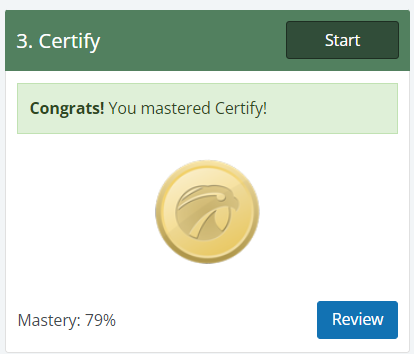
Hawkes Learning’s homework lessons are broken into a 3-step learning mode: Learn, Practice and Certify. Certify is designed to ensure students truly know the material. Built on the principles of Mastery Learning, Certify challenges students to demonstrate a defined level of proficiency before moving forward. During each Certify attempt, tutoring aids are removed, encouraging independent problem-solving and reinforcing genuine understanding. This intentional structure promotes confidence, accountability, and long-term retention, helping students build a strong foundation they can rely on both inside and outside the classroom. This mastery-based approach mirrors the conditions students face on proctored exams, making Certify a powerful preparation tool. By requiring students to work independently—without access to tutoring aids—Certify helps them practice recalling concepts, applying problem-solving strategies, and managing confidence under pressure. Because students must reach a defined level of proficiency before progressing, gaps in understanding are identified and corrected early, not discovered on exam day. The result is deeper retention, reduced test anxiety, and exam performance that reflects true understanding rather than short-term memorization. Learn more about how Hawkes helps students prepare for exams from our Hawkes Student Ambassadors Ash from University of Charleston Certify has helped me feel more ready for exams by giving me practice, but also by bridging the gap between Practice mode and the exam. Certify offers lower stakes than an exam, allowing for multiple retries and allowing you to miss a few problems and still complete it (due to the mastery approach). This can help improve my confidence before an exam and reduce my test anxiety. Certify also holds you accountable to completing practice questions without learning aids which you won't have on an exam. Ty'Nia from University of Arkansas Certify has helped me feel more ready for exams, because once you Certify, that means you've learned to the point of mastery. Hannah from Prairie View A&M University Going through Certify has helped me know the processes and have the understanding needed to complete the problems on the Exams. In my Calculus 1 course, some of the exam problems were similar to those in Certify and having completed them in Certify allowed me to be successful in completing them on my exam. Calliope from Guilford College It [Certify] allowed me to assess my weak spots even if I had shown mastery, and this was very helpful when reviewing for tests. Certify built confidence in my literacy of a subject and that translated well to my confidence on exams when I saw similar problems. Redoing Certifications later also allowed me to prep in a test-like setting. Rishi from University of North Carolina-Charlotte Certify gives me a way to use my own knowledge to complete problems. When I do Certify, I try to do all the problems without getting one wrong. If I get one wrong, I start over so I can be more motivated to take my time and do the problems. Trenton from Prairie View A&M University It [Certify] has made me feel like I was taking a quiz. Since I had to actually learn it to even get a grade for the assignment, it helped me prepare for the questions I would see in the exam environment. Sabrina from SUNY - Old Westbury Certify has helped me feel more ready for exams because the mastery approach pushes me to fully understand the material rather than just complete assignments. Since I have to consistently demonstrate accuracy, it encourages me to review concepts, fix mistakes, and truly learn the content before moving on. For example, when preparing for exams, I noticed that Certify helped me identify weak areas that I might have overlooked. If I struggled to reach mastery on certain topics, I would go back to Practice, use Explain Error, and repeat problems until I felt confident. This process made my studying more focused and effective instead of reviewing everything equally.
![]()
April 6, 2026
Hawkes Learning’s homework lessons are broken into a 3-step learning mode:...
Read More
For any instructor adopting a new courseware platform, there is always an adjustment period. New interfaces, new workflows, new questions. Ahmed Rashed, a statistics instructor at Dallas College, knew this going in. What he did not expect was that the support he had only heard about in stories would be tested in the most stressful way possible, just three days before the semester started. A Last-Minute Assignment It was Spring 2025, and Ahmed was finishing the setup for his MATH 1342 (Statistics) course. As a first-time Hawkes Learning user, he had been working closely with Joshua Rowan, a Hawkes Customer Success Specialist, to make sure everything was in place before classes began. Then, with only three days to go, Ahmed was assigned an additional Co-requisite Statistics course. He had almost no time, limited experience with the platform, and the only window he had to work on it was the day before the semester started. That day also happened to be a holiday. That is when he noticed an email from Josh. Ahmed picked up the phone. "I called the number in the email, and he answered. On a holiday. I explained the situation, and without hesitation, Josh sent me a Zoom link. We had a virtual meeting where I shared my screen, and within an hour, my new course was fully set up and ready for students." Within a single hour, on a holiday, the crisis was resolved. But the support did not stop there. The next day, Ahmed ran into another obstacle: navigating the all-inclusive "IncludED" courseware setup for his students. Julia, his Hawkes Courseware Representative, stepped in to work through it with him, ensuring students had access to everything they needed from day one. And throughout the semester, both Josh and Julia continued to check in regularly, following up to make sure classes were running smoothly and answering any questions along the way. What Sets Hawkes Apart For Ahmed, this experience clarified something important. The platform's mastery-based learning structure and 3-Mode Learning approach matter. But what turned a stressful situation into a successful semester was the people behind it. "Hawkes' service, support, and responsiveness to customer needs is what sets them apart from the rest." As a first-time user, Ahmed had heard good things about Hawkes' customer support before he ever officially adopted the course materials. Those were just stories then. Now they were his own. "That's customer service at its best." A Foundation Built on More Than Software The Hawkes Learning model is built on the idea that student success depends on more than content delivery. The same is true for instructor success. When an educator is supported, prepared, and confident in the tools they are using, that confidence carries into the classroom. Ahmed's experience at Dallas College is a reminder that the right platform partner shows up, not just at onboarding, but when it counts most, including on a holiday, one hour before you think it might be too late.
![]()
March 10, 2026
For any instructor adopting a new courseware platform, there is always an...
Read More
When it comes to strengthening student confidence in Grammar Foundations, nothing speaks louder than the perspective of an instructor who has lived the challenges and found a solution that genuinely works. In this testimonial, we spotlight Professor Lisa Arter's firsthand journey implementing Hawkes Learning’s Grammar Foundations courseware in her ENGL 1410 course at Southern Utah University. Professor Arter's story offers an honest, practical look at how Hawkes transforms the way grammar is taught and learned. "The curriculum is beautifully scaffolded and supported with excellent examples. The online platform is amazing!" Explore the Curriculum Students enter college with little or no grammar knowledge - even as English majors. Creating a grammar class that was at a beginning level but didn't "teach down" to tertiary students was vital. Additionally, I didn't want to spend the class just lecturing and having them think they understood and then do poorly once they left. Using a modified flipped classroom for Grammar Foundations has worked very well. The curriculum is beautifully scaffolded and supported with excellent examples. The online platform is amazing! I love that I can set a proficiency level and the software analyzes a student's trouble spots and gives them more questions to work through in those areas. I also like that the certification quizzes quit once a student can't reach the proficiency score and automatically takes the student to needed review areas. This lessens frustration from students "failing" repeatedly. What Does Implementation Look Like? First, I have my students do the paper textbook, utilizing it as a workbook. They bring the book to class each day and my "lectures" are based on a brief review of the homework and answering the questions students have. This way, the Q&A is targeted. I then have them work on more examples while I move through the class and mark off their work from the homework. I don't grade it - just participation for percentage completed mixed with their Q&A participation. They then know what areas to practice more through the software and take the certification quiz at home. Chapter tests are done in class. Starting with section 2, I introduce sentence diagramming. We work problems in class as this serves as a constant reminder of the parts of speech in section 1 and supports the learned syntax in section 2. Sections 3 and 4 are organized the same way: homework before class, Q&A to work through any questions from that, check it off, diagram some days and then proofread short texts to review and support. Finally, I add an etymology TED Talk and paper. Students research the etymology of their name and a chosen word. They submit a paper, utilizing all they've learned in the class (this is heavily graded on mechanics, style, organization) and give a 5-minute TED Talk on what they've found out about themselves and their chosen word. Students truly enjoy this and end the course with an engaging project. "Scores are up! Students are engaged with the material and feel the success because of this scaffolding. They don't forget early material as they see it repeatedly and in increasingly real-world contexts. I love teaching this class!"
![Image of Professor Lisa Arter]()
February 26, 2026
When it comes to strengthening student confidence in Grammar Foundations,...
Read More
"Hawkes Learning turned a traditionally lecture‑heavy math class into an interactive, data‑driven environment where every student receives instant, personalized feedback, making learning faster, more engaging, and far less stressful for both the instructor and the learners. Working with Hawkes Learning has fundamentally reshaped how I approach mathematics instruction." Professor Olcay Akman has used Hawkes Learning in his statistics courses since fall 1998. He uses Hawkes Learning's Beginning Statistics courseware in his MAT150 and MAT252 courses at Illinois State University. Before adopting Hawkes Learning, I struggled with keeping lessons engaging for diverse learners and providing timely, personalized feedback. My students often felt overwhelmed by abstract concepts, lacked confidence in problem‑solving, and received delayed guidance, which slowed their progress and reduced motivation. Hawkes Learning helped me turn those obstacles into strengths in three key areas: 1. Adaptive, Interactive Lessons Their digital curriculum automatically adjusts the difficulty of each problem based on a student’s real‑time responses. This kept advanced learners challenged while giving struggling students the extra scaffolding they needed, eliminating the “one‑size‑fits‑all” issue I faced with static worksheets. 2. Instant, Targeted Feedback As soon as a student submits an answer, Hawkes provides step‑by‑step explanations and hints. This eliminated the lag between a mistake and corrective instruction, allowing students to self‑correct on the spot and freeing me to focus on higher‑order discussions rather than grading. 3. Data-Driven Insights The platform’s dashboards highlight patterns such as concepts where an individual—or the whole class—frequently errs. With these analytics I could quickly identify misconceptions, re‑teach specific topics, and personalize interventions, turning vague “students are struggling” feelings into concrete, actionable plans. Overall, Hawkes Learning transformed the classroom from a reactive environment into a data‑driven, student‑centered space where learning accelerated, effort was focused where it mattered most, and both teachers and learners experienced greater satisfaction. My classroom polls indicated a boost in “enjoyment of math” scores, and the students’ homework submission rates greatly improved. I reclaimed more time in my weekly schedule which I had previously spent on manual grading and worksheet creation. The Hawkes dashboard alerts flagged at‑risk concepts within minutes, which helped me structure my review with students. This subsequently led to reduced repeat errors among the students' performances. I found that both advanced and struggling students progressed simultaneously, narrowing the achievement gap between top‑ and bottom‑quartile performers. The platform’s adaptive engine continuously gauges each student’s mastery level, allowing me to spend less time crafting differentiated worksheets and more time facilitating deep, conceptual discussions. Instant, step‑by‑step feedback not only empowers students to correct mistakes on the spot but also cultivates a growth mindset—they begin to view errors as learning opportunities rather than setbacks. The rich analytics dashboard gives me a clear, real‑time picture of class‑wide trends, so I can intervene before misconceptions become entrenched, and it also provides concrete evidence of progress that I can share with parents and administrators. Perhaps most importantly, the seamless integration of Hawkes into my existing LMS meant there was virtually no learning curve for me or my students; the transition was smooth, and the immediate improvements in engagement, confidence, and achievement reinforced that technology, when thoughtfully applied, can elevate—not replace—the human element of teaching. Learn more about Hawkes Learning's Statistics Resources
![]()
Courses: Quantitative Reasoning, Elementary Statistics, Functions and Modeling, and Precalculus for ENG-PHYS-CS Course Type: Corequisite Math Pathways Quick Stats: The percentage of students completing college-level math in a single semester rose from 29% to an average of 73% per term, showing steady, lasting improvement. When surveyed, 100% of students enrolled in a lab (corequisite) course said it helped them succeed in their math class. Background & Overview Seminole State College (SSC) math faculty sought to redesign their math sequence to help students graduate on time and place them into math pathways most relevant to their fields of study. In fall 2017, the Mathematics Department launched corequisite math pathways in Quantitative Reasoning, Statistics, and STEM tracks. Within just a few semesters, SSC transitioned to a 100% corequisite model across all math courses. Placement & Course Structure Students are placed in a pathway based on their major, so they can learn the most applicable mathematics for their future careers. Placement into a corequisite course is determined by ACT math scores, QAS Accuplacer results, and a Multiple Measures Rubric to ensure students receive the level of support they need. * STEM includes Precalculus for ENG-PHYS-CS and Functions & Modeling Each pathway pairs with a credit-bearing course immediately followed by a lab (corequisite) course that provides targeted lesson content and individualized support. With this model, students receive one-on-one help immediately after learning new material, reinforcing mastery and confidence. Corequisite remediation is also offered online, where intentional communication and targeted math review are integrated directly into the course design. Results & Student Impact With this new model, more students are passing their credit-bearing math courses within their first year, increasing overall retention and graduation rates. “The lab class (corequisite) helped me so much. I was able to get one-on-one help on questions I needed help with. The extra class was the reason I was able to pass with an A.” -Isaac H., Seminole State College student “Special Topics (corequisite course directly following the credit-bearing math course) really helped me grow as a student! Being able to head to Special Topics after learning a new objective was very helpful because I was able to receive one-on-one help from the professor. It was a class that definitely gave me the confidence to succeed in college! “ -Bryce F., Seminole State College student
![]()
November 11, 2025
Courses: Quantitative Reasoning, Elementary Statistics, Functions and Modeling,...
Read More
Highlights Improved grades and retention: The average grade in the General Psychology course significantly improved by approximately 23.08%, rising from a low “B” average to a mid-“A” average. Improved pass rate: The pass rate increased by approximately 25.64%, and drop rates nearly disappeared by fall 2024. Decreased test anxiety: Excluding the years 2019-2020 due to the influence of COVID-19 on test anxiety, we observe a 40% drop in the first year Hawkes was implemented, based on the 2018-2019 report of 10 students, followed by an 80% decrease and eventually a 100% elimination of students reporting test anxiety at the Center for Testing Support. This case study demonstrates the value of making thoughtful, research-informed changes to course design, particularly when addressing both academic performance and student mental health. Background and Context In the 2019-2020 school year, the psychology faculty at Neosho County Community College (NCCC) were concerned about the pass rate and overall grades achieved in their introductory-level General Psychology course. Some of the concerns were that on average, 6-9% of the students starting the course dropped and that 14-18% received “Ds or Fs” as their final grades. The faculty felt these were not acceptable scores for a 100-level class. (These results were for the cumulative in-person and online courses offered.) On average, the college hosts 250-300 students in the General Psychology class each semester. A secondary issue occurred in the in-person classes on the main campus in Chanute, Kansas. This issue was that each semester 6-11 students were reporting mental health issues about taking the class as well as often voicing concern over their entire class load. Mr. Mark Johnston, a professor on the main campus, runs a test anxiety clinic for all students on the campus. He noted that many students reporting test anxiety or generalized anxiety were concerned about the work required and the assessments in their General Psychology courses. The psychology department saw a need for changes in the course and the course materials used. They also hoped to adjust teaching methods to address these issues. The psychology department reviewed several different textbooks and support materials, seeking a better tool to address the problems and make the course more enjoyable and meaningful overall. “Hawkes is a learning system, not just a textbook or software. Students are immersed in their learning from the moment they start to the very end of the course. The system has so many intuitive elements that even students who are not very computer literate find working in it easy and fulfilling.” – Professor Mark Johnston Implementation In the spring of 2020, the department decided to adopt Hawkes Learning’s Introduction to Psychology. This decision was reached due to a few reasons, one of which was that the courseware was mastery-based, something the faculty agreed was needed. They also valued the support Hawkes was offering to implement the change. The faculty also reviewed other schools’ use of the Hawkes system and felt that Hawkes’ supporting software would fulfill their needs. Over the remainder of the 2019-2020 school year, the faculty worked out a plan to present a uniform class with the same materials and the same teaching methods. Their goal was to provide all students taking the General Psychology class with a similar teaching and learning environment. This included standardizing the associated PowerPoint slides, lecture highlights, and, where appropriate, recorded lectures for online students. Similarly, weekly quizzes, exams, and papers were all standardized to present every student with the same materials and assessment procedures. Beginning in the 2020-2021 school year, the faculty implemented the Hawkes system. To their delight, the results exceeded their expectations. Outcomes within the course all exceeded state standards, and drop rates were almost nonexistent. Similarly, the overall grade averages rose from a low “B” average to a mid-A average. A similar unexpected outcome was noted in the text-anxiety clinic. Likewise, student self-reports on the course were all very positive for the Hawkes system and the mastery-based approach that the psychology faculty implemented. Over the ensuing school years, grades and satisfaction with the Hawkes Learning system have remained high. Similarly, the number of students coming in for test anxiety has less than or equal to 1 for four consecutive semesters. This suggested that the new system not only addressed academic struggles but also alleviated psychological barriers to success. At the start of the Fall 2024 semester, the department implemented the second edition of the textbook and learning tools. This included Hawkes’ AI Tutor feature to support students during their homework sessions. Grades across all General Psychology courses have remained high, as have student reports of the Hawkes system. At first, the AI Tutor tool was not often utilized, as students were afraid that using AI to help them might result in academic dishonesty charges. Once it was made clear that AI Tutor only supports learning and not actual testing, usage improved. Conclusion The integration of the Hawkes Learning System at Neosho County Community College has significantly transformed the General Psychology course, leading to remarkable improvements in both academic performance and student well-being. By embracing a mastery-based learning approach and standardizing course materials and assessments, faculty at NCCC effectively addressed persistent challenges such as low pass rates, high drop-out rates, and mental health concerns, particularly test anxiety. The results have exceeded expectations, with student grades improving, engagement rising, and anxiety-related issues sharply decreasing. These results demonstrate that students flourish in a supportive, engaging, and mentally healthy environment, further establishing Hawkes as a model of effective, student-centered education. Learn more about Hawkes Learning’s Psychology curriculum and mastery-based offerings here.
![]()
November 4, 2025
Highlights Improved grades and retention:
Read More
“I would recommend Hawkes wholeheartedly to anyone seeking to integrate an online textbook experience with their students.” Lucy Horton is an associate professor at College of Coastal Georgia and teaches dual enrollment courses at a local high school. She has been teaching dual enrollment courses for three semesters with Hawkes Learning and recently shared her experience. Title Used: Precalculus, 3rd Edition “The amazing folks at Hawkes Learning understand the challenges that educators face each semester and provide unprecedented, personal one-on-one help every time. What I am in awe about most recently is the fact that Hawkes set up three Sundays in a row that corresponded with the start times of various colleges around the country. It was on Sunday afternoon when I realized something was awry with my grade book. I was able to call in on Sunday and talk with a live agent, and they set up a Zoom call with me, shared my screen, and walked me through all the necessary fixes. It is absolutely amazing that a company would provide this amazing service—right in time—for educators trying to be fully prepared and ready for the new semester! Way to go, Hawkes; you guys get it and provide amazing support when it is most needed. I am so grateful! My students appreciate the Hawkes platform for its videos, practice, AI tutor, and opportunities to improve their math skills. The platform provides students with what they need and educators with seamless integration with various college learning platforms. I would recommend Hawkes wholeheartedly to anyone seeking to integrate an online textbook experience with their students. Their educator support is unparalleled in the marketplace. The integration between it and the various college learning platforms makes it effortless for educators trying to assign and grade student work. Thank you, Hawkes Support; you make my job much easier!” “Thank you, Hawkes Support; you make my job much easier!”
![College of Coastal Georgia]()
October 6, 2025
“I would recommend Hawkes wholeheartedly to anyone seeking to integrate an...
Read More
Courses: Prealgebra, Introductory Algebra, Intermediate Algebra, Precalculus, Prestatistics “With a Master’s degree in Instructional Technology, I always say Hawkes Learning has excellent products, but their service elevates them far beyond any of the other software products that I have experienced over the past 30 years.” Professor Zehr has been teaching mathematics for over 30 years and spent the last 12 years teaching developmental and applied mathematics at North Iowa Area Community College in Mason City, Iowa. Over the course of his teaching career, a significant portion has been spent working with at-risk or developmental students. In each of his courses, Professor Zehr uses Hawkes Learning’s student software and has seen an increase in students’ career-readiness and technical preparedness for future courses including those in the Arts and Sciences areas. “The courseware is designed to build confidence in the students who struggle, as well as, challenge the students, who need a good review and preparation for a college-level course. Students build their confidence as they improve their math skills, and they find comfort in the structure and repetition of the problem sets.” Hawkes’ 3-step mastery approach has helped his students with targeted practice and given them the ability to test out of sections that they’ve already demonstrated mastery. “The structure of the Learn, Practice, and Certify format provides students with a predictable framework while being able to use this structure to be able to practice, improve, and master the necessary skills to transition to the college-level courses needed to pursue their desired career.” A few stand-out features of the courseware include: Practice Test: Provides a quick review of the concepts, serving as a helpful tool for exam preparation. Best Score: Encourages students to retake tests and strive for a higher standard of success without fear of doing worse and lowering their grade. “Combine [these] features with “exceptional” service, and you have a courseware product that will prepare students at any level of ability for a promising future.”
![Rodney Zehr]()
July 21, 2025
Courses: Prealgebra, Introductory Algebra, Intermediate Algebra, Precalculus,...
Read More
Can courseware really make a difference? For one determined student and mom, the answer is yes. Meet Jessica Skinner, a full-time mom, full-time student, and aspiring mechanical engineer at the University of Arkansas – Fort Smith. While juggling parenting and college life, Jessica found that Hawkes Learning didn’t just help her stay on track, it transformed how she learned. With built-in instructional videos, step-by-step problem guidance, and a mastery-based approach, Hawkes gave Jessica the structure and flexibility she needed to succeed. But the impact went beyond the classroom. Her children often watched her work, celebrating every mastery check and learning the value of persistence by example—especially her seven-year-old, who began putting more effort into his own schoolwork. Read the full story to see how Hawkes is helping students like Jessica achieve their goals—while inspiring the next generation along the way. *Interview responses have been slightly edited for content and clarity. Hawkes has played a significant role in my strategies for success, both academically and personally. My children often watch me work on my assignments, and they celebrate with me whenever I achieve mastery. This visible demonstration of progress and perseverance has had a positive impact, especially on my seven-year-old, who has started to put more effort into his own schoolwork. I believe this is directly influenced by seeing me actively engage in my studies and strive for success. Unlike other courses I attend on campus, Hawkes provides a clear, visual representation of progress, which not only motivates me but also serves as a source of inspiration for my children to value hard work and determination. Hawkes Learning offers several features that support my engagement and promote a positive attitude toward learning. One of the most helpful aspects is the inclusion of instructional videos, which visually explain the lessons and make complex topics easier to understand. Additionally, the platform’s step-by-step guidance allows students to work through problems without simply giving away the answers. This approach encourages independent problem-solving and helps reinforce the learning process in a way that supports long-term understanding and success. I am a visual learner, and when I have somebody working out the problems and showing me how to work them out, it is a game changer. The biggest way that Hawkes Learning’s platform has assisted me in overcoming my challenges would be the Step-By-Step part of the Practice section. It helps me understand and work out the problems myself while teaching me how to solve them. I appreciate Hawkes’ mastery-based approach to learning. It functions like a quiz at the end of each lesson, ensuring that I fully understand the material before moving on. This method promotes deeper learning and helps reinforce key concepts. I also find the unlimited practice opportunities especially helpful, as they allow me to learn from my mistakes without added pressure. Overall, this approach reduces frustration and supports long-term academic success by focusing on comprehension rather than speed. In my experience, I would utilize all of the tools they offer you. Be sure to watch all of the videos along with doing the reading. While the professor is working out the problems and explaining them to you, I suggest working them out as well. If you don’t understand how to work a problem, the Step-By-Step option in Practice will help you work the problem out while letting you answer it yourself. Hawkes Learning has so many tools to help you succeed; all you have to do is utilize them. "Hawkes Learning has so many tools to help you succeed; all you have to do is utilize them."
![]()
Dr. Korey Kilburn teaches mathematics and leads the Aeronautical Sciences program at PennWest University–Edinboro. He stays very busy outside of the classroom as he also teaches jiujitsu, is a pilot, serves as a Hawkes Faculty Consultant, and is a former college wrestling athlete. Recently, Hawkes had the opportunity to learn more about Dr. Kilburn’s journey as an instructor and is delighted to shine a spotlight on his passion for mathematics. Read along to learn more about Dr. Kilburn’s experience as a Hawkes instructor! Dr. Kilburn teaches the following courses with Hawkes Learning’s materials: Calculus I, II, and III — Calculus with Early Transcendentals, 2nd Edition College Algebra — College Algebra, 3rd Edition Essentials of Calculus — Essential Calculus with Applications, 3rd Edition Precalculus — Precalculus, 3rd Edition Elements of Statistics — Beginning Statistics, 3rd Edition Statistics and Data Analysis — Discovering Statistics and Data, 3rd Edition While Dr. Kilburn originally attended PennWest University–Edinboro as an undergraduate wrestling athlete, he then pursued three advanced degrees, including his Ph.D. in Mechanical Engineering and Applied Math. He attributes his pursuit of higher education in math to his mentors, Mrs. Judy Scaletta and Dr. Anne Quinn. He shared that Mrs. Scaletta, his 12th grade math teacher, helped him realize he had a knack for the subject. Dr. Anne Quinn taught him in his undergraduate math courses at PennWest University–Edinboro and helped him realize all the opportunities available to him in pursuing a graduate degree in mathematics; they are now colleagues at PennWest–Edinboro. As a first-generation college student, Dr. Kilburn said that he truly appreciated Dr. Quinn’s guidance in exploring the opportunities a future in mathematics could provide for him. Dr. Kilburn’s experience as a former college athlete is applied in his classroom as he reminds his students to continue to show up and work hard in their pursuit of educational success. He reminds them that education is about the big picture, explaining, “It’s not a sprint, it’s a marathon.” Dr. Kilburn teaches a wide array of mathematics courses, ranging from College Algebra to Statistics and Data Analysis to Differential Equations. Dr. Kilburn explained, “Each semester, I look at my schedule, and if there is a corresponding Hawkes textbook I can use for my courses that semester, I will use Hawkes each chance I get.” He was initially introduced to Hawkes during an initiative to bridge the gap for incoming students who had weaker backgrounds in algebra. He enjoyed using Hawkes because of the friendly, timely support he and his students received, Hawkes’ mastery approach, and the HawkesTV video library provided to students. “I think Hawkes and I just get along well; I can implement it into my classes very easily and seamlessly, and the students are happier. I’ve noticed a lot of improvements just since I started using Hawkes,” he explained. Dr. Kilburn uses the Hawkes Sync Tool to link his Hawkes courses with his learning management system, Brightspace. He also utilizes an inclusive access model to distribute his course materials to his students so that they can have access to the Hawkes student platform on the first day of class. When asked his top reasons for returning to Hawkes each academic year, he replied, “The customer service, in general, is through-the-roof amazing. One thing I like about Hawkes is how quickly they help. Not only do they help, but they also really walk you through it. They’ll do everything to make sure you understand.” He continued, “I feel a lot of support there. I don’t feel like I’m just some number,” as he described Hawkes’ Support Team as a friend who genuinely wants to help you. When asked what advice he’d give to an instructor considering adopting Hawkes’ materials, he replied, “First, I would highly recommend it. Secondly, I would say not to be afraid to reach out and ask questions.” He has observed that his students really appreciate the straightforward structure that the Hawkes “Learn, Practice, Certify” sequence provides to them. He also enjoys how easy Hawkes makes it to customize, grade, and manage his courses within the instructor platform. Dr. Kilburn has noticed positive trends since switching to Hawkes in his courses. He explained that when he made the switch to Hawkes in his courses, he did not change his final exams, nor did he change his approach. He said that he noticed both grades and student morale improved, and he believes that is due to the Hawkes approach, which leads to true mathematical understanding. Dr. Kilburn is gifted with the ability to see mathematical applications all around him, from his car tires’ coefficient of friction to an airplane’s rates of ascent and descent. He hopes to help his students see the same applications and relevance of mathematical subjects. This is especially considered when it comes to his calculus sequence courses. He teaches Calculus I through Calculus III with Hawkes’ Calculus with Early Transcendentals. Calculus can be intimidating, so Dr. Kilburn tries to remind his students that mathematics builds upon itself and that the heart of calculus is actually algebra. He appreciates that Hawkes provides students with not only thorough content within the textbook and courseware but also comprehensive free instructional videos to bring the concepts to life. Dr. Kilburn believes that helping students make the connection of mathematics at work around them can be a motivating factor, expressing, “It’s really all around us. We have to just be aware of it.”
![]()
May 27, 2025
Dr. Korey Kilburn teaches mathematics and leads the Aeronautical Sciences...
Read More
Professor Christos Noutsos teaches his Biology I courses at SUNY–Old Westbury with Hawkes Learning’s Biology courseware. As a valued Hawkes Faculty Consultant, we were eager to learn more about his journey as a professor. We invite you to read along to learn more about Professor Noutsos’ experience as a Hawkes instructor below! Professor Christos Noutsos has been teaching since 2017 and has been using Hawkes Learning’s Biology courseware in his courses for three semesters. When asked about what inspired a career in teaching, Professor Noutsos reflected on his childhood. He grew up in Vrisochori (Βρυσοχώρι), Greece. It was in “Gymnasio” (what could be compared to “middle school” in Greece) that he was drawn to learning more about plants and their biology. He considers this time period of his life as what sparked a desire to teach others about biology and what led him to pursue the goal of being a part of an institution that would allow him to both teach and conduct research. He expressed that his current institution gives him this opportunity now. Professor Noutsos also shared a memory of when he had the opportunity to participate in a field trip where his uncle led a lesson in how to cultivate plants. This example sparked creativity, leading to his teaching style today that surrounds helping students become hands-on with their learning. The village of Vrisochori (Βρυσοχώρι), located at the broader region of Zagorochoria Ioannina (Ζαγοροχώρια, Ιωάννινα) in Greece. We asked Professor Noutsos what he would consider to be the most valuable lesson he has learned as a teacher. He replied, “The most important thing I’ve realized is that we are dealing with humans… so I think the most important thing is patience; it’s the best approach to reach the students.” He has certainly applied patience in his teaching, as he described exploring different classroom styles throughout his career. He has found that lectures on their own are not as effective, so he employs a combination of lecture with hands-on learning experiences. He has also used the flipped classroom approach, having students choose a topic and present in class on their topic. Through these adaptations, he has found that the broader umbrella of active learning is what is working best for today’s students. He believes that the students’ biggest challenge is to balance all their responsibilities, so it is important to provide strong structure for them when possible. Challenges and Solutions for the Modern Classroom When asked what he believes to be instructors’ greatest challenge today, Professor Noutsos explained that it can be challenging to engage students properly with the material. He emphasized that discovering what best supports each student requires compassion, active outreach, dedication, and patience. Professor Noutsos explained that his courses have smaller class sizes. This aids in promoting hands-on learning and student engagement within the classroom, as it allows him to get to know his students rather quickly. As he gets to know his students, he learns how to guide them in making meaningful connections between the lecture material and their corresponding lab work. He also has taken an alternative approach to his office hours. In the past, he held traditional office hours within his office on campus. Recently, he has started hosting office hours at the campus café and campus library. By being in a more casual environment, he feels that the students are more comfortable asking their questions. How Hawes Supports Students & Instructors like Prof. Noutsos Affordability and thorough coverage of topics are what have kept Professor Noutsos coming back each semester. He appreciates that students can use the same Biology courseware in both the Biology I and II courses. He also loves that the students have lifetime access to the courseware for continued learning. “The students also love the depth of the book and the style that the platform uses… They like the fact that they can Certify themselves,” Professor Noutsos shared. He went on to say that the Hawkes Support Team has made a difference to him as an instructor, expressing that the 24/7 Live Chat has been extra helpful during late-night questions and on weekends. Professor Noutsos expressed that having a Hawkes Student Ambassador on campus has also provided significant additional support to the students. He has found that one-to-one training meetings with his Hawkes Customer Success Specialist have been beneficial, as they help him set up his entire semester in a single meeting, helping lift a large burden for him in semester preparations. He has especially enjoyed the “Assignment Reminder” feature, which allows instructors to set up automatic assignment reminder emails to be sent to the students throughout the term. “The flexibility is huge – I can choose what I want for my course. I can do that in a very straightforward and easy way. I don’t have to spend hours… I can go exactly where I need to go.” When asked what advice he’d give to new Hawkes instructors, Professor Noutsos said, “Take advantage of the one-to-one sessions. It will save a lot of time throughout the semester. Take the time to explore the platform, because there is so much you can get out of it to help you evaluate your students.”
![]()
May 20, 2025
Professor Christos Noutsos teaches his Biology I courses at SUNY–Old Westbury...
Read More
Andrea Vinci, Ed.D. Andrea Vinci, Ed.D. is an Associate Professor and Division Coordinator at Rowan College of South Jersey. She teaches multiple courses at the college, including ENG 101, in which she uses Hawkes Learning’s English Composition, 2nd Edition courseware. I first started using Hawkes for my online courses in 2019. I thought it was useful and engaging for students in distance-learning courses to master the materials that I usually taught in my in-person lectures. Fast-forward to 2020…the pandemic hit and EVERY class went online. I was uploading lectures, but without the hands-on, in-class activities to gauge student mastery of the different topics, I knew I needed to make a change. That’s when I made the switch to using Hawkes in all of my courses. I still taught each topic through a video to students and used my own essay assignments, but I was able to use the Hawkes Learn/Practice/Certify tools to make sure they truly understood the different modes of writing, how to find, implement, and cite sources, and proper grammar. It gave my students the ability to master these topics and then apply them to their writing. Even after returning to the classroom, I decided to still use Hawkes in this way. We focus on hands-on learning in class, and then they complete the Hawkes assignments at home, at their own pace, to truly master the material. The results have been really great. Not only does Hawkes allow for extra time and materials to master the core content of ENG 101, it also serves as a great resource for when a student is absent or misses a class for any reason (which we all know is very common post-Covid!). Students can still learn all the materials we covered while they were out. I also like that it allows each student to learn at their own pace for each topic. If they understand something well, students can easily certify their mastery. If they need a little more help with a certain topic, they can practice, learn, and attempt mastery as many times as needed to fully learn and master the topic. “Overall, Hawkes has been a truly useful learning resource in both my online, hybrid, and traditional in-person courses. Students find it to be a helpful learning tool, and I think it’s a great teaching tool. The technical support is also readily available and helpful at all times.”
![]()
April 24, 2025
That’s when I made the switch to using Hawkes in all of my courses. I still...
Read More
Dr. Lisa Brewer is an associate professor of English at New River Community and Technical College, where she teaches composition, research, and literature. She uses Hawkes Learning’s Foundations of English, Second Edition courseware for her Developmental English course. We first adopted Hawkes in our Developmental English course because many of our students were not able to score high enough on our placement tests to enroll in English 101. The major issues started at the basic sentence level. The areas of weakness ranged from needing to learn the parts of speech to what sentence boundaries are. Before we could work on thesis statements and paragraphs, I found that we needed to share a vocabulary for talking about sentences, and our wide variety of students in age and experience meant they had different skill levels and competencies. Some needed a refresher in certain areas, while others needed much more instruction and practice. The first thing Hawkes helped with was their diagnostic tests in reading and grammar that are tied to lesson mastery. The diagnostic tests give the student and me a look into what areas need attention and what the student has already learned. I can see how many students need to work on comma splices or apostrophes and how many students performed well with subject and verb agreement and do not need to repeat that lesson. A student’s mastery of a skill will show up in the lessons assigned so that one does not have to do lessons already mastered. This helps a great deal in preventing boredom from the traditional method of covering a particular skill with the entire class and then moving on, knowing some have already mastered it, but others are still struggling. The lessons and mastery of skills are then individualized to each student’s strengths and weakness. The initial scores also indicate which students are almost ready for English 101 and which ones have a larger gap in skills to make up. This insight helps me plan and know where to spend my time and attention. Because students are more conscious of what they are doing well and what they need to work on, they can articulate their accomplishments and become more confident about their writing skills. The Lesson, Practice, Certify method gives them concrete evidence, which I can reinforce when I see the improvement in their essay writing assignments. At mid-term and at the end of the semester, I give them a survey/writing reflection to find out how they are feeling about their writing at this point as compared to when the class started, and I receive specific feedback about what they are happy to have improved, how they had no confidence in the beginning but now they are more comfortable writing, and at mid-term, they let me know what they want to work on in upcoming classes, such as figuring out a good hook, revising introductions, and addressing their audience. They start asking the kinds of questions that I love to hear because they are not as anxious about the mechanics of writing, and their attitudes may have changed from a former negative high school experience. I was skeptical about using Hawkes at first because I thought that this would be another program in which students do grammar exercises in isolation of their own writing and that effort would not translate into improvements in essay writing. I have been pleasantly surprised because a student can not move on from a lesson until he or she has demonstrated competency and learns why an answer is correct or incorrect, so grammar isn’t just busywork. I am also getting detailed feedback, so I know when to offer additional one-on-one help or practice something as a group, and I can let them know when they are succeeding in applying a particular skill in their essays. Confidence about small victories like the elimination of comma splices is something we celebrate. Students often enter their first college English class with dread and anxiety, especially if they have not done well in it in the past. For many, the fundamentals of grammar and reading can be very dry and boring, so it’s not something they want to hear a lecture about or practice on their own. The Hawkes interactive lessons are more engaging because students know they are working on individual areas that need improvement, and they can see tangible evidence of their achievements in both the mastery of a skill and the positive feedback I can give them on their essays. Some students even work ahead and do lessons I have marked as bonus lessons because they see themselves getting better and want to cover additional topics for extra points.
![]()
April 11, 2025
Dr. Lisa Brewer is an associate professor of English at New River Community and...
Read More
“I’ve been really pleased with Hawkes, and their service is the best I’ve ever experienced.” With over 20 years of experience in higher education, Professor Hamid Nahavandi knows that teaching mathematics comes with unique challenges, but complicated courseware shouldn’t be one of them. Titles & Courses: College Algebra, 3rd Edition – College Algebra Precalculus, 3rd Edition – Trigonometry Calculus with Early Transcendentals, 2nd Edition – Calculus When I first adopted the Hawkes Learning platform about four years ago, I was unsure of what to expect. Prior to making the switch to Hawkes, I had been using WebAssign for about a year, but I often found it difficult to navigate, and it lacked sufficient tech support. I’d often have to rely on my colleagues for help, which was frustrating. Once I transitioned to Hawkes, I noticed the difference in Hawkes’ immediately available and excellent Support Team. My designated Customer Success Specialist, Marissa, has been wonderful and always within reach when I have any questions. I can also easily connect with Hawkes Learning’s Support Team’s 24/7 live chat. Over time, I became much more comfortable using the platform, and I continue to learn more. Recently, Joshua from the Customer Success Team came to my office and patiently walked through my Hawkes questions. I also encourage my students not to hesitate in reaching out to Hawkes’ Support Team. I remind them that Hawkes can help them through phone calls and through their live chat on the website. Our campus also has a Hawkes Student Ambassador intern. Having that extra support through the Student Ambassador program has been great for the students, as they may feel more comfortable asking a peer questions outside of our class time and my office hours. When it comes to my favorite features of Hawkes, I always think of the “Learn, Practice, Certify” sequence that Hawkes presents in their homework lessons. I often direct my students to the “Learn, Practice, Certify” features, especially when they miss class. The videos within the Learn segment have been wonderful. These tools have been great for students to catch up on lessons at their own pace, and they really help reinforce the material. The mastery-based approach used in Hawkes has had a positive effect on students’ learning. From an instructor’s perspective, I’ve found the tools within Hawkes to be very complementary to my teaching. The Curriculum feature within Hawkes Teach (the instructor side of the platform) is directly aligned with my classroom lessons, which saves me time and ensures that the material is consistently covered. The step-by-step explanations for each concept are also incredibly helpful, especially when a student needs further clarification. Another feature I really appreciate is Hawkes’ AI Tutor, which provides additional academic support to students outside of class. In conclusion, I’ve been really pleased with Hawkes, and their service is the best I’ve ever experienced.
![]()
April 1, 2025
“I’ve been really pleased with Hawkes, and their service is the best I’ve ever...
Read More
“Hawkes has earned its place as my top choice for educational support.” Professor Niki Stovall at Prairie View A&M University is committed to helping students succeed in mathematics. Like many instructors, she’s seen firsthand how challenges like lack of motivation, poor study habits, and gaps in foundational knowledge can hinder student progress. Titles & Courses: College Algebra, 3rd Edition Plus Integrated Review – Comprehensive Math Skills for College Algebra College Algebra, 3rd Edition – College Algebra Beginning Statistics, 3rd Edition – Elementary Statistics Precalculus, 3rd Edition – College Algebra and Trigonometry Read on to hear firsthand how Professor Stovall has seen Hawkes make a lasting impact, helping students stay engaged, develop stronger study habits, and build the confidence they need to succeed. Many students struggle with motivation, which makes it challenging for them to study consistently, attend class regularly, and seek extra help when needed. Additionally, a significant number of students enter college-level courses without the necessary background knowledge or foundational skills, particularly in areas like reading comprehension and organization. This lack of preparedness can hinder their success in higher education. Thankfully, Hawkes has been an incredible resource, offering valuable support to both students and instructors in multiple ways. Here are just a few of the ways Hawkes has made a difference: Useful Study Resources One of the key aspects of Hawkes’ success is the high-quality study resources they provide. The Hawkes team created a formula sheet for MATH 1314 that is well-designed—concise, easy to read, and highly effective for exams. This tool has proven to be incredibly helpful for students, offering a clear and effective way to prepare for exams. Student Training Hawkes also provides top-notch support and training, which has been invaluable for students navigating the platform. The Hawkes Student Ambassador and Customer Success teams have been essential in helping students develop effective learning strategies. Joshua from Hawkes’ Customer Success Team, in particular, has been a great asset, leading training sessions, answering questions, and providing in-class support. His presence in the classroom has significantly boosted student confidence and comprehension. Students have recognized that Hawkes Support is always available, fostering trust that they will receive the help they need when they reach out. “Students have recognized that Hawkes Support is always available, fostering trust that they will receive the help they need when they reach out.” Encouraging Study Habits Hawkes has also fostered positive study habits and created a more engaging and supportive learning environment. We had a great turnout of students who attended our Final Exam Review at the conclusion of the Fall 2024 term. This event showed how Hawkes’ thoughtful initiatives contribute to a more collaborative and supportive atmosphere, making students feel more prepared and encouraged to succeed. The Tutor button housed in Hawkes’ Practice mode has been especially beneficial to the students’ study time. It walks students through step-by-step solutions and explains errors, helping them learn from mistakes and improve problem-solving skills. Positive Impact on Final Exam Results We had a great turnout for the final exam review session, and overall, final exam results for my classes were pretty good. Having a member of Hawkes Learning’s Customer Success Team come to my class to train students was especially helpful. His presence reinforced that students could rely on Hawkes for support. Exceptional Customer Support One of the standout aspects of Hawkes is their exceptional customer support. I can always count on Hawkes for anything—student support, instructor assistance, and more. Their customer service is outstanding, available 24/7, ensuring we receive help immediately, even after midnight and on weekends. The Hawkes support team is well-trained, helpful, and polite, making every interaction a positive one. Customer support is crucial in any educational platform, and Hawkes truly excels in this area. When students face technical issues, many other publishers are slow to respond—or don’t respond at all—leaving faculty to troubleshoot, which can be time-consuming. Hawkes stands out by providing timely, reliable support. Their tech support team is understanding, proactive, and quick to diagnose and resolve issues, even when instructors aren’t sure what’s wrong. Personalized Support from Marissa Maffei Another huge benefit of Hawkes is the personalized attention we receive from our dedicated Customer Success Specialist, Marissa Maffei. Marissa’s support has been invaluable to both instructors and students. At the start of each term, she conducts in-person meetings to assist with course setup and consistently checks in throughout the semester to ensure we have everything we need. Her eagerness to help and commitment to top-notch support provide a sense of ease, knowing assistance is always available. Marissa makes connecting effortless by offering a direct scheduling link, allowing us to book meetings at our convenience. Thanks to her support, we feel confident using Hawkes every step of the way. Peace of Mind for Faculty and Students Overall, Hawkes has made a positive impact by providing academic, financial, and student support, making learning more accessible and effective. The level of support Hawkes provides has made a significant impact on both faculty and student success. With Hawkes’ dedication to student success and their exceptional customer service, I know that we will always have the resources and assistance we need to thrive in the classroom. Hawkes has earned its place as my top choice for educational support. “The level of support Hawkes provides helps both faculty and students succeed and gives me peace of mind knowing that support is always available.”
![]()
February 28, 2025
“Hawkes has earned its place as my top choice for educational support.”...
Read More
Sheri Stewart, a lecturer at Prairie View A&M University, has found Hawkes Learning to be an invaluable resource across the various courses she teaches. Read along to learn more about the impact Hawkes has made in Professor Stewart’s math classes! Titles & Courses: Mathematics with Applications in Business and Social Sciences – Finite Math Viewing Life Mathematically, Second Edition – Contemporary College Algebra Precalculus, Third Edition –Trigonometry College Algebra, Third Edition – College Algebra “I first started using Hawkes for my Contemporary College Algebra class, and it was a better fit in comparison to what we were using before,” Professor Stewart shares. She appreciated that the platform aligned with her teaching needs, offering engaging content that meets the demands of both face-to-face and online classes. After the math faculty saw Hawkes’ positive impact, they chose to expand its use to other courses, including College Algebra, Trigonometry, and Finite Math. Professor Stewart says that one of the standout features of Hawkes is the Learn-Practice-Certify model. “If students miss class or do not understand something during class, they have Learn to review the material again. Practice gives them all the tools they need if they’re not getting it,” Professor Stewart explains. For online and face-to-face students alike, Hawkes provides the necessary tools for mastering difficult concepts, particularly with its step-by-step guidance and AI-powered feature, AI Tutor. “The AI Tutor is great, and the tool answers the students’ questions in a way that we as professors would do. The other Tutor resources in Practice provide students step-by-step guidance and new iterations of problems to practice,” she says. Professor Stewart appreciates how the Certify feature incentivizes students to work through challenges and reach mastery in each homework lesson. “Who doesn’t like the opportunity to prove you’ve mastered at least 70% of the material and earn a 100% for your grade? This gives the students the incentive to really try,” Professor Stewart expresses. She loves that her students can revisit content until they truly understand it, without pressure. She has noticed that many students enjoy the ability to revisit material until they grasp it fully, without feeling overwhelmed. Additionally, she expressed that her students enjoyed using Hawkes enough to apply to intern for the company! Per her recommendation, her student, Trenton Jeffers, applied for the Hawkes Student Ambassador internship program, which has provided extra Hawkes support to the students on campus. Hawkes Learning’s customer support has been a key positive in Professor Stewart’s experience. “Whenever I’ve had a question or encountered an issue, I’ve been able to speak directly with a knowledgeable person who resolves my problem quickly,” Professor Stewart expresses. She says she’s utilized both Hawkes’ phone and chat service, finding that the Support Team’s response has always been prompt and effective. “Whenever I’ve had a question or encountered an issue, I’ve been able to speak directly with a knowledgeable person who resolves my problem quickly.” She also values the long-term access that Hawkes provides to students. “One thing I especially appreciate is the access that students have to Hawkes materials beyond the current semester,” she notes. For students progressing through a math sequence, such as from College Algebra to Trigonometry, Professor Stewart is happy the students can still access previous course materials online. “This kind of long-term access is not something I’ve seen with other platforms,” she says. Professor Stewart encourages her students to use the “Create Your Own Practice WebTest” feature to help them focus on areas of difficulty. She values this test-prep option Hawkes provides as it allows her students to select sections they’re struggling with and quiz themselves with customized practice tests. Overall, Professor Stewart highly recommends Hawkes Learning for its comprehensive platform, customizable learning tools, and strong support. “It can give you everything that you look for,” she concludes. Ready to learn more about Hawkes Learning? Explore Hawkes’ materials here!
![]()
February 27, 2025
Sheri Stewart, a lecturer at Prairie View A&M University, has found Hawkes...
Read More
Professor Kathie Lennertz teaches her Math 250 courses at Fort Hays State University with Hawkes Learning’s Discovering Statistics and Data, 3rd Edition materials. Before Hawkes, my students would not do enough homework to be able to master the material. They would just make a quick pass at the assignment and move on even though many would have a section score like “2 out of 14 correct.” This contributed to a poor homework score, which frequently led to a poor exam score and a poor course grade. Something had to be done to compel students to spend more time, effort, and attention to actually being able to learn concepts deeply enough to correctly solve a wide range of problems. Also, my students need course materials and technical support that take into account the needs of fully online students, most of whom are working adults. "The mastery-based assignment certification is a game-changer." I set mine to 80%, which requires a strong performance from the student without the burden of perfection. Having the relevant section materials right there in Learn gives them easy access to the book while they are working on problems. In addition, the Practice section has an amazingly large set of problems. This is especially good for difficult concepts like the Central Limit Theorem. Practice makes better, and the students need to practice. Most of the concepts are strange and new to them, so having lots of directed practice with concept-based feedback and the new AI-generated tutor is necessary. This puts the student in charge of his or her own learning, which will be a huge help to each of them later in life. They also benefit greatly from an excellent book written by a statistician like Dr. Hawkes. Statistics is a separate subject from mathematics with its own nomenclature. The book includes a large number of real-world examples from many different areas of human life. Since my students come from many different programs of major study, it gives each of them examples and problems of the sort they might find in their profession. The students demonstrate FAR greater engagement in the course. They dig into the concepts, and most are able to apply the material to their own lives. Most seem more satisfied with their course experience. I also get a lot fewer complaints about the course and some more compliments. The grades in my classes are higher too. Thus, fewer students have to repeat the course. My department likes that, the students like that, and I like that. Everybody wins. The Hawkes system helps my students learn better and have greater success in the course. They go through less “agony” during the semester. The system and I have become partners in helping students learn. The awesome customer service is a real benefit to me and my students. We know that the reps and tech staff are there for us.
![]()
February 18, 2025
Professor Kathie Lennertz teaches her Math 250 courses at Fort Hays State...
Read More
A Hawkes Instructor Spotlight: Dr. Hillary VanSpronsen of Maine Maritime Academy We are delighted to spotlight Dr. Hillary VanSpronsen, a dedicated and passionate educator who teaches at Maine Maritime Academy. Dr. VanSpronsen, who primarily teaches precalculus and calculus courses, has been using the Hawkes Learning platform since 2019 to help foster student success. One of our Hawkes Student Ambassadors, Orion Tevanian, interviewed Dr. VanSpronsen to discuss her teaching philosophy, how she incorporates Hawkes into her courses, and her thoughts on the platform’s mastery-based approach. Read along to learn more about Dr. VanSpronsen’s Hawkes experience. A Diverse Approach to Teaching Dr. VanSpronsen teaches several versions of precalculus, including classes with varying speeds and content, such as business math and trigonometry. This semester, she is also using Hawkes’ Single Variable Calculus with Early Transcendentals for her Calculus II course. Having worked with different textbooks and learning tools over the years, Dr. VanSpronsen has found that Hawkes offers the flexibility and support her students need. “I’ve been using Hawkes since 2019 at a previous institution, and I’ve used it in various forms, mostly for precalculus,” she said. “It’s been a great experience.” The Best Part of Teaching: Student Connection When asked about her favorite aspect of teaching, Dr. VanSpronsen highlighted the connection she builds with her students. “My students are absolutely the favorite part of my day. Going into teaching is not a drain; it fills my cup,” she shared. She enjoys engaging with her students both inside and outside the classroom. “I love talking with them, joking with them, and teaching them,” she added. “There is nothing that they could tell me that would delight me more than to say at the end of the semester that they liked my class and they potentially have a different view of math.” Why the Mastery-Based Approach Works Dr. VanSpronsen told us that she has used nearly every online homework system available over the last 20 years. One of the standout features of Hawkes that Dr. VanSpronsen appreciates is the platform’s mastery-based approach. Unlike traditional methods that focus purely on right or wrong answers, Hawkes’ Learn, Practice, Certify model encourages students to truly master the material, helping them build a solid foundation for future learning. She appreciates that Hawkes allows her the flexibility to adjust the mastery threshold for her classes. The Importance of Practice and Tools Dr. VanSpronsen’s teaching philosophy centers on the importance of practice and using all available resources to succeed. She encourages her students to take advantage of the tools provided in Hawkes, including video explanations, the textbook, and built-in help features. By giving students the opportunity to practice, review, and learn at their own pace, Dr. VanSpronsen helps them gain the confidence they need to succeed in math. Dr. VanSpronsen’s approach to teaching, combined with the support of Hawkes, empowers students to not only excel in her courses but also to build confidence in their mathematical abilities for years to come. At the heart of Dr. VanSpronsen’s teaching philosophy is a belief in her students’ ability to succeed. She strives to create a classroom environment that fosters both academic growth and personal development. “I believe all students are capable of doing math,” she said. “They just need the right coaching, the right materials, and the right mindset.”
![]()
My students no longer saw the course as a struggle between the professor and the students, but as a team effort… It changed an ‘I-win-you-lose environment’ into a ‘win-win environment.' Dr. Lawrence (Larry) Marsh has used Hawkes since the 1980s. When he initially adopted Hawkes Learning’s materials for his courses, he adopted Dr. James Hawkes’ Adventures in Statistics. Throughout the years, Dr. Marsh has watched Hawkes grow into what it is today. Dr. Marsh enthusiastically tells other instructors about the excellent resources Hawkes provides, and as of recently, he has spread this excitement around the globe! Over the summer 2024 semester, Dr. Marsh implemented Hawkes’ Discovering Business Statistics in his regression analysis course. This course was unique in that it was taught in the Tunis City of Sciences, a major educational and cultural institution located in the capital city of Tunisia, under the sponsorship of Carthage University, Avila University and the United States Embassy. The Tunis City of Sciences (Cité des Sciences à Tunis)1 The course was taught in a lecture format with the assistance of two Tunisian professors who showed the students how to use MINITAB and EVIEWS to run the regressions for the Hawkes Learning exercises. In the afternoons, Dr. Marsh would provide additional opportunities to support the students in their homework. meet with the students in a conference room to help them with their Hawkes homework. He could quickly see the students were eager to learn and participate in the course. After his summer course, Dr. Marsh shared the following comments: Hopefully, the students learned an important lesson. Under colonial rule and/or a dictatorship, it is more about who you know, and not so much about what you know. I was allowed to recommend one student for a full scholarship to attend Avila University. I recommended a student who had successfully completed all of the Hawkes’ homework well before the others. I hardly noticed him, but he did the work and got the full scholarship recommendation. The students could see that under freedom and democracy, it is what you know that counts. The students learned about regression analysis and the Hawkes Learning System, but they also learned that it is hard work and accomplishment that really matter in a land of freedom and equal opportunity. My Tunisian experience shows, once again, that the Hawkes Learning System is spreading around the world to, hopefully, be available to benefit all students everywhere. In addition to the Hawkes homework lessons, the students were required to carry out a statistical study as a research project and give a presentation to the class. Dr. Marsh says that he chooses Hawkes time and time again due to the great framework it provides to instructors. He has found that it helps him keep track of his teaching materials while also providing further support resources to him such as activities and exercises for his homework and tests. He also appreciates how Hawkes provides a supportive learning environment for students outside of the classroom. He says, “My students needed a place to learn and gain a better understanding of the course material during times when I was not there to help them. The Hawkes ‘Practice’ exercises are excellent and give my students a very solid understanding of the material.” Dr. Marsh values how Hawkes allows instructors to pinpoint where students spend the most time on their homework. This insight helps him tailor his lectures more effectively, enabling him to emphasize key concepts in class. As a result, students can complete their assignments more easily and use their time more efficiently. “A gamechanger for the professor-student relationship.” Dr. Marsh describes Hawkes as “a gamechanger for the professor-student relationship.” He says, “by using the Hawkes software, my students no longer saw the course as a struggle between the professor and the students but as a team effort with the professor helping the students be successful in achieving certification. It changed an ‘I-win-you-lose environment’ into a ‘win-win environment.'” The professor was no longer seen as the barrier to student success but as providing great encouragement and assistance to the students in gaining a more complete understanding of the material needed to certify in the Hawkes software homework exercises, quizzes and exams.” Dr. Marsh says that his student course evaluations have improved significantly by using Hawkes Learning. He says, “The Hawkes system got me better organized and gave my students excellent instruction to supplement my classroom lectures to give my students a more complete understanding of the material.” Nasreddine Nas’h, CC BY-SA 4.0 https://creativecommons.org/licenses/by-sa/4.0, via Wikimedia Commons ↩︎
![]()
As Professor Neal Chambliss began his second year as an instructor at Calhoun Community College, as well as his second year using the Hawkes Learning online learning platform and textbook, he reflected on the experience he’s had so far. Mainly due to the support he has received from the Hawkes Customer Success Specialists, he describes his experience as being overwhelmingly positive. “I have encountered one thing that they have completely undersold, however: how easy it is to update due dates for a new term. This is my first opportunity to work with a class that I am teaching that I have already had set up. Everything that I did last year was building something new, and the Hawkes rep was ever so helpful and responsive in getting that going. This Fall I have the same class as last year and will be using the same assignments and basically everything that I already had set up." From previous experiences, when it was time to update the same course for the next semester, Professor Chambliss had allotted a fair amount of time to make those changes to have everything ready for his students. That’s when he realized that the amount of time he had set aside wasn’t necessary, and the Hawkes Learning platform made it as easy as 1, 2, 3. In his own words, Professor Chambliss stated, “I seriously think it was three clicks. If it was not exactly three, it was not many more. I was able to just take the previous due dates and move them ALL forward by the same amount of days, which just makes so much sense, of course, but I would not have thought of it ahead of time. This one thing alone should be a big selling point for the software – in big flashing letters on the website somewhere.” Needless to say, Professor Chambliss is a fan of the user-friendly features of the Hawkes Learning platform. “Bottom line: I really appreciate Hawkes’ awesome customer service in general, and this feature in particular."
![]()
July 24, 2024
As Professor Neal Chambliss began his second year as an instructor at Calhoun...
Read More
Highlights & Overview: Of students who passed the course, 100% scored 70% or more on the homework. Of students who passed the course, 91% scored 80% or more on the homework. For students who received less than a C, their average homework score was 55.56%. Of students who failed the course, the average homework score was 31%. For students who earned a final grade of 90 or better, their average homework score was 99%. This case study explores the link between time invested in homework and overall course success. By analyzing the homework scores and final grades, we can identify significant patterns that underline the importance of consistent homework performance. Background & Context This study analyzes Dr. Herb Baum’s use of Hawkes Learning’s course materials at Guilford College during the Spring 2024 term. Dr. Baum uses Hawkes’ Beginning Statistics in his Math112 Elementary Statistics course which is facilitated in a lecture format. He has been using Hawkes’ materials since 2018 to administer his homework lessons, midterms, and final exams. He also utilizes Hawkes’ Canvas synchronization option, providing an easy grade transfer portal while also streamlining the student sign-in process. When asked about his favorite Hawkes features, Dr. Baum reports Hawkes’ renowned Customer Support Team and the intuitive Practice mode in the student platform. Dr. Baum also shares that Hawkes’ grading system in the Instructor Platform has been very beneficial. This study was conducted with the assumption that students must have a C or above to “pass” the course and move on to the next course. At Guilford College, a “C” is equal to or greater than a final grade of 72. A final score of 55 or below indicates a failing grade in the course. With Dr. Baum’s custom course settings, students receive 100% for submitting their Certify assignments on time, 75% if it is up to two weeks late, and 0 thereafter. Data Highlights MATH112 Hawkes Product Used: 3rd Edition Beginning Statistics This scatter plot demonstrates a strong positive correlation (R² = 0.7975) between students’ homework scores and their final grades. The upward trend indicates that higher homework performance is generally associated with better course outcomes, especially with higher homework scores. Additional data analysis beyond this graph further illustrates a clear relationship between homework completion and overall success in the course, providing more detailed insights into performance thresholds and grade distributions. Homework Performance and Passing the Course 100% of students who passed the course scored 70% or more on their homework. 91% of students who passed the course scored 80% or more on their homework. Homework Performance and Lower Grades Students who received less than a C had an average homework score of 55.56%. Students who failed the course had an average homework score of 31%. Homework Performance and High Achievement Students who earned a final grade of 90 or better had an average homework score of 99%. Analysis While correlation does not necessarily equate to causation, the data demonstrates a strong trend between performance in Hawkes’ homework lessons and overall course success. Students who passed the course consistently achieved higher homework scores. The fact that every student who passed the course scored at least 70% on their homework highlights the critical threshold necessary for passing. High achievers (those earning 90 or better as a final grade) nearly perfected their homework, with an average score of 99%, indicating that top students not only complete their homework but excel in it. This is a clear reflection of Hawkes’ mastery learning approach at work. When completing a Hawkes homework lesson, the student has the opportunity to truly master the learning objectives, leading them to become test-ready. Conversely, students who received less than a C or failed the course had significantly lower homework scores, averaging from 31% to 55.56%, respectively. This suggests a clear link between poor homework performance and overall academic achievement. Conclusion The evidence presented strongly supports the notion that dedicating time and effort to homework is a key factor in academic success. Ensuring students understand the importance of homework and providing innovative interactive homework opportunities could significantly improve their overall performance in the course. The more time that students interacted with Hawkes Learning’s mastery pedagogy, their overall grade was positively impacted.
![]()
As an instructor at the University of Mississippi, I’ve integrated Hawkes into my courses, and the impact has been transformative. The intuitive interface and exceptional support from their team have streamlined my course preparation process. With just a few clicks, I can effortlessly update course curriculum, due dates, etc., which has saved me valuable time each semester. Mastery Learning: A Student-Friendly Approach Unlike other textbooks and resources I’ve used before, Hawkes offers a dynamic learning environment that engages students. Through interactive modules and real-world applications, my students develop a deeper understanding of complex concepts. The immediate feedback feature allows students to correct mistakes in real time, enhancing their learning experience. Additionally, the structured Learn, Practice, and Certify approach has significantly boosted my students’ confidence and readiness for higher-level coursework. It provides a predictable framework that supports both struggling students and those seeking to excel. Course Management Made Simple In my courses, I use the Question Builder tool extensively. This allows me to customize questions into a format that I want. It is great for building in partial credit for tests, while still requiring students to get answers completely correct on homework. Further, the review-by-question feature saves me a lot of time in my large courses. It is not uncommon for me to have 500 students each semester. With the review by question feature, I don’t need to look at answers that are already correct and I can be more consistent in my partial credit policy. Our tests are administered in a computer lab, and the questions are in a random order for each student. However, when grading, the questions can be sorted into assignment order. We can grade all of the “question number one” (referring to the assignment order) for all students, and then all of “question number two” for all students, etc. I would estimate that this feature saves me somewhere between 50 to 75% of the time I would previously spend grading each individual student’s test for partial credit. Hawkes has not only enriched my teaching experience but also enabled my students to achieve higher levels of engagement and success in their courses. It’s truly a game-changer in fostering a supportive and effective learning environment. Robert Hunt, Senior Lecturer of Mathematics and Mathematics Lab Administrator at the University of Mississippi Robert has taught with Hawkes Learning’s materials in his classroom for many years. Throughout the years, Professor Hunt has taught with Mathematics with Applications for Business and Social Sciences, Essential Calculus, College Algebra, and Beginning Statistics. Robert is married and has two kids; as a family, they enjoy traveling and attending sporting events together. Robert serves as a Hawkes Faculty Consultant, providing his expertise to new and returning Hawkes instructors. To learn more about Robert, check out his Instructor Spotlight!
![]()
July 17, 2024
As an instructor at the University of Mississippi, I’ve integrated Hawkes into...
Read More
Courses: Introductory Algebra, Intermediate Algebra, & College Algebra Course Type: Supplement to lecture Quick Stats: 30% Increase in Students Earning a C of Better Before using Hawkes, only 58% of students earned a C or better in the course, compared to 88% with the use of Hawkes. 20% Increase in Completion Rate The completion rate in College Algebra increased from 60% to 80% with the implementation of Hawkes. 23% Average Decrease in DFW Rate Introductory algebra DFW rate decreased 24%. Intermediate algebra DFW rate decreased 18%. College algebra DFW rate decreased 26%. At Arkansas State University, 39.6% of all first-time students are unprepared for college-level mathematics. Due to the large influx of students with developmental math needs, the math department redesigned developmental courses in order to increase success rates and standardize instruction. Teaching and learning took place in a lab setting. All lectures were available for students to review. Students were required to complete Hawkes certifications in order to take each exam.
![]()
July 1, 2024
Courses: Introductory Algebra, Intermediate Algebra, & College Algebra
Read More
Professor Andrew Borne, Minnesota Virtual Academy When Andrew Borne was asked to launch a new college-level, dual-credit statistics course for Minnesota Virtual Academy, he had no idea where to begin. But he knew one thing for sure: the course needed to be rigorous, accessible, and (above all) ready fast. Title & Course: Beginning Statistics, 3rd Edition – College Statistics Initially, Andrew was worried that adopting a new platform would create more problems than solutions. As an online school, his students already faced enough digital hurdles. “I was very concerned that it would be difficult to learn and manage. I was concerned it would be yet another technology hurdle my students would need to endure rather than being focused on the course content.” To his relief, Andrew Borne found that Hawkes was built with instructor needs in mind. The course setup took less than an hour, and the tools provided—including account access, an online textbook, and printed materials—made the process seamless. “I needed a high-quality college course up and running quick. That’s what I got. The students had NO difficulties.” One feature that stood out to Professor Borne was the ability to view the course as a student, offering full transparency into the learning experience. “I can actually see for myself how the pacing works—and verify the practice and assessments are fair.” Beyond the platform itself, Andrew emphasizes the exceptional customer support that came with it. “During business hours, I can phone in for a question, and I reach a human that is smart and knows how to answer my questions or fix my issue.” "The Customer Service was uncommonly awesome." For instructors looking for a flexible, well-supported, and easy-to-implement course solution—especially under tight timelines—Andrew says it best: “Quizzes, tests, extra content… all there and with flexibility to teach it how I wanted to teach it with the appropriate rigor.”
![]()
June 19, 2024
Title & Course: Beginning Statistics, 3rd Edition – College Statistics
Read More
Hawkes Learning celebrates the privilege of working with so many fantastic professors across the country who use Hawkes in their classrooms. Recently Hawkes’ Student Ambassador, Molly Linck, had the opportunity to interview Professor Kelvin Holmes from the University of Mississippi. Learn more about Professor Holmes’ Hawkes journey below! Professor Holmes has taught since 2013 and currently teaches at The University of Mississippi in Oxford, Mississippi. When asked what his favorite part of teaching at the university level is, Professor Holmes replied, “seeing students progress, actually learn the material, apply the material, and be able to use it as a stepping stone to the next class.” Professor Holmes began teaching with Hawkes Learning’s mathematics materials in 2016. While the Math Department uses Hawkes’ materials in multiple classes at Ole Miss, such as Business Math and Business Calculus, Professor Holmes has taught College Algebra and Statistics courses with Hawkes. We asked Professor Holmes what he loves about Hawkes, and he shared the following: "My favorite thing is that Hawkes gives students so many resources when they learn and practice." Hawkes gives students some options in the book, while the software’s Practice mode takes it a step further, giving them different options to figure out where they went wrong. “I like for my students to use the Practice mode, and I like the fact that it offers so many resources for the students. The students like Hawkes and when they compare it to other software, they tend to like Hawkes more.“ Meet the Interviewer Molly is a Hawkes Student Ambassador and a freshman at the University of Mississippi where she is a double major in marketing and finance. Molly is from St. Louis, Missouri but grew up in Nashville, Tennessee. Molly’s hobbies include going to the gym, attending cycling classes, watching sports, and playing soccer. After graduating, Molly hopes to become a financial analyst. Student Ambassador Internship
![]()
June 17, 2024
Hawkes Learning celebrates the privilege of working with so many fantastic...
Read More
In the ever-evolving world of education, it is crucial for educators to continually seek out innovative and effective tools to enhance the learning experience of their students. As an instructor in a community college setting, I have had the privilege of exploring a variety of educational platforms and resources. Among these, Hawkes Learning has proven to be a game-changer in my business statistics class. Hawkes Learning is a state-of-the-art adaptive learning platform designed to provide personalized learning paths for students. Its user-friendly interface and student-centric approach set it apart from traditional learning methods. The platform is not just a tool; it’s a comprehensive learning ecosystem that caters to the diverse needs of our student population. The user-friendly design of Hawkes Learning is one of its most appealing features. The platform is intuitive and easy to navigate, making it accessible to students of all skill levels. This feature is particularly beneficial in a subject like business statistics, which can be challenging for many students due to its abstract concepts and complex calculations. With Hawkes Learning, students can explore the course materials at their own pace, reducing the anxiety often associated with learning new subjects. One of the standout features of Hawkes Learning is its adaptive learning capability. The platform adjusts to each student’s learning pace and style, providing customized content and resources based on their performance. This feature is particularly beneficial in a subject like business statistics, where understanding concepts often requires practice and repetition. With Hawkes Learning, students can revisit topics until they grasp the material, ensuring a comprehensive understanding of the subject. Absolutely one of the best things about the company is that Hawkes Learning offers exceptional customer service. Their team is always ready to assist with any technical issues or concerns, ensuring that our class can run smoothly. This level of support is invaluable in an educational setting, as it allows us to focus on teaching and learning without unnecessary interruptions. I have dealt with them on multiple occasions when I or a student had a question, and received a response very rapidly. I have not yet had a question come up that could not be answered. Another important aspect of Hawkes Learning is its flexibility. The platform can be accessed from anywhere, at any time, making it an ideal tool for both in-classroom and remote learning scenarios. This flexibility has been particularly beneficial during the recent shift to online learning due to the COVID-19 pandemic. In conclusion, the integration of Hawkes Learning into my business statistics class has been a transformative experience. The platform’s user-friendly interface, adaptive learning features, excellent customer service, and flexibility have greatly enhanced the learning experience for my students. It has not only made my job as an educator easier but has also empowered my students to take control of their own learning journey. As educators, it is our responsibility to continually seek out and implement tools that can enhance our students’ learning experience. With Hawkes Learning, we’ve found a tool that not only meets but exceeds our expectations. It is a testament to the power of adaptive learning and the potential it holds for the future of education. About the Writer I received my undergraduate degree from Huntingdon College, and I obtained my masters degree from Alabama A&M. I have taught high school since 2008, and have been teaching as an adjunct since 2015, first at Kennesaw State University’s Paulding campus, and I started at Calhoun in 2022.
![]()
April 9, 2024
In the ever-evolving world of education, it is crucial for educators to...
Read More
Hawkes Learning has almost 40 years of experience in educational courseware; in fact, Hawkes Learning forged the first educational courseware that used precursor models of artificial intelligence joined with research-based pedagogical approaches in mastery-based learning. In Hawkes Learning, you get trustworthiness from years of experience, unparalleled care from customer support, and exceptional courseware that considers the student before the dollar. My time with Hawkes spans only 10 years of their student-centered history, but my experience is unique with them. I experienced Hawkes Learning as a tutor, adjunct faculty, and full-time tenure track faculty. For many years, I was a part of the Hawkes family, but I had to leave in 2021 when I joined a new college. For the last 3 years, I used other educational platforms, and I want to tell you why I have finally returned to the Hawkes Nest... I’ll never forget my first experience with Hawkes Learning. I was a freshman at Morehead State University in Morehead, KY studying mathematics, and I began tutoring students who used Hawkes in College Algebra and Precalculus. I was amazed at the modernized look of the system even back in 2014. As a tutor, I was able to assist students through Learn and Practice. With Practice, there were so many questions that I could work with a student on before they went to Certify. I also worked with faculty who used an emporium-style classroom with Hawkes; the instructor helped students, I helped students, and students helped students! The flexibility of Hawkes Learning provides autonomy to an instructor’s dream of their perfect classroom. The courseware never held you back on the possibilities of elevating the student success in your courses. When I transitioned from tutor to adjunct faculty, I was certainly worried that there were a lot of complicated processes behind the scenes that my instructors weren’t showing. Well… I was wrong. As an adjunct, I found the Hawkes Learning Teach accounts to be easily navigable and also offered insightful reports on student progress. These reports were essential to reporting student progress in our Early Alert System. Coordinator/Administrator templates made for an easy start where I was able to focus on course design, activities, and more! Each semester, Hawkes Learning hosted a Getting Starting Session for all faculty using Hawkes on campus. Additionally, if I had a question while working late into the night (which was/is common), Hawkes Learning was there. The 24/7 chat was available for both students and me. My last time using Hawkes was Spring 2020, and I believe we can all remember what happened in March. Since Hawkes already has dedicated Learn and Practice modules, the quick transition to online did not seem as abrupt as some of my other colleagues who did not use Hawkes. Now, I hope we never experience another pandemic, but there are other personal challenges that can cause us to shift our classrooms. Consistency is important during these times, and Hawkes provides exactly that with Learn, Practice, and Certify. When interviewing for my current role, one of my first questions was, “Do you all use Hawkes Learning as your educational courseware?” The answer was an unfortunate “no,” and I started in January 2021 with brand new, never-seen-before, courseware which was a huge challenge to get acclimated to platforms very different from Hawkes in my first year. I have been with my current college for three years, and I have now been promoted to Assistant Professor from Instructor. After talking several times with the Educational Courseware Representative for my region at conferences over the years, it was finally time to return to Hawkes Learning! Also, shoutout to Debra for being the most supportive and energetic rep out there; a great part about Hawkes Learning is that every person who works there believes in the company’s mission and puts student success first. For Spring 2024, my college is piloting Hawkes Learning, and a colleague and I are the pilot instructors for College Algebra. Although I am “piloting,” it is clear I have a long history with Hawkes Learning, and I plan to use Hawkes Learning for my mathematics courses from now on. So, why did I return? I certainly got comfortable with the other platforms; my students were doing fine; my division continued to use them; Why return to Hawkes? My teaching philosophy considers failures and mistakes a part of the learning process, but I felt that I was not creating an environment where students could recover and learn from failure without Hawkes. With the mastery-based learning approach, students may not pass their first or second attempt at Certify, and that is okay because the system will adapt to them. When students do not pass Certify, they are redirected to Practice where problems are adapted to their most immediate needs from the Certify. Students are spending more time on topics they have not mastered and gaining confidence in preparation for their next Certify attempt, Quiz, or WebTest. Parenthetically, there are curricular advantages that really impact student learning and understanding of more rigorous mathematical concepts. I have noticed that the chapters in College Algebra by Paul Sisson appropriately develop a student’s mathematical maturity. Recently, I have been covering Functions and Relations which includes the difference quotient. In the past, the difference quotient was a common challenge for my College Algebra students because the algebraic manipulation and skillset was not well defined early enough for them to attempt some of these problems. With Hawkes this semester, my students seem to take on challenging mathematics with a higher level of confidence. This is a great development in student learning because I can create projects, problems, or activities that require deeper critical thinking and algebraic skills that would have previously taken up too much cognitive load for the students. These curricular advantages are continuously unfolding as the semester progresses. Without a doubt, Hawkes Learning has the best customer support in the EdTech community. The time, dedication, and commitment to instructor and student success are huge factors of why I returned. I was tired of getting the chatbots, the hour-on-hold phone calls, or the email exchanges that don’t help immediate issues. With the 24/7 chat feature, 3 rings or fewer phone calls, and the customer support team, you are in the best hands to get your semester started. I cannot wait to work with the Customer Love team which will help me design my course to better fit the needs of my classes. For Spring 2024, my pilot colleague and I were guided every step of the way to set-up. The ease of setting up your courses is excellent for any faculty member, whether part-time or full-time. Since the last time I used Hawkes, there have been many changes that highlight Hawkes’ ability to adapt to evolving student and instructor needs. Finally, with my return to Hawkes Learning this Spring 2024 semester, how’s it going? My students are engaged in the content, working productively through the Certifys, and developing mathematical skills faster than anticipated. I can change the format of my class from mini-lectures and worksheets to projects to an emporium-style workday in Hawkes. Sure, students still get frustrated when they don’t pass a Certify, but they aren’t getting stuck as much. Features like Tutor, Explain Error, and Solution assist students in a variety of ways that meet them where they are. Misconceptions in mathematics lead to common errors, and Hawkes Learning can guide a student out of those misconceptions and into mastery of the content. I am so happy I have returned to the Hawkes Nest, and I look forward to exploring the variety of ways my teaching will evolve while using Hawkes Learning. About the Writer Hunter Chandler is an Assistant Professor of Mathematics at Bluegrass Community & Technical College. Chandler is a Ph.D. student at the University of Kentucky in STEM Education, and he holds master’s degrees in Mathematics from Central Methodist University and Adult & Higher Education from Morehead State University. He has been teaching mathematics since 2017 and has many years of experience using Hawkes Learning. His research interests include undergraduate and technical mathematics education using project-based learning and other active learning techniques for college and adult learners.
![]()
February 8, 2024
Hawkes Learning has almost 40 years of experience in educational courseware; in...
Read More
Highlights & Overview: MAT2501 showed a 20% increase in the number of students that passed the course YoY, MAT1100 exhibited a 21% increase YoY, and MAT1000 maintained a consistent 83% pass rate. Students who passed MAT1100 and MAT2501 spent an average of 2,097 minutes in Learn, Practice, and Certify – an average of 210 minutes per week, or 30 minutes per day, across the 10-week semester. Students who passed MAT1000 spent an average of 962 minutes in Learn, Practice, and Certify – an average of 192 minutes per week, or 27 minutes per day, across the 5-week course. This study analyzes South College professor Chris Garner’s experience using Hawkes Learning’s course materials. It specifically examines Professor Garner’s course data across three courses– Mathematical Concepts and Applications (MAT1000), College Algebra (MAT1100), and Statistics (MAT2501)–emphasizing pass/fail and the relationship between these grades and students’ time invested in Hawkes Learning’s student software. Background South College initiated a pilot program for courseware in Spring 2021, with Hawkes Learning’s Beginning Statistics. This successful pilot, marked by steady growth and consistent passing rates in Beginning Statistics courses, led to the adoption of three Hawkes titles across the math department at South College in Fall 2021: Beginning Statistics, Introductory & Intermediate Algebra, and Preparation for College Mathematics. In the context of this study, students earning letter grades of A, B, or C are considered to have passed, whereas those receiving a grade of D or F are classified as failed. A, B, C Rate Comparison Statistics (MAT2501) Hawkes Product Used: 3rd Edition Beginning Statistics As illustrated in the chart above, Garner’s MAT2501 section exhibited a remarkable 20% rise in the number of students passing year over year (YoY) (21-22 vs 22-23 academic years) following the adoption of Hawkes. This increase not only reflects a continuous upward trend in the number of passing students but also demonstrates consistent growth among his students. College Algebra (MAT1100) Hawkes Product Used: Introductory & Intermediate Algebra Likewise, we observed consistent success and growth in the total number of students passing Garner’s MAT1100 course with the integration of Hawkes courseware. From the academic year 21-22 to 22-23, there was a 21% increase in the number of students passing YoY. Mathematical Concepts and Applications (MAT1000) Hawkes Product Used: 2nd Edition, Preparation for College Mathematics This course’s analysis involves a considerably smaller enrollment size compared to Garner’s higher-level courses, featuring only 87 and 40 students in each respective academic year. Evaluating this data from a holistic perspective from adoption through the Fall 2023 term indicates a consistent 83% pass rate among all students in this developmental-level course. Investigating Time Spent When investigating trends in student performance as it relates to *time spent in the courseware, the data reveals a direct relationship between the time spent in the Learn and Practice modes and pass rates. Notably, students who received failing grades (D or F) generally invested significantly less time in the software compared to their successful counterparts, underscoring the proven pedagogical design of our 3-step approach to mastery; when ample time is dedicated to genuine engagement and practice with the course material, students generally exhibit increased understanding and retention of course content, and subsequently, higher final grades, as demonstrated in the chart below. South College’s partnership with Hawkes Learning has resulted in sustained success and improved passing rates. The strategic adoption of Beginning Statistics, Introductory and Intermediate Algebra, and Preparation for College Mathematics, coupled with an emphasis on students spending more time in Learn and Practice, has proven to be a successful formula for student success as determined by their final grades. This study suggests that Hawkes’ mastery-based courseware, focusing on student engagement and time investment, can yield significant improvements in academic outcomes. *“Time spent” is measured by the duration a particular page in Learn or Practice remains on the screen, which may not precisely reflect the actual time spent interacting with the content. This variable is presumed to account for outliers in the chart, where some students exhibit high recorded ‘time spent’ without achieving the expected rate of success.
![]()
January 2, 2024
Highlights & Overview: MAT2501 showed a 20% increase in the number of students...
Read More
Over the years, Professor Saboori has employed a variety of textbooks in his statistics course. While these Open Educational Resources (OERs) like OpenStax and Introductory Statistics by Shafer and Zhang contained valuable content, he discovered that they were lacking in providing a genuinely active learning experience. This constraint hindered students’ capacity to independently explore concepts and apply them practically, consequently impeding their overall success in the course. Hawkes Learning’s Discovering Business Statistics textbook and mastery-based software effectively fulfilled this need, presenting a multitude of advantages that vastly outweighed the cost savings benefits of OERs. Interactive Learning Environment: Students are equipped with a dynamic, interactive platform where they can actively engage with the material, complete practice problems, simulations, and real-world applications, and develop a deeper understanding of statistical concepts. Self-Paced Learning: One key advantage is the ability for students to progress through the software’s Learn and Practice modes at their own pace, personalizing instruction and allowing each student to grasp the material fully before moving on to Certify and the next lesson. Immediate Feedback and Support: Hawkes Learning offers instant, error-specific feedback on assignments, empowering students to identify and correct mistakes in real-time. Additionally, the platform provides access to an array of resources such as instructional videos and step-by-step problem-solving tutorials to guide students. Engaging and Relevant Content: Discovering Business Statistics incorporates an “outstanding data set that applies real-world data as part of the student learning process,” making the subject matter both relatable and engaging. By bridging the gap between theory and practice, Hawkes fosters a deeper appreciation for the practical applications of business statistics across a span of disciplines and careers. “The textbook is well written, accurate, and reflects the most recent concepts and techniques in teaching statistics.” The interactive nature of the platform, combined with immediate feedback and support, sets the stage for enhanced comprehension and a heightened ability to apply statistical techniques in real-world scenarios. Students become more confident and enthusiastic about their coursework, resulting in higher levels of engagement and participation. By choosing Hawkes Learning over free resources like OpenStax, Professor Saboori has effectively transformed the educational experience for his students at Albright College, preparing them for success in their future courses by empowering students to become proficient problem solvers.
![]()
July 7, 2023
Over the years, Professor Saboori has employed a variety of textbooks in his...
Read More
Courses: GEN 103: Special Topics in College Mathematics for Non-STEM Majors and GEN 104: Special Topics for STEM Majors Course Type: Emporium Quick Stats: In 2015, the average pass rate was 63% (excluding withdrawals) and 57% overall using a different software platform; after implementing Hawkes Learning in 2016 the pass rate reached 79% and continued to stay above 70% over the next four years. In fall ‘16, the pass rate increased by 18%, the fail rate decreased by 15% and the withdrawal rate decreased by 4% compared to the previous fall semester. Over 75% of students who passed University of Louisville’s GEN 103/104 in the summer or fall term of 2021 using Hawkes went on to earn a passing grade in their next credit-level math course. The University of Louisville (UofL) implemented intervention courses for students who were not college-ready in mathematics to give them the support and resources they needed without slowing down their paths to graduation. With this goal in mind, UofL replaced all traditional sections of Intermediate Algebra with two new emporium-style intervention courses in algebra. These courses are part of the Resources for Academic Achievement (REACH) program, the university’s centralized academic support unit for undergraduate students. Instead of whole-class lecturing, students meet in a computer lab setting and work through their lessons with the assistance of self-paced courseware, peer tutors, and a course instructor (who serves as a facilitator and guide). REACH is the recipient of the International College Learning Center Association’s (ICLCA) 2022 President’s Outstanding Learning Center Award for Specialized Populations and a Hawkes Learning customer since 2016. After piloting the materials in spring ’16, UofL adopted Hawkes Learning’s Introductory and Intermediate Algebra courseware and customized Guided Notebook starting in summer ’16 after receiving positive student feedback, seeing overall success rates and experiencing unmatched customer support. One of the key deciding factors in moving forward with Hawkes Learning was the ability to use diagnostic testing through the courseware at the start of the term. After switching to Hawkes Learning and making several other structural changes to the program (such as the development of a common final exam), the pass rate of GEN 103/104 students increased dramatically. "The diagnostic abilities of Hawkes are a game changer." As an intervention course, GEN 103/104 students enter the course at all points on the spectrum. Hawkes’ diagnostic testing with automatic grading allows students to demonstrate proficiency in prerequisite material. For the learning center, this feature saved them from grading over 1,000 pen and paper assessments each term, saving valuable time for instruction. Since adopting the Hawkes Learning mastery-based courseware and implementing other course changes, the REACH program at UofL has seen consistent success year over year: From fall ’13-’16 pass rates were averaging below 63%. After implementing HL, average pass rates from fall ’16 to spring ’22 increased to 71.8% (74.6% when excluding the 20-21 pandemic outlier) Table 1: Hawkes Learning was implemented as part of the UofL course curriculum at the start of the 2016-2017 academic year. From the start, the course pass rate in the fall of 2016 outperformed the fall of 2015 pass rate by 18% with fail rates and withdraw rates dropping by 14% and 4%, respectively. Table 2: Over time, the implemented Hawkes Learning products have seen successful trends with consistent pass, fail, and withdraw rates that all outperform past averages from competitor curriculum materials. As demonstrated by the charts above, this upward trend in pass rates was interrupted by the 2020 COVID-19 pandemic causing the 2020-2021 academic year to be an outlier. The impact of the pandemic is still evident, as pass rates have not yet returned to pre-pandemic levels. It may take several years for students to recover the learning losses caused by the COVID-19 pandemic.
![]()
June 8, 2023
Courses: GEN 103: Special Topics in College Mathematics for Non-STEM Majors and...
Read More
The REACH program at the University of Louisville was recently selected for the International College Learning Center Association (ICLCA) 2022 President’s Outstanding Learning Center Award for Specialized Populations. Led by Associate Director Carrye Wilkins, the math center at UofL’s Learning Center has accomplished a truly meaningful mission: to close the opportunity/performance gap in undergraduate math students for four consecutive years, proven by no association between GEN 103/104 pass rates and ethnicity. University of Louisville, REACH 2021-2022 Annual Report Additionally, data shows that both minority and non-minority students enrolled in GEN 103/104 are passing at not only similar rates but also higher rates than before the implementation of Hawkes. Using the Certify Learning Path of Hawkes, students are given the flexibility and greater opportunity to succeed. With this flexibility, UofL saw overall pass rates for fall/spring semesters of ’20-21 increase by 38.7% in comparison to the previous academic year. This concerted effort to level the playing field in undergraduate math is possible through a culmination of dedication and fine-tuned efforts between instructors, tutors, and a mastery-based methodology bolstered by Hawkes Learning’s unique, adaptive platform. Carrye and her right-hand, Assistant Director Kelly Coultas, currently oversee over 1,900 students annually (including 1,000 students in FA2022) in the University’s GEN 103/104 foundational math course, which has utilized Hawkes Learning’s Introductory and Intermediate Algebra textbook, software and Guided Notebook with customized content for since 2016. While the team at the University of Louisville’s REACH program is honored to have received this award and proud of the success they’ve seen with their own students, they want other learning centers to know that they can see similar successes! “This is the fourth consecutive year we have demonstrated that our classes help close the opportunity/performance gap.” – 2021-2022 REACH Annual Report, University of Louisville Here are a few ways that UofL uses Hawkes in its award-winning Learning Center: Learn, Practice, Certify Learning Path The software is self-paced in nature and allows students to move through course content at their own speed, creating a more individualized experience versus a traditional “one size fits all” lecture. Additionally, Hawkes Learning’s mastery-based homework is inherently equitable for students regardless of their prerequisite knowledge. Unlimited, penalty-free attempts on homework assignments paired with remediation and tutoring built into Practice mode, allows students as much time and help to learn content as they need without being penalized. Advanced Learning Aids Rather than simply telling students when their answer is wrong, Hawkes’ error-specific feedback pinpoints where students went wrong and walk them through the steps to get the right solution. Similarly, REACH students find the “try similar” option helpful in Practice mode to ensure understanding of the problem-solving process. Attendance Features Students in GEN 103/104 are allowed 10 absences over the course of the semester. The built-in attendance features in Hawkes helps holds students accountable and lets instructors identify at-risk students who may be struggling with outside factors. Course coordinators utilize this information to schedule Plan of Action meetings with students who are “off-track” with their course progress. Diagnostic Testing As an intervention course, GEN 103/104 students enter the course at all points on the spectrum. Hawkes’ diagnostic testing with automatic grading allows students to demonstrate proficiency in prerequisite material. For the learning center, this feature saved them from grading over 1,000 pen and paper assessments each term, saving valuable time for instruction. “The diagnostic abilities of Hawkes are a game changer.” Proctoring Solutions Carrye Wilkins has online students take Hawkes Exams in conjunction with her school’s proctoring service. She credits this with aiding the transition to virtual learning during the pandemic and keeping students honest. Easy-to-Use Interface Both the student and instructor interface make organization simple with clearly-defined requirements, “copy and paste” grade books for each learning center instructor, and the self-accelerated nature of the 3-mode learning path. It’s no coincidence that over 75% of students who passed University of Louisville’s GEN 103/104 in the summer or fall term of 2021 went on to earn a passing grade in their next credit-level math course! With the Hawkes mastery mindset, students can access the resources they need to achieve the same level of success as their peers who may have entered the course with stronger foundational knowledge, thus leveling the playing field and supporting equal-opportunity education.
![]()
Courses: Precalculus Math 1103 Course Type: Lecture and online Quick Stats: Students who completed at least 80% on their homework in Hawkes scored on average 5 percentage points higher on the final exam and almost 20 percentage points higher in the overall course. The University of North Carolina Charlotte has used Hawkes’ Precalculus curriculum in all of their Math 1103 courses since Fall 2020. Course coordinator, Professor Anna Athanasopoulou, sees first-hand the impact that Hawkes Learning’s mastery-based approach has on her students and the strong correlation between the coursework they complete in Hawkes and their final exams and overall course grades. Recent data from her Fall 2021 courses show that students who completed at least 80% of their homework in Hawkes scored on average 5 percentage points higher on the final exam and almost 20 percentage points higher in the overall course, which takes all tests throughout the term into account. “Hawkes provides excellent support.” In addition to improved scores and excellent support, professor Athanasopoulou says that she finds the software convenient, especially when reviewing homework, stating, “I can see the questions the system provides to students as homework assignments.” Using Hawkes, instructors can review exact iterations of the questions each student was asked in their assignments.
![]()
April 21, 2022
Courses: Precalculus Math 1103 Course Type: Lecture and online Quick Stats:...
Read More
Courses: Elementary Statistical Methods MATH 1342 Course Type: Corequisite Lecture Quick Stats: 62% decrease in withdrawals 33% of students finished with an A 175% increase in passing rates After seeing increased student success in her curriculum-level statistics course at Dallas College, Professor Yolanda Manzano implemented Hawkes Learning’s Beginning Statistics courseware in her corequisite lecture course as well. Students that are deemed unprepared for curriculum-level statistics are placed in a corequisite course where they receive additional instruction on prerequisite skills outside of the traditional curriculum-level course with their peers. Because these classes are corequisites, they meet for three hours twice a week. By the end of fall 2021, 66% of students finished with a C or above compared to the 24% of students receiving a C or above using Carnegie Math Pathways (WestEd) in the fall of 2019. 43% more students passed the course using Hawkes compared to those using the competitor product. The fall 2021 class also saw a significant 62% decrease in the number of students who decided to withdraw from this course. When asked about students’ success using Hawkes, Professor Manzano highlighted the mastery learning pedagogy of the software, which encourages students to continue working through the material and “not settle for a low score”. She finds the software to be user-friendly and also noted the responsive and friendly tech support team that she and her students have experienced while working with Hawkes Learning. “…I like to use Chapter Projects as classroom activities… I love these because they reinforce concepts in a way that extends their knowledge by applying it in different scenarios. Making this connection is important to me because it helps them to retain information and use statistical concepts in their daily lives.” –Professor Yolanda Manzano
![]()
April 20, 2022
Courses: Elementary Statistical Methods MATH 1342 Course Type: Corequisite...
Read More
Courses: General Math Problem Solving, Intermediate Algebra, College Algebra, Precalculus, and Calculus Course Type: Computer Lab, Self-Paced Overview: “I think using Hawkes Learning is a fantastic opportunity for all students to learn and achieve at their own pace. Teachers can add in their own activities and resources to continue to aid students in enhancing their math abilities. The friendliness of the Hawkes team is second to none. Patient, informative, and knowledgeable are all excellent qualities possessed by the Hawkes family.” —Kim Halsey Kim Halsey has been using Hawkes Learning’s courseware at Bath County High School since 2009. Her class is part of Morehead State University’s Dual Enrollment Program, which offers high school students college credit. From the first time she saw the courseware, Kim knew she wanted to “use it in every class possible.” Read more of Kim’s experience below! Testimonial: “When I first started using Hawkes, I switched off days between lecture and lab. This was harder to manage because every student worked at a different pace. All my classes now meet in a computer lab, and I may have up to six classes meeting at the same time. Each is self-paced, and I do one-on-one instruction to help students with any questions. I also encourage them to ask each other questions and talk about the math. I love the self-paced atmosphere Hawkes allows. The Learn and Practice sections offer instant feedback and flexibility and help students focus on their weak areas. The most beneficial part for students is that the Certify section is mastery-based. This is very important! It forces students to work hard to learn the material and not just memorize problem types. “As an instructor, I like the grade book and the ease of set up for the classes overall. It is very user-friendly, and I can tell at a quick glance what part of the Learning Path a student is on. I also love the friendly people at Hawkes. They are very knowledgeable and patient with phone calls. You can almost hear them smiling at you through the phone.”
![]()
July 21, 2021
Courses: General Math Problem Solving, Intermediate Algebra, College Algebra,...
Read More
We are inspired by our Hawkes instructors and are eager to showcase their talent and compassion for their students. Victoria Kelly, member of the Customer Support Team, interviewed Professor Jill Neidlinger from Ancilla College to learn more about her career, as well as her passion for investing in students’ lives and strengthening their math skills. We’ve had the pleasure of supporting Professor Neidlinger and her students since fall 2007, as she uses our Basic Mathematics, Introductory Algebra, and Viewing Life Mathematically materials in her courses. Check out the interview below for a peek inside Professor Neidlinger’s classroom! How long have you been teaching? I’ve been teaching at Ancilla College since 2000 and have been full time since 2005. I believe it was 2006 that I attended a conference where I saw a Hawkes presentation. I was very impressed, so I came back to tell my colleagues about Hawkes, and we started using Hawkes the following semester. What would you say your secret to teaching is? I would say patience -especially with math! Having a good attitude is important, because many students have “horror stories” associated with math experiences. A quote I try to share with students is “math is fun!” Students don’t always agree with this statement at first, but I try to make it fun for them. I hope to show them tricks and shortcuts to help make math a more enjoyable experience for them. They’ll eventually tell me, “Oh! That was easy!” and that’s what I like to hear! What would you say has been the most valuable lesson you’ve learned throughout your teaching career? I have the mentality that everyone can do anything if they work hard enough. I try to be optimistic in every approach I take with students. I’ve learned that with some students, math is especially challenging, which leads to extra care and attention on my part as the instructor. I’ve had students come back to me and say, “I passed the course because you stuck with me!” I know it’s important not to give up on them and to keep encouraging them. You’ll have more success stories than not, and the students must know you have their back. I love the fact that Ancilla College is a small school, so there are more opportunities to build those relationships with students. Regarding your classroom structure-what setups or styles have you tried? What worked, and what didn’t work out? I learned so much from one of my colleagues who was my 8th Grade Algebra teacher. She recently retired after 40 years of teaching, and she spent the last 10 years teaching at Ancilla College with me. We learned that going through the Learn portion of Hawkes in class is helpful. We also found that providing the students with a paper copy of the Practice problems in conjunction with reviewing Learn really helps the students. Since they have a physical copy of the Practice problems in front of them, they can follow along with my explanations in class. I create these assignments from the Hawkes Assignment Builder in the WebTest area of the Grade Book, and then I print them out to distribute in class. How do you engage and motivate under-performing students? I try to spend more personal time with them. If I am working directly with them, it’s harder for them to sneak out of the classroom. I have all the students text me their phone numbers on the first day of class. If I notice the student is struggling in the course or skipping classes, I reach out by texting them directly. We have a smaller school, so we have more of a capacity to do this. I love having the opportunity to make personal connections with my students! I truly believe that personal connections really go a long way. Do you have a favorite “breakthrough” moment you’ve experienced with a student? I’ve had so many of these moments. I try to help them identify and shake off their bad math experiences, since I know those previous experiences are holding them back from growing in their math skills. Some students don’t realize where their math anxiety comes from. I try to help the student identify that negative math moment, break down the wall, and move forward. Anytime I can do that, the student feels so much better and it makes me feel good! How have your thoughts about technology in the classroom evolved over time? I remember when students would work through an entire worksheet of math problems just to turn it in and find out everything was wrong. I like to be able to give immediate feedback to students, but traditionally there is a gap between when the student submits their homework and when I can give it back to them. When the student immediately realizes if they’re right or wrong, they can learn from their mistakes as they practice. This is an example where technology helps so much, and I appreciate the immediate feedback Hawkes gives to students! One of my colleagues was drawn to Hawkes because I told her about the automatic homework grading Hawkes provides. What keeps you coming back to Hawkes each year? I’m comfortable with Hawkes, as I’ve used it for so long! I find it user-friendly and easy to teach. The interface is very simple to explain to my students, as well as new instructors. It’s just three buttons: Learn, Practice, and Certify. One of my colleagues was new to Hawkes this past spring semester, and she loved it. I’ve had several representatives throughout the years and having that personal connection has been great. I tell my colleagues that it’s great to talk with people from Hawkes since they understand math. I’ve found other companies do not have that understanding and math background. I also tell them that it’s great to call Tech Support, since they have an awesome South Carolina accent! How has Hawkes’ unique Mastery approach made a difference in your courses? I’m encouraged that students can truly understand the material before moving forward to the next lesson. I know that they’re working their way through the lessons. I really love how Hawkes introduced FlexMastery, and I think the students have really appreciated this! I also encourage the students to do the Practice Tests. I think it’s a great feature that students do not always utilize like they should. I love that Hawkes gives me the opportunity to make practice worksheets in the Assignment Builder tool. I typically give paper tests in class, but I like to give my Developmental Math students an opportunity to retake the test online if they desire. I use the WebTest tool so that the questions are presented in a random order. I think this approach helps with their test anxiety, since they’re used to working on their homework online. I appreciate that Hawkes allows me to drop the lowest test grade. I like to set up this grading approach in my Developmental Math courses. What is one thing your students don’t know about you? My students may not know that I love to sing! I was a member of a small theatre group in my hometown, and I participated in many musicals and plays. My students do know that I love Star Wars! I have to share this with you: one of my students painted me a picture that features the Star Wars opening setting, but instead of a “galaxy far, far away,” it has a short description of my “classroom not so far away.” The painting reads “in a classroom not so far away, college students were trying their best to succeed in Math for Elementary teachers. Who was leading them? The fearless Jill Neidlinger.” The student painted math symbols and equations among the stars in the background and surprised me with it at the end of the term! I know this is a hard question, but who is your favorite Star Wars character? I’m a Luke Skywalker fan. I’m a fan of the original good guys: Leia, Han, and all of them! I love musicals too-what is your favorite play or musical that you’ve been in? As for the musicals I have been in, my favorite was Sound of Music! Right now I’m constantly listening to The Greatest Showman. The songs in it are very powerful. What is your favorite aspect of your campus or college? Everything! The main thing is the size of the campus. Due to the campus size, I can have personal relationships with my students. Even if someone is not directly my student, I typically know who they are. I am the advisor of Ancilla College’s Student Government, and I get to know many students this way. I’m also a graduate of Ancilla College! I have always loved the campus size and seeing that the instructors really care about the students’ overall well-being.
![]()
June 25, 2020
We are inspired by our Hawkes instructors and are eager to showcase their...
Read More
Course: English Composition Course Type: Supplement to Lecture and Hybrid Sections “I was immediately drawn to the customer service. Whenever there is an issue, and there aren’t many, the Hawkes support teams can resolve it within minutes. As for the product, I think it makes sense to students, and it’s comfortable yet challenging for them to use.” “I really enjoy using Hawkes; both the product and service are phenomenal. I think my students get a lot out of it.” Professor Nick Brittin at Lake Michigan College has been using Hawkes Learning’s English Composition since 2016 in both his face-to-face and hybrid sections. Brittin chose to incorporate this software in his courses because he wanted to spend more time with students developing their ideas and their writing. By assigning homework through Hawkes, he uses less class time lecturing and more time on collaboration, essay development, revision, and in-depth class discussions. Brittin believes the mastery-based approach of Hawkes benefits students, who are able to learn at a “personalized pace, so they aren’t held back by the rigidity of a traditional content structure.” He has observed how some students move through the material quickly, while others need to spend more time with the lesson content before mastering it. Each student has access to interactive eBook content in the software’s Learn mode, which includes videos and relates lessons to students’ personal, professional, and academic lives. The Practice mode contains questions with detailed tutorials and step-by-step, error-specific feedback for common mistakes. The Certify mode acts as the homework that students must master at an 80% proficiency level to receive full credit for each assignment. With this system and their valuable class time, students master the foundational content of a composition course while deepening the writing skills that they can apply to any college course.
![nick brittin]()
February 28, 2020
Course: English Composition Course Type: Supplement to Lecture and Hybrid...
Read More
Course: Developmental Mathematics Course Type: Traditional lecture and flipped classroom – both with Hawkes online homework Quick Stats: When students completed at least 80% of the homework, they had a 93% chance of passing the course. When students completed less than 80% of the homework, they had a 28% chance of passing. In spring 2015, Shawnee State University’s Developmental Mathematics faculty adopted Hawkes Learning’s Foundations of Mathematics workbook and online courseware in MATH 0099: Fundamental Math, Math 0101: Basic Algebra with Geometry & Applications, and Math 0102: Intermediate Algebra & Applications. The faculty chose these materials because the workbook’s beginning chapters are non-STEM, whereas the subsequent chapters focus on STEM-related topics. The explanations provide conceptual understanding, and the application questions keep students engaged. All instructors required students to complete homework within Hawkes’ online system. Most instructors assigned homework as 20% of the final grade; however, it ranged from 15% to 25%. The faculty saw a correlation between homework completion and passing the overall course. When students completed at least 80% of the assigned homework, they had a 93% chance of passing the course. When students did less than 80% of the homework, they only had a 28% chance of passing.
![]()
December 13, 2019
Course: Developmental Mathematics Course Type: Traditional lecture and flipped...
Read More
Course: Rhetoric and Composition (ENGL 1101) Course Type: Supplement to Lecture Quick Stats: The average final grade for the class was 89.35%. Student performance on the grammar diagnostic test (taken at both the start and end of the semester) improved by an average of 24.7%. In fall 2018, students in Dr. Stephen Whited’s Rhetoric and Composition course began using Hawkes Learning’s Foundations of English software. The instructor chose this title for its clean format and ease of use. He wanted to ensure students received an organized review of grammar and mechanics to become more prepared for class. At the beginning of the semester, students were assigned Hawkes’ pre-created grammar diagnostic to identify specific areas of weakness and receive a customized set of homework lessons based on individual results. During the 16-week course, students completed two to three Hawkes assignments per week. Assignments ranged from five to 15 questions, depending on the complexity of each section. This self-directed homework accounted for 30% of students’ overall grades. Students then completed the grammar diagnostic at the end of the semester to assess how much their grammar skills improved. After Hawkes was implemented, students had more time to discuss concepts and ideas in class, as well as participate in more group writing experiences, rather than asking the instructor for help on remedial topics. Additionally, the instructor observed fewer basic errors on student papers. The writing practice and topics learned throughout the course had a lasting positive effect on students outside of the English classroom. Bar graph of Average Grade on Grammar Diagnostic. The pre-test average was 55.97%, while the post-test was 80.67%. Bar graph of Course Letter Grade Distribution. 60% of students received an A; 33.33% received a B; 0% a C; 6.67% a D; and 0% an F.
![]()
September 30, 2019
Course: Rhetoric and Composition (ENGL 1101) Course Type: Supplement to Lecture...
Read More
Courses: English Composition I and II Course Type: Corequisite, Online The English Department at Big Sandy Community and Technical College – Pikeville Campus found that many students entering English Composition needed additional support and remediation to target reading and writing skill gaps. So, in addition to offering ENG 101, the department offers a section of this course with supplemental instruction. Testimonial: Professor Rebecca Mullins teaches online and in-person sections of ENG 101, ENG 101S, and ENG 102. She chose to incorporate Hawkes Learning’s English Composition with Integrated Review courseware in each course because of the publisher’s quality support, the platform’s user-friendly interface, its ability to offer single sign-on and sync grades with Blackboard, and its flexible nature in accommodating the needs of her different course structures. The supplemental section is offered to students with lower placement scores. At the beginning of the semester, students complete a pre-created grammar diagnostic test within the courseware. This 50-question assessment identifies areas of proficiency and specific knowledge gaps and creates a customized curriculum for each student. Students can place out of certain learning modules in the Hawkes’ courseware based on their performance. Students are also required to meet with the instructor at least twice a semester. They can gain bonus points by completing four additional lesson modules to help remedy skill gaps and prepare them for success in ENG 102. Quick Quotes: “Students who worked on the lessons (supplemental and not supplemental) remarked how beneficial they felt the lessons were and how well they tied to my curriculum…They also stated that they felt this freed us up to focus more on actual writing and writing strategies during our face-to-face time; therefore, they were able to become more aware and confident of who they were as writers and how effective writing would benefit their futures.” —Professor Rebecca Mullins “This system allowed me to get ideas and review my own story for any errors before turning in a full draft. With the full draft system, I certainly appreciated the rewrite option. I always took this opportunity. Even if my score was fine, I would still go back and revise to know what I did incorrectly.” —Student
![]()
June 25, 2019
Courses: English Composition I and II Course Type: Corequisite, Online The...
Read More
Courses: Prealgebra, Elementary Algebra, and Intermediate Algebra Course Type: Modified Emporium Model with Computer-Based Learning Quick Stat: The University of Wisconsin-Green Bay, Sheboygan Campus increased its overall student success in developmental math as much as 27% by implementing a course redesign using Hawkes. Background & Overview Looking to increase success, attendance, and flexibility, the University of Wisconsin-Green Bay, Sheboygan Campus chose to implement a course redesign for three of its developmental math courses. This sequence was overhauled from lecture-based courses using MyLab Math to a modified emporium model using Hawkes Learning. The Hawkes platform fit the redesign goals to give students the flexibility to learn using their preferred style, make students responsible for managing the pace of their learning, and encourage mastery of the material. Students are required to attend class in the new emporium model. There, they are able to move through the material as quickly as they wish, allowing them to easily progress past sections they know and spend time filling knowledge gaps. Classes do not include any lecture. Instead, students use the Learn mode in Hawkes, including the instructor-made videos, to master lessons and complete the coursework. Instructor support is available for individual students who need help mastering a concept or working out a problem as they practice. Open labs are offered three days a week for additional support. Results The redesign implementation using Hawkes has improved success in these developmental math courses, as well as helped students pass the subsequent course, College Algebra. The university now has more flexibility to offer multiple courses at the same time, increasing overall course offerings per semester. Additionally, this model has helped provide more student ownership of learning, more collaboration among students, and a better understanding of individual student needs.
![]()
February 27, 2019
Courses: Prealgebra, Elementary Algebra, and Intermediate Algebra Course Type:...
Read More
Course: Enhanced English Composition Course Type: Supplement to lecture Quick Stat: During the first semester using Hawkes, a pilot section at Rowan College at Gloucester County boosted the number of students passing Corequisite English Composition by 28 percent. Background In fall 2018, the faculty at Rowan College at Gloucester County were looking to offer something more expansive than the McGraw-Hill textbook (Clouse) that was being used for corequisite English Composition. Hawkes’ course, English Composition, “felt like a welcome change.” Professor Emily Maddox piloted Hawkes in her classroom with great success, helping a dramatically larger percentage of students pass the course and move towards graduation. Results Enhanced English Composition I at Rowan College is a course that accelerates developmental writing by “catching students up” in a 4-credit version of English Composition I. The goal is for students to move into English Composition II the following semester and work seamlessly alongside peers who had been enrolled in the regular 3-credit English Composition I. Using the Hawkes platform, students have at their disposal a textbook, online courseware, and a supplemental Reading & Writing Handbook that contains writing, research, grammar, and style tips. By requiring online homework throughout the semester, students were held accountable for mastering the material and using the textbook effectively. It also made class discussions more lively and allowed for interactive classroom elements using the Hawkes courseware. “I’m thrilled to have so many students want to talk to me about the course. I’ve never had so many students stay after class or visit me in my office.” —Emily Maddox
![]()
February 26, 2019
Course: Enhanced English Composition Course Type: Supplement to lecture Quick...
Read More
Courses: College Algebra and Elementary Statistics Course Type: Corequisite Math Pathways Navarro College wanted to reduce the amount of time required for students needing remediation to complete developmental level math courses and move them more quickly into credit bearing courses. A shorter development sequence gives students an increased chance of completing gateway courses and lowers their costs. To do this, faculty sought to align the curriculum with student’s needs thereby improving success. Algebraic Pathway: Students can shorten developmental course work from four semesters to two. Non-Algebraic Pathway: Students can shorten developmental course work from three semesters to two. A “boot camp” course was designed to fast track students through developmental math. This course was tailored specifically to the needs of the individual student. Initial placement was based off the Texas state placement assessment. Course work consisted of a diagnostic exam that allowed students to exempt specific sections. Students only completed necessary lessons and were given individualized instruction through small group lectures, instructor-created videos, and instructor-supported practice. Post-tests were then given to certify passing. In the semester following boot camp, students were placed into a corequisite course. The corequisite course consisted of a full credit bearing course and a support lab section. The lab provided extra tutoring and just-in-time remediation to boot camp students. Using this format, in addition to a shortened sequence, instructors saw increased student retention and persistence.
![navarro college campus]()
November 26, 2018
Courses: College Algebra and Elementary Statistics Course Type: Corequisite...
Read More
Course: Foundations for Quantitative Reasoning Course Type: Supplement to Lecture Quick Stats: In summer 2016, students who completed more than 80% of their Hawkes homework saw a 17% increase in final scores than their peers. The following summer, students who finished more than 80% of their homework saw a 24% increase in final scores than those who did not. ABC grades continue to rise after the adoption of Hawkes, with 62.5% of students achieving ABC grades in summer 2016, and 72.5% in summer 2017. In summer 2016, Lorain County Community College implemented Hawkes Learning’s Foundations of Mathematics courseware into MTHM 058: Foundations for Quantitative Reasoning. This course meets the needs of students in a non-engineering degree track. One of the goals of the course is to reduce the number of developmental math courses needed for students to achieve college-level status. All sections meet three days a week for this eight-week summer course. It is lecture-based with Hawkes lessons assigned as homework. Students have improved their ability to prepare and study their math coursework by using the courseware’s three-mode Learning Path. By identifying their strengths and weaknesses through the Learn, Practice, and Certify modes, students can create their own practice tests to improve specific areas of study. The instructor uses the PowerPoint presentations available on the Hawkes website. These slides serve as a guide for lecture and are shared with students to reinforce content gaps during class or content missed during an absence. Two bar graphs are shown. The first is titled Summer 2016, and the second is titled Summer 2017. Both compare the average percentage grade for students who completed less than 80% of their homework and those who completed more than 80% of their homework. The average grades for quizzes, exams, and final grades are higher for students who completed more than 80% of their homework.
![]()
August 7, 2018
Course: Foundations for Quantitative Reasoning Course Type: Supplement to...
Read More
Course: Statistics (MAT 2323) Course Type: Supplement to lecture Quick Stats: Using Hawkes, the average homework scores increased 4% over the average homework scores in classes using MyMathLab. This led to an overall 3% increase in final exam scores comparing classes using Hawkes to MyMathLab. In fall courses, overall scores increased by 7% using Hawkes compared to MyMathLab. Copiah-Lincoln Community College offers MAT 2323, a statistics course for non-math majors. Many students in the allied health fields take the course to receive an introduction to algebra-based statistics. The Mathematics and Computer Science Department began using Hawkes Learning’s Discovering Statistics courseware in fall 2015 across all three campuses for MAT 2323. They chose to implement it because of the approachable presentation of the course content and the courseware’s mastery-based, three-mode Learning Path. Students complete Hawkes online tests and homework lessons, which are supplemented with the division chair’s lecture videos. Each campus offers online sections each semester and on-campus sections in the spring. The instructors take advantage of Hawkes Learning’s online reports to assess student performance. Checking reports such as the Average Time Per Class and Time Per Lesson allows instructors to view how much time students spend in each part of the courseware and help keep students on track to succeed.
![]()
November 22, 2017
Course: Statistics (MAT 2323) Course Type: Supplement to lecture Quick Stats:...
Read More
Courses: Basic Math and Elementary Algebra Course Type: Supplement to lecture Quick Stats: Overall, New Mexico Junior College saw a 20.05% grade increase in switching to Hawkes from Pearson’s MyMathLab. New Mexico Junior College redesigned its developmental math sequence using MyMathLab courseware in a flipped classroom. The classes evolved over the years into lectures with lab time included. However, the Mathematics Department was not satisfied with the redesign’s results. Hawkes Learning was implemented into Basic Math and Elementary Algebra in spring 2016. The department adopted Developmental Mathematics because the content covers basic math through algebra, allowing students to move through the developmental math sequence into a credit-bearing class using just one text. Its low price, lifetime student access to the courseware, and customer support also factored into the decision. Students meet for an in-person lecture that includes time to work on their online Hawkes assignments. They complete Hawkes homework, online tests within the courseware, and mastery-based paper exams. Students must average 75% or better on three assessments to pass, regardless of grades earned on other coursework. The department has observed higher pass rates using Hawkes vs. MyMathLab in both Basic Math and Elementary Math, as well as a positive correlation between test scores and overall scores using Hawkes.
![]()
November 22, 2017
Courses: Basic Math and Elementary Algebra Course Type: Supplement to lecture...
Read More
Course: COMM 90: Integrated Communication Arts and Study Skills Course Type: Self-paced, lab setting Quick Stats: 77% of students who completed COMM 90 in one academic year are on track to graduate. Successful COMM 90 students had a 90% retention rate from fall ’15 to fall ’16. Background & Overview Crowder College needed a new approach to helping first-semester freshmen who are not college-ready to succeed. After reviewing state and national recommendations, the college created COMM 90, an integrated communications and study skills course for at-risk students to develop their reading, writing, and critical thinking skills while also building general study skills and accessing campus resources. The course consists of eight-week sessions in a self-paced, modularized format. The instructor uses Hawkes Learning’s Foundations of English courseware, writing prompts, PowerPoints, and vocabulary lessons. Each of the 17 modules includes several online lessons in Hawkes. Results The department has observed higher pass and retention rates. The at-risk students who completed COMM 90 had nearly identical passing rates in English 101 compared to students who were directly placed into the credit-bearing course. Furthermore, the majority of students surveyed felt more confident in their reading and writing abilities. They felt more prepared for college because of the skills they’ve gained from the course.
![]()
August 17, 2017
Course: COMM 90: Integrated Communication Arts and Study Skills Course Type:...
Read More
Course: COMM 90: Integrated Communication Arts and Study Skills Course Type: Self-paced, lab setting Quick Stats: 77% of students who completed COMM 90 in one academic year are on track to graduate. Successful COMM 90 students had a 90% retention rate from fall ’15 to fall ’16. Crowder College needed a new approach to helping first-semester freshmen who are not college-ready to succeed. After reviewing state and national recommendations, the college created COMM 90, an integrated communications and study skills course for at-risk students to develop their reading, writing, and critical thinking skills while also building general study skills and accessing campus resources. The course consists of eight-week sessions in a self-paced, modularized format. The instructor uses Hawkes Learning’s Foundations of English courseware, writing prompts, PowerPoints, and vocabulary lessons. Each of the 17 modules includes several online lessons in Hawkes. The department has observed higher pass and retention rates. The at-risk students who completed COMM 90 had nearly identical passing rates in English 101 compared to students who were directly placed into the credit-bearing course. Furthermore, the majority of students surveyed felt more confident in their reading and writing abilities. They felt more prepared for college because of the skills they’ve gained from the course.
![]()
August 17, 2017
Course: COMM 90: Integrated Communication Arts and Study Skills Course Type:...
Read More
Courses: Introductory Algebra & Intermediate Algebra Course Type: Online, Self-Paced Quick Stats: 41% increase in the number of students who graduated 41% increase in students who graduated after passing a developmental math course using Hawkes. This contributed to a 21% increase in the total number of students who graduated the university. 92% success rate in self-paced courses using Hawkes The success rate for all courses using Hawkes at the university was 88%. More specifically, the success rate for the redesigned self-paced courses was 92%. To provide additional options for students, online, self-paced developmental math courses were designed. Student success in these courses and in subsequent courses was tracked. To address student questions in this online format, the discussion board and other communication tools within Hawkes software were utilized. Students Successful in Follow-Up Courses “I really think that the Hawkes program is wonderful. I have always been a C student in math until this program & now I am an A student!” —Intermediate Algebra Student
![]()
October 20, 2015
Courses: Introductory Algebra & Intermediate Algebra Course Type: Online,...
Read More
Course: Prealgebra & Introductory Algebra Course Type: Modular-Emporium Quick Stats: Increase in Student Performance on Common Exam Questions Redesign students outperformed traditional students on 39 of 46 common exam questions. 54% average final exam score before redesign 74% average final exam score using Hawkes Half of the students entering Kirkwood Community College are enrolled in Developmental Mathematics. Since there is no one size fits all solution to student learning, instructors were eager to find a way to meet student learning objectives for the largest number of students. This led instructors at Kirkwood to redesign the way their courses were taught. Using the Emporium-Modular course structure as defined by NCAT, Kirkwood started their redesign in Spring 2011 with 130 students. In the Fall it grew to 289 students in face-to-face classes and 417 students in distance-learning courses. The new course structure consists of 13 individually paced modules with three exit points determined by the student’s pathway. Instructors used a scheduling worksheet and set goals for each student to encourage early completion and ensure success. Just-in-time teaching and the ability to monitor individual student progress have created a student-centered learning environment leading to increased performance. “I’ve taken five college math classes and this is the first time I felt like I was actually learning the material.” —Kirkwood Student
![]()
September 16, 2015
Course: Prealgebra & Introductory Algebra Course Type: Modular-Emporium Quick...
Read More
Course: College Algebra Course Type: Computer-assisted Quick Stats: 13.6% Increase in Post-Test Scores Mean score on the post-test before adopting Hawkes was 62.2%, while the mean score after adopting Hawkes increased to 75.8%. Increase in Rate of Improvement Rate of improvement in knowledge between the pre- and post-test increased from 346% to 442% after implementing Hawkes. 44% Increase in the Number of As on Post-Test Only 23% of the students achieved an A before Hawkes, compared to 67% who achieved an A while using Hawkes. Two groups of College Algebra students were compared in order to assess objectives learned throughout the term. One group used Hawkes Learning courseware, while one used a textbook only. Both groups were given a pre-test to determine their initial knowledge base. At the end of the semester a post-test was administered to assess the rate of improvement. The pre- and post- test covered a range of 14 competencies. Post-test scores were compared for both groups of students. “My students have told me they never understood math until now. I believe that 99% of that success has to do directly with the courseware. – Kathy Malone, Instructor Post-Test Grade Comparison
![]()
September 16, 2015
Course: College Algebra Course Type: Computer-assisted Quick Stats: 13.6%...
Read More
Course: College Algebra Course Type: Hybrid Part 1: Pearson compared to Hawkes Result: Increased ABC rate for students using Hawkes Fall 2014 84.54% of students using Hawkes earned final grade of C or better in course 77.04% of students using MyMathLab earned final grade of C or better in course Spring 2015 71.14% of students using Hawkes earned final grade of C or better in course 58.67% of students using MyMathLab earned final grade of C or better in course Result: Improved performance on learning objectives overall for students using Hawkes Total Duration of Study Students using Hawkes outperformed the students using MyMathLab on 71% of learning objectives. Hawkes students’ performance exceeded MyMathLab students’ performance by greater than 5% on 53% of learning objectives Hawkes students’ performance exceeded MyMathLab students’ performance by greater than 10% on 32% of learning objectives In the Fall of 2014, the University of Mississippi began a year-long pilot study comparing the efficacy of two courseware systems, Hawkes Learning and MyMathLab, in its College Algebra courses. Over 1,000 students were involved in the study and 50 learning objectives were measured. All sections included in this analysis were a hybrid format, with face-to-face lecture being supplemented by online homework and testing administered by Hawkes and MyMathLab outside of scheduled class meetings. Fall 2014 In the initial pilot, 97 students used Hawkes, while 636 students continued using MyMathLab. Homework: Homework was completed online in the respective software and was weighted at 16.7% of the overall grade for all sections. Lab Work: : In addition to scheduled class meetings, students spent a minimum of 50 minutes per week in the campus Mathematics Lab Testing: Four unit tests were given online using the respective software in a proctored setting in the lab. Final Exam: The final exam taken by all students was a multiple-choice paper exam generated within MyMathLab and was weighted at 33.3% of the overall grade. Spring 2015 Following the measurable success of the Hawkes courseware in the Fall, Ole Miss expanded the pilot for the Spring to include 253 students using Hawkes. The other 150 continued using MyMathLab. Homework: Homework was completed online in the respective software and was weighted at 8% of the overall grade for all sections. Lab Work: Students were required to attend the Mathematics lab each week to complete quizzes, which were administered in the respective software. Notes were allowed for quizzes, and students were allowed three attempts. Testing: Four unit tests were given online using the respective software in a proctored setting in the lab. Final Exam: In order to better measure students’ grasp of the material, final exam was changed to a free-response format. The Hawkes students took their final exams within Hawkes, while the Pearson students took their final exams within MyMathLab. The final was weighted 22% of the overall grade, or 36% if higher than the lowest unit test grade. Mean Score Comparison Final Grade Distribution Comparison Part 2: ALEKS compared to Hawkes Result: Spring 2017 Overall grades averaged 7 percentage points higher for students using Hawkes Learning compared to those using ALEKS (percentage points based on median data). Fall 2017 Overall grades averaged 5 percentage points higher for students using Hawkes Learning compared to those using ALEKS. In the spring of 2017, the University of Mississippi was awarded the Association of Public and Land-grant Universities’ (APLU) Accelerating Adoption of Adaptive Courseware Grant, and the Mathematics Department was tasked with participating in the grant across several courses. Since Hawkes Learning was not on the approved courseware list at the time, faculty elected to pilot ALEKS in several sections of College Algebra in each of the last two semesters to satisfy the terms of the grant. In each semester, student performance across the board in Hawkes Learning (homework, tests, final exam, and overall grade) was significantly better than student performance in ALEKS. Hawkes is now on the approved courseware list for the APLU grant. Due to its features such as adaptability, scaffolded learning, deep levels of interaction and specific feedback for students, learner autonomy, and customization options, Hawkes continues to be used by math faculty at the University of Mississippi.
![]()
September 3, 2015
Course: College Algebra Course Type: Hybrid Part 1: Pearson compared to Hawkes...
Read More
Course: Prealgebra & Introductory Algebra Course Type: Modular, Self-Paced Quick Stats: Increase in Success Rate Across All 3 Courses Data from Academic Year 2012-2013 (MyMathLab) and Academic Year 2013-2014 (Hawkes) were compared, showing an increase in Student Success across all three courses in the developmental sequence. 9% increase in ABCP rate in MAT 55 Prealgebra course 6% increase in ABCP rate in MAT 65 Basic Algebra course 17% increase in ABCP rate in MAT 85 Intermediate Algebra course Increase in Student Satisfaction 80% of students surveyed preferred Hawkes to MyMathLab West Kentucky Community and Technical College (WKCTC) improved learning outcomes in its developmental math sequence by implementing MyMathLab in a self-paced, modular structure with computer-based instruction. Under this model, the department saw overall learning outcomes increase 20% over the previous three-year average. However, instructors found it difficult to identify at-risk students while students’ progress through the sequence was slow and attendance at the Math Center was minimal. In seeking to further improve the results of their redesign, WKCTC chose to implement Hawkes Prealgebra and Introductory Algebra courseware for the Fall 2013 semester. The course structure was also modified to require students to attend 2.5 hours of scheduled instructor-led class time per week. Each instructor was assigned to 5-6 classes per week. The results of Hawkes implementation included an increase in student retention rates, a decreased need for tutors, an increase in student motivation and satisfaction, and an increase in the number of students finishing the developmental sequence early or on time. Further, the success rate for students across all three courses in the sequence improved after switching from MyMathLab to Hawkes. Pass Rate Comparison
![]()
July 16, 2015
Course: Prealgebra & Introductory Algebra Course Type: Modular, Self-Paced...
Read More
Course: Basic Mathematics Course Type: online pre-semester PREPARATORY course Quick Stats: Diagnostic Test Pass Rate Before vs. After Prep Course 61% Pass Rate on Pre-Test 95% Pass Rate on Post-Test Diagnostic Test Scores After Completing Prep Course Students’ average raw score increased by 19 points from Pre-Test Average percent score increased 13 points for class as a whole Average percent score increased 21 points for those who failed Pre-Test Shift in Grade Distribution on Diagnostic Test Pre-Test Grades: 8 out of 23 students (35%) scored above 80% 3 out of 23 students (13%) scored above 90% Post-Test Grades: 18 out of 23 students (78%) scored above 80% 13 out of 23 students (57%) scored above 90% Background & Overview During the summer of 2014, incoming students to the Public Service Management (PSM) Master’s program at The City College of New York participated in a mandatory pre-semester preparation course in basic mathematics using Hawkes Learning software. The purpose of the course was to remediate the students’ mathematics skills and prepare them for the first of three quantitative courses which constitute core requirements of the PSM program. A total of 24 admitted students participated and were assigned 32 assignments each, which needed to be completed at an 80% mastery level or higher. To accurately measure performance, all students took two diagnostic tests: a pre-test, administered at the beginning of the course, and a post-test, administered after students submitted all 32 Hawkes assignments. The tests were identical to each other, and students were not allowed to review their answers until after the course was over. Results On average, students’ raw scores increased by 19 points, representing an average increase of 13 percentage points in their percent scores. Pass rates in the pre and post-tests increased from 61% to 95%. More strikingly, the 39% who failed the pre-test experienced an average increase in their post-test of 21 percentage points. The increase experienced by this group is much higher than that experienced by the entire class, thereby indicating that this preparatory course very likely circumvented retention problems in the PSM program before students even began with their formal coursework. Based on the success of the initial pilot, the PSM program decided to implement the preparatory math course in each year thereafter.
![]()
July 15, 2015
Course: Basic Mathematics Course Type: online pre-semester PREPARATORY course...
Read More
Course: College Algebra Course Type: Corequisite with Intermediate Algebra remediation Quick Stats: Strong correlation between coursework average and final grade The department observed a strong relationship (r=0.91) between students’ Hawkes mastery-based coursework assignment average and final grade for the course. 8.52% Increase in overall mean test scores Prior to the redesign, the overall mean test score for the course (5 tests + Final Exam) was 65.40. The overall mean test score for the new grant course was 70.97. 15.3% Increase in retention rate Developmental students who enrolled in the new corequisite grant course had a retention rate of 87.5%, while those who enrolled in the traditional developmental course had a retention rate of 72.2%. As part of the Texas Higher Education Coordinating Board Scaling and Sustaining Success (S3) Grant project, Texas State Technical College in Waco, TX implemented a new corequisite approach to remedial education with the goal of accelerating students through the developmental sequence and reducing time to degree. With over 40% of the college’s incoming students placing into non-credit bearing math courses and high course repeat rates, developmental education had become overpopulated and often created a road block for students to graduate. The new grant course streamlined developmental students alongside college-ready students into one credit-bearing course consisting of 4 weeks of Intermediate Algebra instruction followed by 10 weeks of College Algebra instruction and a final exam. The course employed team teaching, an additional scheduled lab hour, mastery based Hawkes courseware, and just-in-time remediation in the form of peer tutors, supplemental instruction, online notes, and videos. Using both direct and indirect measures of data from the inaugural cohort, TSTC found that it was possible to successfully accelerate developmental students into a college level curriculum and that students with initial academic deficiencies could still succeed in a credit bearing course alongside college ready students. Learn More: Watch the Webinar On Demand
![]()
July 15, 2015
Course: College Algebra Course Type: Corequisite with Intermediate Algebra...
Read More
Course: Intermediate Algebra Course Type: Supplement to lecture, Computer assisted Quick Stats: 31% Improvement in Post Test Scores Pre to Post-test Improvement Rates 31% scored 12+ points higher using Hawkes 11% scored 12+ points higher using MyMathLab 9% scored 12+ points higher using a textbook only 10% Increase in Success Rate in Follow-Up Course Success Rate in College Algebra 70% – Textbook only 72% – MyMathLab 80% – Hawkes Learning 16% of first time students at University of North Carolina-Charlotte are under prepared for college-level mathematics. No developmental courses were offered prior to 2000, resulting in a DFW rate of 33% in College Algebra alone. UNC-C took several steps to address this issue, initially by offering their first Intermediate Algebra course in the Summer of 2000. This resulted in noticeable changes in the success rate of the follow-up course, College Algebra. The second step, in Fall 2006, was to implement software. However, instructors quickly noticed a pattern. Students were scoring a 100% on the homework in the software, but lacked the fundamental understanding to perform well on exams. In the Summer of 2010, UNC-C implemented Hawkes Learning. The mastery-based homework assignments and error-specific feedback helped to accomplish the goal of improving student results and made Intermediate Algebra an effective gateway course. ABC Rate on Common Final Exam
![]()
July 15, 2015
Course: Intermediate Algebra Course Type: Supplement to lecture, Computer...
Read More
Course: Developmental Mathematics, Beginning Algebra, & Intermediate Algebra Course Type: Supplement to lecture, online, & emporium Quick Stats: 30% Increase in Student Success Rate After Redesign The average student success rate before implementing the overall redesign was 50%. Once the course was redesigned using Hawkes, the success rate increased to 71%. Continued Success Observed Years Later The average increase in ABC grades for Hawkes courses and subsequent math courses from academic year 2009-2010 (pre-Hawkes implementation) to academic year 2015-2016 (post-Hawkes implementation) is 9%. Only 55.5% of students in MAT 109: College Algebra with Modeling received a C or higher before the department implemented Hawkes. In the 2015-2016 academic year, that percentage was 73.4%, a 24% increase. Greenville Technical College’s Mathematics Department led a large-scale redesign of its developmental mathematics courses involving more than 6,000 students after a year-long pilot study. Initially, the department chose to pilot three different courseware systems: Hawkes Learning, MyMathLab (MML), and Aleks. The pilot then continued with Hawkes and MML. After observing higher success rates and a 13.88% increase in the final exam average compared to MML, the faculty decided to move forward with Hawkes for MAT 032: Developmental Mathematics, MAT 101: Beginning Algebra, and MAT 102: Intermediate Algebra. The department continues to see success among students currently using Hawkes Learning. The Hawkes courses are prerequisites for MAT 109: College Algebra with Modeling, MAT 120: Probability and Statistics, and MAT 155: Contemporary Mathematics. Students achieve a higher success rate in these subsequent math courses now that they use Hawkes in prerequisite courses.
![]()
July 15, 2015
Course: Developmental Mathematics, Beginning Algebra, & Intermediate Algebra...
Read More