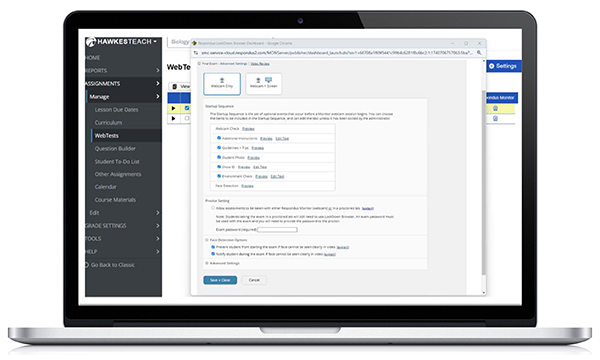
You’ve shared your feedback and we are listening! This platform update contains thoughtful enhancements to make your course easier to manage, strengthen the quality and flexibility of assessments, and support better outcomes for you and your students. Instructor Experience Directly Edit Lesson Scores You now have more control and flexibility. Adjust a student's lesson score directly on Detailed Student Grades or from the All Student Scores Report. Multiple student scores can be changed in bulk from the All Student Scores Report: see how. LMS Ease-of-Use Improvements We've refined the LMS integration with clear instructions for a more intuitive experience. Less friction, fewer clicks, more time for teaching! Deep Link UI Warning The right information at the right moment! You now see clear guidance within the deep linking tool with a reminder to return to the sync tool and complete assignment linking after creating deep links. Sync Tool Modal: Deep Link Setup Reminder You will now see a modal reminding you to create deep links before mapping assignments, with clear guidance. A “Don’t show this again” checkbox allows returning instructors to avoid the reminder in the future. Final Grade Tab Feature Flag To avoid confusion, the Final Grade tab option is now hidden inside a collapsed Advanced Settings accordion on the LMS Sync setup page. This is off by default for new instructors. Instructors who need the feature flag can expand Advanced Settings and enable it—no support call required. For Your Students New AI Literacy Lesson Equip your students with understanding and responsible use of Artificial Intelligence. Found in the Instructor Resources of every Hawkes Learning course, the AI Literacy for College Students: Thinking Critically, Ethically, and Creatively with AI lesson is highly relevant, student-centered information to help you prepare your students with tools and knowledge to boost their readiness for facing challenges in today’s academic and professional landscape. Student Onboarding Tutorial Quiz Help your students start off on the right foot with a short onboarding tutorial quiz that walks them through the platform before diving into coursework—reducing early confusion, saving you time, and setting students up for success from day one. Reach out to your Customer Success Representative to have this assignable video quiz added directly to your course! As always, if you have any questions or need assistance, please don’t hesitate to reach out to our Customer Success Team anytime at instructorsupport@hawkeslearning.com
![]()
July 23, 2026
You’ve shared your feedback and we are listening! This platform update contains...
Read More
Update (April 2026): After this post was published, the compliance deadline was extended to April 26, 2027—but our timeline hasn't changed. At Hawkes Learning we already conform to WCAG 2.1 AA guidelines, not because of a deadline, but because our students deserve an equitable experience now and always. We’ll continue to stay ahead and keep improving the experience for you and your students. To the Higher Education Community, The Hawkes Learning team has worked diligently to ensure accessibility compliance and our products have been improved on two fronts simultaneously: Broad platform enhancements that benefit all products A product-by-product review to ensure each title meets WCAG 2.1 AA standards This Isn’t New for Us Accessibility has been a priority at Hawkes Learning long before current compliance requirements. We design our products with students in mind, helping make your institution’s work easier every step of the way. What You Can Count on From Us The Hawkes Learning platform is on track to meet WCAG 2.1 AA conformance by April 24, 2026. Below are some specifics: Our core learning components (Learn screens, question banks, and PowerPoints) have each been individually addressed for accessibility within our Learn-Practice-Certify framework. Our company was founded by educators, and you can be confident we will continue working to provide the most equitable user experience possible. Hawkes is about making sure every student can engage with the material and learn without barriers. If your institution needs documentation for its own compliance review, we will provide a Voluntary Product Accessibility Template (VPAT). Our dedicated accessibility team is happy to answer questions about specific products. Please email accessibility@hawkeslearning.com. The Bigger Picture Accessibility compliance can feel like a lot to manage, especially when you’re juggling vendor conversations, internal reviews, and deadlines. Our goal is to be one less thing on that list. While April 24, 2026, is a milestone for the industry, it’s not a departure from how we’ve designed our products. As always, the Hawkes team is here to support you. Please reach out with any questions. Warm regards, Marcel Prevuznak VP, Research and Development FAQ What is WCAG 2.1 AA? Web Content Accessibility Guidelines, version 2.1, Level AA (WCAG 2.1 AA) is the internationally recognized standard for digital accessibility, developed by the World Wide Web Consortium (W3C). It defines how websites, software, and digital content should be designed so they are accessible to people with disabilities, including those with visual, auditory, motor, or cognitive impairments. Level AA is considered the practical benchmark for compliance and is the standard referenced in most legal and regulatory accessibility requirements — including those relevant to higher education institutions under the ADA and Section 508. Which Hawkes Learning products and components are being addressed? Short answer? All of them! Each of our core learning components are being individually reviewed and updated, including Learn screens, question banks, and PowerPoints within the Learn, Practice, Certify framework. Can my institution get documentation for its own compliance review? Absolutely. Hawkes Learning is happy to provide a Voluntary Product Accessibility Template (VPAT) upon request. For documentation or product-specific questions, contact the dedicated accessibility team at accessibility@hawkeslearning.com. What should I do if I have questions about a specific product's accessibility status? Reach out directly to the Hawkes Learning accessibility team at accessibility@hawkeslearning.com. They can answer questions about individual titles, provide VPATs, and support your institution's internal compliance review process.
![]()
March 30, 2026
Update (April 2026): After this post was published, the compliance deadline was...
Read More
Hawkes Learning, a leading provider of educational technology solutions, announces the launch of a new bilingual feature in AI Tutor, the secure, AI-driven tool designed to empower students by providing immediate, individualized support with contextualized responses, enhancing mastery and building confidence. With the addition of Spanish support in the tool, we are better able to reach more students by removing a language barrier and allowing students to focus on learning. Meeting More Students Where They Are The newly bilingual AI Tutor represents Hawkes Learning’s continued commitment to educational equity and its founding belief that with the right tools, every student can learn and succeed. This enhancement addresses a growing need in higher education by ensuring Spanish-speaking students have equitable access to personalized learning support, a population that represents: More than 41 million Americans who speak Spanish as their first language Nearly 18 percent of the total undergraduate population A demographic whose enrollment at colleges and universities has more than doubled in the past two decades, according to Pew Research Center Equitable, Empathetic, and Easy Students simply begin typing their question in Spanish and AI Tutor will automatically respond in the student’s language of choice. Built in a secure environment, AI Tutor provides peace of mind for instructors with guardrails around Hawkes’ trusted content, protection of user data, and prevention of shared answers. The tool understands the student experience and provides a supportive, personalized learning journey, guiding students toward mastery. “I liked how it provided the same resources as AI tutor in English, making it very inclusive for all learners! AI Tutor made me feel less alone in the stress in that there’s an outlet to help.” —Sharon Kariyev, Student at SUNY College at Old Westbury Supports More Students Hawkes Learning invites educators and students to explore how AI Tutor can transform the learning experience and drive student success. Since its original launch one year ago, AI Tutor has served more than 81,000 students and had more than 460,000 conversations. On average, 40 percent of students utilized the tutor multiple times, proving ongoing assistance. This innovative tool represents the future of education, providing a secure, inclusive, and student-centered approach to mastering course material in a technology-forward landscape. “At Hawkes Learning, we don’t just say that learning is for everyone; we are doing something about it,” said Scott Virkler, CEO of Hawkes Learning. “I’m thrilled to announce this bilingual feature to make learning much easier for such a large group of students. We truly believe all students deserve support, wherever they are in their learning journey.” For more information about this newly bilingual AI-powered learning tool and how it can enhance the learning experience, please visit www.hawkeslearning.com/aitutor.
![]()
October 27, 2025
Hawkes Learning, a leading provider of educational technology solutions,...
Read More
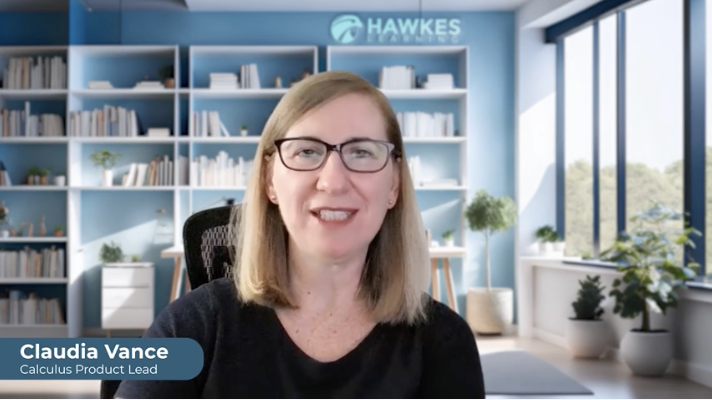
We’re excited to introduce Calculus with Early Transcendentals Plus Integrated Review courseware and eBook: a complete calculus course solution that supports student success without the need for separate remediation or additional materials. Flexibly designed for both corequisite and traditional courses, this title combines the full rigor of the calculus curriculum with strategically placed review chapters and powerful learning aids to meet each student where they are. Take a quick tour of the new Calculus with Early Transcendentals Plus Integrated Review with Calculus Product Lead, Claudia Vance! Highlights Include: Premade Diagnostics Assessments 2,800+ Total Courseware Questions 1,150+ Precalculus Courseware Questions 38 Precalculus Review Lessons & Videos New Chapter: Strategies for Academic Success Explore the Full Table of Contents Let’s Take a Closer Look at What’s Inside Premade Diagnostics Quickly assess student preparedness for curriculum-level content with pre-built diagnostic tests for each review chapter, plus a comprehensive test covering all review chapters. These assessment tools make it easy to identify gaps early and adjust instruction efficiently. 2,800+ Courseware Questions Support mastery through meaningful and plentiful practice. With more than 2,800 questions across difficulty levels—including over 1,150 dedicated to precalculus review—students can reinforce both foundational skills and core calculus concepts with immediate, guided feedback through Explain Error and AI Tutor. Precalculus Review Lessons & Videos Provide targeted, just-in-time review content right when it’s needed. These 38 short, focused lessons reinforce essential precalculus concepts with engaging lesson and example-level videos provide clear explanations and appeal to diverse student learning preferences. New Chapter: Strategies for Academic Success Give students the tools to thrive with a chapter dedicated to effective study skills, problem-solving strategies, and habits for lasting academic success. Chapter 0: Strategies for Academic Success 0.1 Understanding and Reducing Stress 0.2 Staying Organized 0.3 Managing Your Time Effectively 0.4 Reading a Textbook and Note-Taking 0.5 Using Effective Study Strategies 0.6 Reducing Test Anxiety
![]()
September 18, 2025
We’re excited to introduce Calculus with Early Transcendentals Plus Integrated...
Read More
We’re excited to announce the release of the 3rd Edition of Introductory & Intermediate Algebra, a high-quality combination title designed to support both corequisite models and two-course developmental algebra sequences. This new edition helps students build algebra skills for future math courses through active learning, practical examples, and real-world applications. Introductory & Intermediate Algebra, 3rd Edition Topics include: Real numbers Linear equations and inequalities Exponents and polynomials Quadratic equations Complex numbers Conic sections Sequences and series Students build conceptual understanding while engaging with skill-based and application-driven content. Explore the Full Table of Contents Let’s Take A Look At What’s New Expanded Practice & Assessment Questions To meet a wide range of learning styles and provide more opportunities for skill development, we’ve expanded both the courseware and textbook practice materials. In the Courseware: 1,400+ new questions 360 application-based 3,500+ total questions In the Textbook: 1,892 new exercises 909 new Concept Checks (Total: 925) 369 new Practice Exercises (Total: 5,468) 574 new Application Exercises (Total: 1,092) 38 new Writing & Thinking Exercises (Total: 195) 2 new Collaborative Learning Exercises (Total: 5) 7,685 total textbook exercises Completion Examples & Margin Exercises: Completion examples in the content guide students with partial solutions and an answer key at the end, while corresponding margin exercises for each example reinforce understanding through immediate practice. New & Updated Instructional Content This edition reflects feedback from instructors and students, with updates that promote academic success and more seamless instruction. Streamlined table of contents and a redesigned textbook with a modern layout improve content flow, readability, and the overall student experience. New chapter: Strategies for Academic Success Covers time management, test-taking strategies, note-taking, and stress reduction to help students thrive in any math course. New lesson: Least Common Multiple of Polynomials Updated examples and lesson content for modern relevance and improved clarity New and updated calculator instructions Real-World Connections & Application-Based Learning We’ve added new projects, exercises, and contextual content to help students see how algebra connects to everyday life. 26 ready-to-assign chapter projects (two per chapter) promote collaboration and connect math to hands-on, real-world scenarios. “Connections” chapter openers link key concepts to everyday experiences, building engagement from the start. Application-based exercises in both courseware and textbook create a cohesive learning experience that helps develop real-world problem-solving skills. Want a Closer Look? Request demo access to explore the student experience firsthand or get a free review copy of the 3rd edition textbook today!
![]()
September 9, 2025
We’re excited to announce the release of the 3rd Edition of Introductory &...
Read More
To our customers, team members, and everyone following the Hawkes journey. At Hawkes Learning, our commitment to a diverse workforce is a key tenet of our organization. We believe in a diverse workforce made up of the best employees possible that is not only a reflection of our core values – collaborative, service-oriented, adaptable, and innovative – but also a vital part of our continued success. We know true progress stems from the richness of different backgrounds, experiences, and perspectives. That is why we are dedicated to fostering a culture where everyone — regardless of race, ethnicity, gender, age, religion, sexual orientation, disability, socioeconomic background, or any identity—is welcomed, supported, and empowered to help make Hawkes Learning better. But this commitment is more than just words. We are actively taking action to ensure our company mirrors the diverse communities we serve and that everyone — from our employees to our customers — feels valued and respected. We believe that embracing diversity at every level helps us to understand and serve the needs of today’s evolving student population. We are continually evaluating our practices to promote equal opportunity and will continue working to create an environment where all can thrive. Thank you for being part of this journey. We are proud to have you with us. Sincerely, Scott Virkler Chief Executive Officer Hawkes Learning
![]()
May 1, 2025
To our customers, team members, and everyone following the Hawkes journey.
Read More
“The addition of AI Tutor in Hawkes Learning is an exciting step forward in building stronger supports for student learning!” – Professor Hunter Chandler, Bluegrass Community and Technical College Like Professor Chandler, I am extremely excited about Hawkes’ new learning tool, AI Tutor, and I want to share more information on how well the launch has gone. On October 1, 2024, Hawkes Learning proudly launched the AI Tutor—a groundbreaking tool designed to provide students with personalized, on-demand support 24/7. While we are still in the early days, it has already shown tremendous potential in establishing how students and instructors can leverage AI tools in a learning environment. Based on market feedback, we have the leading AI tool in use in higher education today. Built on Hawkes’ proven pedagogy and trusted content, AI Tutor meets students where they are, delivering real time assistance in a safe and supportive learning environment. Key Objectives AI Tutor was created with these core goals in mind: Support Where it’s Needed—When it’s Needed – Today’s students benefit from help exactly when they need it. AI Tutor is always available to supplement instructors and provide timely assistance. A Safe, Secure Learning Space – By combining Hawkes’ trusted content with advanced AI technology, AI Tutor delivers precise, reliable guidance in a safe, secure learning environment. Promoting Critical Thinking – Rather than providing quick answers, AI Tutor encourages students to engage deeply with their work by offering thoughtful, relevant hints and guiding them on where to begin. A Judgement-Free Space to Learn – Students can freely ask questions and explore concepts without fear of judgment, fostering confidence and curiosity in a supportive environment. AI Tutor converses empathetically, providing support even when learning becomes frustrating for the student. Designed with the Instructor in Mind – Instructor feedback played a crucial role in shaping AI Tutor, ensuring alignment with classroom teaching methods to seamlessly extend instructor reach. How We are Achieving This Hawkes Content: By integrating AI Tutor with our trusted, robust curriculum and legacy tutoring aids, students are given precise and actionable support. Hawkes Pedagogy: AI-powered support is designed to align with the proven teaching methods instructors rely on, ensuring a seamless and consistent classroom fit. Enhanced User Experience: We have prioritized simplicity and targeted prompts and focused responses to engage students and maximize learning outcomes. Early Results & Insights After nearly three months, we are thrilled with the results! While over 40% of our users have tried AI Tutor, daily usage stands at an impressive 15% of active users with steady engagement since launch. Feedback from both students and instructors has been overwhelmingly positive, highlighting AI Tutor’s ability to provide timely, accurate, and empathetic support while maintaining a non-judgmental, secure learning environment. “Hawkes’ new AI Tutor tool creates a safe space for me to ask questions I might hesitate to ask in a classroom setting for fear of being judged. It feels like I have a private tutor who allows me to explore the topics and learn at my own pace!” – Lauren Zafonte, student at Nassau Community College At the same time, we have identified valuable opportunities for growth. For example, some students prefer a more subtle approach for when AI Tutor steps in after periods of inactivity, and we’re eager to fine-tune this experience. Additionally, while the tool is performing well across disciplines, we are actively exploring ways to enhance mathematical explanations by incorporating alternative models and refining how the AI processes data. The Road Ahead We are just getting started—we can’t wait to expand on AI Tutor with innovative features like multilingual support, speech-to-text functionality, and self-diagnostic tools. These enhancements will enable us to reach even more students and provide an even richer learning experience. The early success of AI Tutor reinforces our belief in the transformative power of AI in education. By offering personalized, on-demand support in a safe and encouraging environment, we’re empowering students to unlock their full potential. Together, we are not just adapting to the future of learning—we are actively shaping it. Thank you for joining us on this journey!
![]()
January 8, 2025
“The addition of AI Tutor in Hawkes Learning is an exciting step forward in...
Read More
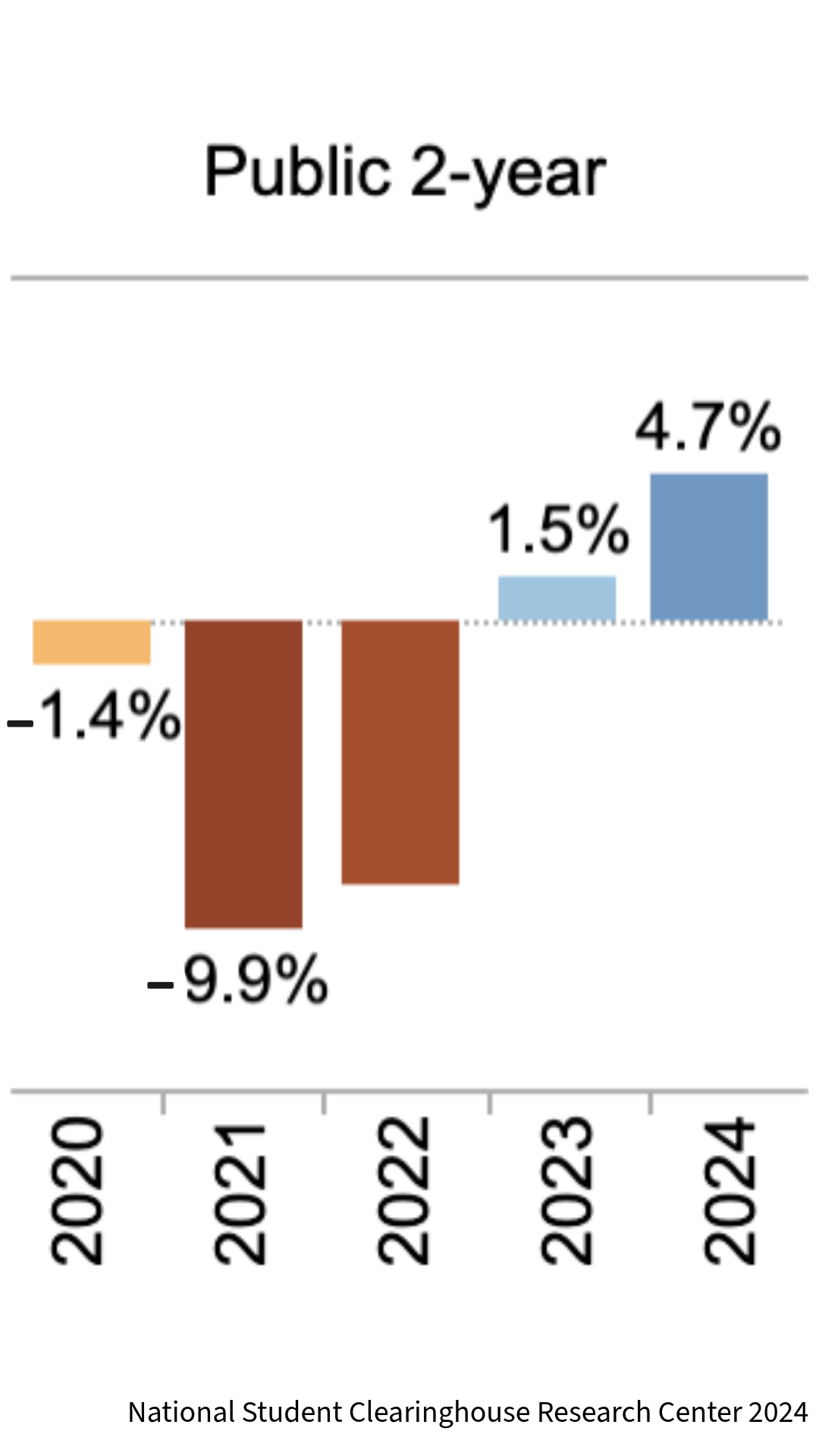
Dear Colleagues, Partners, and Friends, As we wind down the current academic year and prepare for the next, I find myself reflecting on my experiences this past year in the exciting world of EdTech, my first year as CEO at Hawkes Learning and the ever-evolving landscape of higher education. Join me in this open letter exploring the internal and external pressures significantly impacting both Hawkes Learning and the greater educational community. What a Year The world of higher education is arguably moving faster than ever before. Instructors are being asked to do more with less, while students are arriving less prepared and with shorter attention spans. New technology offers many opportunities, which come along with adjacent challenges. Remote learning is prevalent and here to stay, and while Artificial Intelligence holds promise for new learning methods, it also presents additional challenges in maintaining academic integrity. Schools are under pressure to lower costs and demonstrate their value amidst a politically charged environment. As a partner in higher education, it’s crucial that we fully understand these impacts and ensure we are positioned to help. Hawkes Learning is growing as we approach our 45th anniversary next month and our Mastery Learning approach becomes more widely understood and embraced. In an industry where success is often defined by maintaining the status quo year over year, we are growing by nearly 10% annually; I am immensely proud of our team and their efforts to make this happen. We continue to be a leading innovator in the field and remain focused on providing world-class service to our customers, easing the challenges faced by instructors in every way we can. Challenges in Higher Education Value of Higher Education The pressure on higher education to demonstrate its value in preparing students for a modern workforce has intensified, leading to the unfortunate closure of several smaller liberal arts colleges. This environment challenges us to continuously prove our worth and elevate our contributions to student success and career-focused skill-building. The good news on this front is enrollments for this past Spring were up 4.7% YOY for community colleges1. COVID-19 Impact We continue to see the adverse effects of the pandemic on learning for students entering college, particularly in foundational subjects. Hawkes’ courseware, with its powerful learning aids and mastery-based design, stands ready to address these gaps. However, college instructors face immense pressure to either bridge these gaps themselves or advance students prematurely, a practice that is ultimately unsustainable and detrimental to long-term student and societal success. At Hawkes Learning, our dedicated success team provides instructors with expert course implementation support and guidance that empowers them to create more supportive and efficient learning environments, ultimately enhancing student success and reducing stress for both educators and students. Increased Student Stress and Anxiety According to a 2023 Campus Pulse2 survey by Inside Higher Ed, 3 out of 4 students report that stress negatively impacts their academic focus and performance, and 76% of faculty feel that supporting students’ mental health is a job expectation. In a survey Hawkes conducted with faculty this past May, 87% of instructors surveyed felt under-equipped to navigate conversations with students needing support on topics outside of academic content. Additionally, 58% of instructors reported having insufficient mental health resources available at their institution. To help support this need, Hawkes Learning partnered with a group of passionate instructors during Mental Health Awareness Month to offer a free webinar series, aimed at equipping educators with the knowledge and strategies necessary to nurture wellness in the higher education classroom. This well-received series continues to prove valuable, with many people watching the recorded event to gain insights. Cost Initiatives and Financial Pressures Universities are striving to reduce the cost of course materials amidst rising operational expenses. While Inclusive Access programs adopted by many institutions and publishers, including Hawkes Learning, have been a lifeline for bookstore operators, they often do not translate into savings for students. Hawkes Learning is committed to providing truly affordable learning solutions beyond just Inclusive Access and is actively taking steps to lower our course creation costs, passing those savings on to students. For example, in some courses we leverage OER content as a starting point for new materials, then edit, supplement, and enhance it with robust digital learning tools, keeping student prices much lower. Additionally, to enhance our non-math offerings, we’ve launched StudyText, a cost-effective eReader priced at $36 or less for students. This new eReader is expected to significantly boost accessibility and student engagement, promoting both financial and educational sustainability. AI in Education While AI is clearly at the top of the hype cycle, the reality is the growth of AI use by students presents both challenges and opportunities. We see AI as another learning tool for us to collectively use, much like we did as one of the first innovators using adaptive technology and automated just-in-time tutoring. We are committed to leveraging AI to enhance learning while upholding high standards of academic integrity. Internal Developments at Hawkes Learning Team Growth We have welcomed five new veteran industry executives to our team over the past year and hired 20 new employees in total. We are focused on bringing in good people who are committed to working in education. We also believe in the importance of individual growth within our team, so we are providing opportunities for them to develop both professionally and personally. Innovative Educators Summit (IES) We believe that when instructors connect and collaborate, everyone benefits—especially students. That’s why we’ve made it our mission to foster a vibrant network of educators. For over ten years, the Innovative Educators Summit (IES) hosted by Hawkes Learning has been bringing instructors together to share insights, ignite ideas, and build a community of passionate educators. This spring, we had over 2,400 instructors attend the virtual Innovative Educators Summit; following up on that success, we’re excited to host a Fall IES, happening October 10th and 11th! While we will have several themes at this IES, one of major interest will focus on AI in the classroom. Mark your calendars, as this upcoming Summit will be our best yet. AI-Enhanced Tutoring Inside Higher Ed reports that student use of AI is outpacing its use by instructors3. We are piloting the use of AI to expand on our existing just-in-time tutoring help for students, ensuring they receive the support they need to succeed, exactly when they need it. We have been testing AI tools for content creation and assessment generation, but they are not up to our standard at this point. For example, while simply creating assessments is easy, validating them is an entirely different and complex process that requires a human touch. As AI continues to advance, we are committed to finding innovative ways for instructors to leverage its capabilities to enhance engagement and drive student success. Improved Instructor User Interface Over the next year, we will be rolling out a new User Interface for the instructor platform. We are excited about improving the user experience by incorporating valuable feedback from our customers and implementing ways to make course setup and management more streamlined and effective. Customer Support and Service Our focus on providing world-class customer support and service remains unwavering. All companies tout their service and support, but we live it. Our four-ring policy underscores our dedication to live support. While others continue to reduce support staff and hours to cut costs, we maintain 24/7 Live Chat for both students and instructors, achieving a 99.5% chat satisfaction rating by the end of the academic year in June! A Bright Future in Education It is an exciting time to be part of the education ecosystem. Rapid changes create opportunities for companies like Hawkes Learning to innovate and excel. We are ready to rise to these challenges and will continue to make a meaningful impact on education. My team and I are committed to providing the best learning experience possible for both students and instructors. While we can’t solve all the challenges facing educators, we can ensure we are doing our best in the areas we can impact. This means providing a cost-effective, reliable, and secure platform with easy course setup and management capabilities. Moving forward, we will continue to leverage the latest technologies, like AI and robust LMS integrations, and offer penalty-free online learning approaches to reduce student stress and anxiety. Your students can get immediate help and chat with a real person 24/7. And lastly, if you need help, just call us—we will answer the phone. We are devoted to working with the best instructors and institutions in the world to help students thrive on their learning journey. Thank you for your continued support and partnership. Sincerely, G. Scott Virkler CEO, Hawkes Learning https://nscresearchcenter.org/current-term-enrollment-estimates/#:~:text=Current%20Term%20Enrollment%20Estimates%3A%20Spring%202024&text=Gains%20occurred%20across%20all%20major,4.7%25%20over%20spring%20202 ↩︎ https://www.insidehighered.com/news/student-success/health-wellness/2023/05/23/survey-stress-hurting-college-students ↩︎ https://www.insidehighered.com/news/tech-innovation/artificial-intelligence/2023/10/31/most-students-outrunning-faculty-ai-use ↩︎
![]()
August 14, 2024
Dear Colleagues, Partners, and Friends,
Read More
Hawkes Learning, a pioneering educational technology provider, is pleased to announce the appointment of Kuljit Dharni as its new Chief Technology Officer (CTO), effective July 23, 2024. This strategic appointment reinforces Hawkes Learning’s position as a market leader in adaptive courseware and signals the company’s commitment to accelerating growth and innovation in the competitive EdTech landscape. With over 25 years of technology and leadership experience, Dharni has a proven track record of driving data-informed innovation and digital transformation across the education sector, spanning both EdTech companies and higher education institutions. Dharni has significant experience with major industry players, including leadership roles at Ellucian and McGraw Hill Education. Throughout his career, Dharni has held technology leadership roles, spearheading digital change at Harvard University and most recently as the CTO at Babson College. “Hawkes was founded on the key pillars of service, innovation, and pushing the boundaries of what is possible in EdTech. Kuljit’s extensive experience and future-focused approach align seamlessly with this continued vision, ensuring we remain at the forefront of educational innovation. We are growing rapidly in a space filled with old, tired print publishers who are struggling to remain relevant. Adding a digital leader like Kuljit to our team sets us up for even faster growth.” – Scott Virkler, CEO of Hawkes Learning Dharni’s appointment comes at a pivotal moment for Hawkes Learning and the educational technology sector, which is experiencing rapid advancements in personalized learning, AI-driven analytics, and cloud-based solutions. The global education technology market, estimated at USD 142.37 billion in 2023, is projected to grow at a compound annual growth rate (CAGR) of 13.4% from 2024 to 2030 (Source: Grand View Research, 2023). In this expanding landscape, Dharni’s expertise will play a crucial role in accelerating growth at Hawkes Learning. “I’m excited to build on the existing infrastructure at Hawkes to harness the transformative power of technology. I thrive on being able to directly improve learning solutions and being close to the customer.” – Kuljit Dharni As Hawkes Learning continues to advance its mastery-based software and integrates AI into the learning process, Dharni’s leadership will be instrumental in optimizing learning support and improving course outcomes for hundreds of thousands of higher education students annually. His strategic vision, coupled with the company’s commitment to remaining at the forefront of educational innovation, positions Hawkes Learning to deliver cutting-edge solutions in an ever-evolving digital landscape. About Hawkes Learning Partnering with the higher education community since 1979, Hawkes Learning has harnessed the transformative potential of technology to provide reliable course materials and exemplary service in the shared pursuit of student success. By combining student-centered innovation with AI-based tutoring and a proven, mastery learning approach, Hawkes cultivates an effective learning experience for students while simultaneously supporting educators. For more information, please visit www.hawkeslearning.com.
![]()
July 30, 2024
Hawkes Learning, a pioneering educational technology provider, is pleased to...
Read More
You and your students are our top priority. We’re committed to providing you with a positive experience with Hawkes, starting from the moment you begin exploring our materials to the time you’re submitting final grades for the term! No-Wait Support We take pride in our family-style service provided by knowledgeable Hawkes employees. Nobody likes waiting on hold or going through five-minute long automated prompts to speak with someone on the phone, so at Hawkes we take a different approach. Instead, both you and your students receive one number—1-800-426-9538—so you can reach us directly. When you call us between 8 a.m. and 9 p.m. Monday–Friday, you chat with our friendly technical support team within just a few rings and a single-question menu. Robert Bennett, a professor at Oklahoma State University Institute of Technology, claimed, “Hawkes customer service is the best I have used… Students can get immediate help when needed.” We respect your time. You shouldn’t have to spend hours trying to figure out how to set up your online grading system without any help, and you shouldn’t have to worry that no one is within reach if technical questions arise in the middle of class. Jane Kessler, a former instructor at Quinnipiac University, shared, “I am of the generation where my grandkids know more about the computer than me, so I need a system that will be supportive of me. I have that Support in Hawkes.” Giving you peace of mind when it comes to working with technology is worth a lot to us. Working on the weekend or at midnight during the week? We still have you covered with 24/7 live chat. Students and instructors can instantly start a live chat support session to get the help they need right away. Customer Success Specialists We believe in driving student success through service and innovation. When you join the Hawkes family, your school is assigned a dedicated Customer Success Specialist who works with you before, during, and after each term to learn about your course goals and help you use the Hawkes system to achieve them. Your direct point of contact at Hawkes helps you with setting up your online instructor materials and exploring the student courseware, providing free and unlimited training when you need it. Whether you’re a first-time user or a Hawkes expert looking for some new tips, your Customer Success Specialist is happy to share their knowledge. Seminole State College professor, Emily Carpenter, affirmed, “I appreciate how the professional development [training] they provide for instructors seems to be very timely. It’s like Hawkes has the pulse of education and knows what instructors need.” We aim to deliver the best experience you’ve had working with a publisher – or anyone! Instructors inform us we succeed in this endeavor, like our friend Stephen Whited at Piedmont University who said, “Hawkes’ Support is excellent… Hawkes Support consistently shows courtesy and friendliness.” We won’t rest on our laurels, though; we’ll keep striving for perfection.
![]()
December 19, 2023
You and your students are our top priority. We’re committed to providing you...
Read More
Explore an application-driven approach to core sociological concepts with the NEW Introduction to Sociology textbook, e-book & software! With straightforward, approachable language, this introductory-level course summarizes key topics and explores them through the lenses of major theoretical perspectives while fostering data literacy, critical thinking, and self-awareness. Students gain a balanced, thoughtful approach to understanding the impactful ways that individuals and society shape one another with this easy-to-follow curriculum. Foster Lasting Knowledge with Textbook Features Including: Real-World Applications Relevant examples and scenarios including social issues like racial justice, COVID-19, feminism, LGBTQ+ rights, climate change, and politics encourage students to use their sociological imaginations to find connections to their own experiences and the world around them. These applications are at the heart of the textbook. Further Resources Different students have different learning styles. The additional resource links are highlighted throughout each chapter to help students connect concepts to outside sources ranging from TED Talks to contemporary data & studies. Dig Deeper Sidebars in the textbook contextualize complex topics to deepen understanding through a further examination of related ideas and real-life scenarios. Interactive Exercises and Activities Reflection Questions, Chapter Projects, On Your Own Activities, & Group Activities prompt students to apply lessons in real-time. Through these interactive activities and open-ended exercises, they make connections and develop their sociological imagination. Want a complimentary examination copy? Request one today by emailing info@hawkeslearning.com! Questions? Contact us.
![]()
Learn how to use Hawkes’ instructor slides alongside your lesson content to create a more impactful, comprehensive learning experience. About the Presenter Dr. Herbert Baum has a Ph.D. in Population Dynamics from the Johns Hopkins School of Public Health. He has a 35 year career as a statistician/evaluator analyzing data from federal, state and local programs. Dr. Baum’s focus was on health and education data/programs. Since 2018, he has been teaching Elementary Statistics at Guilford College.
![]()
March 10, 2022
Learn how to use Hawkes’ instructor slides alongside your lesson content to...
Read More
As more courses migrate to online and hybrid deliveries, it is difficult to ascertain which elements could be useful in successful online delivery models. Having been both an online student and an online professor, Dr. Stephanie Schaefer has analyzed & researched which key components should be a part of every online design model to reduce cognitive overload and increase student engagement. About the Author: Dr. Stephanie Schaefer has over a decade of experience teaching in K-12 and community college settings. She is currently teaching in the capstone course in the Master’s of Online Education program at Southern New Hampshire, including courses in STEM education and guiding doctoral candidates at the American College of Education, and teaching students writing at SUNY Broome. She is particularly interested in how content is represented through multiple means of representation and how to help diverse student populations navigate online courseware more successfully.
![]()
February 9, 2022
As more courses migrate to online and hybrid deliveries, it is difficult to...
Read More
Presentation Resources Start your 2022 semester off right! In this webinar by instructor Becki Streett of the University of Arkansas at Little Rock, she will walk through an example of an interactive virtual classroom that can accommodate several scenarios such as hybrid classes, in-person classes that quickly need to go virtual, and individual students needing to go virtual. Professor Streett will share her virtual classroom template for you to use as a base for your own courses and share her resources & tips for creating your own space. About the Authors: Becki Streett is a Senior Mathematics Instructor and the Coordinator of Developmental Mathematics at University of Arkansas at Little Rock. With nearly 30 years of experience teaching mathematics, she advocates for approaching math courses “like a camp counselor,” connecting students through discussion and collaboration in a safe environment where everyone can be heard.
![]()
January 6, 2022
Presentation Resources Start your 2022 semester off right! In this webinar by...
Read More
The Hawkes Grade Book is a vast and wondrous space! Depending on your setup, you may have several instructors, administrators, and helpers needing access to this space. You don’t want others using your account, and you may not need to let others access certain reports and tools in the Grade Book. Fortunately, we have Grade Book Permissions, a feature that lets you designate which roles individuals have in the Grade Book for a more streamlined experience. User Roles Course Administrators can choose from five roles when adding a new user to the Grade Book. The five roles are the following: Course Administrator: Able to change all users’ settings. Instructor: Able to change section settings. Teaching Assistant: Able to view/edit grades and attendance. Update: TA’s can create and assign WebTests, too. View-Only: Able to view grades and attendance. Update: These users can directly access Assignment Reviewer from the All Student Grades and Detailed Student Grades reports. Attendance Taker: Able to view/edit attendance. The Teaching Assistant, View-Only, and Attendance Taker permissions can also be customized. New Users Add a new user by selecting the Tools tab and Manage Instructors/Sections. Choose Add New Instructor and enter the user’s information. When adding the user, select the role from the drop-down menu. Course Administrators and Instructors The Course Administrator and instructor roles have not changed. Course Administrators have access to all user accounts, while instructors have access to only their account. After selecting either of these roles, select Next and enter all information needed for the user’s section. With permissions, you now have the option to Share this section with other instructors. Selecting this option will add this section to a list to share with other users. After entering the section information, select Next and either Add Another Section for that user or select Finish. Teaching Assistants, View-Only, and Attendance Takers These three user roles have limited grade book privileges. Select the role from the drop-down menu and select Next. You will not be prompted to create a section, but rather choose which sections you want the user to have access to. Once you’ve selected the section(s) to which you want to grant access, select Next and Finish on the next screen. Share Sections Course Administrators can adjust which sections Instructors, Teaching Assistants, View-Only, and Attendance Takers can access. Select the Tools tab, Manage Instructors/Sections, and choose the name of the user. To grant access to sections, select Share Section(s) at the top of the page. A new menu will display to choose the section(s) to which you would like to grant access. Select the section(s) and select Finish. To stop sharing sections with a user, select the section(s) and select Unshare Section(s) at the top. This will remove the user’s ability to access those sections. If you would like to view the specific privileges for the Teaching Assistant, View-Only, or Attendance Taker roles, select the icon under the Permissions column on the Instructor List page. You can edit these three roles to completely remove access for any area in the Grade Book. Questions? Contact your Training & Support Specialist any time at training@hawkeslearning.com.
![]()
December 9, 2021
The Hawkes Grade Book is a vast and wondrous space! Depending on your setup,...
Read More
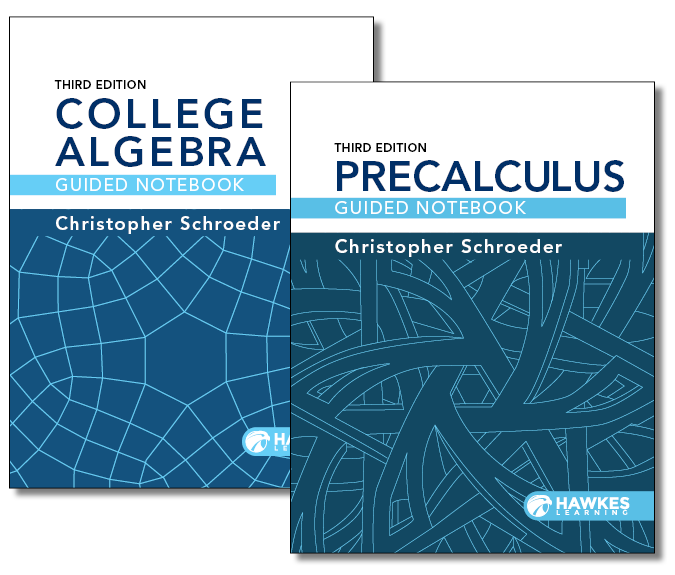
Written by Dr. Chris Schroeder of Morehead State University, the third editions of the Precalculus Guided Notebook & College Algebra Guided Notebook provide tangible, pencil-to-paper resources to supplement in-person, hybrid, or online learning environments. View sample: Precalculus Guided Notebook View sample: College Algebra Guided Notebook These guided notebooks ensure accountability to course content, prompting students to actively follow along with the respective courseware’s instructional Learn mode and apply knowledge as they go. Additionally, use these resources as scaffolded learning tools to help students develop organizational and note-taking skills & build a solid foundation for future courses: Transcribe key definitions & concepts Additional problem-solving practice Build note-taking skills By the time students are ready to apply the concepts from Learn mode to answer questions, they have the major concepts of each section written down, as well as several worked-out problems to reference as they move through Certify. As test time approaches, these notes become a useful study aid covering key course material. Want a complimentary examination copy? Request one today by emailing info@hawkeslearning.com! Questions? Contact us.
![]()
March 11, 2021
Written by Dr. Chris Schroeder of Morehead State University, the third editions...
Read More
The Viewing Life Mathematically software has 57 new questions available in Chapter 8: Statistics. With multiple iterations for each, these algorithmically generated questions provide 2,765 options for practice and assessment. 8.1: Collecting Data 8.2: Displaying Data 8.3: Describing and Analyzing Data Examples range in level of difficulty and mimic real-world data. Several allow students to create their own graphs, and many involve frequency tables, histograms, pie charts, and line graphs. Consider an example from Lesson 8.2: 21-B Book Street Books sells about 5,400 books each month. The pie chart displays the most popular book categories, by percentage, each month. Find the number of romance books sold each month. Round your answer to the nearest integer. View examples of new questions. How to add these new questions to your assignments: These questions will automatically be added to assignments if you are using the Hawkes Default Curriculum. If you have a customized curriculum, add these new questions to Certify assignments in Curriculum or your online WebTests. To add these questions to a custom Curriculum: In the Grade Book, select Assignments Tab > Curriculum. Name the curriculum template and select Save Changes. Select any Lesson Name in the right column. New questions will display in the left column without the ‘In Use’ designation. Select the Add button to include questions. To add these questions to a current WebTest: In the Grade Book, select Assignments Tab > WebTest. Select the Manage tab, then select the test name and Copy button. Select the Edit icon to the left of the copy of the Test. Select a Chapter then Lesson from the left column. New questions will display in the left column without the ‘In Use’ designation. Select the Add button to include questions. If you have questions, contact your Training & Support Specialist at 1-800-426-9538 or training@hawkeslearning.com.
![]()
January 24, 2020
The Viewing Life Mathematically software has 57 new questions available in...
Read More
The Hawkes Grade Book got a light makeover! It retained all of its previous functionality, and all reports, settings, templates, and tools remain in their current locations. Each tab in the Grade Book now has a sleek new look: Wondering what each button does? Just hover over it with your mouse to get a description: Please note that once you select an option in the Grade Book’s new look, the next page is the same as before, since this is just the first step in our larger-scale plans for exciting improvements. Have questions about the new changes? Contact your Training & Support Specialist at 1-800-426-9538 or training@hawkeslearning.com.
![]()
June 3, 2019
The Hawkes Grade Book got a light makeover! It retained all of its previous...
Read More
Earlier this month, Hawkes Learning joined other South Carolina businesses at Columbia’s Metropolitan Convention Center to celebrate being one of South Carolina’s Best Places to Work! The statewide program—managed by Best Companies Group—identifies, recognizes, and honors the best employers in the state of South Carolina for benefiting the state’s economy, workforce, and businesses. Only 70 businesses in South Carolina received this distinguished award for 2017, so we are very grateful we are counted among those organizations! “I love working at Hawkes because my coworkers are the best,” says Educational Courseware Specialist Taylor. We tend to agree. All of us at Hawkes appreciate the honor!
![]()
August 31, 2018
Earlier this month, Hawkes Learning joined other South Carolina businesses at...
Read More
Do your students think good grammar is important? They might after reading these stats: Passed over for promotions: A study found that employees who didn’t get promoted to director-level positions within 10 years made 2.5 times as many grammatical mistakes as the individuals who did achieve such positions. (Learn more.) Love lost: The online dating site Zoosk polled 9,000 users, and 48% consider bad grammar to be a deal breaker. (Learn more.) Develop critical grammar skills of your English students with the new Foundations of English Grammar Workbook. Activities, reading passages, and sentence-analysis questions build a strong understanding of topics that range from correcting run-on sentences to spelling commonly confused words. (Affect vs. effect, anyone?) Written by instructors, the workbook is an excellent resource to complement in-class activities and online lessons available in Foundations of English. It can also be used as a standalone resource. View a sample of the Foundations of English Grammar Workbook. Key Features Editing applications ask students to annotate short passages and apply editing skills to writing samples. Comprehensive source of practice and application gives students additional help with grammar, punctuation, and mechanics. Topics include grammar, punctuation, mechanics, spelling, syntax, and diction. Exercises include multiple choice, matching lists, true/false, fill-in-the-blank prompts, and more. Pssst! Looking for a grammar handbook? Check out the Reading & Writing Handbook for the College Student , a resource that covers not only grammar but writing, research, critical thinking, and style as well. This pocket-sized guide helps students in all disciplines achieve stronger English skills. If you’re an English instructor interested in seeing more, request a complimentary examination copy today or call us at 1-800-426-9538.
![]()
March 1, 2018
Do your students think good grammar is important? They might after reading...
Read More
This new edition offers more robust exercise sets that include conceptual assessment, an increased focus on real-world application, new lessons on study skills to develop the academic mindset of mathematics learners, chapter projects and collaborative opportunities for discovery-based learning with peers, and additional content to cover all topics through intermediate algebra. View a free sample of the new edition of Developmental Mathematics. Request an examination copy. NEW features include: Strategies for Academic Success – study skills and learning strategies build stronger learners with tips on note taking, time management, test taking, and more Chapter Projects – discovery-based projects promote collaboration and practical applications of mathematics Concept Checks – exercise sets assess students’ conceptual understanding of topics before each practice set Applications – exercise sets for each section challenge students to apply topics learned to real-world contexts Extra Material – more advanced topics cover all learning outcomes to prepare students for future college math courses Writing & Thinking – opportunities for students to independently explore and expand on chapter concepts Table of Contents: Chapter 0: Strategies for Academic Success How to Read a Math Textbook Tips for Success in a Math Course Tips for Improving Math Test Scores Practice, Patience, and Persistence! Note Taking Do I Need a Math Tutor? Tips for Improving Your Memory Overcoming Anxiety Online Resources Preparing for a Final Math Exam Managing Your Time Effectively 1. Whole Numbers Introduction to Whole Numbers Addition and Subtraction with Whole Numbers Multiplication with Whole Numbers Division with Whole Numbers Rounding and Estimating with Whole Numbers Problem Solving with Whole Numbers Exponents and Order of Operations Tests for Divisibility Prime Numbers and Prime Factorizations 2. Fractions and Mixed Numbers Introduction to Fractions and Mixed Numbers Multiplication with Fractions Division with Fractions Multiplication and Division with Mixed Numbers Least Common Multiple (LCM) Addition and Subtraction with Fractions Addition and Subtraction with Mixed Numbers Comparisons and Order of Operations with Fractions 3. Decimal Numbers Introduction to Decimal Numbers Addition and Subtraction with Decimal Numbers Multiplication with Decimal Numbers Division with Decimal Numbers Estimating and Order of Operations with Decimal Numbers Decimal Numbers and Fractions 4. Ratios, Proportions, and Percents Ratios and Unit Rates Proportions Decimals and Percents Fractions and Percents Solving Percent Problems Using Proportions Solving Percent Problems Using Equations Applications of Percent Simple and Compound Interest 5. Measurements US Measurements The Metric System: Length and Area The Metric System: Capacity and Weight US and Metric Equivalents 6. Geometry Angles and Triangles Perimeter Area Circles Volume and Surface Area Similar and Congruent Triangles Square Roots and the Pythagorean Theorem 7. Statistics, Graphs, and Probability Statistics: Mean, Median, Mode, and Range Reading Graphs Constructing Graphs from a Database Probability 8. Introduction to Algebra The Real Number Line and Absolute Value Addition with Real Numbers Subtraction with Real Numbers Multiplication and Division with Real Numbers Order of Operations with Real Numbers Properties of Real Numbers Simplifying and Evaluating Algebraic Expressions Translating English Phrases and Algebraic Expressions 9. Solving Linear Equations and Inequalities Solving Linear Equations: x + b = c Solving Linear Equations: ax = c Solving Linear Equations: ax + b = c Solving Linear Equations: ax + b = cx + d Working with Formulas Applications: Number Problems and Consecutive Integers Applications: Distance-Rate-Time, Interest, Average Solving Linear Inequalities in One Variable Compound Inequalities Absolute Value Equations Absolute Value Inequalities 10. Graphing Linear Equations and Inequalities The Cartesian Coordinate System Graphing Linear Equations in Two Variables Slope-Intercept Form Point-Slope Form Introduction to Functions and Function Notation Graphing Linear Inequalities in Two Variables 11. Systems of Linear Equations Systems of Linear Equations: Solutions by Graphing Systems of Linear Equations: Solutions by Substitution Systems of Linear Equations: Solutions by Addition Applications: Distance-Rate-Time, Number Problems, Amounts, and Costs Applications: Interest and Mixture Systems of Linear Equations: Three Variables Matrices and Gaussian Elimination Systems of Linear Inequalities 12. Exponents and Polynomials Rules for Exponents Power Rules for Exponents Applications: Scientific Notation Introduction to Polynomials Addition and Subtraction with Polynomials Multiplication with Polynomials Special Products of Binomials Division with Polynomials Synthetic Division and the Remainder Theorem 13. Factoring Polynomials Greatest Common Factor (GCF) and Factoring by Grouping Factoring Trinomials: x^2+bx+c Factoring Trinomials ax^2+bx+c Special Factoring Techniques Review of Factoring Techniques Solving Quadratic Equations by Factoring Applications: Quadratic Equations 14. Rational Expressions Introduction to Rational Expressions Multiplication and Division with Rational Expressions Least Common Multiple of Polynomials Addition and Subtraction with Rational Expressions Simplifying Complex Fractions Solving Rational Equations Applications: Rational Expressions Applications: Variation 15. Roots, Radicals, and Complex Numbers Evaluating Radicals Rational Exponents Simplifying Radicals Addition, Subtraction, and Multiplication with Radicals Rationalizing Denominators Solving Radical Equations Functions with Radicals Introduction to Complex Numbers Multiplication and Division with Complex Numbers 16. Quadratic Equations Quadratic Equations: The Square Root Method Quadratic Equations: Completing the Square Quadratic Equations: The Quadratic Formula More Applications of Quadratic Equations Equations in Quadratic Form Graphing Quadratic Functions More on Graphing Functions and Applications Solving Polynomial and Rational Inequalities 17. Exponential and Logarithmic Functions Algebra of Functions Composition of Functions and Inverse Functions Exponential Functions Logarithmic Functions Properties of Logarithms Common Logarithms and Natural Logarithms Logarithmic and Exponential Equations and Change-of-Base Applications: Exponential and Logarithmic Functions 18. Conic Sections Translations and Reflections Parabolas as Conics Distance Formula, Midpoint Formula, and Circles Ellipses and Hyperbolas Nonlinear Systems of Equations Request an examination copy. Want to learn more? Contact us at sales@hawkeslearning.com!
![]()
January 15, 2018
This new edition offers more robust exercise sets that include conceptual...
Read More
We’re proud to announce the new edition of Discovering Statistics and Data! This new edition pays homage to modern day’s technology-driven data explosion, helping students understand the context behind future statistical concepts to be learned and explaining why the study of statistics is critical. View a free sample of the new edition of Discovering Statistics and Data. The text opens by describing the necessity of understanding the data around us, introducing students to what data is, how we measure it, where it comes from, how to visualize it, and what kinds of career opportunities surround its analysis and processing. This focus makes upcoming content more meaningful for students and then challenges them to think with statistics. Request an examination copy. NEW features include: Greater focus on data – Introductory chapters place a strong emphasis on helping students understand where data comes from, data visualization techniques, “Big Data,” and the problems arising from having large data sets. Downloadable data sets – More real data sets are available for download, including over 15 large data sets and one giant data set. More technology integration – Detailed instruction using graphing calculators, Excel, Minitab, and R Statistical language are included. Real-world applications – Larger scale chapter projects challenge students and brief, relatable articles engage readers. Expanded exercises and examples – Over 60 examples and 200 exercises, including new conceptual questions, have been added. Pedagogy modernization – GAISE guidelines were carefully considered and incorporated, and the most current P-value significance testing recommendations published by the ASA for guidance on hypothesis testing are included. Virtual simulations and games – Students develop conceptual understanding and statistical literacy through hands-on interactives and simulations. Table of Contents: 1. Statistics and Problem Solving The Meaning of Data Statistics as a Career The Data Explosion Modern Computing, Networks, and Statistics Big Data Introduction to Statistical Thinking Descriptive vs. Inferential Statistics The Consequences of Statistical Illiteracy 2. Data, Reality, and Problem Solving Collecting Data Data Classification Time Series Data vs. Cross-Sectional Data Data Resources 3. Visualizing Data Frequency Distributions Displaying Qualitative Data Graphically Constructing Frequency Distributions for Quantitative Data Histograms and Other Graphical Displays of Quantitative Data Analyzing Graphs 4. Describing and Summarizing Data from One Variable Measures of Location Measures of Dispersion Measures of Relative Position, Box Plots, and Outliers Data Subsetting Analyzing Grouped Data Proportions and Percentages 5. Discovering Relationships Scatterplots and Correlation Fitting a Linear Model Evaluating the Fit of a Linear Model Fitting a Linear Time Trend Scatterplots for More Than Two Variables 6. Probability, Randomness, and Uncertainty Introduction to Probability Addition Rules for Probability Multiplication Rules for Probability Combinations and Permutations Combining Probability and Counting Techniques Bayes’ Theorem 7. Discrete Probability Distributions Types of Random Variables Discrete Random Variables The Discrete Uniform Distribution The Binomial Distribution The Poisson Distribution The Hypergeometric Distribution 8. Continuous Probability Distributions The Uniform Distribution The Normal Distribution The Standard Normal Distribution Applications of the Normal Distribution Assessing Normality Approximations to Other Distributions 9. Samples and Sampling Distributions Random Samples and Sampling Distributions The Distribution of the Sample Mean and the Central Limit Theorem The Distribution of the Sample Proportion Other Forms of Sampling 10. Estimation: Single Samples Point Estimation of the Population Mean Interval Estimation of the Population Mean Estimating the Population Proportion Estimating the Population Standard Deviation or Variance Confidence Intervals Based on Resampling (Bootstrapping) (Courseware only) 11. Hypothesis Testing: Single Samples Introduction to Hypothesis Testing Testing a Hypothesis about a Population Mean The Relationship between Confidence Interval Estimation and Hypothesis Testing Testing a Hypothesis about a Population Proportion Testing a Hypothesis about a Population Standard Deviation or Variance Practical Significance vs. Statistical Significance 12. Inferences about Two Samples Inference about Two Means: Independent Samples Inference about Two Means: Dependent Samples (Paired Difference) Inference about Two Population Proportions Inference about Two Population Standard Deviations or Variances 13. Regression, Inference, and Model Building Assumptions of the Simple Linear Model Inference Concerning β1 Inference Concerning the Model’s Prediction 14. Multiple Regression The Multiple Regression Model The Coefficient of Determination and Adjusted R2 Interpreting the Coefficients of the Multiple Regression Model Inference Concerning the Multiple Regression Model and its Coefficients Inference Concerning the Model’s Prediction Multiple Regression Models with Qualitative Independent Variables 15. Analysis of Variance (ANOVA) One-Way ANOVA Two-Way ANOVA: The Randomized Block Design Two-Way ANOVA: The Factorial Design 16. Looking for Relationships in Qualitative Data The Chi-Square Distribution The Chi-Square Test for Goodness of Fit The Chi-Square Test for Association 17. Nonparametric Tests The Sign Test The Wilcoxon Signed-Rank Test The Wilcoxon Rank-Sum Test The Rank Correlation Test The Runs Test for Randomness The Kruskal-Wallis Test 18. Statistical Process Control (Courseware only) Request an examination copy. Want to know more? Contact us at sales@hawkeslearning.com!
![]()
January 15, 2018
We’re proud to announce the new edition of Discovering Statistics and Data!
Read More
Save class time and identify individual areas of weakness for remediation with Hawkes Learning’s free grammar diagnostic test! Click through a demonstration of the test at your own pace. This 50-question assessment identifies areas of proficiency and specific knowledge gaps for individual students. A customized curriculum is developed for each student to strengthen their grammar skills and eliminate those errors from their writing. The tailored learning path through the grammar curriculum provides students the opportunity to learn, practice, and then master each topic. Let Hawkes assist you in ensuring these skills become second nature for your students, helping them become more effective communicators of their ideas. While diagnostic tests are pre-created to save you time for both Hawkes Learning’s Foundations of English and English Composition courses, you can also customize either by removing or adding questions based on your own lesson objectives. As you click through the demonstration here, you’ll see how students access their assessment, answer questions, and receive a performance breakdown of each topic covered in the test. Want to see more? Contact your Hawkes courseware specialist at 1-800-426-9538 or sales@hawkeslearning.com today!
![]()
November 16, 2017
Save class time and identify individual areas of weakness for remediation with...
Read More
Jeff Humphrey is a lead instructor and professor in developmental math education at Wake Technical Community College (Raleigh, NC), where he’s worked since 2005. With experience ranging from tutoring in learning centers to teaching in the classroom, he has been teaching adults for 20 years. Jeff has transitioned from being an effective traditional math instructor to finding success with the modular approach. However, he admits that success did not come easy! Jeff shared with us his thoughts on the modular courses he teaches and how he’s changed his teaching style over the years. Jeff is featured in our new Best in the Nest section on our blog because of his fresh approach to challenges in education, as well as the care and effort he puts into his profession to help students succeed. Can you tell me a little bit about your background? I have two master’s degrees: one in divinity from Westminster Theological Seminary in Philadelphia, and one in adult education from NC State. I’ve taught lecture courses face-to-face, as well as tutored online courses. I’ve taught at a learning center at a junior college and at the learning center at Wake Tech. Since coming back to Wake Tech in 2005, I’ve been teaching developmental math. How has your learning center experience impacted your current teaching? Learning centers prepare you to be able to teach at any given instance. In a learning center, you have people covering a very wide gamut of understanding. They could be in a prealgebra class or doing differential equations, and at a moment’s notice you have to change gears and reach the level where they are. That experience helps a great deal with working within a modular style because you’re bringing in that skill set. In a modular course, students aren’t necessarily grouped together according to the topics they’re learning—one might be solving equations while another is doing word problems with inequalities. The approach is flexible, and individuals are learning at their own pace. How do students of diverse backgrounds benefit from the courses you teach? Being modular means you’re getting students into the math they need more quickly because you’re only giving them the math they need. It helps students with diverse backgrounds because you’ll have a medical coding student who only needs prealgebra unit conversions, as well as a student who’s going into engineering who needs to get Algebra 2 material out of the way. We can focus on the math that students need at that moment in time—nothing more, nothing less. That enables students to progress more quickly toward their degree. What are some different needs of developmental math students compared to those in college algebra or higher? Victim mentality is an issue. Many developmental students have struggled and haven’t seen success. What has happened is they see themselves as a victim, and they get flustered to the point that they don’t know what they should do in order to be successful. For some, it’s a matter of coming alongside and helping them realize they’re no longer looking for a solution; they’re digging a hole deeper and deeper. A lot of that comes into play with learning how to ask for help. Students are so flustered that they no longer feel comfortable asking for help when they’re spinning their wheels and getting stuck. Sometimes they keep trying the same thing and hoping that trying the same thing will magically help them get out of the rut. I come in and let students know they can call or stop by the office. I even sometimes walk students down to the Individualized Learning Center on campus. They see that the tutors there are people too, and we get them comfortable in a new situation where they can get help. What do you think is the most difficult part of a modular course setup for students? Some older students are expecting that traditional course when they sign up, and then they’re a little shocked when they see the emporium style in a large lab and everyone working at their own pace. They haven’t experienced that dynamic before and may feel overwhelmed. You can help them get over that initial nervousness by explaining that something new and different can be better! You get them to understand they’re focusing just on the material they need to get into the 100-level course. Younger students sometimes have a hard time with flexible pacing. We work with a large group of students and help them with the time management hurdle. Additionally, just like in a traditional class, students may be getting help from a website outside of class or they use a calculator to get the answer without understanding the math behind it. At times we require students to “show all work” so they can truly learn the math; instead of just getting an answer, they must understand the material. With Hawkes, I can see the time students are putting in. For instance, I may see students who are making unbelievably fast time on a concept that even I couldn’t do that quickly, which lets me know they’re getting help outside with technology or another student. I have a one-on-one meeting to show the students I’m not working against them; I’m trying to help them see why they’re struggling and not passing quizzes so we can work together to get back on track. Can you talk a little about the Success Meetings that you focus on in your webinar? These meetings are one-on-one with a student. They’re nonjudgmental; they’re not “the teacher is out to get me.” It has to be more caring and personal than that. At the first meeting, we diagnose the problem, then I work with the student to find a solution to help them improve as they go through the course. I wait for the fourth week of classes before meeting with students individually. I used to have the meetings earlier; however, when I thought I was encouraging them at this early stage, I was actually nagging them. I learned I needed to wait for the fourth, eighth, and twelfth weeks to check in. For example, I worked with a student with a disability who had paperwork from Disability Services saying he takes about 1.5 times the amount of time it takes other students to complete the material. I did the averages for students getting through the homework, and I noticed that student was actually going 1.5 times faster than the average student. I waited the four weeks, and then had the first round of testing. The student failed those quizzes and tests. When I met with him, I started talking to him about how he’s going 1.5 times faster, and I asked how he’s going more quickly. The student was a little shocked at first, then he eventually said he’s been going to an external website and using a graphing calculator to get the answers. I let him know, “Hey, you have to put away the calculator and not go to the website; you have to allow yourself to struggle to learn. And if you’re struggling, come and ask me questions—that’s what I’m here for!” So the student got more comfortable with that module and started going through at the average pace in the next module. He passed that quiz and test. In the final module—he sometimes went faster or slower—and on the second quiz he got a 100! He now learned what it took to be successful. What’s one of the most rewarding parts of teaching for you? I’m now building stronger relationships with students, and those continue after the students take my class. A former student who used to be terrified to get extra help stopped by my office the other day to say hi and check in. Several students email me and tell me how classes are going. They’re not asking for help—they’re just keeping in touch and letting me know what they’re up to. Some of them are getting ready to transfer to four-year institutions. These relationships are developing more deeply compared to what I had before in traditional teaching, when I was the “sage on the stage.” Back then, I had the same jokes to tell, same lessons to teach…Now, each week is a new story and new situation. Students see me more as a mentor or coach. Some of the students who don’t pass my class come back and apologize. They don’t want to let me down. I let them know they’ve got to keep going, that the only way to let yourself down is to not keep going and passing this hurdle you’re trying to overcome.
![]()
November 1, 2017
Jeff Humphrey is a lead instructor and professor in developmental math...
Read More
We have a quick interface update in the online student courseware: the splitter is no longer there! In case you’re unsure of what the splitter looked like, it was the line between the question and answer in Practice and Certify. It could be moved up and down, but doing so was difficult; sometimes it would hide part of the question. Instructors and students informed us of this issue, and we took action. Before: Now, students only see a clean and simple divider differentiating between the space for question and answer. This change makes our student courseware more accessible and user-friendly for all. After:
![]()
August 14, 2017
We have a quick interface update in the online student courseware: the splitter...
Read More
With Question Builder, you can customize your course content by building dynamic questions into the Practice and Certify modes, as well as your Hawkes assessments. Questions can be free response or multiple choice and include images, explanations for wrong answers, adjustable tolerance ranges, and more. Question Builder allows you to seamlessly integrate your very own questions into your students’ Hawkes experience to get the most out of their course led by you. Question Builder Overview You can access the Question Builder tool directly from your online Grade Book. Questions are organized and displayed in folders for organization. You can create multiple folders to house different types of questions you’re creating. Either choose to create a new question, or, if you already have one built, you can choose the Edit icon next to the question name to open up the question. Question Types You can choose from the following question types: Multiple choice Free response Open ended Click-to-select Click-to-insert Multiple choice questions let you do the following: Add up to 30 answer choices Assign partial credit to answers Choose between check boxes or radio buttons Add answer explanations to incorrect answers Lock the answer order Creating free response questions allows you to assign one or more answers to a question for which the answer must be typed in using the keyboard and/or keypad. Free response questions let you do the following: Choose how to evaluate the answer Set the number of decimal places for the correct answer Specify a tolerance range in which an answer will be accepted as correct Create an expression that must be entered to answer the question Add a static prefix or suffix to correspond with the answer box Add a second answer box or add another answer choice For any question, you’ll be asked to complete the required steps: Enter the question Enter your answer(s) Name the question (This is how the question will be identified in the question folder.) Select a difficulty level For any question type you can add more steps using the left-hand navigation panel. Open-ended questions do not require an answer. The toolbar located across the top offers standard editing options, as well as the ability to insert images, tables, symbols, expressions, and variable iterations into the question or answer. Tutor options are listed on the left, giving you the ability to add a General Explain Error, Hint, Step-by-Step, or Solution to the question you’ve built. The Step-by-Step option allows you to provide more in-depth help to your students by breaking up the question at hand into more workable steps and walking the student through it at a manageable pace. Students can use as much or as little guided assistance as they need to truly learn how to answer the question. This feature is a student favorite in Hawkes Learning’s pre-created questions, so we wanted to give you the freedom to add it to your own questions to better assist students in their learning. For math questions, the tool uses LaTeX, the common document preparation system used in many mathematics publications. The technology is so user-friendly that anyone trying out the tool for the first time will quickly become an expert. Check out our quick video below! https://youtu.be/B-trifg_bqw
![]()
August 10, 2017
With Question Builder, you can customize your course content by building...
Read More
You asked, and we delivered! Now, WebTests that you assign to your classes have a different color at the top of the page than the practice tests that students themselves create. This update is especially helpful for instructors who teach in a computer lab. It’s now easier to know when students are taking a test that counts toward their grade, which is when they shouldn’t be working with other students or getting help from instructors or TAs. Now, assigned WebTests are purple: Student-created practice tests are in blue: What makes this update even better? These colors are WCAG 2.1 Level AA compliant!
![]()
August 2, 2017
You asked, and we delivered! Now, WebTests that you assign to your classes have...
Read More
Updated 2/7/20. Make online testing within Hawkes even more secure at no additional cost with Respondus® LockDown Browser®. This custom browser locks down the testing environment so students are not able to do the following while taking or reviewing a WebTest: Print the WebTest Copy and paste into or out of the WebTest Visit another URL Access other applications How to set up Respondus® LockDown Browser® in Hawkes First, you will need the following system requirements: Operating Systems Windows: 10, 8, 7 Mac: OS X 10.10 or higher Memory Windows: 2 GB RAM Mac: 512 MB RAM LockDown Browser Versions Windows: Version 2.0.6.00, January 15, 2020 OS X: Version 2.0.6.00, January 30, 2020 For computer lab settings, lab managers will need to download the following LockDown Browser Lab Editions*: Note: If you downloaded this in fall 2017, please select the link to download the latest version this term. Windows (w/ MSI Installer): https://fileburst.hawkeslearning.com/respondus/LockDownBrowserLabOEM-MSI.zip Windows (w/ self-installing .exe): https://fileburst.hawkeslearning.com/respondus/LockDownBrowserLabOEMSetup.exe Mac**: https://fileburst.hawkeslearning.com/respondus/InstallLDBOEM.zip * Lab Editions will not prompt students for UAC permissions ** Mac Lab and Student Editions are the same (no UAC) To enable Respondus LockDown Browser for an assigned WebTest, navigate to WebTests → Select a WebTest → Additional Settings. Select Require Respondus LockDown Browser. Once this option is checked, students will be required to launch the WebTest within a compatible Respondus LockDown Browser in order to open the assignment. You can set up a custom proctor exit password in case students need to exit the test for any reason, such as needing to use the restroom. The time on the test will stop until they reenter the test. You also have the option to enable a basic or scientific calculator for students to access within the protected test. For additional security, you can require students to review their graded test only within Respondus LockDown Browser, which is especially helpful if you allow students to review their test at any time—including when other students still haven’t taken the test yet. What students will see When students log in to their courseware to take their WebTest, they’ll receive a message that Respondus LockDown Browser is required: Students will select the Launch LockDown Browser button in order to take the test: No other browser tabs are allowed as students select the Start button to begin their WebTest: How students can download it on their personal computers Have WebTests that students are taking at home instead of in a campus computer lab? Student editions are available to download from the WebTest’s start page after enabling Require Respondus LockDown Browser. Please note that students only need to download these links on their personal computers. These will not be needed in a lab setting. To use Respondus LockDown Browser on their personal computers, students must download the following links: Windows: https://fileburst.hawkeslearning.com/respondus/LockDownBrowserOEMSetup.exe Mac: https://fileburst.hawkeslearning.com/respondus/InstallLDBOEM.zip How to perform a browser compatibility check To ensure everything is all set up, please perform the following compatibility check. Sign in at https://learn.hawkeslearning.com and select a WebTest that has been set up to require Respondus LockDown Browser. From the start page, select Check Your Browser and follow the instructions. If your LockDown Browser is up-to-date and compatible with Hawkes WebTests, you’ll receive this message: If not, you’ll need to update and/or install a compatible version of LockDown Browser. Please revisit the links at the top of this blog post. How to test it out as an instructor Test Respondus LockDown Browser for yourself in 6 easy steps: Create a new class section titled “Testing Section.” Update the General Settings on a WebTest to be due in the future and assign it to your Testing Section. Update the Additional Settings to Require Respondus LockDown Browser. Transfer yourself into your Testing Section, then log in to your student account and select the test you assigned. Select Respondus LockDown Browser in the blue banner above Test Details to download and install. Select Launch LockDown Browser and follow the prompts to begin taking your test in a more secure environment! If you have any questions, please contact us at (800) 426-9538 or chat.hawkeslearning.com.
![]()
July 21, 2017
Updated 2/7/20.
Read More
Many students struggle with math. Most don’t realize that developing their soft skills as learners contributes to success with the subject. How can you make time to teach both curricular content along with critical study habits to your students in just one course? The NEW study skills question bank is now available! We’ve partnered with learning assessment expert Dr. Paul Nolting to incorporate exercises from Winning at Math directly into the Hawkes online courseware. Build more independent learners by integrating instruction and assessment on proper study practices into your homework, assignments, and tests. The online questions are automatically graded in Hawkes so you have time to do what you do best: teach! These questions promote students’ positive academic mindsets by encouraging better academic behaviors. Students will learn how to: rework class notes on their own control test anxiety understand and improve their memory process use positive self-talk coordinate a Supplemental Instruction study group get the most out of online text, tests, and homework and more! FREE Study Skills Assessment When you adopt Winning at Math, your students will also receive the Math Study Skills Evaluation—an ungraded, penalty-free assessment that asks students to reflect on their test-taking, study, and homework habits before providing feedback on how to improve these skills. Get in touch with us today at 1-800-426-9538 to learn more!
![]()
May 30, 2017
Many students struggle with math. Most don’t realize that developing their soft...
Read More
…that it’s Customer Appreciation Month! Thank you to all the instructors who inspire us with your hard work, passion, and dedication to your students and their learning. You and your students keep us striving to do our best and help us enjoy what we’re working toward each day. We have to say…we must be doing something right, because you guys have said some pretty nice things about us! Here are some of your most recent comments that make us glow with pride and happiness. Hope you enjoy as much as we did, and thank you!
![]()
April 7, 2017
…that it’s Customer Appreciation Month!
Read More
The school year is upon us! Right before the kiddos of Charleston headed back to school this week, the city held its annual First Day Festival. Yesterday’s festival included face-painting, boat riding, and aquarium exploring! Along with these fun activities, students received school supplies donated by the community. Hawkes donated school supplies ranging from notebooks to colored pencils to index cards to brightly colored folders. We had a few volunteers at the festival to welcome kids to a new school year! We wish everyone the best of luck on their new 2016–2017 adventure. One of our donation boxes was expertly decorated with Lisa Frank images and photos of other ’90s supplies. The Ravenel Bridge stretches underneath puffy clouds. Florie and Venessa paused for a pic! Volunteers got cute T-shirts! The festival had plenty of bags for all the kiddos. Florie makes volunteering look cool in her sunglasses.
![]()
August 15, 2016
The school year is upon us! Right before the kiddos of Charleston headed back...
Read More
This new tool allows you to add comments, hyperlinks, examples and videos to our pre-created Learn screens! Our beta Learn Screen Notes is an easy way for you to further customize your course and better connect with your students virtually. Whether you are encouraging students through helpful tips and reminders or directing them to supplemental resources, adding Learn Screen Notes can help increase student engagement with the course content presented in Hawkes. (Once you get the hang of the basics, check out six fun ideas to help you take advantage of this new tool!) To use the tool, open your online Grade Book and navigate to Assignments -> Curriculum: Select a section to launch the curriculum assigned to it. Once that’s open, select the lesson to which you wish to add Learn Screen Notes: From here, Learn Screen Notes are accessible through the settings drop down on the right hand side: This tool will allow you to navigate through each of the available Learn Notes and add your own custom comments to the page. Please note that you will need to save progress between each page to ensure your updates show up on the student side. Some notable features include the following: embedding videos from YouTube, adding hyperlinks to redirect students to other resource pages, adding special characters, and adding images. When students log in and access the Learn portion of a lesson, your custom notes will appear in the bottom area of the page. Additionally, students can toggle the page to view just the custom Learn Screen note or just the Hawkes-created Learn content. Have questions about this new tool? Contact your Training and Support Specialist or call 1-800-426-9538!
![]()
August 15, 2016
This new tool allows you to add comments, hyperlinks, examples and videos to...
Read More
According to the American Red Cross, there’s a national shortage of our emergency blood supply. Hawkes folks did their part to decrease that shortage last week. Our neighborhood had a blood drive, and several of us stopped by to donate! As you can see, some donors were all smiles: If you’re able to donate blood, please consider doing so soon!
![]()
August 14, 2016
According to the American Red Cross, there’s a national shortage of our...
Read More
Hawkes Learning was recently named one of the Best Places to Work in South Carolina! The eleventh annual program was created by SC Biz News in partnership with the South Carolina Chamber of Commerce and Best Companies Group. This program identifies, recognizes, and honors the best employers in the state of South Carolina for benefiting the state’s economy, workforce, and businesses. The list is made up of 60 companies. Across the state, businesses entered the program to determine who gets to call themselves the best. We were presented with the prestigious award at a ceremony in Columbia, the state’s capital, on August 2. We at Hawkes couldn’t agree more that we’re one of the best places to work in the state (and, to us, anywhere!). Mazen, a member of our video production team, said, “I love being able to have creative freedom and improve my skill set while working on professional projects.” Educational Courseware Specialist Jennifer explained why she loves working at Hawkes: “You can’t beat the company culture here at Hawkes. It is easy to enjoy your job when you have upbeat and enthusiastic colleagues working beside you every day!” We’re so appreciative of this wonderful award.
![]()
August 11, 2016
Hawkes Learning was recently named one of the Best Places to Work in South...
Read More
Last year, we were thrilled to announce the beta release of our first English course, Foundations of English. Now, we’re even more excited to announce that it’s no longer in its beta version! Ready for the fall term, this courseware has even more questions, images, diverse examples, and interactive exercises to help students engage with your learning goals. What have we added? We now have over 100 interactive examples so students have a more hands-on approach to their learning — check out one below! We have a wider range of question types as well, such as click-to-select questions. Instead of only having multiple choice questions to assign, you can mix things up in your curriculum by adding more of what you see below in this example: Plus, we have a whole new lesson! That’s right—we’ve created Lesson 2.4: “Deconstructing Topics, Ideas, and Details” based on contributors’ feedback this past year. This lesson breaks down the components of a paragraph to provide students with direction as they practice reading on their own. Speaking of contributors’ feedback, we compiled it all and let it guide our restructuring of the table of contents. We reordered a few lessons and changed the wording of some from the beta version. Check out the full release’s table of contents for Foundations of English below: Chapter 1: Study Skills 1.1 Understanding Different Learning Styles 1.2 Determining Your Personal Learning Styles 1.3 Understanding and Reducing Stress 1.4 Keeping Yourself Organized 1.5 Managing Your Time Effectively 1.6 Taking Notes and Annotating Texts 1.7 Using Effective Study Strategies 1.8 Reducing Test Anxiety 1.9 Taking Advantage of Campus Resources Chapter 2: Reading Skills 2.1 Preparing Yourself to Read 2.2 Using Visual Clues 2.3 Reading Actively and Purposefully 2.4 Deconstructing Topics, Ideas, and Details 2.5 Identifying Organizational Patterns 2.6 Using Context for Unfamiliar Words or Phrases 2.7 Using Word Parts for Unfamiliar Words 2.8 Making Inferences About a Text 2.9 Recognizing Types of Main Ideas and Evidence Chapter 3: Critical Thinking 3.1 Identifying Purpose and Tone 3.2 Analyzing Argumentation Strategies 3.3 Identifying Bias 3.4 Evaluating Evidence 3.5 Understanding the Basics of Logic 3.6 Recognizing Logical Fallacies 3.7 Analyzing and Evaluating Visuals Chapter 4: Grammar and Mechanics 4.1 Understanding Nouns 4.2 Understanding Pronouns 4.3 Understanding Verbs 4.4 Understanding Adjectives and Adverbs 4.5 Understanding Prepositions 4.6 Understanding Conjunctions and Interjections 4.7 Identifying the Characteristics of Sentences 4.8 Identifying Common Sentence Errors 4.9 Using Consistent Subjects and Verbs 4.10 Using Consistent Pronouns and Antecedents 4.11 Using Correct Pronoun Reference and Case 4.12 Using Commas 4.13 Using Semicolons and Colons 4.14 Using Apostrophes 4.15 Using Quotation Marks, Parentheses, and Brackets 4.16 Using Ellipses, Hyphens, and Dashes 4.17 Using Capitalization and Italics 4.18 Using Abbreviations and Numbers 4.19 Using Basic Spelling Rules 4.20 Spelling Commonly Confused Words 4.21 Proofreading Sentences for Grammar Chapter 5: Style 5.1 Determining a Writing Style 5.2 Using an Appropriate Tone 5.3 Maintaining Consistency in Tense and Person 5.4 Correcting Misplaced and Dangling Modifiers 5.5 Using Word and Sentence Variety 5.6 Using Parallelism, Coordination, and Subordination 5.7 Using Active and Passive Voice 5.8 Emphasizing Words or Phrases 5.9 Choosing Clear, Concise, and Vivid Words 5.10 Using Inclusive Language 5.11 Proofreading Sentences for Style Chapter 6: Writing Paragraphs 6.1 The Writing Process for Paragraphs 6.2 Choosing a Topic and Scope for a Paragraph 6.3 Writing a Topic Sentence 6.4 Choosing an Organizational Pattern 6.5 Drafting a Paragraph 6.6 Revising and Editing a Paragraph 6.7 Submitting a Paragraph Chapter 7: Writing Longer Texts 7.1 Preparing to Write a Longer Text 7.2 Understanding Genre and Purpose 7.3 Choosing a Topic and Scope for a Longer Text 7.4 Writing a Thesis or Purpose Statement 7.5 Organizing and Outlining a Longer Paper 7.6 Writing with Technology 7.7 Writing a First Draft 7.8 Using Paragraphs Effectively 7.9 Revising a Longer Text 7.10 Participating in Peer Review 7.11 Submitting a Longer Text Chapter 8: Research 8.1 Researching and Writing Responsibly 8.2 Making a Research Plan 8.3 Organizing the Research Process 8.4 Identifying Types of Sources 8.5 Evaluating the Credibility of Sources 8.6 Applying MLA Styles and Formatting
![]()
August 4, 2016
Last year, we were thrilled to announce the beta release of our first English...
Read More
Remember when we told you about some of the simulations in our statistics courseware? Well, simulations are so cool that we needed a blog post about two more! Check out these simulations available in our Beginning Statistics, Discovering Statistics, and Discovering Business Statistics courseware below. These simulations engage students with hands-on applications to make difficult concepts easier to grasp. Type II Error Found in the following courses’ Learn screens: Beginning Statistics A.4 Discovering Business Statistics A.11 Discovering Statistics A.10 This simulation on Type II Errors shows students the interrelationship between alpha, sample size, and population variance. Students can develop an understanding of the concept of Type II errors and the calculation of beta, and they can play around with the simulation in order to explore the relationship between alpha and beta errors. Central Limit Theorem with Proportions Found in the following courses’ Learn screens: Beginning Statistics 7.3 Discovering Business Statistics 8.4 Discovering Statistics 9.8 We know that a sample is a subset of the population. When we need to learn more about a population, we collect data from a sample. After all, the sample proportion is a pretty good estimate of the population proportion. To illustrate how the sample proportion varies depending on the selected sample, we have a simulation that draws three different samples. All you have to do is select the “Draw Sample” button for each box, and the simulation calculates the sample proportions for each sample taken: After this simulation, students learn how to find the probability that a sample proportion will be at least a given value, will be more than a given value, and will differ from the population proportion. Want to see more? Contact us at 1-800-426-9538 or sign up for an online demonstration today.
![]()
June 13, 2016
Remember when we told you about some of the simulations in our statistics...
Read More
Last month, volunteers from Hawkes spent their Sunday morning at Charleston’s Ronald McDonald House cooking breakfast for the families staying there. Pancakes, bacon, sausages, fruit, and more were cooked and served up on a beautiful May day. Volunteers tested out their pancake-flipping and fruit-slicing skills, but more importantly, they got to spend time with a couple of the house’s special residents. Sarah, a Hawkes educational courseware specialist who has volunteered at Ronald McDonald House since kindergarten and all throughout college, said the day was very memorable: “We had the opportunity to meet one of the women staying at the house, and she introduced us to her son and daughter. We got to learn about her story, and she shared with us that she has leukemia and just gave birth to twins. She’s grateful to stay so close to the hospital during this time, and we’re grateful to have met her and her family.”
![]()
June 10, 2016
Last month, volunteers from Hawkes spent their Sunday morning at Charleston’s...
Read More
During this semester, we’ve made some changes to WebTest Management. Now, your list of WebTests is easier to read, and you have some more options listed below. Under Additional Settings, you’ll be able to allow students to pause their WebTest X number of times. You will also be able to allow multiple WebTest attempts for individual students in the Student Settings or for whole sections in General Settings. Decide whether you want to count the last score or average the scores of each attempt. Make bulk changes when you edit an individual student’s settings too! You can also manage all WebTests assigned to a particular section at once: Did you know you can also submit and unsubmit a student’s WebTest attempt? Click here to learn more. Check out the video on WebTest Management below: Contact us at 1-800-426-9538 or training@hawkeslearning.com if you have questions.
![]()
May 16, 2016
During this semester, we’ve made some changes to WebTest Management. Now, your...
Read More
As the spring term comes to a close, we’re reflecting on all the visits and activities we’ve completed over the past few months. Between January 1st and May 5th of this year, more than 51,000 students completed 1,184,577 successful Certifies in our lessons! That’s a lot of math and English content to master. Go, students! Thank you to the instructors and students who let us spend time with them on their campuses to provide trainings, learn more about their courses, and understand more about their math and English needs. We have fun in and outside of the office, so make sure you check out our photos below!
![]()
May 13, 2016
As the spring term comes to a close, we’re reflecting on all the visits and...
Read More
In “Remedial Classes Have Become a Hidden Cost of College,” Danielle Douglas-Gabriel reports that one in four students enroll into a remedial class in their first year of college. These classes, though, can get pricey; Education Reform Now’s report states that students pay an additional $3,000 on average for remedial classes. On top of that, the research shows that “full-time undergraduate students who take such courses their first year are 74 percent more likely to drop out of college” (Douglas-Gabriel). One solution that Complete College America supports is corequisite courses, which allow students to receive remediation at the same time they take credit-bearing courses. Several states, including Connecticut and Tennessee, have made great strides in including such classes within schools’ course offerings. Read more from the Washington Post article here or below. Douglas-Gabriel, Danielle. “Remedial classes have become a hidden cost of college.” The Washington Post. The Washington Post, 6 April 2016. Web. 13 April 2016.
![]()
April 13, 2016
In “Remedial Classes Have Become a Hidden Cost of College,” Danielle...
Read More
The Tennessee Board of Regents recently conducted a study of the state’s 13 public community colleges in scaling up corequisite remediation in math, reading, and writing. The study found that, although it resulted in a few small decreases in pass rates from a pilot similar to the current program, the increased corequisite remediation led to overall success for students completing credit-bearing courses compared to students who took prerequisite remedial courses in 2012. According to Ashley Smith’s article, “Evidence of Remediation Success,” “Over all, 51 percent of students in a co-requisite math course this fall passed the college-level course, compared to 12.3 percent of students who began in a remediation course and completed a credit-bearing math class within an academic year in 2012.” Check out the Inside Higher Ed article here or below. Smith, Ashley. “Evidence of Remediation Success.” Inside Higher Ed. Inside Higher Ed, 5 April 2016. Web. 8 April 2016.
![]()
April 8, 2016
The Tennessee Board of Regents recently conducted a study of the state’s 13...
Read More
Many concepts in statistics can be hard to grasp for students, especially if they get stuck on their homework after class with no one around to guide them. Sometimes they need a little more than just text to really understand the material. Now they can access key simulations in the instructional Learn mode of the Hawkes courseware for that extra help! The Central Limit Theorem Found in our Beginning Statistics Chapter 7.1, Discovering Statistics Chapter 9.1, and Discovering Business Statistics Chapter 8.3, the introduction to the Central Limit Theorem is essential to statistics students. There’s a lot to it, so we break down the setup and distribution in the simulation: Students can choose how many observations to simulate. They can also choose what kind of distribution: Uniform Exponential Chi-square Normal Poisson Bi-modal Students can then run another simulation or select “Auto” for the simulation to continuously run. Estimating Population Proportions Want students to learn more about population proportions? We’ve got you covered in Beginning Statistics Chapter 8.4, Discovering Statistics Chapter 10.7-10.9, and Discovering Business Statistics Chapter 9.6-9.7. Included is a game in which students can draw sample sizes of 20, 50, or 100 and guess the population proportion. After students try the game, we keep track of the chosen sample size, population proportion, and their guesses. This simulation makes understanding how to estimate population proportions easier by making it more of a hands-on activity! Want to see more? Call us at 1-800-426-9538 to request access.
![]()
March 30, 2016
Many concepts in statistics can be hard to grasp for students, especially if...
Read More
Pi Day is always a great holiday, but New Mexico Junior College (NMJC) really knows how to make it a true celebration! The college, with the generous support of local businesses and organizations, hosts the Pi Day Fair and Celebration, an event that involves 150 volunteers sharing educational games and fun activities with the local community. This year, more than 1,700 people attended! Several attendees were elementary school students who had fun playing around as they visited booths teaching them about volume, circumference, Cartesian divers, the Mobius strip, and much more. As the event’s lead organizer, Professor of Mathematics Shyla McGill, said, “Pi Day takes math off its ivory tower pedestal and puts it back in the toy box where it belongs.” Twenty-nine booths with math and science activities were staffed and ready for community members to have fun while thinking critically, building, and experimenting. One booth had bubble supplies that allowed participants to blow square and rectangular bubbles and find their volume. Another booth showed how pressure, not suction, keeps Pressure Pullers together. Participants tried their best to pull them apart. Many kids learned about Cartesian divers and made their own using glue guns, pipe cleaners, glitter, food coloring, hoops, and hooks. If you were there, you could have even pretended you were Einstein! NMJC’s chapter of the math honor society Mu Alpha Theta plans year-round for this event, and you can tell it was well worth all the effort and preparation! The day was a success filled with education, discovery, and fun. “Many parents and grandparents are tired of using the line: ‘I can’t do math,'” said McGill. “They don’t want that excuse for their children, and they definitely don’t want their children held back because they couldn’t do the math. Parents are hungry for ways to build justified confidence and comprehension in math and science because they know that is a direct path to success.” New Mexico Junior College’s momentous Pi Day event was the work of several local business sponsors and organizations: The Community Drug Coalition of Lea County New Mexico Junior College Urenco Mu Alpha Theta (NMJC chapter) Tate Branch Auto Group La Tienda Grocery Store Pizza Inn Big Cheese Pizza Domino’s Pizza O&S Oil Quick Change Rebecca Long Farmers Insurance Walmart The Maddox Foundation
![]()
March 25, 2016
Pi Day is always a great holiday, but New Mexico Junior College (NMJC) really...
Read More
The Chronicle of Higher Education‘s Peter Schmidt reported this week that Rosemary Feal will step down as executive director of the Modern Language Association of America. Feal has held the position for 15 years. While some MLA members feel she made great strides to create a more inclusive group that has adapted to the demands of the workforce, others are looking forward to a new executive director who can do more on those fronts. What are your thoughts? Let us know who you think should be the next executive director in the comments! Check out the Chronicle of Higher Education‘s article here. Schmidt, Peter. “Rosemary Feal to Step Down as Executive Director of Modern Language Association.” Faculty. The Chronicle of Higher Education, 24 Feb. 2016. Web. 25 Feb. 2016.
![]()
February 25, 2016
The Chronicle of Higher Education‘s Peter Schmidt reported this week that...
Read More
The Viewing Life Mathematically courseware continues to grow! Check out some of the question types now available to you and your students. Lesson 1.1: Thinking Mathematically Help make sure students understand counterexamples with this example: Find a counterexample to the statement. The quotient of an integer and a decimal number is never an integer. There are multiple correct answers in this case. Lesson 6.1: Everyday Geometry and Applications There’s a set of three related questions that use a similar figure and ask a student to find the measure of angle 1, 2, or 3. These test your students’ knowledge of the sum of angles in a triangle and opposite angles. Lesson 7.3: Using Counting Methods to Find Probability Want to ensure your students understand the complement rules of probability? You probably do! Here’s what question type you should assign: Find the probability of choosing a letter other than the letter S from a bag that contains the eighteen letters of the name SRINIVASA RAMANUJAN. Express your answer as a fraction in lowest terms or a decimal rounded to the nearest millionth. Lesson 7.4: Addition and Multiplication Rules of Probability Assign this question to test students’ knowledge of independent events. Select all of the situations that contain independent events. A: Pulling a red marble from a jar and then putting a second red marble from a jar without replacing the first marble. B: The destinations of three randomly selected travelers at an airport. C: Running every day and winning a marathon. D: Selecting an A and then an S from a pile of face-down lettered tiles without replacing the first tile. Lesson 9.3: Saving Money Your students will have to calculate the monthly payment required to meet a retirement fund goal for this question. I should brush up on this information myself! Ruby wishes to retire at age 65 with $1,200,000 in her retirement account. When she turns 25, she decides to begin depositing money into an account with an APR of 8%. What is the monthly deposit Ruby must make in order to reach her goal? Round your answer to the nearest cent, if necessary. All in all, there are more than 70 new question types available to assign to your students. Below is a list of sections where you can find them. 1.1: Thinking Mathematically 1.2: Problem Solving: Processes and Techniques 2.1: Set Notation 2.2: Subsets and Venn Diagrams 2.4: Applications and Survey Analysis 5.4: Exponential Growth 6.1: Everyday Geometry and Applications 6.2: Circles, Polygons, Perimeter, and Area 7.1: Introduction to Probability 7.3: Using Counting Methods to Find Probability 7.4: Addition and Multiplication Rules of Probability 7.5: Expected Value 9.1: Understanding Personal Finance 9.2: Understanding Interest 9.3: Saving Money 9.4: Borrowing Money
![]()
February 17, 2016
The Viewing Life Mathematically courseware continues to grow! Check out some of...
Read More
Everything—from the initial login to the final assessment—is designed with the student in mind. Students receive lifetime access to the tools they need to achieve academic excellence. Hawkes Learning’s user-friendly interface allows students to focus less on navigating the program and more on mastering the course content. A Virginia Tech student said, “The interface is really user-friendly and easy to use. I have used plenty of other online learning systems for other classes and I can honestly say I prefer Hawkes by a landslide.” Student Dashboard The courseware encourages students’ time-management skills right after they log in with a to-do list. This list displays assignments that are due or overdue. Students just need to select the assignment name directly from the list to start their work. Additionally, a red notification pops up in the top right corner alerting students to looming assignment deadlines. The Learning Path Once students select an assignment, they are greeted with the Learning Path. This path has three modes: Learn offers a multimedia-rich presentation of the lesson content. It includes concept builders, animations, instructional videos, and interactive skill checks. Practice engages students with algorithmically generated problems and intelligent tutoring in an ungraded, penalty-free environment. Certify requires students to demonstrate mastery of the material at a defined proficiency level without access to tutoring aids. This learning path operates on Hawkes Learning’s mastery-based approach. Our method to mastery promotes positive, active learning and adapts to each student’s needs through algorithmically generated questions and tutorials. Students gain a holistic understanding of the course content, meaning that if students do well on their homework, they’re going to see positive results come test time. The courseware’s unique tools also include: Explain Error – Get precise feedback from the system’s artificial intelligence, which anticipates and diagnoses specific errors. Interactive Tutor – Break down questions with guided, step-by-step tutorials and detailed explanations. A student from Riverland Community College – Austin Campus claimed that Hawkes Learning “is helping me learn better by having that tutor option and showing a step-by-step option as well. I will be using this for as long as I can.” Take a look at the English courseware: Take a look at the math courseware: Practice Tests Students can create practice tests to better prepare for their assigned tests. With these practice tests, students select which topics to cover, how many questions to answer, and an optional time frame to complete the test. After students finish, they receive a breakdown of demonstrated competency to identify their individual strengths and weaknesses on a per-topic basis. Students can jump into the specific lessons that need more review directly from this personalized feedback. Are you an instructor who wants to check out a quick virtual demonstration of the student courseware? Sign up today to get a personalized online demonstration!
![]()
February 15, 2016
Everything—from the initial login to the final assessment—is designed with the...
Read More
We provide a flexible course management system that can be customized to any course structure. The online Grade Book makes your courseware implementation simple so you can spend less time setting up and more time teaching. Course Customization Choose from the robust question bank to create your curriculum, tests, and quizzes that can be printed or administered online. Diagnostic testing Prerequisite tests and assignments Security settings and IP address restrictions Custom question integration Reporting & Analytics The course management system contains robust reporting tools so you can track how students are doing on any assignment in real time. Detailed performance reporting and analytics allow you to keep a finger on the pulse of your classroom. Reporting capabilities include: Student Time-On-Task Data – Assess how students allocate their time in Hawkes. Assignment Completion – Pinpoint students who are at risk of falling behind. Assignment Reviewer – Identify when intervention points are necessary. Mastery Objectives – Define course objectives and measure learning outcomes. Attendance Tracking – Record attendance to include in students’ grades. Search By Criteria – Identify students based on activity and performance. Syncing with Learning Management Systems Sync your class rosters, grades, and assignments directly from Hawkes with your LMS, including Blackboard, Canvas, and Brightspace (formerly D2L). Allow your students to log directly into Hawkes using single sign-on. Our developers will work directly with your school’s system administrator to set up the functionality before classes start. For more information about these tools, please check out our Instructor Tools page, our Instructor Grade Book Reports page, and our YouTube channel. If you’d like a 20-minute online demonstration of the materials, sign up today!
![]()
February 12, 2016
We provide a flexible course management system that can be customized to any...
Read More
The New York Times posted some interesting information regarding the relationship between higher education and economic status. According to reporter Eduardo Porter, the achievement gap between the rich and poor has expanded. In the U.S., students ages 25-34 whose parents do not have a high school diploma comprise only 5 percent of college degree holders. Children of parents who graduated from college are more than twice as likely to attend college as children of high school graduates and seven times as likely as those whose parents dropped out of high school (Porter). Students from lower socioeconomic backgrounds face hardships that include higher obesity rates, limited to no access to tutoring and expensive remedial services, and more social and emotional issues on average. According to the article, usually low-income students are more than a year behind children of college graduates in reading and math when they start kindergarten. Read more from this New York Times article. Porter, Eduardo. “Education Gap Between Rich and Poor Is Growing Wider.” The New York Times. The New York Times, 22 Sept. 2015. Web. 28 Sept. 2015.
![]()
September 28, 2015
The New York Times posted some interesting information regarding the...
Read More