We recently received valuable feedback from Doris Bennett, a respected member of the educational community at Jacksonville State University. Doris has had a profound experience with Hawkes Learning and our Mastery approach, prompting us to showcase her insights on our blog and social media platforms. With her gracious permission, we’re excited to provide a glimpse into her educational journey with us. Mastery-Based Learning: A Pragmatic Approach Doris emphasized the significance of Mastery-based learning in the realm of economics. According to her, “almost everything students learn is important for understanding later in studying economics.” She values the Hawkes system’s allowance for multiple attempts in the Practice and Certify phases, enabling students to refine their skills until they achieve proficiency. This approach empowers students to earn the grades they aspire to, contingent upon their commitment to mastering the subject matter. Student Perspective: Fostering Comprehensive Understanding From a student’s standpoint, Mastery-based learning ensures a thorough grasp of topics before moving forward. Doris underscores the essential nature of a solid foundation in subjects like economics, emphasizing its role in comprehending subsequent topics and applying newly acquired concepts to diverse situations. Learn Mode: A Holistic Learning Environment Doris shed light on the Learn mode, an invaluable resource for both online and in-person courses. This feature significantly aids students in successfully navigating Practice modes and, ultimately, the Certify mode, shaping their lesson grades. To enhance the learning experience, Doris encourages students to utilize interactive elements such as ‘On Your Own’ and ‘Reflection Questions’, ‘Work it Out’, and ‘Quizlet’. She also recommends exploring ‘Further Resources’ for additional lesson information. Mastery Approach: Meeting Student Needs Doris addresses potential student resistance to the Mastery approach with a positive response. She joyfully shares unsolicited positive comments from her students, highlighting their appreciation for the ability to fully grasp crucial concepts before moving forward. This approach makes a substantial difference in their educational journey, particularly in the field of economics. We extend our sincere gratitude to Doris for sharing her experience with our Mastery approach at Hawkes Learning. It’s truly gratifying to know that our educational tools play a significant role in enhancing the lives of educators and students alike. When I started in 1974 classes were all lectures in the classroom on chalkboards. A university had one computer, the size of a large classroom. We wrote programs on punch cards to solve statistics problems. Now we each have our own laptop with adaptive learning courseware. What a long, wonderful trip it’s been. —Professor Doris Bennett
March 20, 2024
We recently received valuable feedback from Doris Bennett, a respected member...
Read More
Just in time for spring term, we have released 98 new questions available across 18 lessons in our Principles of Macroeconomics software! These questions are algorithmically generated with 25-50 iterations of each problem, providing unlimited practice opportunities for students with built in step-by-step tutorials and error-specific feedback for mistakes. Whether students are completing coursework fully online or using software as a supplement for lectures, Hawkes’ automated homework and testing software helps students to master fundamental economics concepts through video and eBook instruction, personalized practice, and automated assessments. Explore the software question bank. Accompanying Guided Notebooks available for additional support for your virtual learners! These resources provide tactile learning for online students and supplement your courses with features including: Hands-on graphing practice Scenario-based applications Activities that prompt students to connect concepts to their own lives Self-tests to check understanding of key topics Request a free copy shipped to you for review. Questions? Email us any time at info@hawkeslearning.com for more information.
December 18, 2020
Just in time for spring term, we have released 98 new questions available...
Read More
The brand new Principles of Macroeconomics Guided Notebook is the perfect supplement for online students, presenting content and exercises in an easy-to-follow format. Created to accompany the online course and homework platform, the guided notebook asks students to identify key concepts and apply them immediately. Ensure a strong understanding of course content while learners follow along with videos and ebook instructions to fill in lecture notes, take self-tests, and think critically to complete Microeconomics and You, Say it in a Sentence, and other On Your Own activities. Explore Principles of Macroeconomics Software Explore Principles of Microeconomics Software
August 13, 2020
The brand new Principles of Macroeconomics Guided Notebook is the perfect...
Read More
Hawkes Learning is proud to announce the beta release of the NEW Principles of Macroeconomics software. Our beta software will give your students cost-effective, lifetime licensing to their instructional courseware. Automated homework and testing software for this course streamlines assessment and provides step-by-step tutorials for your online learners. Contact us to request a free software demo and a sample of the Principles of Macroeconomics guided notebook! Principles of Macroeconomics emphasizes current social and policy concerns as supported by updated data and case studies. The courseware enables students to think critically about economics both within a global framework and in the context of their own personal and financial decisions. Request a free software demo.
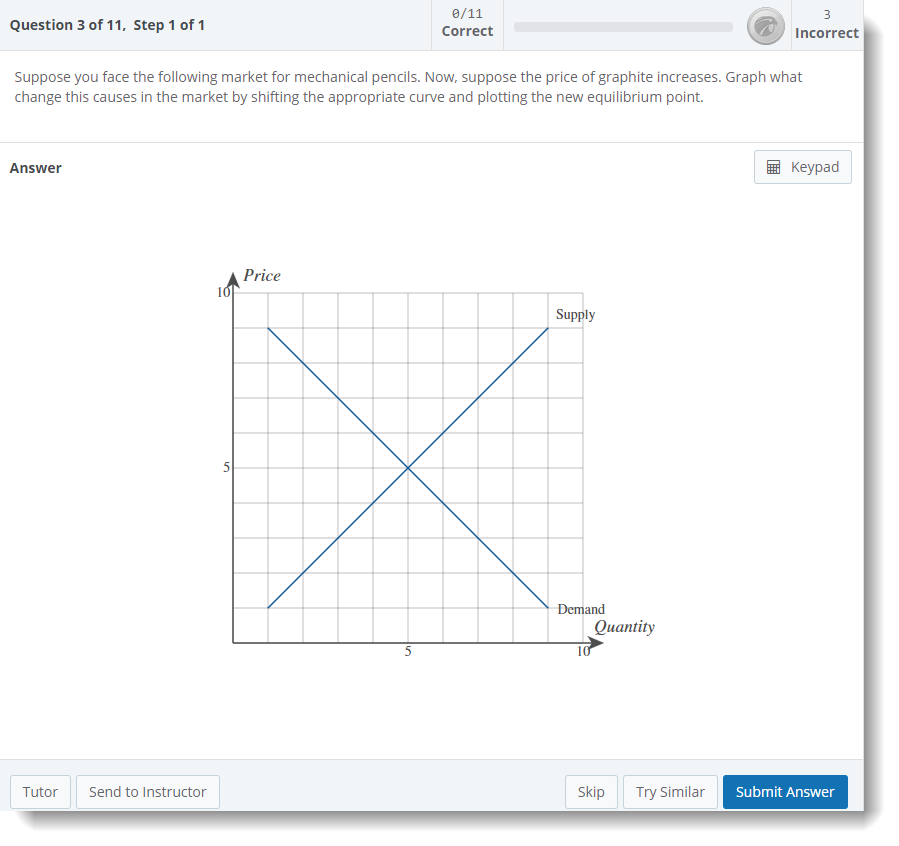
Hawkes Learning’s Principles of Microeconomics homework and testing platform provides new user-directed graphing that doesn’t rely on Flash or plugins. These graphing questions enforce deeper learning, provide step-by-step tutorials, and offer specific feedback through an interactive experience! This summer, we’re releasing more graphing questions throughout the software. Here’s a sneak peak of upcoming graphing question types that will be ready for fall: Start from scratch and plot the supply and demand curves Plot producer and consumer surplus, then calculate each surplus Plot price floors and price ceilings Use graphing for different market structures, such as monopoly and monopolistic competition Want to see more? Contact us today at 1-800-426-9538 or sales@hawkeslearning.com to start exploring these graphing questions in Chapter 3: Demand and Supply. Principles of Microeconomics helps students gain a broad understanding of microeconomics concepts. Through multimodal instruction, interactive practice, and real-world examples, students learn to think as economists and apply basic micro principles to the situations around them. Table of Contents: 0. Math Review 1. Welcome to Economics 2. Choice in a World of Scarcity 3. Demand and Supply 4. Labor and Financial Markets 5. Elasticity 6. Consumer Choices 7. Production, Costs, and Industry Structure 8. Perfect Competition 9. Monopoly 10. Monopolistic Competition and Oligopoly 11. Monopoly and Antitrust Policy 12. Environmental Protection and Negative Externalities 13. Positive Externalities and Public Goods 14. Labor Markets and Income 15. Poverty and Economic Inequality 16. Information, Risk, and Insurance 17. Financial Markets 18. Public Economy 19. International Trade 20. Globalization and Protectionism
May 23, 2019
Hawkes Learning’s Principles of Microeconomics homework and testing platform...
Read More
The new Principles of Microeconomics Guided Notebook presents content in an easy-to-follow format. It asks students to pick out key concepts and then apply them immediately. Students also have access to basic mathematics remediation in the first chapter, which is designed to target math skill gaps in topics such as graphing, solving equations, and calculating area. Top 3 reasons you should consider a Guided Notebook: Application of content in real time through interactive activities & exercises Accountability for reading material and actively participating in instruction Development of soft skills like note-taking by identifying key concepts and completing examples Inspire students to take a more active role in accessing instruction, create and label graphs from blank templates, and complete practice exercises. Extensive graphing practice Fill-in-the-blank statements Say it in a Sentence Wrap-up Define & reflect questions On Your Own short answers Self-Test check-ins If you’re an instructor who would like to see more, download a free sample or request your free exam copy today!
Within the Principles of Microeconomics software, an interactive tutor assists students when they’re struggling with a question and you can’t be there to help. The Tutor tool in the Practice mode provides Step-by-Step, a feature that walks students through the steps needed to correctly solve any question by breaking it up into smaller, more manageable pieces. Students can also view the completely worked-out solution to the question at hand or return to the eBook content for a quick refresher. Students can use as much or as little guided assistance they need in order to successfully learn how to solve the question. Whenever they feel ready, students can jump right back into the Practice mode and finish that exact question on their own. View examples of Step-by-Step below! Example 1: Question: Step-by-Step: Example 2: Question: Step-by-Step: Example 3: Question: Step-by-Step: Example 4: Question: Step-by-Step:
April 29, 2019
Within the Principles of Microeconomics software, an interactive tutor assists...
Read More
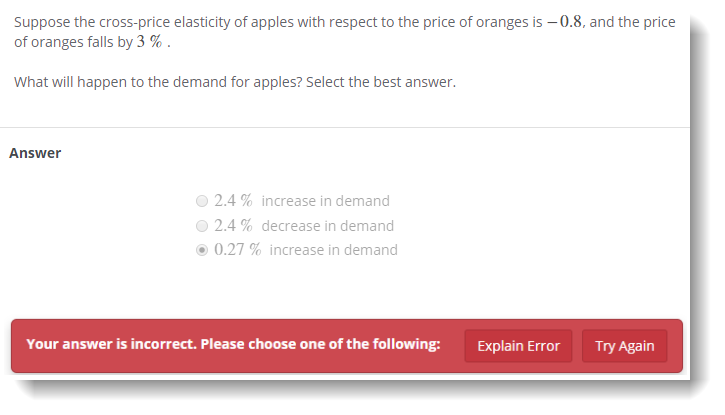
When students make a common mistake in answering a question in our Principles of Microeconomics software, the program’s artificial intelligence pinpoints their exact error and provides detailed feedback to correct the mistake. The software not only tells students what they got wrong, but why they’re wrong—letting students immediately fix their errors before committing them to memory. This feedback is provided through the tool Explain Error. View examples of it below! Example from Chapter 3: Demand and Supply In the following question, we ask students to calculate the change in quantity demanded of apples. To solve for this, students will need to know the formula for cross price elasticity of demand. Explain Error will provide this formula, and in this scenario we also identify that the student made a simple math error when solving for the quantity demanded of apples by dividing the cross-price elasticity (given) by the % change in price of oranges (given), rather than multiplying those two values. Question: Explain Error: Examples from Chapter 5: Elasticity We provide specific feedback to help students who are struggling to apply the concept of elasticity to labor supply by explaining how a change in wages will or will not impact the job mentioned in the question. Question 1: Explain Error: Question 2: Explain Error: Examples from Chapter 9: Monopoly Question 1: Explain Error: Question 2: Explain Error: Explain Error: Question 3: Explain Error: Hawkes Learning’s new Principles of Microeconomics course helps teach students to think as economists and apply basic micro principles to the situations around them through multimodal instruction, interactive practice, and real-world examples. Contact us at 1-800-426-9538 or sales@hawkeslearning.com to request free demo access to the software.
April 9, 2019
When students make a common mistake in answering a question in our Principles...
Read More
Principles of Microeconomics couples the mastery-based approach of Hawkes’ automated homework and testing platform with an interactive worktext for extensive problem solving and graphing practice. Use innovative software as part of the teaching team outside of the classroom. Automate assessment to save time. Ensure students understand course concepts through unlimited practice. Robust user-directed graphing Artificial intelligence to diagnose common errors Basic math skills remediation Step-by-step interactive question tutorials Hawkes Learning is excited to bring you this new course developed by contributing economics professors from across the country. With over 40 years of experience teaching and assessing student performance, Hawkes provides an expert homework platform to transform the way your students learn and help you reach your course learning outcome goals. EXPLORE THE STUDENT SOFTWARE FOR FREE Principles of Microeconomics 0. Math Review 1. Welcome to Economics 2. Choice in a World of Scarcity 3. Demand and Supply 4. Labor and Financial Markets 5. Elasticity 6. Consumer Choices 7. Production, Costs, and Industry Structure 8. Perfect Competition 9. Monopoly 10. Monopolistic Competition and Oligopoly 11. Monopoly and Antitrust Policy 12. Environmental Protection and Negative Externalities 13. Positive Externalities and Public Goods 14. Labor Markets and Income 15. Poverty and Economic Inequality 16. Information, Risk, and Insurance 17. Financial Markets 18. Public Economy 19. International Trade 20. Globalization and Protectionism Explore The Student Software For Free
January 24, 2019
Principles of Microeconomics couples the mastery-based approach of Hawkes’...
Read More
Principles of Microeconomics helps students gain a broad understanding of microeconomics concepts. This engaging, interactive course takes students through all the main microeconomics topics. Through multimodal instruction, interactive practice, and real-world examples, students learn to think as economists and apply basic micro principles to the situations around them. Included in this new course is a chapter covering fundamental math concepts for students to review before delving into the economics topics that build off that necessary knowledge. Table of Contents: Chapter 0: Math Review 0.1 Addition and Subtraction 0.2 Multiplication and Division 0.3 Order of Operations 0.4 Algebraic Expressions 0.5 Basics of Percent 0.6 Linear Equations 0.7 Graphing 0.8 Calculating Area Chapter 0 Review Chapter 0 Review Chapter 1: Welcome To Economics 1.1 What Is Economics, and Why Is It Important? 1.2 Economic Theories, Models, and Systems Chapter 1 Review Chapter 1 Review Chapter 2: Choice in a World of Scarcity 2.1 How Individuals Make Choices Based on Their Budget Constraint 2.2 The Production Possibilities Frontier and Social Choices 2.3 Confronting Objections to the Economic Approach Chapter 2 Review Chapter 2 Review Chapter 3: Demand and Supply 3.1 Demand, Supply, and Equilibrium in Markets for Goods and Services 3.2 Shifts in Demand and Supply for Goods and Services 3.3 Changes in Equilibrium Price and Quantity: The Four-Step Process 3.4 Price Ceilings and Price Floors 3.5 Demand, Supply, and Efficiency Chapter 3 Review Chapter 3 Review Chapter 4: Labor and Financial Markets 4.1 Demand and Supply at Work in Labor Markets 4.2 Demand and Supply in Financial Markets 4.3 The Market System as an Efficient Mechanism for Information Chapter 4 Review Chapter 4 Review Chapter 5: Elasticity 5.1 Price Elasticity of Demand and Price Elasticity of Supply 5.2 Polar Cases of Elasticity and Constant Elasticity 5.3 Elasticity and Pricing 5.4 Elasticity in Areas Other Than Price Chapter 5 Review Chapter 5 Review Chapter 6: Consumer Choices 6.1 Consumption Choices 6.2 How Changes in Income and Prices Affect Consumption Choices 6.3 Behavioral Economics: An Alternative Framework for Consumer Choice Chapter 6 Review Chapter 6 Review Chapter 7: Production, Costs, and Industry Structure 7.1 Explicit and Implicit Costs, and Accounting and Economic Profit 7.2 Production in the Short Run 7.3 Costs in the Short Run 7.4 Production in the Long Run 7.5 Costs in the Long Run Chapter 7 Review Chapter 7 Review Chapter 8: Perfect Competition 8.1 Perfect Competition and Why It Matters 8.2 How Perfectly Competitive Firms Make Output Decisions 8.3 Entry and Exit Decisions in the Long Run 8.4 Efficiency in Perfectly Competitive Markets Chapter 8 Review Chapter 8 Review Chapter 9: Monopoly 9.1 How Monopolies Form: Barriers to Entry 9.2 How a Profit-Maximizing Monopoly Chooses Output and Price Chapter 9 Review Chapter 9 Review Chapter 10: Monopolistic Competition and Oligopoly 10.1 Monopolistic Competition 10.2 Oligopoly Chapter 10 Review Chapter 10 Review Chapter 11: Monopoly and Antitrust Policy 11.1 Corporate Mergers 11.2 Regulating Anticompetitive Behavior 11.3 Regulating Natural Monopolies 11.4 The Great Deregulation Experiment Chapter 11 Review Chapter 11 Review Chapter 12: Environmental Protection and Negative Externalities 12.1 The Economics of Pollution 12.2 Policies to Reduce Pollution 12.3 The Benefits and Costs of US Environmental Laws 12.4 International Environmental Issues 12.5 The Tradeoff between Economic Output and Environmental Protection Chapter 12 Review Chapter 12 Review Chapter 13: Positive Externalities and Public Goods 13.1 Why the Private Sector Underinvests in Innovation 13.2 How Governments Can Encourage Innovation 13.3 Public Goods Chapter 13 Review Chapter 13 Review Chapter 14: Labor Markets And Income 14.1 The Theory of Labor Markets 14.2 Wages and Employment in an Imperfectly Competitive Labor Market 14.3 Market Power on the Supply Side of Labor Markets 14.4 Employment Discrimination 14.5 Immigration Chapter 14 Review Chapter 14 Review Chapter 15: Poverty and Economic Inequality 15.1 Drawing the Poverty Line 15.2 The Poverty Trap 15.3 The Safety Net 15.4 Income Inequality: Measurement and Causes 15.5 Government Policies to Reduce Income Inequality Chapter 15 Review Chapter 15 Review Chapter 16: Information, Risk, and Insurance 16.1 The Problem of Imperfect Information and Asymmetric Information 16.2 Insurance and Imperfect Information Chapter 16 Review Chapter 16 Review Chapter 17: Financial Markets 17.1 How Businesses Raise Financial Capital 17.2 How Households Supply Financial Capital 17.3 How to Accumulate Personal Wealth Chapter 17 Review Chapter 17 Review Chapter 18: Public Economy 18.1 Voter Participation and Costs of Elections 18.2 Special Interest Politics 18.3 Flaws in the Democratic System of Government Chapter 18 Review Chapter 18 Review Chapter 19: International Trade 19.1 Absolute and Comparative Advantage 19.2 What Happens When a Country Has an Absolute Advantage in All Goods 19.3 Intra-industry Trade between Similar Economies 19.4 The Benefits of Reducing Barriers to International Trade Chapter 19 Review Chapter 19 Review Chapter 20: Globalization and Protectionism 20.1 Protectionism: An Indirect Subsidy from Consumers to Producers 20.2 International Trade and its Effects on Jobs, Wages, and Working Conditions 20.3 Arguments in Support of Restricting Imports 20.4 Trade Policy Chapter 20 Review Chapter 20 Review
January 3, 2019
Principles of Microeconomics helps students gain a broad understanding of...
Read More