An independent, peer-reviewed study found that students using Hawkes Learning outperformed students using traditional paper-and-pencil homework — on quizzes, on final exams, and overall satisfaction. This study was conducted by James Quinlan, a mathematician at the University of Southern Maine. It was published in the Ohio Math Journal and was not funded, commissioned, or sponsored by Hawkes Learning in any way. The Question Every Math Instructor Has Asked Does online homework actually work, or does it just make grading easier? It is a fair question. Switching students from paper-and-pencil homework to an online platform is a real change, and instructors deserve more than a promise that it will improve student outcomes. They deserve evidence. James Quinlan designed a controlled study in a first-semester calculus course, comparing students using traditional homework to students using Hawkes Learning with no funding from Hawkes. Just a researcher who wanted an honest answer. This blog shines a light on what he found. How the Study Was Designed Quinlan ran his study across two sections of first-semester calculus at a small private college in New England. The setup was carefully controlled to ensure a fair comparison: Same course. Both groups covered identical material. Same instructor. Both sections were taught by the same person using the same teaching approach. Same assessments. Both groups took the same quizzes and the same final exam. The only difference was the homework format. The control group completed traditional paper-and-pencil homework — the same approach most math courses have used for decades. The experimental group completed their homework using Hawkes Learning, a mastery-based learning system that guides students to a deep and genuine understanding with personalized learning support along the way. At the end of the course, Quinlan also surveyed the Hawkes Learning group about their experience with the platform. What the Study Found Performance: Hawkes Learning students scored higher Students in the Hawkes Learning group outperformed the traditional homework group on both quizzes and the final exam. Assessment Traditional Homework Hawkes Learning Quiz Average 74 (SD 14.5) 83 (SD 9.7) Final Exam Average 72 (SD 19.3) 81 (SD 16.7) This was not a marginal difference. Across the course's two primary measures of student learning, the Hawkes Learning group came out ahead, and both gaps were statistically significant (quiz average: p = 0.0047; final exam: p = 0.0428). Notably, students using Hawkes Learning weren't just scoring higher on average — they were also more consistent. Their lower standard deviations on both assessments (9.7 vs. 14.5 on quizzes; 16.7 vs. 19.3 on the final) indicate scores clustered more tightly around the higher average, rather than the improvement being driven by a handful of standout performers. That consistency reflects how the platform is designed to work. Hawkes Learning tracks each student's performance at the problem level, identifies where individual students are struggling, and generates practice sequences calibrated to those specific gaps. Students who would typically fall behind in a traditional homework format get support targeted to what they personally need, not a uniform experience that works best for students who were already on track. Satisfaction: Students preferred the online experience When surveyed at the end of the semester, students using Hawkes Learning reported higher satisfaction with the homework format than the traditional group: 93% of students using Hawkes agreed they received prompt feedback on their homework — a 45 point gap from students in the traditional group. Students specifically highlighted instant feedback and access to worked example solutions as features that helped them learn. Hawkes Learning students were also significantly more likely to say they liked mathematics (81% vs. 61%, a 20-point gap). They reported spending less time on homework overall, with only 22% agreeing they spent too much time, compared to 43% of traditional students — a 21 point gap. The table below, from the original study, breaks down agreement rates on all six student survey items by group, along with the statistical significance of each difference. Student satisfaction is not just about comfort — it is connected to engagement. Students who feel supported by their course materials are more likely to complete assignments, stay in the course, and persist through difficulty. 4 Reasons Why Online Homework Works Quinlan's findings are consistent with what researchers have observed across college algebra, pre-calculus, and statistics courses: online homework platforms produce results at least equal to traditional homework, and often better. The reasons are not mysterious. 1. Feedback that arrives when it is still useful. With paper homework, a student who solves a problem incorrectly on Monday may not find out until Thursday, after already moving on. Hawkes Learning tells students immediately whether they got the question correct, and helps them understand why or why not. The feedback arrives at the exact moment when it can change how a student thinks about a problem. 2. Support for students who are stuck. When a student hits a wall on traditional homework, they either leave the problem blank or worse...they guess. Hawkes provides example solutions so students can see how a problem is approached and apply that reasoning to their own work. The result is less frustration and more time actually learning. 3. Data that helps instructors help students. Hawkes Learning tracks which topics students struggle with, how many attempts each problem takes, and how much time students spend on each lesson. Instructors do not have to wait for a poor quiz grade to find out a concept did not land; the platform tells them in advance. 4. Time back for instructors. Automated grading is more than just an added convenience. It recovers time that can go toward better course preparation, more focused student interaction, and the work that actually requires a human touch. What This Means for Your Course First-semester calculus is one of the highest-stakes courses in undergraduate education. Students who struggle often lose confidence, change majors, or leave STEM pathways entirely. Quinlan's study supports that the right homework platform can move the needle on the outcomes that matter most — the quiz grades, the final exam scores, and the student experience that determines whether someone stays engaged with mathematics. About the Researcher James Quinlan is a mathematician at the University of Southern Maine. His research focuses on mathematics education, including the effectiveness of technology-based learning tools in college mathematics courses. Published in: Ohio Math Journal Full study available at: https://ohiomathjournal.org/article/4182/galley/4423/view/ The author disclosed no financial or non-financial interests related to this research. This study was not funded, commissioned, or sponsored by Hawkes Learning. About Hawkes Learning Hawkes Learning's platform is built around mastery-based learning, immediate feedback, and data-driven instruction — the same principles that drove the results in Quinlan's study. Ready to see Hawkes Learning in your courses? Contact us to learn more and get started seeing results in your courses.
![]()
September 9, 2026
An independent, peer-reviewed study found that students using Hawkes Learning...
Read More
Course: Math2228 — Elementary Statistical Methods I Hawkes Learning Product Used: Beginning Statistics, 3rd Edition Highlights: 86.67% final grade average — across three Spring 2026 sections of Math2228 using Hawkes Learning, students averaged a final course grade of 86.67%. 93.12% homework grade average — using Hawkes Learning, students engaged consistently with the homework with a 93.12% average homework score across all three sections. Greater confidence and independence — students reported feeling less anxious, more capable, and better prepared for exams compared to previous sections using ALEKS. Overview: Across three sections of Professor Jeffery Mobley’s statistics course at East Carolina University, students who demonstrated strong mastery through Hawkes Learning homework also performed strong on tests and the final exam. The pattern was consistent across assessment types: students earning A and B averages on tests maintained homework averages above 98%, while students earning A and B grades on the final exam maintained homework averages above 97%. For Professor Mobley, the results point to something important: student success in Hawkes homework aligned with their ability to demonstrate that learning again in tests and final exams. The Data: Homework Grades by Course Outcome Final Overall Grade Students who earned an A in the course averaged a homework grade of 99.57%. Students who earned a B averaged 95.31% on homework. For students who failed the course, the average homework grade was 47%. Final Grade Average Homework Grade A 99.57% B 95.31% F 47% Test Average (40% of Course Grade) The pattern holds for tests, which account for 40% of the course grade. Test Average Grade Average Homework Grade A 99.39% B 97.54% Final Exam (20% of Course Grade) Even on the final exam — a single, high-stakes assessment — homework completion predicted performance. Final Exam Grade Average Homework Grade A 98.34% B 96.62% What the Numbers Tell Us Students earning the highest marks consistently completed nearly all their Hawkes homework, with this pattern appearing at every assessment level, suggesting that the mastery-based homework is helping students build genuine understanding that carries beyond homework and into higher-stakes testing. Students who failed the course averaged just 47% on Hawkes homework, reinforcing the connection between engaging with the mastery-based work and overall success. “The educational roadblocks that Hawkes Learning courseware solved for my classes were helping students to understand their mistakes, time spent on learning the material, and the confidence level of students with the subject matter.” What Hawkes Solved Professor Mobley identified three specific educational challenges that Hawkes Learning addressed: Helping students understand their mistakes — The AI Tutor and tutoring aids in Learn and Practice mode guide students through errors in real time rather than leaving gaps unaddressed. Time spent on learning the material — The structured model keeps students engaged with the content meaningfully, not just clicking through. Student confidence with the subject matter — By requiring demonstrated mastery before progressing, Hawkes builds the kind of confidence that shows up on exam day. Professor Mobley's Statistics students offered candid feedback on their experience with Hawkes Learning: "I really enjoy Hawkes Learning. My favorite subject has always been math, but I have to say this is the easiest math I've ever had because of Hawkes Learning." "Before starting this class, I was really nervous and knew I was going to struggle. Hawkes Learning has helped me succeed a lot and feel better about my math skills." "I really love the way that it has a feature to help in every aspect. It really helps me understand the material and solve problems on my own." "I like Hawkes Learning, and it is easier to learn from than other math platforms like ALEKS." "It is the best learning platform I have used in my academic career. It is easy to use and explains the lessons well." Key Takeaway At East Carolina University, strong Hawkes Learning homework performance carried through to strong results on tests, the final exam, and in the course overall. The data tells only part of the story. Students also reported feeling more confident, less anxious, and better able to understand mistakes and solve problems independently. Photo Courtesy of ECU University Communications
![]()
August 19, 2026
Course: Math2228 — Elementary Statistical Methods I Hawkes Learning Product...
Read More
Courses: Quantitative Reasoning, Elementary Statistics, Functions and Modeling, and Precalculus for ENG-PHYS-CS Course Type: Corequisite Math Pathways Quick Stats: The percentage of students completing college-level math in a single semester rose from 29% to an average of 73% per term, showing steady, lasting improvement. When surveyed, 100% of students enrolled in a lab (corequisite) course said it helped them succeed in their math class. Background & Overview Seminole State College (SSC) math faculty sought to redesign their math sequence to help students graduate on time and place them into math pathways most relevant to their fields of study. In fall 2017, the Mathematics Department launched corequisite math pathways in Quantitative Reasoning, Statistics, and STEM tracks. Within just a few semesters, SSC transitioned to a 100% corequisite model across all math courses. Placement & Course Structure Students are placed in a pathway based on their major, so they can learn the most applicable mathematics for their future careers. Placement into a corequisite course is determined by ACT math scores, QAS Accuplacer results, and a Multiple Measures Rubric to ensure students receive the level of support they need. * STEM includes Precalculus for ENG-PHYS-CS and Functions & Modeling Each pathway pairs with a credit-bearing course immediately followed by a lab (corequisite) course that provides targeted lesson content and individualized support. With this model, students receive one-on-one help immediately after learning new material, reinforcing mastery and confidence. Corequisite remediation is also offered online, where intentional communication and targeted math review are integrated directly into the course design. Results & Student Impact With this new model, more students are passing their credit-bearing math courses within their first year, increasing overall retention and graduation rates. “The lab class (corequisite) helped me so much. I was able to get one-on-one help on questions I needed help with. The extra class was the reason I was able to pass with an A.” -Isaac H., Seminole State College student “Special Topics (corequisite course directly following the credit-bearing math course) really helped me grow as a student! Being able to head to Special Topics after learning a new objective was very helpful because I was able to receive one-on-one help from the professor. It was a class that definitely gave me the confidence to succeed in college! “ -Bryce F., Seminole State College student
![]()
November 11, 2025
Courses: Quantitative Reasoning, Elementary Statistics, Functions and Modeling,...
Read More
Highlights Improved grades and retention: The average grade in the General Psychology course significantly improved by approximately 23.08%, rising from a low “B” average to a mid-“A” average. Improved pass rate: The pass rate increased by approximately 25.64%, and drop rates nearly disappeared by fall 2024. Decreased test anxiety: Excluding the years 2019-2020 due to the influence of COVID-19 on test anxiety, we observe a 40% drop in the first year Hawkes was implemented, based on the 2018-2019 report of 10 students, followed by an 80% decrease and eventually a 100% elimination of students reporting test anxiety at the Center for Testing Support. This case study demonstrates the value of making thoughtful, research-informed changes to course design, particularly when addressing both academic performance and student mental health. Background and Context In the 2019-2020 school year, the psychology faculty at Neosho County Community College (NCCC) were concerned about the pass rate and overall grades achieved in their introductory-level General Psychology course. Some of the concerns were that on average, 6-9% of the students starting the course dropped and that 14-18% received “Ds or Fs” as their final grades. The faculty felt these were not acceptable scores for a 100-level class. (These results were for the cumulative in-person and online courses offered.) On average, the college hosts 250-300 students in the General Psychology class each semester. A secondary issue occurred in the in-person classes on the main campus in Chanute, Kansas. This issue was that each semester 6-11 students were reporting mental health issues about taking the class as well as often voicing concern over their entire class load. Mr. Mark Johnston, a professor on the main campus, runs a test anxiety clinic for all students on the campus. He noted that many students reporting test anxiety or generalized anxiety were concerned about the work required and the assessments in their General Psychology courses. The psychology department saw a need for changes in the course and the course materials used. They also hoped to adjust teaching methods to address these issues. The psychology department reviewed several different textbooks and support materials, seeking a better tool to address the problems and make the course more enjoyable and meaningful overall. “Hawkes is a learning system, not just a textbook or software. Students are immersed in their learning from the moment they start to the very end of the course. The system has so many intuitive elements that even students who are not very computer literate find working in it easy and fulfilling.” – Professor Mark Johnston Implementation In the spring of 2020, the department decided to adopt Hawkes Learning’s Introduction to Psychology. This decision was reached due to a few reasons, one of which was that the courseware was mastery-based, something the faculty agreed was needed. They also valued the support Hawkes was offering to implement the change. The faculty also reviewed other schools’ use of the Hawkes system and felt that Hawkes’ supporting software would fulfill their needs. Over the remainder of the 2019-2020 school year, the faculty worked out a plan to present a uniform class with the same materials and the same teaching methods. Their goal was to provide all students taking the General Psychology class with a similar teaching and learning environment. This included standardizing the associated PowerPoint slides, lecture highlights, and, where appropriate, recorded lectures for online students. Similarly, weekly quizzes, exams, and papers were all standardized to present every student with the same materials and assessment procedures. Beginning in the 2020-2021 school year, the faculty implemented the Hawkes system. To their delight, the results exceeded their expectations. Outcomes within the course all exceeded state standards, and drop rates were almost nonexistent. Similarly, the overall grade averages rose from a low “B” average to a mid-A average. A similar unexpected outcome was noted in the text-anxiety clinic. Likewise, student self-reports on the course were all very positive for the Hawkes system and the mastery-based approach that the psychology faculty implemented. Over the ensuing school years, grades and satisfaction with the Hawkes Learning system have remained high. Similarly, the number of students coming in for test anxiety has less than or equal to 1 for four consecutive semesters. This suggested that the new system not only addressed academic struggles but also alleviated psychological barriers to success. At the start of the Fall 2024 semester, the department implemented the second edition of the textbook and learning tools. This included Hawkes’ AI Tutor feature to support students during their homework sessions. Grades across all General Psychology courses have remained high, as have student reports of the Hawkes system. At first, the AI Tutor tool was not often utilized, as students were afraid that using AI to help them might result in academic dishonesty charges. Once it was made clear that AI Tutor only supports learning and not actual testing, usage improved. Conclusion The integration of the Hawkes Learning System at Neosho County Community College has significantly transformed the General Psychology course, leading to remarkable improvements in both academic performance and student well-being. By embracing a mastery-based learning approach and standardizing course materials and assessments, faculty at NCCC effectively addressed persistent challenges such as low pass rates, high drop-out rates, and mental health concerns, particularly test anxiety. The results have exceeded expectations, with student grades improving, engagement rising, and anxiety-related issues sharply decreasing. These results demonstrate that students flourish in a supportive, engaging, and mentally healthy environment, further establishing Hawkes as a model of effective, student-centered education. Learn more about Hawkes Learning’s Psychology curriculum and mastery-based offerings here.
![]()
November 4, 2025
Highlights Improved grades and retention:
Read More
Highlights & Overview: Of students who passed the course, 100% scored 70% or more on the homework. Of students who passed the course, 91% scored 80% or more on the homework. For students who received less than a C, their average homework score was 55.56%. Of students who failed the course, the average homework score was 31%. For students who earned a final grade of 90 or better, their average homework score was 99%. This case study explores the link between time invested in homework and overall course success. By analyzing the homework scores and final grades, we can identify significant patterns that underline the importance of consistent homework performance. Background & Context This study analyzes Dr. Herb Baum’s use of Hawkes Learning’s course materials at Guilford College during the Spring 2024 term. Dr. Baum uses Hawkes’ Beginning Statistics in his Math112 Elementary Statistics course which is facilitated in a lecture format. He has been using Hawkes’ materials since 2018 to administer his homework lessons, midterms, and final exams. He also utilizes Hawkes’ Canvas synchronization option, providing an easy grade transfer portal while also streamlining the student sign-in process. When asked about his favorite Hawkes features, Dr. Baum reports Hawkes’ renowned Customer Support Team and the intuitive Practice mode in the student platform. Dr. Baum also shares that Hawkes’ grading system in the Instructor Platform has been very beneficial. This study was conducted with the assumption that students must have a C or above to “pass” the course and move on to the next course. At Guilford College, a “C” is equal to or greater than a final grade of 72. A final score of 55 or below indicates a failing grade in the course. With Dr. Baum’s custom course settings, students receive 100% for submitting their Certify assignments on time, 75% if it is up to two weeks late, and 0 thereafter. Data Highlights MATH112 Hawkes Product Used: 3rd Edition Beginning Statistics This scatter plot demonstrates a strong positive correlation (R² = 0.7975) between students’ homework scores and their final grades. The upward trend indicates that higher homework performance is generally associated with better course outcomes, especially with higher homework scores. Additional data analysis beyond this graph further illustrates a clear relationship between homework completion and overall success in the course, providing more detailed insights into performance thresholds and grade distributions. Homework Performance and Passing the Course 100% of students who passed the course scored 70% or more on their homework. 91% of students who passed the course scored 80% or more on their homework. Homework Performance and Lower Grades Students who received less than a C had an average homework score of 55.56%. Students who failed the course had an average homework score of 31%. Homework Performance and High Achievement Students who earned a final grade of 90 or better had an average homework score of 99%. Analysis While correlation does not necessarily equate to causation, the data demonstrates a strong trend between performance in Hawkes’ homework lessons and overall course success. Students who passed the course consistently achieved higher homework scores. The fact that every student who passed the course scored at least 70% on their homework highlights the critical threshold necessary for passing. High achievers (those earning 90 or better as a final grade) nearly perfected their homework, with an average score of 99%, indicating that top students not only complete their homework but excel in it. This is a clear reflection of Hawkes’ mastery learning approach at work. When completing a Hawkes homework lesson, the student has the opportunity to truly master the learning objectives, leading them to become test-ready. Conversely, students who received less than a C or failed the course had significantly lower homework scores, averaging from 31% to 55.56%, respectively. This suggests a clear link between poor homework performance and overall academic achievement. Conclusion The evidence presented strongly supports the notion that dedicating time and effort to homework is a key factor in academic success. Ensuring students understand the importance of homework and providing innovative interactive homework opportunities could significantly improve their overall performance in the course. The more time that students interacted with Hawkes Learning’s mastery pedagogy, their overall grade was positively impacted.
![]()
Courses: Introductory Algebra, Intermediate Algebra, & College Algebra Course Type: Supplement to lecture Quick Stats: 30% Increase in Students Earning a C of Better Before using Hawkes, only 58% of students earned a C or better in the course, compared to 88% with the use of Hawkes. 20% Increase in Completion Rate The completion rate in College Algebra increased from 60% to 80% with the implementation of Hawkes. 23% Average Decrease in DFW Rate Introductory algebra DFW rate decreased 24%. Intermediate algebra DFW rate decreased 18%. College algebra DFW rate decreased 26%. At Arkansas State University, 39.6% of all first-time students are unprepared for college-level mathematics. Due to the large influx of students with developmental math needs, the math department redesigned developmental courses in order to increase success rates and standardize instruction. Teaching and learning took place in a lab setting. All lectures were available for students to review. Students were required to complete Hawkes certifications in order to take each exam.
![]()
July 1, 2024
Courses: Introductory Algebra, Intermediate Algebra, & College Algebra
Read More
Highlights & Overview: MAT2501 showed a 20% increase in the number of students that passed the course YoY, MAT1100 exhibited a 21% increase YoY, and MAT1000 maintained a consistent 83% pass rate. Students who passed MAT1100 and MAT2501 spent an average of 2,097 minutes in Learn, Practice, and Certify – an average of 210 minutes per week, or 30 minutes per day, across the 10-week semester. Students who passed MAT1000 spent an average of 962 minutes in Learn, Practice, and Certify – an average of 192 minutes per week, or 27 minutes per day, across the 5-week course. This study analyzes South College professor Chris Garner’s experience using Hawkes Learning’s course materials. It specifically examines Professor Garner’s course data across three courses– Mathematical Concepts and Applications (MAT1000), College Algebra (MAT1100), and Statistics (MAT2501)–emphasizing pass/fail and the relationship between these grades and students’ time invested in Hawkes Learning’s student software. Background South College initiated a pilot program for courseware in Spring 2021, with Hawkes Learning’s Beginning Statistics. This successful pilot, marked by steady growth and consistent passing rates in Beginning Statistics courses, led to the adoption of three Hawkes titles across the math department at South College in Fall 2021: Beginning Statistics, Introductory & Intermediate Algebra, and Preparation for College Mathematics. In the context of this study, students earning letter grades of A, B, or C are considered to have passed, whereas those receiving a grade of D or F are classified as failed. A, B, C Rate Comparison Statistics (MAT2501) Hawkes Product Used: 3rd Edition Beginning Statistics As illustrated in the chart above, Garner’s MAT2501 section exhibited a remarkable 20% rise in the number of students passing year over year (YoY) (21-22 vs 22-23 academic years) following the adoption of Hawkes. This increase not only reflects a continuous upward trend in the number of passing students but also demonstrates consistent growth among his students. College Algebra (MAT1100) Hawkes Product Used: Introductory & Intermediate Algebra Likewise, we observed consistent success and growth in the total number of students passing Garner’s MAT1100 course with the integration of Hawkes courseware. From the academic year 21-22 to 22-23, there was a 21% increase in the number of students passing YoY. Mathematical Concepts and Applications (MAT1000) Hawkes Product Used: 2nd Edition, Preparation for College Mathematics This course’s analysis involves a considerably smaller enrollment size compared to Garner’s higher-level courses, featuring only 87 and 40 students in each respective academic year. Evaluating this data from a holistic perspective from adoption through the Fall 2023 term indicates a consistent 83% pass rate among all students in this developmental-level course. Investigating Time Spent When investigating trends in student performance as it relates to *time spent in the courseware, the data reveals a direct relationship between the time spent in the Learn and Practice modes and pass rates. Notably, students who received failing grades (D or F) generally invested significantly less time in the software compared to their successful counterparts, underscoring the proven pedagogical design of our 3-step approach to mastery; when ample time is dedicated to genuine engagement and practice with the course material, students generally exhibit increased understanding and retention of course content, and subsequently, higher final grades, as demonstrated in the chart below. South College’s partnership with Hawkes Learning has resulted in sustained success and improved passing rates. The strategic adoption of Beginning Statistics, Introductory and Intermediate Algebra, and Preparation for College Mathematics, coupled with an emphasis on students spending more time in Learn and Practice, has proven to be a successful formula for student success as determined by their final grades. This study suggests that Hawkes’ mastery-based courseware, focusing on student engagement and time investment, can yield significant improvements in academic outcomes. *“Time spent” is measured by the duration a particular page in Learn or Practice remains on the screen, which may not precisely reflect the actual time spent interacting with the content. This variable is presumed to account for outliers in the chart, where some students exhibit high recorded ‘time spent’ without achieving the expected rate of success.
![]()
January 2, 2024
Highlights & Overview: MAT2501 showed a 20% increase in the number of students...
Read More
Courses: Basic Mathematics & Introductory Algebra Course Type: Modular-Emporium Quick Stats: Overall, GCC saw a 32% Increase in students scoring between 80–100% on the final exam. Before using Hawkes, 33% of students in Basic Mathematics scored between 80-100% on the final exam, compared to 69% with the use of Hawkes. Before using Hawkes, 34% of students in Introductory Algebra scored between 80-100% on the final exam, compared to 63% with the use of Hawkes. Genesee Community College’s implementation of a Developmental Math Emporium for MAT 091 and MAT 092 was facilitated by a Changing the Equation grant through the National Center for Academic Transformation (NCAT). For the redesign, faculty chose Hawkes Learning, a mastery-based learning system used to engage students in the learning process with error-specific feedback. With customized assistance replacing the generic lecture, instructors began to notice an increase in student success. Instructors conducted a study to assess two major categories: achievement of student learning outcomes and course completion rates.
![]()
July 21, 2022
Courses: Basic Mathematics & Introductory Algebra Course Type: Modular-Emporium...
Read More
Courses: Precalculus Math 1103 Course Type: Lecture and online Quick Stats: Students who completed at least 80% on their homework in Hawkes scored on average 5 percentage points higher on the final exam and almost 20 percentage points higher in the overall course. The University of North Carolina Charlotte has used Hawkes’ Precalculus curriculum in all of their Math 1103 courses since Fall 2020. Course coordinator, Professor Anna Athanasopoulou, sees first-hand the impact that Hawkes Learning’s mastery-based approach has on her students and the strong correlation between the coursework they complete in Hawkes and their final exams and overall course grades. Recent data from her Fall 2021 courses show that students who completed at least 80% of their homework in Hawkes scored on average 5 percentage points higher on the final exam and almost 20 percentage points higher in the overall course, which takes all tests throughout the term into account. “Hawkes provides excellent support.” In addition to improved scores and excellent support, professor Athanasopoulou says that she finds the software convenient, especially when reviewing homework, stating, “I can see the questions the system provides to students as homework assignments.” Using Hawkes, instructors can review exact iterations of the questions each student was asked in their assignments.
![]()
April 21, 2022
Courses: Precalculus Math 1103 Course Type: Lecture and online Quick Stats:...
Read More
Courses: Elementary Statistical Methods MATH 1342 Course Type: Corequisite Lecture Quick Stats: 62% decrease in withdrawals 33% of students finished with an A 175% increase in passing rates After seeing increased student success in her curriculum-level statistics course at Dallas College, Professor Yolanda Manzano implemented Hawkes Learning’s Beginning Statistics courseware in her corequisite lecture course as well. Students that are deemed unprepared for curriculum-level statistics are placed in a corequisite course where they receive additional instruction on prerequisite skills outside of the traditional curriculum-level course with their peers. Because these classes are corequisites, they meet for three hours twice a week. By the end of fall 2021, 66% of students finished with a C or above compared to the 24% of students receiving a C or above using Carnegie Math Pathways (WestEd) in the fall of 2019. 43% more students passed the course using Hawkes compared to those using the competitor product. The fall 2021 class also saw a significant 62% decrease in the number of students who decided to withdraw from this course. When asked about students’ success using Hawkes, Professor Manzano highlighted the mastery learning pedagogy of the software, which encourages students to continue working through the material and “not settle for a low score”. She finds the software to be user-friendly and also noted the responsive and friendly tech support team that she and her students have experienced while working with Hawkes Learning. “…I like to use Chapter Projects as classroom activities… I love these because they reinforce concepts in a way that extends their knowledge by applying it in different scenarios. Making this connection is important to me because it helps them to retain information and use statistical concepts in their daily lives.” –Professor Yolanda Manzano
![]()
April 20, 2022
Courses: Elementary Statistical Methods MATH 1342 Course Type: Corequisite...
Read More
Course: Developmental Mathematics Course Type: Traditional lecture and flipped classroom – both with Hawkes online homework Quick Stats: When students completed at least 80% of the homework, they had a 93% chance of passing the course. When students completed less than 80% of the homework, they had a 28% chance of passing. In spring 2015, Shawnee State University’s Developmental Mathematics faculty adopted Hawkes Learning’s Foundations of Mathematics workbook and online courseware in MATH 0099: Fundamental Math, Math 0101: Basic Algebra with Geometry & Applications, and Math 0102: Intermediate Algebra & Applications. The faculty chose these materials because the workbook’s beginning chapters are non-STEM, whereas the subsequent chapters focus on STEM-related topics. The explanations provide conceptual understanding, and the application questions keep students engaged. All instructors required students to complete homework within Hawkes’ online system. Most instructors assigned homework as 20% of the final grade; however, it ranged from 15% to 25%. The faculty saw a correlation between homework completion and passing the overall course. When students completed at least 80% of the assigned homework, they had a 93% chance of passing the course. When students did less than 80% of the homework, they only had a 28% chance of passing.
![]()
December 13, 2019
Course: Developmental Mathematics Course Type: Traditional lecture and flipped...
Read More
Course: Rhetoric and Composition (ENGL 1101) Course Type: Supplement to Lecture Quick Stats: The average final grade for the class was 89.35%. Student performance on the grammar diagnostic test (taken at both the start and end of the semester) improved by an average of 24.7%. In fall 2018, students in Dr. Stephen Whited’s Rhetoric and Composition course began using Hawkes Learning’s Foundations of English software. The instructor chose this title for its clean format and ease of use. He wanted to ensure students received an organized review of grammar and mechanics to become more prepared for class. At the beginning of the semester, students were assigned Hawkes’ pre-created grammar diagnostic to identify specific areas of weakness and receive a customized set of homework lessons based on individual results. During the 16-week course, students completed two to three Hawkes assignments per week. Assignments ranged from five to 15 questions, depending on the complexity of each section. This self-directed homework accounted for 30% of students’ overall grades. Students then completed the grammar diagnostic at the end of the semester to assess how much their grammar skills improved. After Hawkes was implemented, students had more time to discuss concepts and ideas in class, as well as participate in more group writing experiences, rather than asking the instructor for help on remedial topics. Additionally, the instructor observed fewer basic errors on student papers. The writing practice and topics learned throughout the course had a lasting positive effect on students outside of the English classroom. Bar graph of Average Grade on Grammar Diagnostic. The pre-test average was 55.97%, while the post-test was 80.67%. Bar graph of Course Letter Grade Distribution. 60% of students received an A; 33.33% received a B; 0% a C; 6.67% a D; and 0% an F.
![]()
September 30, 2019
Course: Rhetoric and Composition (ENGL 1101) Course Type: Supplement to Lecture...
Read More
Courses: Prealgebra, Elementary Algebra, and Intermediate Algebra Course Type: Modified Emporium Model with Computer-Based Learning Quick Stat: The University of Wisconsin-Green Bay, Sheboygan Campus increased its overall student success in developmental math as much as 27% by implementing a course redesign using Hawkes. Background & Overview Looking to increase success, attendance, and flexibility, the University of Wisconsin-Green Bay, Sheboygan Campus chose to implement a course redesign for three of its developmental math courses. This sequence was overhauled from lecture-based courses using MyLab Math to a modified emporium model using Hawkes Learning. The Hawkes platform fit the redesign goals to give students the flexibility to learn using their preferred style, make students responsible for managing the pace of their learning, and encourage mastery of the material. Students are required to attend class in the new emporium model. There, they are able to move through the material as quickly as they wish, allowing them to easily progress past sections they know and spend time filling knowledge gaps. Classes do not include any lecture. Instead, students use the Learn mode in Hawkes, including the instructor-made videos, to master lessons and complete the coursework. Instructor support is available for individual students who need help mastering a concept or working out a problem as they practice. Open labs are offered three days a week for additional support. Results The redesign implementation using Hawkes has improved success in these developmental math courses, as well as helped students pass the subsequent course, College Algebra. The university now has more flexibility to offer multiple courses at the same time, increasing overall course offerings per semester. Additionally, this model has helped provide more student ownership of learning, more collaboration among students, and a better understanding of individual student needs.
![]()
February 27, 2019
Courses: Prealgebra, Elementary Algebra, and Intermediate Algebra Course Type:...
Read More
Course: Enhanced English Composition Course Type: Supplement to lecture Quick Stat: During the first semester using Hawkes, a pilot section at Rowan College at Gloucester County boosted the number of students passing Corequisite English Composition by 28 percent. Background In fall 2018, the faculty at Rowan College at Gloucester County were looking to offer something more expansive than the McGraw-Hill textbook (Clouse) that was being used for corequisite English Composition. Hawkes’ course, English Composition, “felt like a welcome change.” Professor Emily Maddox piloted Hawkes in her classroom with great success, helping a dramatically larger percentage of students pass the course and move towards graduation. Results Enhanced English Composition I at Rowan College is a course that accelerates developmental writing by “catching students up” in a 4-credit version of English Composition I. The goal is for students to move into English Composition II the following semester and work seamlessly alongside peers who had been enrolled in the regular 3-credit English Composition I. Using the Hawkes platform, students have at their disposal a textbook, online courseware, and a supplemental Reading & Writing Handbook that contains writing, research, grammar, and style tips. By requiring online homework throughout the semester, students were held accountable for mastering the material and using the textbook effectively. It also made class discussions more lively and allowed for interactive classroom elements using the Hawkes courseware. “I’m thrilled to have so many students want to talk to me about the course. I’ve never had so many students stay after class or visit me in my office.” —Emily Maddox
![]()
February 26, 2019
Course: Enhanced English Composition Course Type: Supplement to lecture Quick...
Read More
Courses: College Algebra and Elementary Statistics Course Type: Corequisite Math Pathways Navarro College wanted to reduce the amount of time required for students needing remediation to complete developmental level math courses and move them more quickly into credit bearing courses. A shorter development sequence gives students an increased chance of completing gateway courses and lowers their costs. To do this, faculty sought to align the curriculum with student’s needs thereby improving success. Algebraic Pathway: Students can shorten developmental course work from four semesters to two. Non-Algebraic Pathway: Students can shorten developmental course work from three semesters to two. A “boot camp” course was designed to fast track students through developmental math. This course was tailored specifically to the needs of the individual student. Initial placement was based off the Texas state placement assessment. Course work consisted of a diagnostic exam that allowed students to exempt specific sections. Students only completed necessary lessons and were given individualized instruction through small group lectures, instructor-created videos, and instructor-supported practice. Post-tests were then given to certify passing. In the semester following boot camp, students were placed into a corequisite course. The corequisite course consisted of a full credit bearing course and a support lab section. The lab provided extra tutoring and just-in-time remediation to boot camp students. Using this format, in addition to a shortened sequence, instructors saw increased student retention and persistence.
![navarro college campus]()
November 26, 2018
Courses: College Algebra and Elementary Statistics Course Type: Corequisite...
Read More
Course: Foundations for Quantitative Reasoning Course Type: Supplement to Lecture Quick Stats: In summer 2016, students who completed more than 80% of their Hawkes homework saw a 17% increase in final scores than their peers. The following summer, students who finished more than 80% of their homework saw a 24% increase in final scores than those who did not. ABC grades continue to rise after the adoption of Hawkes, with 62.5% of students achieving ABC grades in summer 2016, and 72.5% in summer 2017. In summer 2016, Lorain County Community College implemented Hawkes Learning’s Foundations of Mathematics courseware into MTHM 058: Foundations for Quantitative Reasoning. This course meets the needs of students in a non-engineering degree track. One of the goals of the course is to reduce the number of developmental math courses needed for students to achieve college-level status. All sections meet three days a week for this eight-week summer course. It is lecture-based with Hawkes lessons assigned as homework. Students have improved their ability to prepare and study their math coursework by using the courseware’s three-mode Learning Path. By identifying their strengths and weaknesses through the Learn, Practice, and Certify modes, students can create their own practice tests to improve specific areas of study. The instructor uses the PowerPoint presentations available on the Hawkes website. These slides serve as a guide for lecture and are shared with students to reinforce content gaps during class or content missed during an absence. Two bar graphs are shown. The first is titled Summer 2016, and the second is titled Summer 2017. Both compare the average percentage grade for students who completed less than 80% of their homework and those who completed more than 80% of their homework. The average grades for quizzes, exams, and final grades are higher for students who completed more than 80% of their homework.
![]()
August 7, 2018
Course: Foundations for Quantitative Reasoning Course Type: Supplement to...
Read More
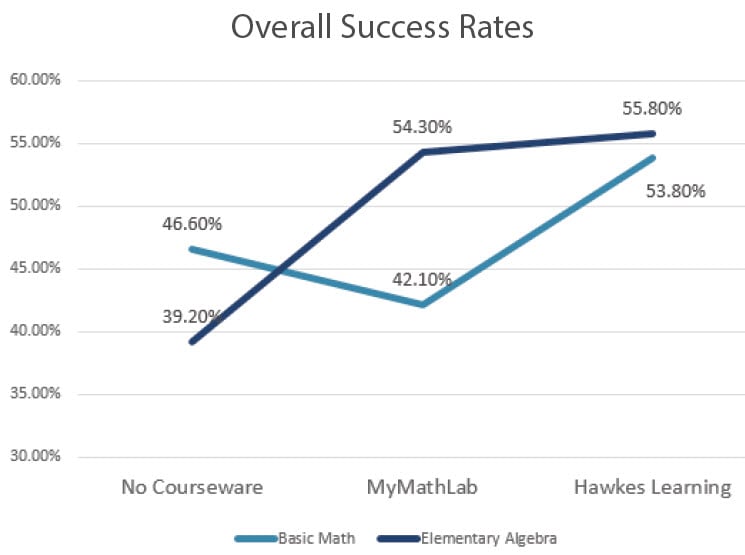
Courses: Basic Math and Elementary Algebra Course Type: Supplement to lecture Quick Stats: Overall, New Mexico Junior College saw a 20.05% grade increase in switching to Hawkes from Pearson’s MyMathLab. New Mexico Junior College redesigned its developmental math sequence using MyMathLab courseware in a flipped classroom. The classes evolved over the years into lectures with lab time included. However, the Mathematics Department was not satisfied with the redesign’s results. Hawkes Learning was implemented into Basic Math and Elementary Algebra in spring 2016. The department adopted Developmental Mathematics because the content covers basic math through algebra, allowing students to move through the developmental math sequence into a credit-bearing class using just one text. Its low price, lifetime student access to the courseware, and customer support also factored into the decision. Students meet for an in-person lecture that includes time to work on their online Hawkes assignments. They complete Hawkes homework, online tests within the courseware, and mastery-based paper exams. Students must average 75% or better on three assessments to pass, regardless of grades earned on other coursework. The department has observed higher pass rates using Hawkes vs. MyMathLab in both Basic Math and Elementary Math, as well as a positive correlation between test scores and overall scores using Hawkes.
![]()
November 22, 2017
Courses: Basic Math and Elementary Algebra Course Type: Supplement to lecture...
Read More
Course: COMM 90: Integrated Communication Arts and Study Skills Course Type: Self-paced, lab setting Quick Stats: 77% of students who completed COMM 90 in one academic year are on track to graduate. Successful COMM 90 students had a 90% retention rate from fall ’15 to fall ’16. Background & Overview Crowder College needed a new approach to helping first-semester freshmen who are not college-ready to succeed. After reviewing state and national recommendations, the college created COMM 90, an integrated communications and study skills course for at-risk students to develop their reading, writing, and critical thinking skills while also building general study skills and accessing campus resources. The course consists of eight-week sessions in a self-paced, modularized format. The instructor uses Hawkes Learning’s Foundations of English courseware, writing prompts, PowerPoints, and vocabulary lessons. Each of the 17 modules includes several online lessons in Hawkes. Results The department has observed higher pass and retention rates. The at-risk students who completed COMM 90 had nearly identical passing rates in English 101 compared to students who were directly placed into the credit-bearing course. Furthermore, the majority of students surveyed felt more confident in their reading and writing abilities. They felt more prepared for college because of the skills they’ve gained from the course.
![]()
August 17, 2017
Course: COMM 90: Integrated Communication Arts and Study Skills Course Type:...
Read More
Courses: Introductory Algebra & Intermediate Algebra Course Type: Online, Self-Paced Quick Stats: 41% increase in the number of students who graduated 41% increase in students who graduated after passing a developmental math course using Hawkes. This contributed to a 21% increase in the total number of students who graduated the university. 92% success rate in self-paced courses using Hawkes The success rate for all courses using Hawkes at the university was 88%. More specifically, the success rate for the redesigned self-paced courses was 92%. To provide additional options for students, online, self-paced developmental math courses were designed. Student success in these courses and in subsequent courses was tracked. To address student questions in this online format, the discussion board and other communication tools within Hawkes software were utilized. Students Successful in Follow-Up Courses “I really think that the Hawkes program is wonderful. I have always been a C student in math until this program & now I am an A student!” —Intermediate Algebra Student
![]()
October 20, 2015
Courses: Introductory Algebra & Intermediate Algebra Course Type: Online,...
Read More
Course: Prealgebra & Introductory Algebra Course Type: Modular-Emporium Quick Stats: Increase in Student Performance on Common Exam Questions Redesign students outperformed traditional students on 39 of 46 common exam questions. 54% average final exam score before redesign 74% average final exam score using Hawkes Half of the students entering Kirkwood Community College are enrolled in Developmental Mathematics. Since there is no one size fits all solution to student learning, instructors were eager to find a way to meet student learning objectives for the largest number of students. This led instructors at Kirkwood to redesign the way their courses were taught. Using the Emporium-Modular course structure as defined by NCAT, Kirkwood started their redesign in Spring 2011 with 130 students. In the Fall it grew to 289 students in face-to-face classes and 417 students in distance-learning courses. The new course structure consists of 13 individually paced modules with three exit points determined by the student’s pathway. Instructors used a scheduling worksheet and set goals for each student to encourage early completion and ensure success. Just-in-time teaching and the ability to monitor individual student progress have created a student-centered learning environment leading to increased performance. “I’ve taken five college math classes and this is the first time I felt like I was actually learning the material.” —Kirkwood Student
![]()
September 16, 2015
Course: Prealgebra & Introductory Algebra Course Type: Modular-Emporium Quick...
Read More
Course: College Algebra Course Type: Hybrid Part 1: Pearson compared to Hawkes Result: Increased ABC rate for students using Hawkes Fall 2014 84.54% of students using Hawkes earned final grade of C or better in course 77.04% of students using MyMathLab earned final grade of C or better in course Spring 2015 71.14% of students using Hawkes earned final grade of C or better in course 58.67% of students using MyMathLab earned final grade of C or better in course Result: Improved performance on learning objectives overall for students using Hawkes Total Duration of Study Students using Hawkes outperformed the students using MyMathLab on 71% of learning objectives. Hawkes students’ performance exceeded MyMathLab students’ performance by greater than 5% on 53% of learning objectives Hawkes students’ performance exceeded MyMathLab students’ performance by greater than 10% on 32% of learning objectives In the Fall of 2014, the University of Mississippi began a year-long pilot study comparing the efficacy of two courseware systems, Hawkes Learning and MyMathLab, in its College Algebra courses. Over 1,000 students were involved in the study and 50 learning objectives were measured. All sections included in this analysis were a hybrid format, with face-to-face lecture being supplemented by online homework and testing administered by Hawkes and MyMathLab outside of scheduled class meetings. Fall 2014 In the initial pilot, 97 students used Hawkes, while 636 students continued using MyMathLab. Homework: Homework was completed online in the respective software and was weighted at 16.7% of the overall grade for all sections. Lab Work: : In addition to scheduled class meetings, students spent a minimum of 50 minutes per week in the campus Mathematics Lab Testing: Four unit tests were given online using the respective software in a proctored setting in the lab. Final Exam: The final exam taken by all students was a multiple-choice paper exam generated within MyMathLab and was weighted at 33.3% of the overall grade. Spring 2015 Following the measurable success of the Hawkes courseware in the Fall, Ole Miss expanded the pilot for the Spring to include 253 students using Hawkes. The other 150 continued using MyMathLab. Homework: Homework was completed online in the respective software and was weighted at 8% of the overall grade for all sections. Lab Work: Students were required to attend the Mathematics lab each week to complete quizzes, which were administered in the respective software. Notes were allowed for quizzes, and students were allowed three attempts. Testing: Four unit tests were given online using the respective software in a proctored setting in the lab. Final Exam: In order to better measure students’ grasp of the material, final exam was changed to a free-response format. The Hawkes students took their final exams within Hawkes, while the Pearson students took their final exams within MyMathLab. The final was weighted 22% of the overall grade, or 36% if higher than the lowest unit test grade. Mean Score Comparison Final Grade Distribution Comparison Part 2: ALEKS compared to Hawkes Result: Spring 2017 Overall grades averaged 7 percentage points higher for students using Hawkes Learning compared to those using ALEKS (percentage points based on median data). Fall 2017 Overall grades averaged 5 percentage points higher for students using Hawkes Learning compared to those using ALEKS. In the spring of 2017, the University of Mississippi was awarded the Association of Public and Land-grant Universities’ (APLU) Accelerating Adoption of Adaptive Courseware Grant, and the Mathematics Department was tasked with participating in the grant across several courses. Since Hawkes Learning was not on the approved courseware list at the time, faculty elected to pilot ALEKS in several sections of College Algebra in each of the last two semesters to satisfy the terms of the grant. In each semester, student performance across the board in Hawkes Learning (homework, tests, final exam, and overall grade) was significantly better than student performance in ALEKS. Hawkes is now on the approved courseware list for the APLU grant. Due to its features such as adaptability, scaffolded learning, deep levels of interaction and specific feedback for students, learner autonomy, and customization options, Hawkes continues to be used by math faculty at the University of Mississippi.
![]()
September 3, 2015
Course: College Algebra Course Type: Hybrid Part 1: Pearson compared to Hawkes...
Read More
Course: Basic Mathematics Course Type: online pre-semester PREPARATORY course Quick Stats: Diagnostic Test Pass Rate Before vs. After Prep Course 61% Pass Rate on Pre-Test 95% Pass Rate on Post-Test Diagnostic Test Scores After Completing Prep Course Students’ average raw score increased by 19 points from Pre-Test Average percent score increased 13 points for class as a whole Average percent score increased 21 points for those who failed Pre-Test Shift in Grade Distribution on Diagnostic Test Pre-Test Grades: 8 out of 23 students (35%) scored above 80% 3 out of 23 students (13%) scored above 90% Post-Test Grades: 18 out of 23 students (78%) scored above 80% 13 out of 23 students (57%) scored above 90% Background & Overview During the summer of 2014, incoming students to the Public Service Management (PSM) Master’s program at The City College of New York participated in a mandatory pre-semester preparation course in basic mathematics using Hawkes Learning software. The purpose of the course was to remediate the students’ mathematics skills and prepare them for the first of three quantitative courses which constitute core requirements of the PSM program. A total of 24 admitted students participated and were assigned 32 assignments each, which needed to be completed at an 80% mastery level or higher. To accurately measure performance, all students took two diagnostic tests: a pre-test, administered at the beginning of the course, and a post-test, administered after students submitted all 32 Hawkes assignments. The tests were identical to each other, and students were not allowed to review their answers until after the course was over. Results On average, students’ raw scores increased by 19 points, representing an average increase of 13 percentage points in their percent scores. Pass rates in the pre and post-tests increased from 61% to 95%. More strikingly, the 39% who failed the pre-test experienced an average increase in their post-test of 21 percentage points. The increase experienced by this group is much higher than that experienced by the entire class, thereby indicating that this preparatory course very likely circumvented retention problems in the PSM program before students even began with their formal coursework. Based on the success of the initial pilot, the PSM program decided to implement the preparatory math course in each year thereafter.
![]()
July 15, 2015
Course: Basic Mathematics Course Type: online pre-semester PREPARATORY course...
Read More
Course: College Algebra Course Type: Corequisite with Intermediate Algebra remediation Quick Stats: Strong correlation between coursework average and final grade The department observed a strong relationship (r=0.91) between students’ Hawkes mastery-based coursework assignment average and final grade for the course. 8.52% Increase in overall mean test scores Prior to the redesign, the overall mean test score for the course (5 tests + Final Exam) was 65.40. The overall mean test score for the new grant course was 70.97. 15.3% Increase in retention rate Developmental students who enrolled in the new corequisite grant course had a retention rate of 87.5%, while those who enrolled in the traditional developmental course had a retention rate of 72.2%. As part of the Texas Higher Education Coordinating Board Scaling and Sustaining Success (S3) Grant project, Texas State Technical College in Waco, TX implemented a new corequisite approach to remedial education with the goal of accelerating students through the developmental sequence and reducing time to degree. With over 40% of the college’s incoming students placing into non-credit bearing math courses and high course repeat rates, developmental education had become overpopulated and often created a road block for students to graduate. The new grant course streamlined developmental students alongside college-ready students into one credit-bearing course consisting of 4 weeks of Intermediate Algebra instruction followed by 10 weeks of College Algebra instruction and a final exam. The course employed team teaching, an additional scheduled lab hour, mastery based Hawkes courseware, and just-in-time remediation in the form of peer tutors, supplemental instruction, online notes, and videos. Using both direct and indirect measures of data from the inaugural cohort, TSTC found that it was possible to successfully accelerate developmental students into a college level curriculum and that students with initial academic deficiencies could still succeed in a credit bearing course alongside college ready students. Learn More: Watch the Webinar On Demand
![]()
July 15, 2015
Course: College Algebra Course Type: Corequisite with Intermediate Algebra...
Read More
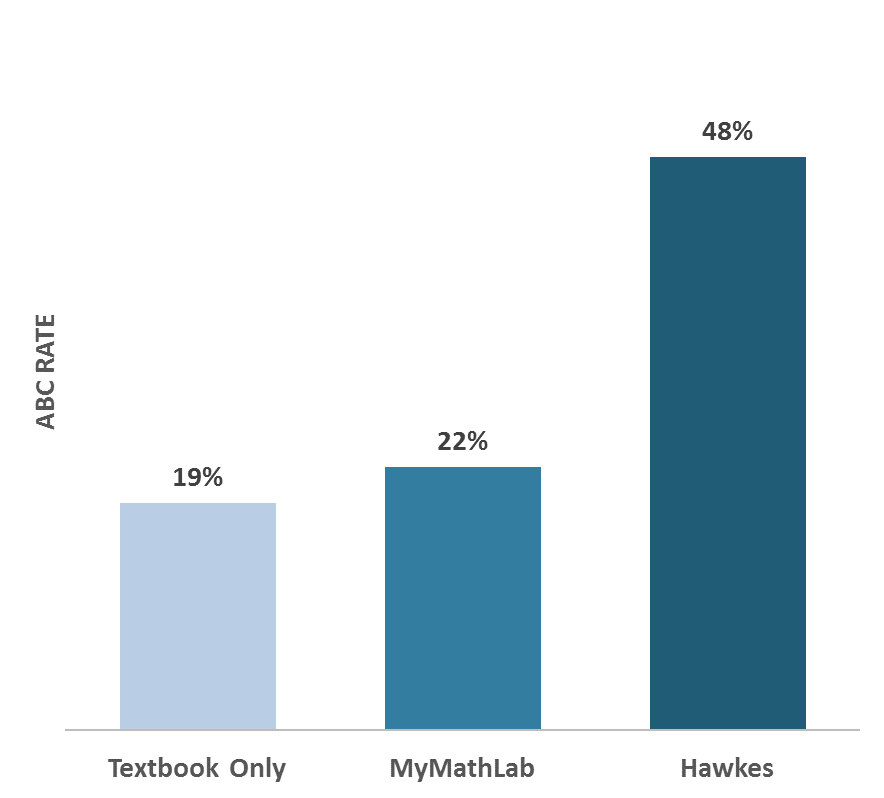
Course: Intermediate Algebra Course Type: Supplement to lecture, Computer assisted Quick Stats: 31% Improvement in Post Test Scores Pre to Post-test Improvement Rates 31% scored 12+ points higher using Hawkes 11% scored 12+ points higher using MyMathLab 9% scored 12+ points higher using a textbook only 10% Increase in Success Rate in Follow-Up Course Success Rate in College Algebra 70% – Textbook only 72% – MyMathLab 80% – Hawkes Learning 16% of first time students at University of North Carolina-Charlotte are under prepared for college-level mathematics. No developmental courses were offered prior to 2000, resulting in a DFW rate of 33% in College Algebra alone. UNC-C took several steps to address this issue, initially by offering their first Intermediate Algebra course in the Summer of 2000. This resulted in noticeable changes in the success rate of the follow-up course, College Algebra. The second step, in Fall 2006, was to implement software. However, instructors quickly noticed a pattern. Students were scoring a 100% on the homework in the software, but lacked the fundamental understanding to perform well on exams. In the Summer of 2010, UNC-C implemented Hawkes Learning. The mastery-based homework assignments and error-specific feedback helped to accomplish the goal of improving student results and made Intermediate Algebra an effective gateway course. ABC Rate on Common Final Exam
![]()
July 15, 2015
Course: Intermediate Algebra Course Type: Supplement to lecture, Computer...
Read More
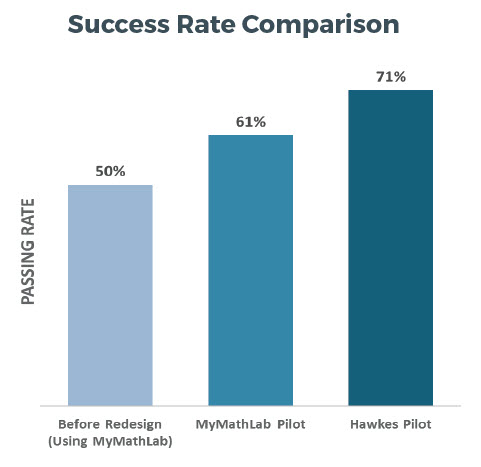
Course: Developmental Mathematics, Beginning Algebra, & Intermediate Algebra Course Type: Supplement to lecture, online, & emporium Quick Stats: 30% Increase in Student Success Rate After Redesign The average student success rate before implementing the overall redesign was 50%. Once the course was redesigned using Hawkes, the success rate increased to 71%. Continued Success Observed Years Later The average increase in ABC grades for Hawkes courses and subsequent math courses from academic year 2009-2010 (pre-Hawkes implementation) to academic year 2015-2016 (post-Hawkes implementation) is 9%. Only 55.5% of students in MAT 109: College Algebra with Modeling received a C or higher before the department implemented Hawkes. In the 2015-2016 academic year, that percentage was 73.4%, a 24% increase. Greenville Technical College’s Mathematics Department led a large-scale redesign of its developmental mathematics courses involving more than 6,000 students after a year-long pilot study. Initially, the department chose to pilot three different courseware systems: Hawkes Learning, MyMathLab (MML), and Aleks. The pilot then continued with Hawkes and MML. After observing higher success rates and a 13.88% increase in the final exam average compared to MML, the faculty decided to move forward with Hawkes for MAT 032: Developmental Mathematics, MAT 101: Beginning Algebra, and MAT 102: Intermediate Algebra. The department continues to see success among students currently using Hawkes Learning. The Hawkes courses are prerequisites for MAT 109: College Algebra with Modeling, MAT 120: Probability and Statistics, and MAT 155: Contemporary Mathematics. Students achieve a higher success rate in these subsequent math courses now that they use Hawkes in prerequisite courses.
![]()
July 15, 2015
Course: Developmental Mathematics, Beginning Algebra, & Intermediate Algebra...
Read More