
An independent, peer-reviewed study found that students using Hawkes Learning outperformed students using traditional paper-and-pencil homework — on quizzes, on final exams, and overall satisfaction.
This study was conducted by James Quinlan, a mathematician at the University of Southern Maine. It was published in the Ohio Math Journal and was not funded, commissioned, or sponsored by Hawkes Learning in any way.
The Question Every Math Instructor Has Asked
Does online homework actually work,
or does it just make grading easier?
It is a fair question. Switching students from paper-and-pencil homework to an online platform is a real change, and instructors deserve more than a promise that it will improve student outcomes. They deserve evidence.
James Quinlan designed a controlled study in a first-semester calculus course, comparing students using traditional homework to students using Hawkes Learning with no funding from Hawkes. Just a researcher who wanted an honest answer.
This blog shines a light on what he found.
How the Study Was Designed
Quinlan ran his study across two sections of first-semester calculus at a small private college in New England. The setup was carefully controlled to ensure a fair comparison:
Same course. Both groups covered identical material.Same instructor. Both sections were taught by the same person using the same teaching approach.
Same assessments. Both groups took the same quizzes and the same final exam.
The only difference was the homework format.
The control group completed traditional paper-and-pencil homework — the same approach most math courses have used for decades.
The experimental group completed their homework using Hawkes Learning, a mastery-based learning system that guides students to a deep and genuine understanding with personalized learning support along the way.
At the end of the course, Quinlan also surveyed the Hawkes Learning group about their experience with the platform.
What the Study Found
Performance: Hawkes Learning students scored higher
Students in the Hawkes Learning group outperformed the traditional homework group on both quizzes and the final exam.
|
Assessment |
Traditional Homework |
Hawkes Learning |
|
Quiz Average |
74 (SD 14.5) |
83 (SD 9.7) |
|
Final Exam Average |
72 (SD 19.3) |
81 (SD 16.7) |
This was not a marginal difference. Across the course's two primary measures of student learning, the Hawkes Learning group came out ahead, and both gaps were statistically significant (quiz average: p = 0.0047; final exam: p = 0.0428).
Notably, students using Hawkes Learning weren't just scoring higher on average — they were also more consistent. Their lower standard deviations on both assessments (9.7 vs. 14.5 on quizzes; 16.7 vs. 19.3 on the final) indicate scores clustered more tightly around the higher average, rather than the improvement being driven by a handful of standout performers.
That consistency reflects how the platform is designed to work. Hawkes Learning tracks each student's performance at the problem level, identifies where individual students are struggling, and generates practice sequences calibrated to those specific gaps. Students who would typically fall behind in a traditional homework format get support targeted to what they personally need, not a uniform experience that works best for students who were already on track.
Satisfaction: Students preferred the online experience
When surveyed at the end of the semester, students using Hawkes Learning reported higher satisfaction with the homework format than the traditional group:
- 93% of students using Hawkes agreed they received prompt feedback on their homework — a 45 point gap from students in the traditional group.
- Students specifically highlighted instant feedback and access to worked example solutions as features that helped them learn.
- Hawkes Learning students were also significantly more likely to say they liked mathematics (81% vs. 61%, a 20-point gap).
- They reported spending less time on homework overall, with only 22% agreeing they spent too much time, compared to 43% of traditional students — a 21 point gap.
The table below, from the original study, breaks down agreement rates on all six student survey items by group, along with the statistical significance of each difference.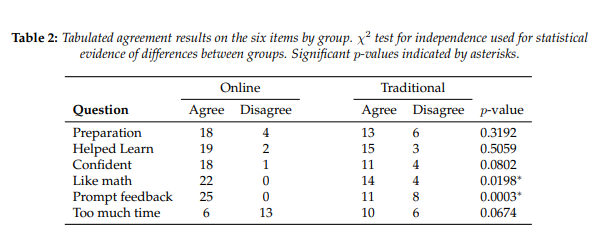
Student satisfaction is not just about comfort — it is connected to engagement. Students who feel supported by their course materials are more likely to complete assignments, stay in the course, and persist through difficulty.
4 Reasons Why Online Homework Works
Quinlan's findings are consistent with what researchers have observed across college algebra, pre-calculus, and statistics courses: online homework platforms produce results at least equal to traditional homework, and often better. The reasons are not mysterious.
1. Feedback that arrives when it is still useful.
With paper homework, a student who solves a problem incorrectly on Monday may not find out until Thursday, after already moving on. Hawkes Learning tells students immediately whether they got the question correct, and helps them understand why or why not. The feedback arrives at the exact moment when it can change how a student thinks about a problem.
2. Support for students who are stuck.
When a student hits a wall on traditional homework, they either leave the problem blank or worse...they guess. Hawkes provides example solutions so students can see how a problem is approached and apply that reasoning to their own work. The result is less frustration and more time actually learning.
3. Data that helps instructors help students.
Hawkes Learning tracks which topics students struggle with, how many attempts each problem takes, and how much time students spend on each lesson. Instructors do not have to wait for a poor quiz grade to find out a concept did not land; the platform tells them in advance.
4. Time back for instructors.
Automated grading is more than just an added convenience. It recovers time that can go toward better course preparation, more focused student interaction, and the work that actually requires a human touch.
What This Means for Your Course
First-semester calculus is one of the highest-stakes courses in undergraduate education. Students who struggle often lose confidence, change majors, or leave STEM pathways entirely.
Quinlan's study supports that the right homework platform can move the needle on the outcomes that matter most — the quiz grades, the final exam scores, and the student experience that determines whether someone stays engaged with mathematics.
About the Researcher
James Quinlan is a mathematician at the University of Southern Maine. His research focuses on mathematics education, including the effectiveness of technology-based learning tools in college mathematics courses.
Published in: Ohio Math Journal
Full study available at: https://ohiomathjournal.org/article/4182/galley/4423/view/
The author disclosed no financial or non-financial interests related to this research. This study was not funded, commissioned, or sponsored by Hawkes Learning.
About Hawkes Learning
Hawkes Learning's platform is built around mastery-based learning, immediate feedback, and data-driven instruction — the same principles that drove the results in Quinlan's study.
Ready to see Hawkes Learning in your courses? Contact us to learn more and get started seeing results in your courses.
Recent posts