Hello, my name is Hillary VanSpronsen and I am a faculty member at Maine Maritime Academy in Castine, Maine. I have been using Hawkes software for almost 10 years in various math classes, including Precalculus and Calculus. If you are like me, you may be onboarding several new instructors or you yourself may be new to using Hawkes software. Here are some tips for supporting student success with Hawkes. Support Starts on Day 1 At the beginning of each term, I spend about 5 minutes having students log in to the Hawkes platform; I’ve found that students who log onto Hawkes early are far more likely to complete their first homework on time because they have the chance to familiarize themselves with the platform before any work is due. During this time I highlight features students will see and follow up on any questions they have, and any pointers from faculty for a successful start. Tip from Hawkes: Have students watch Dashboard and Beyond for a quick intro to the platform! Before the first assignment, remind students often of the best ways to use Hawkes. Let them know that they should start in Practice mode, preferably doing the entire assignment, and move to Certify only after they feel confident with the material. Even after they have certified, they should complete the remainder of the questions to make sure they’ve seen everything. When issues arise and students have questions, remind them that Practice mode is a good place to revisit. Responding to Student Concerns "In the past 20 years, I have used most major competitors for online mathematics software. I have found Hawkes to be the most intuitive, the most user friendly from both student and faculty perspective, and overall, the best value. This message is one we reinforce consistently to students throughout the term, making it clear that we, as faculty, value what Hawkes brings to them." In my experience, most student complaints about the software actually stem from real problem-solving mistakes or misconceptions that would also have also given them trouble on a paper assignment—with Hawkes however, they have the opportunity to correct those mistakes and learn from them in real time. If we are gentle but consistent about having students correct their own mistakes, while also having a positive attitude about the platform, students will have a more positive outlook on the value Hawkes offers as well. Learning at Their Own Pace Hawkes makes it seamless for students to work at their own pace because they can start an assignment, pause, and resume later. You can choose to allow unlimited pauses to the Certify attempts as well. It can be beneficial for students to be able to walk away, think, tend to personal business, attend another class, or anything they might have going in their world. Save Yourself Time & Effort From the instructor’s standpoint, one tool I recommend to help students stay on track is setting auto reminders from Hawkes. I prefer to set a reminder to send to students if they have not completed the assignment by 24 hours prior to their due date, and again if they are more than five days late. The best feature of these reminders is that I can push those notifications to myself as well, helping me see at a glance who has not completed an assignment. This saves a lot of time and effort. Most importantly, as an instructor using Hawkes, it’s helpful if we complete the homework ourselves in student mode. It provides insight for tips that we can pass to students! I hope that you find these tips helpful and I wish you a successful semester using Hawkes!
![]()
Dr. Lisa Brewer is an associate professor of English at New River Community and Technical College, where she teaches composition, research, and literature. She uses Hawkes Learning’s Foundations of English, Second Edition courseware for her Developmental English course. We first adopted Hawkes in our Developmental English course because many of our students were not able to score high enough on our placement tests to enroll in English 101. The major issues started at the basic sentence level. The areas of weakness ranged from needing to learn the parts of speech to what sentence boundaries are. Before we could work on thesis statements and paragraphs, I found that we needed to share a vocabulary for talking about sentences, and our wide variety of students in age and experience meant they had different skill levels and competencies. Some needed a refresher in certain areas, while others needed much more instruction and practice. The first thing Hawkes helped with was their diagnostic tests in reading and grammar that are tied to lesson mastery. The diagnostic tests give the student and me a look into what areas need attention and what the student has already learned. I can see how many students need to work on comma splices or apostrophes and how many students performed well with subject and verb agreement and do not need to repeat that lesson. A student’s mastery of a skill will show up in the lessons assigned so that one does not have to do lessons already mastered. This helps a great deal in preventing boredom from the traditional method of covering a particular skill with the entire class and then moving on, knowing some have already mastered it, but others are still struggling. The lessons and mastery of skills are then individualized to each student’s strengths and weakness. The initial scores also indicate which students are almost ready for English 101 and which ones have a larger gap in skills to make up. This insight helps me plan and know where to spend my time and attention. Because students are more conscious of what they are doing well and what they need to work on, they can articulate their accomplishments and become more confident about their writing skills. The Lesson, Practice, Certify method gives them concrete evidence, which I can reinforce when I see the improvement in their essay writing assignments. At mid-term and at the end of the semester, I give them a survey/writing reflection to find out how they are feeling about their writing at this point as compared to when the class started, and I receive specific feedback about what they are happy to have improved, how they had no confidence in the beginning but now they are more comfortable writing, and at mid-term, they let me know what they want to work on in upcoming classes, such as figuring out a good hook, revising introductions, and addressing their audience. They start asking the kinds of questions that I love to hear because they are not as anxious about the mechanics of writing, and their attitudes may have changed from a former negative high school experience. I was skeptical about using Hawkes at first because I thought that this would be another program in which students do grammar exercises in isolation of their own writing and that effort would not translate into improvements in essay writing. I have been pleasantly surprised because a student can not move on from a lesson until he or she has demonstrated competency and learns why an answer is correct or incorrect, so grammar isn’t just busywork. I am also getting detailed feedback, so I know when to offer additional one-on-one help or practice something as a group, and I can let them know when they are succeeding in applying a particular skill in their essays. Confidence about small victories like the elimination of comma splices is something we celebrate. Students often enter their first college English class with dread and anxiety, especially if they have not done well in it in the past. For many, the fundamentals of grammar and reading can be very dry and boring, so it’s not something they want to hear a lecture about or practice on their own. The Hawkes interactive lessons are more engaging because students know they are working on individual areas that need improvement, and they can see tangible evidence of their achievements in both the mastery of a skill and the positive feedback I can give them on their essays. Some students even work ahead and do lessons I have marked as bonus lessons because they see themselves getting better and want to cover additional topics for extra points.
![]()
April 11, 2025
Dr. Lisa Brewer is an associate professor of English at New River Community and...
Read More
“I’ve been really pleased with Hawkes, and their service is the best I’ve ever experienced.” With over 20 years of experience in higher education, Professor Hamid Nahavandi knows that teaching mathematics comes with unique challenges, but complicated courseware shouldn’t be one of them. Titles & Courses: College Algebra, 3rd Edition – College Algebra Precalculus, 3rd Edition – Trigonometry Calculus with Early Transcendentals, 2nd Edition – Calculus When I first adopted the Hawkes Learning platform about four years ago, I was unsure of what to expect. Prior to making the switch to Hawkes, I had been using WebAssign for about a year, but I often found it difficult to navigate, and it lacked sufficient tech support. I’d often have to rely on my colleagues for help, which was frustrating. Once I transitioned to Hawkes, I noticed the difference in Hawkes’ immediately available and excellent Support Team. My designated Customer Success Specialist, Marissa, has been wonderful and always within reach when I have any questions. I can also easily connect with Hawkes Learning’s Support Team’s 24/7 live chat. Over time, I became much more comfortable using the platform, and I continue to learn more. Recently, Joshua from the Customer Success Team came to my office and patiently walked through my Hawkes questions. I also encourage my students not to hesitate in reaching out to Hawkes’ Support Team. I remind them that Hawkes can help them through phone calls and through their live chat on the website. Our campus also has a Hawkes Student Ambassador intern. Having that extra support through the Student Ambassador program has been great for the students, as they may feel more comfortable asking a peer questions outside of our class time and my office hours. When it comes to my favorite features of Hawkes, I always think of the “Learn, Practice, Certify” sequence that Hawkes presents in their homework lessons. I often direct my students to the “Learn, Practice, Certify” features, especially when they miss class. The videos within the Learn segment have been wonderful. These tools have been great for students to catch up on lessons at their own pace, and they really help reinforce the material. The mastery-based approach used in Hawkes has had a positive effect on students’ learning. From an instructor’s perspective, I’ve found the tools within Hawkes to be very complementary to my teaching. The Curriculum feature within Hawkes Teach (the instructor side of the platform) is directly aligned with my classroom lessons, which saves me time and ensures that the material is consistently covered. The step-by-step explanations for each concept are also incredibly helpful, especially when a student needs further clarification. Another feature I really appreciate is Hawkes’ AI Tutor, which provides additional academic support to students outside of class. In conclusion, I’ve been really pleased with Hawkes, and their service is the best I’ve ever experienced.
![]()
April 1, 2025
“I’ve been really pleased with Hawkes, and their service is the best I’ve ever...
Read More
Course: General Psychology Quick Stats: Since adopting Hawkes’ Introduction to Psychology, pass rates for General Psychology now average 96% per semester, which reflects a 29.73% improvement from the previous format and materials. The campus test anxiety clinic saw the rate of students seeking help for anxiety over psychology courses drop from 18% to 6%, an almost 67% decrease. “Hawkes is a learning system, not just a textbook or software. Students are immersed in their learning from the moment they start to the very end of the course. The system has so many intuitive elements that even students who are not very computer literate find working in it easy and fulfilling.” Professor Mark Johnston teaches General Psychology with Hawkes Learning’s Introduction to Psychology materials at Neosho County Community College. When initially considering adopting Hawkes’ materials, Professor Johnston described specific challenges the psychology department hoped to improve. The first of these was the students’ pass rates when taking General Psychology. Before implementing Hawkes’ materials, Professor Johnston reported that his course’s average pass rate was at 74%, averaging a high “C.” The biggest concern was that students taking the course were not psychology majors, which often led to struggling to master the concepts and terminology associated with the field. To improve his own course pass rates as well as the others, the department decided to find out the “why” behind students’ performance, hoping to identify common factors that may be causing students to retake the course. They discovered that a significant factor affecting students’ pass rates was the anxiety associated with class assessments. Students expressed feeling overwhelmed due to their unfamiliarity with the material and lack of prior exposure to psychology in high school. This combination of factors intensified the pressure they felt when trying to succeed in the course. Upon expanding their investigation to also include students who passed the course, Professor Johnston reports that anxiety related to assessments and course material was common, even among those who performed well. As the coordinator of a campus test anxiety clinic, Johnston observed that prior to implementing Hawkes, 18% of clinic visitors specifically reported anxiety about psychology courses, with General Psychology being the most frequently mentioned. This highlighted a broader challenge: to boost pass rates, it was crucial to enhance the overall learning experience and students’ perception of the course. Professor Johnston has since investigated the stress levels of all students taking the course since now only a small minority need to retake the class. Evaluations have indicated that stress associated with the course and assessments is now quite low. Additionally, many students who had early reservations about taking General Psychology reported that by the end of the semester, it was one of their most liked classes! Students attributed this positive shift in sentiment largely to the mastery-based approach which helped alleviate their initial anxieties and encouraged them to persist through challenges. This improvement is also reflected in the campus test anxiety clinic’s data. Now, less than 6% of the students seeking help report anxiety specifically related to psychology classes; that’s 2/3 of the original number of cases since implementing Hawkes. The vast majority of visitors to the clinic now come for generalized test anxiety rather than concerns tied specifically to psychology courses. Overall, since moving to Hawkes, the department has found that students’ reports of stress related to psychology classes are almost non-existent. Student feedback at the end of the course often cites mastery-based learning as both fun and freeing. Additionally, many students, even those not majoring in psychology, report that the course is one of their favorites compared to all their other classes. The department ensures thorough course reviews at the end of each semester and as a result, General Psychology now ranks as one of the top classes for learning and student satisfaction at Neosho County Community College! “The students also report great satisfaction with the support they receive from the Hawkes team. This is especially helpful early in the semester, as students are just starting. With Hawkes Learning’s 24-hour support, they can get answers in minutes even if they’re doing their work at 2:00 AM.” Webinar: Reducing Stress & Anxiety in the Classroom As part of our Mental Health Webinar Series in May 2024, Professor Johnston addressed the critical issue of mental health in education with an emphasis on post-pandemic challenges. His insightful presentation explored methods for identifying stress and anxiety in students, and more importantly, strategies for designing coursework to alleviate these pressures. Watch the recording to gain valuable insights from Johnston’s firsthand experience in reducing classroom stress and anxiety, supporting students’ mental well-being, and empowering them to succeed academically. Watch the Recording
![]()
June 19, 2024
Course: General Psychology Quick Stats: Since adopting Hawkes’ Introduction to...
Read More
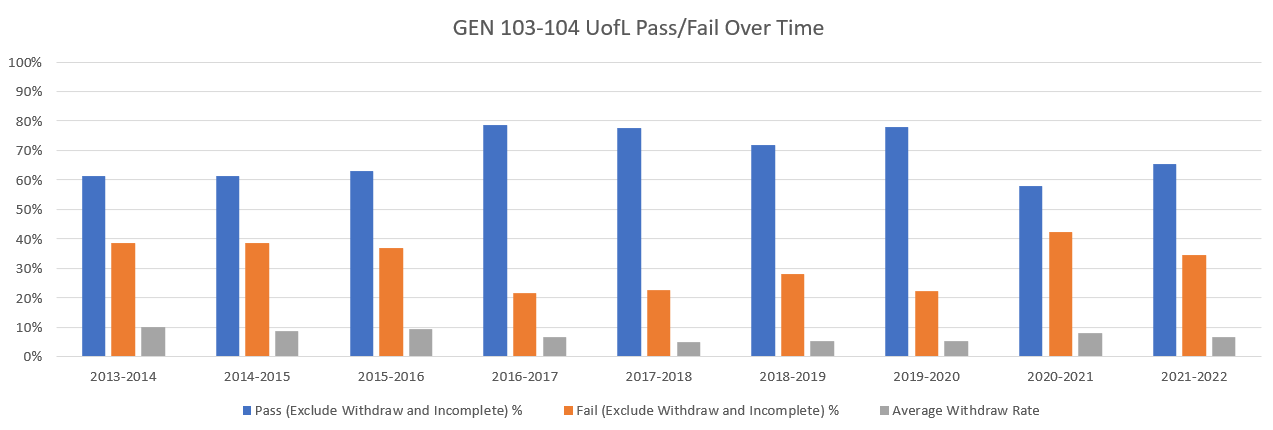
Courses: GEN 103: Special Topics in College Mathematics for Non-STEM Majors and GEN 104: Special Topics for STEM Majors Course Type: Emporium Quick Stats: In 2015, the average pass rate was 63% (excluding withdrawals) and 57% overall using a different software platform; after implementing Hawkes Learning in 2016 the pass rate reached 79% and continued to stay above 70% over the next four years. In fall ‘16, the pass rate increased by 18%, the fail rate decreased by 15% and the withdrawal rate decreased by 4% compared to the previous fall semester. Over 75% of students who passed University of Louisville’s GEN 103/104 in the summer or fall term of 2021 using Hawkes went on to earn a passing grade in their next credit-level math course. The University of Louisville (UofL) implemented intervention courses for students who were not college-ready in mathematics to give them the support and resources they needed without slowing down their paths to graduation. With this goal in mind, UofL replaced all traditional sections of Intermediate Algebra with two new emporium-style intervention courses in algebra. These courses are part of the Resources for Academic Achievement (REACH) program, the university’s centralized academic support unit for undergraduate students. Instead of whole-class lecturing, students meet in a computer lab setting and work through their lessons with the assistance of self-paced courseware, peer tutors, and a course instructor (who serves as a facilitator and guide). REACH is the recipient of the International College Learning Center Association’s (ICLCA) 2022 President’s Outstanding Learning Center Award for Specialized Populations and a Hawkes Learning customer since 2016. After piloting the materials in spring ’16, UofL adopted Hawkes Learning’s Introductory and Intermediate Algebra courseware and customized Guided Notebook starting in summer ’16 after receiving positive student feedback, seeing overall success rates and experiencing unmatched customer support. One of the key deciding factors in moving forward with Hawkes Learning was the ability to use diagnostic testing through the courseware at the start of the term. After switching to Hawkes Learning and making several other structural changes to the program (such as the development of a common final exam), the pass rate of GEN 103/104 students increased dramatically. "The diagnostic abilities of Hawkes are a game changer." As an intervention course, GEN 103/104 students enter the course at all points on the spectrum. Hawkes’ diagnostic testing with automatic grading allows students to demonstrate proficiency in prerequisite material. For the learning center, this feature saved them from grading over 1,000 pen and paper assessments each term, saving valuable time for instruction. Since adopting the Hawkes Learning mastery-based courseware and implementing other course changes, the REACH program at UofL has seen consistent success year over year: From fall ’13-’16 pass rates were averaging below 63%. After implementing HL, average pass rates from fall ’16 to spring ’22 increased to 71.8% (74.6% when excluding the 20-21 pandemic outlier) Table 1: Hawkes Learning was implemented as part of the UofL course curriculum at the start of the 2016-2017 academic year. From the start, the course pass rate in the fall of 2016 outperformed the fall of 2015 pass rate by 18% with fail rates and withdraw rates dropping by 14% and 4%, respectively. Table 2: Over time, the implemented Hawkes Learning products have seen successful trends with consistent pass, fail, and withdraw rates that all outperform past averages from competitor curriculum materials. As demonstrated by the charts above, this upward trend in pass rates was interrupted by the 2020 COVID-19 pandemic causing the 2020-2021 academic year to be an outlier. The impact of the pandemic is still evident, as pass rates have not yet returned to pre-pandemic levels. It may take several years for students to recover the learning losses caused by the COVID-19 pandemic.
![]()
June 8, 2023
Courses: GEN 103: Special Topics in College Mathematics for Non-STEM Majors and...
Read More
Please view the presentations from each session of the Innovative Educators Summit below. Contact marketing@hawkeslearning.com if you have questions. Keynotes Capturing the Hearts and the Minds of Today’s Students | Recording | Presentation Slides —Tracy Imm, Leadership Coach & Communications Expert Rethinking Academic Rigor: Addressing Burnout and Quiet Quitting through Sustainable Approaches to Teaching and Learning | Recording —Gino Perrotte, M.A., Founder + Lead Educator, Coach and Mentor of Right Brain Journeys Biohacking For You & Your Classroom | Recording | Presentation Slides — Dr. Jacquie Leone N.M.D., Author, executive coach and award-winning public speaker Hawkes Sessions Psychology Software for Today’s Students | Recording —Kate Sharp, Hawkes Learning Sociology Software for Today’s Students | Recording —Debra Campbell, Hawkes Learning Mathematics Software in the Classroom | Recording —Austin Swack, Hawkes Learning English & Composition Software in the Classroom | Recording —Sydney Smith, Hawkes Learning Economics Software for Today’s Students | Recording —Austin Swack, Hawkes Learning Thursday Speakers Eliminating Barriers: Embracing Student Complexity | Recording — Kay Walter, University of Arkansas at Monticello & Kathryn Broyles, American Public University System Spicing up Online Discussion Boards in Mathematics | Recording | Presentation Slides — Angie Hodge-Zickerman, Northern Arizona University & Cindy York, Northern Illinois University Critical Thinking in the Classroom | Recording — Lori Daniels, PhD, Keiser University Promoting Mental & Physical Health in Any Discipline | Recording | Presentation Slides — Joab Corey, University of California, Riverside Sociological Perspectives on Education | Recording — Dr. Alaina Desjardin, Kean University Listening, Communication, and Compassion: Teachers As Intercessors for Historically Marginalized Students Emerging from the COVID-19 Pandemic | Recording — Jamie Parmese & Lisa Tucker, Raritan Valley Community College Using Online Meeting Tools in Your Traditional Classroom | Recording — Tony Baker, Three Rivers Community College Bookwalking Through a Flipped Classroom (and Other Return to Learning Challenges…) | Recording — Dr. Kymberli Barker, The Citadel, Johns Hopkins, Central Carolina Community College, The Technical College of the Lowcountry International Economics: Engaging Students with Real World Group Projects | Recording | Presentation Slides — Svitlana Maksymenko, University of Pittsburgh Creating Optimal Learning Environments for All Students: Promoting Diversity and Inclusivity in Online and Face-to-Face Sociology and Criminal Justice Courses | Recording — Dr. Monica Radu & Dr. Kristen Sobba, Southeast Missouri State University Using Bad Examples for Good Outcomes | Recording — Jennifer P. Gray & Stephanie B. Conner, College of Coastal Georgia Using Item Analysis Assessment to Improve Learning & Instruction | Recording | Presentation Slides — Dr. Jamie Foor, Lock Haven University Assignments Design for General Education Courses at Wesleyan College | Recording | Presentation Slides — Dr. Ying Zhen, Wesleyan College A Wolf in Sheets Clothing: Accessible Spreadsheets | Recording — Chrystal Trapani & Kristin White, Old Dominion University Equitable Assessment in the Community College Classroom | Recording | Presentation Slides — Dr. Gregory Ramirez, Madera Community College I Hate Math! How to Help Your Students Overcome Their Fear of Mathematics | Recording — Jennifer Johnke, Ed.D., South College Resiliency: It’s Easier Than We Thought | Recording — Maryellen Dance, Nazareth College Blend with Data | Recording — Burcu Karabina, University of Waterloo Setting Up the Stage for Black Students’ Success | Recording — Dr. Mica Stewart, Mt. San Antonio College Adding SLIs to SLOs: Why Student Learning Insights Matter | Recording — Dr. Shirley Kahlert, Merced College Improve Success and Retention: Integrate Math Study Skills into Courses, Co-requisites, and Labs | Recording — Dr. Paul Nolting, State College of Florida Increasing Student Engagement with Low-To-No-Prep Activities | Recording — Jennifer Merrill, Skyline College Evaluating Students through Self-Evaluation | Recording — Laura Driver & Kevin Moore, County College of Morris Building Connections – Remotely | Recording | Presentation Slides — Ilene Benz, Monroe Community College Friday Speakers Teaching Using Interactive TV| Recording — Maggie E. Habeeb, PennWest California Chapter Zero: What Students REALLY Need on Day One| Recording | Presentation Slides — Dan Van der Vieren, Aims Community College Our Economy: What Would You Do? | Recording — Dennis Avola, Northeastern University, Framingham State University and the University of New England The Pedagogy of Social Justice Using Critical Hydra Theory: DEI Expanded| Recording — Tom Arcaro & Kathleen Wirth, Elon University Equity and Inclusion Using an Emporium Model Approach | Recording | Presentation Slides — Kelly Coultas & Tyler Price, University of Louisville Journey to Find Self | Recording — Christine Floether, Ph.D., Centenary University Equity in the Classroom | Recording — Manjunath Burdekar, Concord University Incorporating Real Scenarios in a Statistics Discussion Board | Recording — Michael Heeren, Purdue University Global Teaching Statistics Using R | Recording — Ashok Singh & Mana Azizsoltani, University of Nevada, Las Vegas Intercultural Development at a Small, Private, Liberal Arts College| Recording — Simon Lucas & Angela Mitchell, Wilmington College Encouraging and Engaging Students on the Discussion Board | Recording — Dr. Laurie Slifka, Keiser University Grading Grammar is Racist: Current Pedagogical Practices to Promote Anti-Racism in the Writing Classroom| Recording — Professor Marie Taylor, M.A., Arcadia University Strengthen Test and Out-of-Class Assignments with MS Office | Recording | Presentation Slides — Melinda Clardy, South Louisiana Community College Lights, Camera, Classroom – Take your Content to the Center Stage! | Recording — Matt Anderson & Dennis Johnson, Fayetteville Technical Community College Engaging in Real-world Economic Development with Coffee Farmers in Honduras | Recording — Dr. Matthew Osborn, Culver-Stockton College
![]()
March 21, 2023
Please view the presentations from each session of the Innovative Educators...
Read More
Please view the presentations from each session of the Innovative Educators Summit below. Contact marketing@hawkeslearning.com if you have questions. Keynotes Stress: How to actually manage the most powerful emotion | Recording —Maryellen Dance, Quantum Leap Therapy, Keynote Speaker Communication Skills for Positive Learning, Living and Work | Recording —Arjun Buxi, Culture of Speak Hawkes Sessions Elements of a Successful Course in the Digital Age | Recording —Laura Shevlin, Hawkes Learning Behind the Scenes: Discovering Business Statistics | Recording —Kelsey Wiest & Robin Hendrix, Hawkes Learning Economics Software Demonstration | Recording —Kathryn Schaefer, Hawkes Learning Mathematics Software Demonstration | Recording —Taylor Ireland, Hawkes Learning Sociology Software Demonstration | Recording —Laura Shevlin, Hawkes Learning English Software Demonstration | Recording —Laura Shevlin, Hawkes Learning Behind the Scenes – Viewing Life Mathematically 2nd Edition | Recording —Kelsey Weist & Barbara Miller, Hawkes Learning Customizing Hawkes Courses for any Environment| Recording —Taylor Ireland, Hawkes Learning Psychology Software Demonstration| Recording —Laura Shevlin, Hawkes Learning Speakers A Gold Medal in Math! Using Digital Badges to Boost Confidence | Recording —Tami Tacker & Kirsten Meymaris, Purdue University Global College Algebra: A Redesign Success Story | Recording —Dr. John Taylor, University of North Carolina – Charlotte Overcoming Compassion Fatigue in Higher Education | Recording —Rachel Gallardo, Blinn College Flex to Success! A retrospective on liberalizing the learning experience during a pandemic | Recording —Dr. David Chaplin, Northwest Nazarene University Interior Importance: Personalizing the College Composition Classroom | Recording —Julie T Quarles, Pepperdine University Quantitative Reasoning with Hawkes Learning | Recording —August Roberson, Ball State University Improving Self-efficacy in Students: Problem Solving Approaches | Recording —Lori Daniels, Ph.D., Keiser University How Covid Changed Us | Recording —Jennifer Johnke Ed.D., South College What is Reality? | Recording —Nick Brittin, Lake Michigan College Making Math More User-Friendly – Metaphors and Connections to Help Student Retention | Recording —Melinda Clardy, South Louisiana Community College So, here’s the thing…The Science and Process of Having Difficult Conversations | Recording —Rachel Gallardo, Blinn College Making Your Own Math Questions | Recording —Dr. Ira L. Robbin, Southern Connecticut State University Discussion Bored?! Ideas for Revamping Online Discussion Boards | Recording —Tami Tacker & Kirsten Meymaris, Purdue University Global Equity and Inclusion Using an Emporium Model Approach in Math Intervention Courses| Recording —Kelly Coultas & Tyler Price, University of Louisville Blended (Hybrid) Course Learning and Teaching In Action | Recording —Lisa P. Diehl, University of North Georgia Beyond the Boxes: Not just “Boys” and “Girls” | Recording —Dr. Trisha Prunty, Blackburn College Three Miniwebinars: Bestowing Virtual Awards, Office Hours Outside the Box, and DEIB at the Instructor Level | Recording —Lynda Mae, Ph.D. Arizona State University Implementing Hawkes Foundations of English into the Classroom | Recording —Mike Thompson, North Iowa Area Community College Hawkes Diagnostics and Mastery Learning Paths | Recording —Dr. Latrice Bowman, University of Alaska Fairbanks, Hawkes Learning Certified Instructor Flipped Classrooms: Two Sides of the Coin | Recording —Kymberli Barker, Ph.D., Central Carolina Community College The Local Impact of Teaching Voting Theory | Recording —Jon Anderson & Max Aeschbacher, Utah Valley University Trading Spaces: Designing a Virtual Learning Space | Recording —Becki Streett, University of Arkansas at Little Rock Transitioning Co-Requisite Math Course to an Online Environment | Recording — Amy Young, Navarro College and Brandon Ford, Navarro College, Hawkes Learning Certified Instructor The New way of relating to students in times of Covid | Recording —Hope Cate, Cape Fear Community College That’s a Great Idea! Acknowledging Faculty Creativity and Resourcefulness | Recording —Tami Tacker & Leslie Johnson, Purdue Global Why Are There No Presentations About Rainbows?: How to Create a Visually Interesting Yet Accessible Presentation | Recording —Kristin White & Chrystal Trapani, Old Dominion University The Five Ws of Math Corequisites | Recording —Emily Carpenter, Seminole State, Hawkes Learning Certified Instructor Neurotransmitters and Communication Between Neurons | Recording —Dr. Laurie Slifka Bakers, Keiser University Communication and Organization – Keys to Online Learning | Recording —Dr. Jason Caudill, King University Plagiarism in the Digital Era: Methods, Detection, & Prevention | Recording —Dr. Laurie Slifka Bakers, Keiser University Keeping Online Students Engaged | Recording —Dr. Jacqueline Jensen-Vallin, Lamar University How to Improve the Quality of Asynchronous Discussion | Recording —T.L. Brink, Crafton Hills College Inclusive & Equitable Learning Experience in Economics | Recording —Dr. Ying Zhen, Wesleyan College Turning Baggage Into Luggage | Recording —Nick Brittin, Lake Michigan College Ensure Integrity in Online Courses | Recording —Dr. Arunachalam (Chalam) Narayanan, University of North Texas Delivery Retention: Is Your Course Content Digestible? | Recording —Kristin White & Chrystal Trapani, Old Dominion University Innovative Media to Enliven Student Presentations| Recording —Amanda Hill, St. Mary’s University Circumventing the Hijacked Classroom: Effective Practices for Managing the Classroom Online| Recording —Nicole Wilson & Tayna Mclnnis, Bowie State University Rguroo: Introducing a Web-Based Statistical Software for Teaching Your Statistics Courses | Recording —Dr. Mori Jamshidian, California State University, Fullerton Quality evaluation and feedback using rubrics | Recording —Michael Heeren, Purdue University Global Integrating Math Study Skills and Student Collaboration into Virtual and in Person Courses | Recording —Paul Nolting, Ph.D., Author of Winning At Math
![]()
March 24, 2022
Please view the presentations from each session of the Innovative Educators...
Read More
Please view the presentations from each session of the Innovative Educators Summit below. Contact marketing@hawkeslearning.com if you have questions. Keynotes Addressing Faculty Anxiety, Stress, and Trauma: Recover, Renew, and Rewire | Website [No Recording] —Dr. Janet N. Zadina, President of Brain Research and Instruction, Co-Founder of The Butterfly Project, Keynote Speaker Nelson Lauver: Who Am I? | Keynote Recording | Q&A Recording —Nelson Lauver, Keynote Speaker Stress: How to actually manage the most powerful emotion | Recording —Maryellen Dance, Quantum Leap Therapy, Keynote Speaker Hawkes Sessions Customizing Hawkes Courses for Any Environment | Recording —Taylor Ireland, Hawkes Learning Digital Learning: A Constructive Approach to Reaching Today’s Psychology Student | Recording —Cory Eno, Hawkes Learning Discovering Statistics and Data | Recording —Taylor Ireland, Hawkes Learning Economics Software Demonstration | Recording —Sydney Smith, Hawkes Learning English Software Demonstration | Recording —Sydney Smith, Hawkes Learning Mathematics Software Demonstration | Recording —Kathryn Schaefer, Hawkes Learning Psychology Software Demonstration | Recording —Laura Shevlin, Hawkes Learning Strengthening Connections through Real-World Applications in English Composition | Recording —Sarah Quinn, Hawkes Learning Virtual Courses Require Mastery-Based Solutions | Recording —Laura Shevlin, Hawkes Learning Speakers A College Algebra Success Story | Recording —Dr. John Taylor, University of North Carolina – Charlotte Beyond the Boxes: Not just “Boys and Girls” | Recording —Dr. Trisha Prunty, Lindenwood University Bridging the Gap: Corequisite Mathematics at Navarro College | Recording — Amy Young, Navarro College and Brandon Ford, a Hawkes Learning Certified Instructor, Navarro College Building Confidence in the Economics Classroom during the Pandemic | Recording —Dr. Ying Zhen, Wesleyan College Communication and Organization – Keys to Online Learning | Recording —Dr. Jason Caudill, King University Corequisite and Traditional English Composition Courses in a “Live Online” Format | Recording —Emily Maddox, Rowan College Creating & Engaging GEEKS | Recording —Dr. Lane Boyte-Eckis, Troy University Delivery Retention: Is Your Course Content Digestible? | Recording —Kristin White & Chrystal Trapani, Old Dominion University Ensure Integrity in Online Courses | Recording | Slidedeck —Dr. Arunachalam (Chalam) Narayanan, University of North Texas Equitable & Enjoyable Online Instruction: tips, tricks & hacks | Recording —T.L. Brink, Crafton Hills College Experiments: Student Achievement, Engagement and Diversity in the Economics Classroom | Recording | Slidedeck —Dr. Tisha Emerson, Baylor University Flipped Classrooms: Two Sides of the Coin | Recording —Kymberli Barker, Ph.D., Central Carolina Community College Human Cannonballs and Evil Geniuses: Boosting Performance in Online Discussions | Recording —Tami Tacker M.S., Purdue Global; and Lea Rosenberry M.A. Ed., Penn State Innovative Media to Enliven Student Presentations| Recording —Amanda Hill, St. Mary’s University Integrating Math Study Skills and Leaning into Virtual Courses | Recording —Paul Nolting, Ph.D. Integrity in STEM Online Testing | Recording —Dr. Joy Beverly, University of Miami Is This a Game Show or My Online Class? | Recording —Tami Tacker M.S., Purdue Global; and Lea Rosenberry M.A. Ed., Penn State Keeping Online Students Engaged | Recording | Slidedeck —Dr. Jacqueline Jensen-Vallin, Lamar University Learning by Doing, Incentive Alignment, and Low-Stress Grading | Recording | Slidedeck —Dr. Stefani Milovanska-Farrington, University of Tampa Liberate to Educate! Creating a free-flowing, face-to-face learning experience during a pandemic | Recording —David Chaplin, Northwest Nazarene University Making Sure the Students Learn before They Take the Exam in Principles of Micro | Recording —Gabriel Xavier Martinez, Ave Maria University Neurotransmitters and Communication Between Neurons | Recording —Dr. Laurie Slifka Bakers, Keiser University Online Group Work for Math Students | Recording —Jon Anderson & Max Aeschbacher, Utah Valley University Power Reading and Writing | Recording —Mike Thompson, North Iowa Area Community College Rguroo: Introducing a Web-Based Statistical Software for Teaching Your Statistics Courses | Recording | Slidedeck —Dr. Mori Jamshidian, California State University, Fullerton Strategies for Orchestrating a Comprehensive Math Learning Center When Using Online and Hybrid Formats | Recording | Slidedeck —Kelly Coultas & Tyler Price, University of Louisville Stress Less: Addressing Burnout All While Handling the Paperload in an Online Setting | Recording —Nicole Wilson, Bowie State University Student Engagement in Remote Learning: Note taking for quant heavy classes | Recording —Anisha Nyatee, Endicott College Teaching HyFlex Math … Providing Students with more options | Recording —Dr. Latrice Bowman, University of Alaska Fairbanks, Hawkes Learning Certified Instructor The Five Ws of Math Corequisites | Recording —Emily Carpenter, Seminole State, Hawkes Learning Certified Instructor The Innovative Moment: How to Start Using Mindful Writing in the Classroom | Recording —Alexandria Peary, MFA, MFA, Ph.D., and New Hampshire Poet Laureate The Need for Speed: Understanding How and Why We Use Stereotypes | Recording —Lisa Diehl, University of North Georgia The Pedagogical Power of Podcasts: Leveraging Pre-Existing Podcasts and the Value of Student-Created Podcasts | Recording | Slidedeck —Garth Neufeld & Eric Landrum, PsychSessions Trading Spaces: Designing a Virtual Learning Space | Recording | Slidedeck —Becki Streett, University of Arkansas at Little Rock Turning Baggage Into Luggage | Recording | Slidedeck —Nick Brittin, Lake Michigan College Using Breakout Fun! to enhance your in person or virtual classes | Recording | Slidedeck —Daniel Holbrook, Emmanuel College
![]()
March 24, 2021
Please view the presentations from each session of the Innovative Educators...
Read More
Please view the presentations from each session of the Innovative Educators Summit below. Contact marketing@hawkeslearning.com if you have questions. Tuesday Integrating Math Study Skills into Online and Classroom Courses | Recording | Math Study Skills Evaluation —Dr. Paul Nolting, Academic Success Press Strategies for Orchestrating a Comprehensive Math Learning Center | Recording | PowerPoint | Handout —Dr. Jonathan Watkins, Kelly Coultas, and Tyler Price, The University of Louisville Why We Fly with Hawkes| Recording | PowerPoint —Cindy Bond, Butler Community College and Bethany Chandler, Butler Community College, Hawkes Learning Certified Instructor Prerequisites for Implementing Strong Corequisites: A Panel Discussion | Recording —Hosted by Dr. Tristan Denley, featuring Amy Young & Brandon Ford from Navarro College, and Emily Maddox from Rowan College Performance Reporting & Analytics | Recording —Kate Wise, Hawkes Learning Hawkes 101 – Getting Your Course Up and Running Online | Recording —Alex Saville, Hawkes Learning Wednesday Identifying At-risk Students with Hawkes’ Reporting and Analytics | Recording| PowerPoint —Curtis Mitchell, Kirkwood Community College Corequisite Statistics | Recording | PowerPoint —Dr. Jacqueline Ann Jensen-Vallin, Lamar University Corequisite vs. Traditional English Composition Courses | Recording | PowerPoint| Professors Quiz | Weekly Module —Emily Maddox, Rowan College Quantitative Reasoning with or without Integrated Algebra | Recording —Max Aeschbacher and Jon Anderson, Utah Valley University Unleash the Power of R with Rguroo Statistical Software | Recording | PowerPoint —Dr. Mori Jamshidian, California State University, Fullerton Customizing Your Course with Hawkes | Recording | PowerPoint —Jennifer O’Brien, Hawkes Learning Tips & Tricks for Making Online Discussion Boards Take Off! | Recording | PowerPoint —Tami Tacker and Lea Rosenberry, Purdue University Global Thursday A College Algebra Success Story | Recording | PowerPoint —Dr. John Taylor, University of North Carolina – Charlotte New Editions of College Algebra and Precalculus | Recording | PowerPoint —Dr. Paul Sisson, Author Technology as Part of the Teaching Toolkit in First-Year English | Recording | PowerPoint | Handout —Nick Brittin, Lake Michigan College The Promise and Peril of the Developmental Education Reform | Recording | PowerPoint | Handout —Dr. Hunter Boylan Bridging the Gap: Corequisite Mathematics at Navarro College | Recording| PowerPoint —Amy Young and Brandon Ford, Navarro College Implementation Tips for Online Courses | Recording | PowerPoint —Jennifer O’Brien, Hawkes Learning (Google) Meet You There! Free, Easy, Efficient Student Communication | Recording | PowerPoint —Tami Tacker and Lea Rosenberry, Purdue University Global Friday Supplemental Instruction in the English Composition Classroom | Recording | PowerPoint | Editing Sheets —Dr. Rebecca Mullins, Big Sandy Community and Technical College The 5 Ws of Math Corequisites | Recording | PowerPoint —Melissa Bryant, Emily Carpenter, and Dr. Linda Goeller, Seminole State
![]()
March 17, 2020
Please view the presentations from each session of the Innovative Educators...
Read More
Hawkes Accessibility Accessible practices ensure all students, no matter their ability level, are able to use technology to learn. Web accessibility opens doors for everyone, including students who have auditory, visual, motor, or cognitive disabilities. Presenter Jen O’Brien explains Web Content Accessibility Guidelines (WCAG) 2.0 Level AA conformance and how Hawkes meets this standard. Learn the basics of web accessibility, how web design works with assistive technologies, and tips to ensure your materials are accessible. About the Presenter: As Hawkes Learning’s Strategic Solutions & Learning Manager, Jen O’Brien works closely with Hawkes Learning’s Accessibility Team to provide accessible solutions for students across the country. Jen has been with Hawkes Learning for over 10 years and is passionate about partnering with instructors in order to have a positive impact on students’ academic success.
![]()
December 17, 2019
Hawkes Accessibility Accessible practices ensure all students, no matter their...
Read More
Easy to use and incredibly powerful, Question Builder allows instructors to create custom homework and test questions. We walk through a detailed overview of this feature. Learn how to access the tool and go through a step-by-step walk-through of the easy question creation process, including how to create basic, algorithmic, and graphing questions! With Question Builder you can: Create free response, multiple choice, and open-ended questions. Make algorithmic generations. Add tutoring assistance with hints and solutions. Provide feedback and explanations for incorrect answers. Assign custom questions to your curriculum and tests.
![]()
June 27, 2019
Easy to use and incredibly powerful, Question Builder allows instructors to...
Read More
Easy to use and incredibly powerful, Question Builder allows instructors to create custom homework and test questions. Join Hawkes’ Sarah Quinn as she walks through a detailed overview of this feature. As part of this webinar, Sarah demonstrates the straightforward step-by-step question creation process. With Question Builder you can: Create multiple choice and click-to-select questions. Quickly make several different versions of each question. Add tutoring assistance with hints and solutions. Provide feedback and explanations for incorrect answers. Assign custom questions to your curriculum and tests. About the Presenter: As Hawkes Learning’s English Product Specialist, Sarah Quinn develops and maintains the English product line. Sarah joined the Hawkes family in 2017; since then, the English team has launched the NEW English Composition with Integrated Review course and two new print resources: Foundations of English Guided Notebook and Foundations of English Grammar Workbook.
![]()
June 13, 2019
Easy to use and incredibly powerful, Question Builder allows instructors to...
Read More
Course: Statistics (MAT 2323) Course Type: Supplement to lecture Quick Stats: Using Hawkes, the average homework scores increased 4% over the average homework scores in classes using MyMathLab. This led to an overall 3% increase in final exam scores comparing classes using Hawkes to MyMathLab. In fall courses, overall scores increased by 7% using Hawkes compared to MyMathLab. Copiah-Lincoln Community College offers MAT 2323, a statistics course for non-math majors. Many students in the allied health fields take the course to receive an introduction to algebra-based statistics. The Mathematics and Computer Science Department began using Hawkes Learning’s Discovering Statistics courseware in fall 2015 across all three campuses for MAT 2323. They chose to implement it because of the approachable presentation of the course content and the courseware’s mastery-based, three-mode Learning Path. Students complete Hawkes online tests and homework lessons, which are supplemented with the division chair’s lecture videos. Each campus offers online sections each semester and on-campus sections in the spring. The instructors take advantage of Hawkes Learning’s online reports to assess student performance. Checking reports such as the Average Time Per Class and Time Per Lesson allows instructors to view how much time students spend in each part of the courseware and help keep students on track to succeed.
![]()
November 22, 2017
Course: Statistics (MAT 2323) Course Type: Supplement to lecture Quick Stats:...
Read More
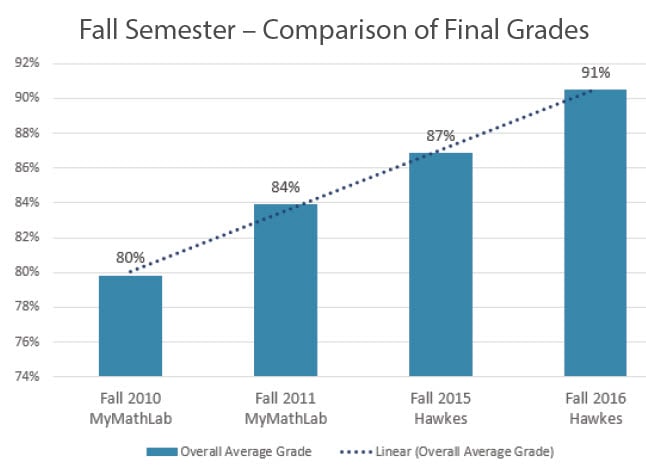
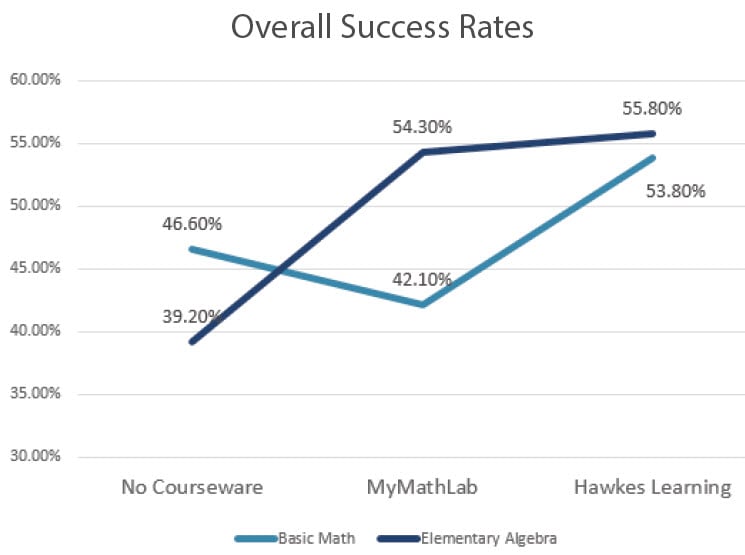
Courses: Basic Math and Elementary Algebra Course Type: Supplement to lecture Quick Stats: Overall, New Mexico Junior College saw a 20.05% grade increase in switching to Hawkes from Pearson’s MyMathLab. New Mexico Junior College redesigned its developmental math sequence using MyMathLab courseware in a flipped classroom. The classes evolved over the years into lectures with lab time included. However, the Mathematics Department was not satisfied with the redesign’s results. Hawkes Learning was implemented into Basic Math and Elementary Algebra in spring 2016. The department adopted Developmental Mathematics because the content covers basic math through algebra, allowing students to move through the developmental math sequence into a credit-bearing class using just one text. Its low price, lifetime student access to the courseware, and customer support also factored into the decision. Students meet for an in-person lecture that includes time to work on their online Hawkes assignments. They complete Hawkes homework, online tests within the courseware, and mastery-based paper exams. Students must average 75% or better on three assessments to pass, regardless of grades earned on other coursework. The department has observed higher pass rates using Hawkes vs. MyMathLab in both Basic Math and Elementary Math, as well as a positive correlation between test scores and overall scores using Hawkes.
![]()
November 22, 2017
Courses: Basic Math and Elementary Algebra Course Type: Supplement to lecture...
Read More
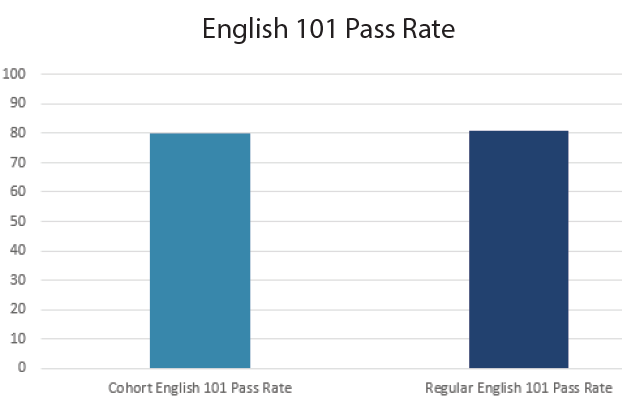
Course: COMM 90: Integrated Communication Arts and Study Skills Course Type: Self-paced, lab setting Quick Stats: 77% of students who completed COMM 90 in one academic year are on track to graduate. Successful COMM 90 students had a 90% retention rate from fall ’15 to fall ’16. Crowder College needed a new approach to helping first-semester freshmen who are not college-ready to succeed. After reviewing state and national recommendations, the college created COMM 90, an integrated communications and study skills course for at-risk students to develop their reading, writing, and critical thinking skills while also building general study skills and accessing campus resources. The course consists of eight-week sessions in a self-paced, modularized format. The instructor uses Hawkes Learning’s Foundations of English courseware, writing prompts, PowerPoints, and vocabulary lessons. Each of the 17 modules includes several online lessons in Hawkes. The department has observed higher pass and retention rates. The at-risk students who completed COMM 90 had nearly identical passing rates in English 101 compared to students who were directly placed into the credit-bearing course. Furthermore, the majority of students surveyed felt more confident in their reading and writing abilities. They felt more prepared for college because of the skills they’ve gained from the course.
![]()
August 17, 2017
Course: COMM 90: Integrated Communication Arts and Study Skills Course Type:...
Read More
Course: Prealgebra & Introductory Algebra Course Type: Modular, Self-Paced Quick Stats: Increase in Success Rate Across All 3 Courses Data from Academic Year 2012-2013 (MyMathLab) and Academic Year 2013-2014 (Hawkes) were compared, showing an increase in Student Success across all three courses in the developmental sequence. 9% increase in ABCP rate in MAT 55 Prealgebra course 6% increase in ABCP rate in MAT 65 Basic Algebra course 17% increase in ABCP rate in MAT 85 Intermediate Algebra course Increase in Student Satisfaction 80% of students surveyed preferred Hawkes to MyMathLab West Kentucky Community and Technical College (WKCTC) improved learning outcomes in its developmental math sequence by implementing MyMathLab in a self-paced, modular structure with computer-based instruction. Under this model, the department saw overall learning outcomes increase 20% over the previous three-year average. However, instructors found it difficult to identify at-risk students while students’ progress through the sequence was slow and attendance at the Math Center was minimal. In seeking to further improve the results of their redesign, WKCTC chose to implement Hawkes Prealgebra and Introductory Algebra courseware for the Fall 2013 semester. The course structure was also modified to require students to attend 2.5 hours of scheduled instructor-led class time per week. Each instructor was assigned to 5-6 classes per week. The results of Hawkes implementation included an increase in student retention rates, a decreased need for tutors, an increase in student motivation and satisfaction, and an increase in the number of students finishing the developmental sequence early or on time. Further, the success rate for students across all three courses in the sequence improved after switching from MyMathLab to Hawkes. Pass Rate Comparison
![]()
July 16, 2015
Course: Prealgebra & Introductory Algebra Course Type: Modular, Self-Paced...
Read More