
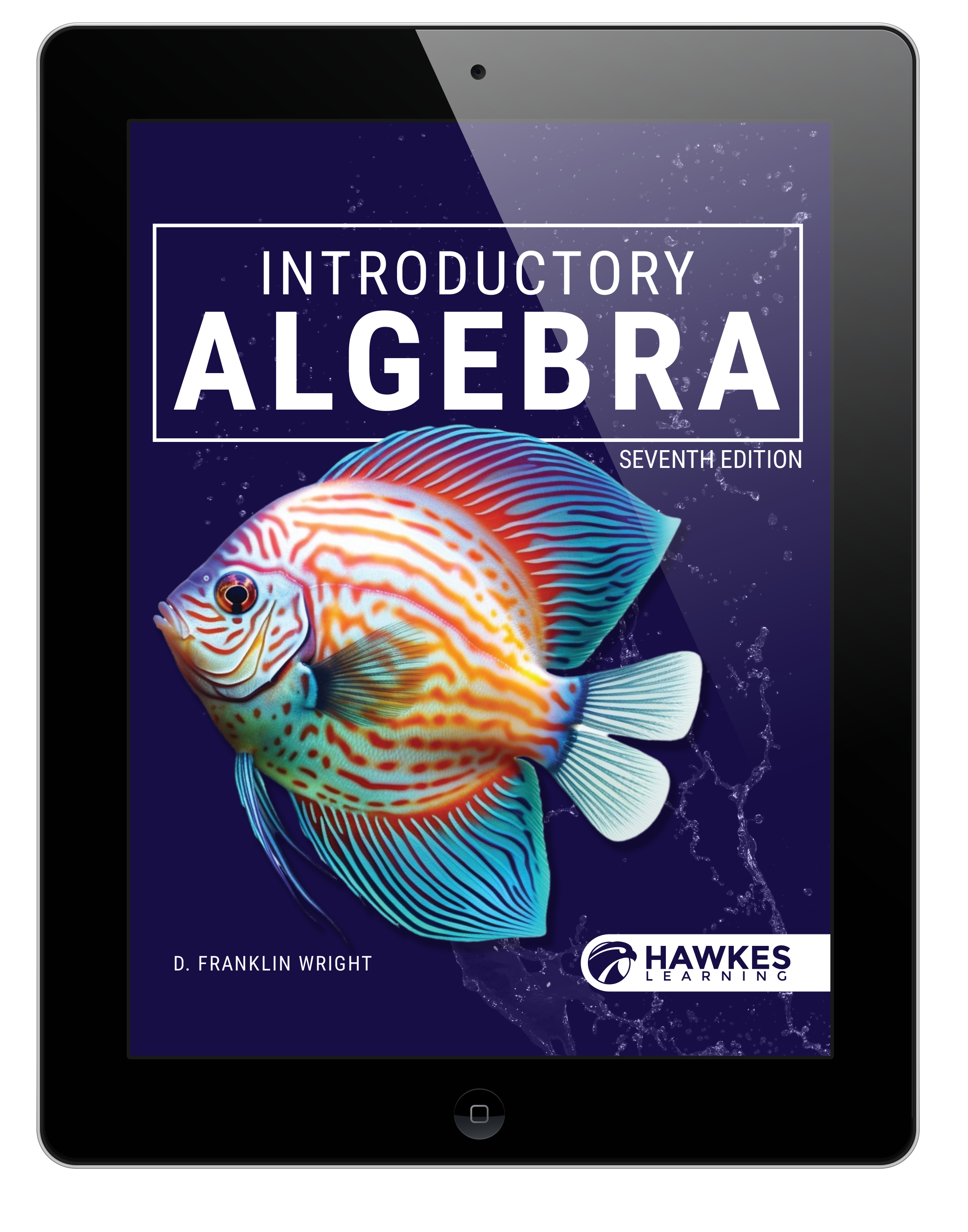
Introductory Algebra, 7th Edition
By D. Franklin Wright
Instructors
Get Trial AccessStudents
Buy DigitalOverview
Introductory Algebra ensures students develop a robust understanding of foundational concepts through active learning and application-based exploration opportunities. Comprehensive coverage includes geometry and statistics, solving linear equations and inequalities, exponents and polynomials, rational expressions, and quadratic equations, offering a seamless transition from prealgebra to algebra.
Key Features of the 7th Edition:
- Practical Application Projects: Each chapter includes two projects that illuminate real-world uses of mathematics, fostering practical understanding.
- Margin Exercises: Designed to reinforce comprehension, these exercises test students' grasp of concepts introduced in corresponding examples.
- Concept Checks: Assessing comprehension of essential definitions and concepts, these checks ensure students grasp fundamental principles.
- Strategies for Academic Success: A dedicated chapter equips students with vital study skills, time management techniques, stress management strategies, and tips for excelling in college-level mathematics courses.
Products
Formats: Software + eBook
| Product | ISBN |
|---|---|
| Software + eBook | 978-1-64277-738-3 |
Table of Contents
- Chapter 0: Strategies for Academic Success
- 0.1 Understanding and Reducing Stress
- 0.2 Staying Organized
- 0.3 Managing Your Time Effectively
- 0.4 Reading a Textbook and Note-Taking
- 0.5 Using Effective Study Strategies
- 0.6 Reducing Test Anxiety
- Chapter 1: Review of Foundational Math Skills
- 1.1 Exponents and Order of Operations with Integers
- 1.2 Prime Factorization and Least Common Multiple
- 1.3 Multiplication and Division with Fractions
- 1.4 Addition and Subtraction with Fractions
- 1.5 Introduction to Decimal Numbers
- 1.6 Operations with Decimal Numbers
- 1.7 Decimal Numbers and Fractions
- 1.8 Basics of Percent
- Chapter 1 Review
- Chapter 2: Geometry and Statistics
- 2.1 Perimeter, Area, and Volume
- 2.2 Angles and Triangles
- 2.3 Measures of Center
- 2.4 Measures of Dispersion and Percentiles
- Chapter 2 Review
- Chapter 3: Introduction to Algebra
- 3.1 The Real Number Line and Absolute Value
- 3.2 Addition with Real Numbers
- 3.3 Subtraction with Real Numbers
- 3.4 Multiplication and Division with Real Numbers
- 3.5 Order of Operations with Real Numbers
- 3.6 Properties of Real Numbers
- 3.7 Simplifying and Evaluating Algebraic Expressions
- 3.8 Translating English Phrases and Algebraic Expressions
- Chapter 3 Review
- Chapter 4: Solving Linear Equations and Inequalities
- 4.1 Solving Linear Equations: x + b = c and ax = c
- 4.2 Solving Linear Equations: ax + b = c
- 4.3 Solving Linear Equations: ax + b = cx + d
- 4.4 Working with Formulas
- 4.5 Applications: Number Problems and Consecutive Integers
- 4.6 Applications: Distance-Rate-Time, Interest, Average, and Cost
- 4.7 Applications of Percent
- 4.8 Solving Linear Inequalities in One Variable
- Chapter 4 Review
- Chapter 5: Graphing Linear Equations and Inequalities
- 5.1 The Cartesian Coordinate System
- 5.2 Graphing Linear Equations in Two Variables
- 5.3 Slope-Intercept Form
- 5.4 Point-Slope Form
- 5.5 Introduction to Functions and Function Notation
- 5.6 Graphing Linear Inequalities in Two Variables
- Chapter 5 Review
- Chapter 6: Systems of Linear Equations
- 6.1 Systems of Linear Equations: Solutions by Graphing
- 6.2 Systems of Linear Equations: Solutions by Substitution
- 6.3 Systems of Linear Equations: Solutions by Addition
- 6.4 Applications: Distance-Rate-Time, Number Problems, Amounts, and Cost
- 6.5 Applications: Interest and Mixture
- 6.6 Systems of Linear Inequalities
- Chapter 6 Review
- Chapter 7: Exponents and Polynomials
- 7.1 Rules for Exponents
- 7.2 Power Rules for Exponents
- 7.3 Applications: Scientific Notation
- 7.4 Introduction to Polynomials
- 7.5 Addition and Subtraction with Polynomials
- 7.6 Multiplication with Polynomials
- 7.7 Special Products of Binomials
- 7.8 Division with Polynomials
- Chapter 7 Review
- Chapter 8: Factoring Polynomials
- 8.1 Greatest Common Factor (GCF) and Factoring by Grouping
- 8.2 Factoring Trinomials: x2 + bx + c
- 8.3 Factoring Trinomials: ax2 + bx + c
- 8.4 Factoring Trinomials: ac-Method
- 8.5 Special Factoring Techniques
- 8.6 Review of Factoring Techniques
- 8.7 Solving Quadratic Equations by Factoring
- 8.8 Applications: Quadratic Equations
- Chapter 8 Review
- Chapter 9: Rational Expressions
- 9.1 Introduction to Rational Expressions
- 9.2 Multiplication and Division with Rational Expressions
- 9.3 Least Common Multiple of Polynomials
- 9.4 Addition and Subtraction with Rational Expressions
- 9.5 Simplifying Complex Fractions
- 9.6 Solving Rational Equations
- 9.7 Applications: Rational Expressions
- 9.8 Applications: Variation
- Chapter 9 Review
- Chapter 10: Roots and Radicals
- 10.1 Evaluating Radicals
- 10.2 Simplifying Radicals
- 10.3 Rational Exponents
- 10.4 Addition and Subtraction with Radicals
- 10.5 Multiplication with Radicals
- 10.6 Rationalizing Denominators
- 10.7 Solving Radical Equations
- 10.8 The Pythagorean Theorem
- Chapter 10 Review
- Chapter 11: Quadratic Equations
- 11.1 Quadratic Equations: The Square Root Method
- 11.2 Quadratic Equations: Completing the Square
- 11.3 Quadratic Equations: The Quadratic Formula
- 11.4 More Applications of Quadratic Equations
- 11.5 Graphing Quadratic Functions and Applications
- Chapter 11 Review
Instructors
Trial Software AccessStudents.
Purchase Access